From hunting stories to hunting fossils

Montana Hodges just brought a suitcase full of fossils back from Alaska and wears Tyrannosaurus Rex shaped earrings. This month she is the lead author of a paper in a geology journal about approximately 200 million year old coral reefs. Believe it or not it was journalism, a career singularly obsessed with the here and now, that brought her here.
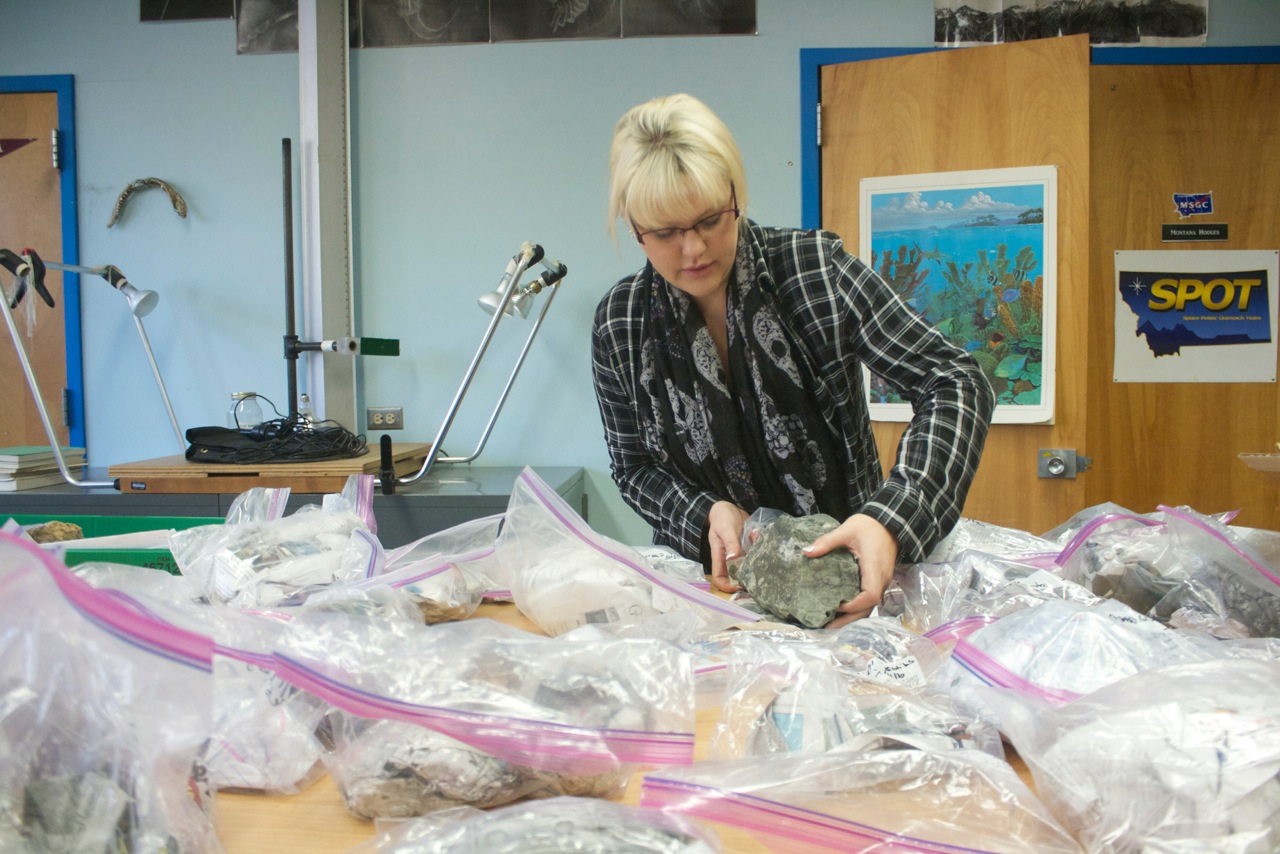
Montana Hodges unpacks coral reef fossils after a recent trip to Alaska.
Montana Hodges unpacks coral reef fossils after a recent trip to Alaska. Photo by Andrew Graham

Now, she’s pursing a degree in the University of Montana’s Individualized Interdisciplinary Doctoral Program (I.I.P.). As an undergraduate student at Sacramento State she double majored in journalism and geology. Afterwards Hodges entered the graduate program in Environmental Science and Natural Resource Journalism at the University of Montana. Right from the beginning, she knew she wanted to write about fossils for her Masters Project.

Her story, ‘Dinosaur Wars,’ would run on the cover of the August 19, 2013 issue of High Country News, a prestigious environmental news magazine out of Colorado. It described the conflict between for-profit fossil hunters and academic paleontologists. Hodges explored whether this conflict existed to the detriment of the science.

Hodges was nowhere near finished with fossils after receiving her Masters degree however, and decided to pursue an I.I.P. The article didn’t make her the most popular newcomer to the field. “There’s a lot of people in the paleontology community that don’t accept me,” she said.

She’s now studying mass extinctions; points in the Earth’s history where half or more of all living species have been wiped out. Her focus is on an extinction event which occurred around 2 million years ago, probably as a result of global climate change.

In particular, she is studying the massive die off, and eventual recovery, of coral reefs. Her new paper describes coral reef fossils found in Nevada, which was underwater 2 million years ago. They’re the earliest examples of coral’s recovery after the extinction.

Journalism has helped her with her new work Hodges thinks, particularly in her ability to write clear and succinct scientific papers. Though the writing is more technical, she says the foundation remains the same. Her reporting career has also helped. “I think journalists are trained to do excellent research,” she said.

Hodges hopes her current work with coral will eventually lead to a better understanding of the perils coral reefs face today. According to the United Nation’s Intergovernmental Panel on Climate Change, coral reefs face near extinction as a result of warming temperatures.  There is a story of recovery too, says Hodges, and even though it’s a story predicting far into the future, it’s one she’s particularly well equipped to tell.

By Andrew Graham

Photojournalism students learn the reality of freelancing

Journalism school students and others received a crash course in how to run a photography business, when Judy Herrmann, past president of the trade association American Society of Media Photographers (ASMP), spoke to a large crowd Wednesday evening.

Close up of Judy Herrmann speaking to students and faculty
Judy Herrmann spoke to budding photojournalists and told them how to make it in the business. Photo by Katy Spence.

Although with a show of hands the vast majority of the audience identified themselves as aspiring photojournalists, that didn’t stop Herrmann from starting her talk with a dose of industry reality. “As much as all of you that raised your hand for photojournalism are thinking ‘I’m getting a staff job,’ you’re probably not,” she said.

Given the changing nature of the business, with staff jobs disappearing but opportunities for self employment increasing, Herrmann said it’s likely most people in the audience will at some point start their own photography business. She then proceeded to give a highly practical, nuts and bolts seminar on how to do so.

She began at the first step and covered most aspects of running a freelance businesses. Throughout her talk, Herrmann emphasized the benefits of speaking with and hiring professionals for business advice, from accountants to lawyers. “Photographers are not lawyers,” she said, “as much as some of them would like to think they are.”

Judy Herrmann speaks to students and faculty in large lecture hall.
Photo by Katy Spence.

Herrmann, who has won numerous awards for her own business, Herrmann + Starke, brought years of experience to the topic. She is aware of the hidden pitfalls that await freelancers starting out; bad contracts, unforeseen disasters like equipment theft (for which she recommends a careful choice in insurance), and losing control and copyright of your own work.

Erik Petersen, an adjunct photojournalism professor and long time freelancer, weighed in on her advice. “The material she covered,” he said, “is essential to anyone wanting to run a successful freelance photography business.”

At the core of her message was the importance of being a professional. By conveying professionalism at the beginning of a client relationship a freelancer ensures they’ll receive professionalism, and a fair deal, in return, Herrmann said.

By Andrew Graham

To our supporters and fellow J-Schoolers…

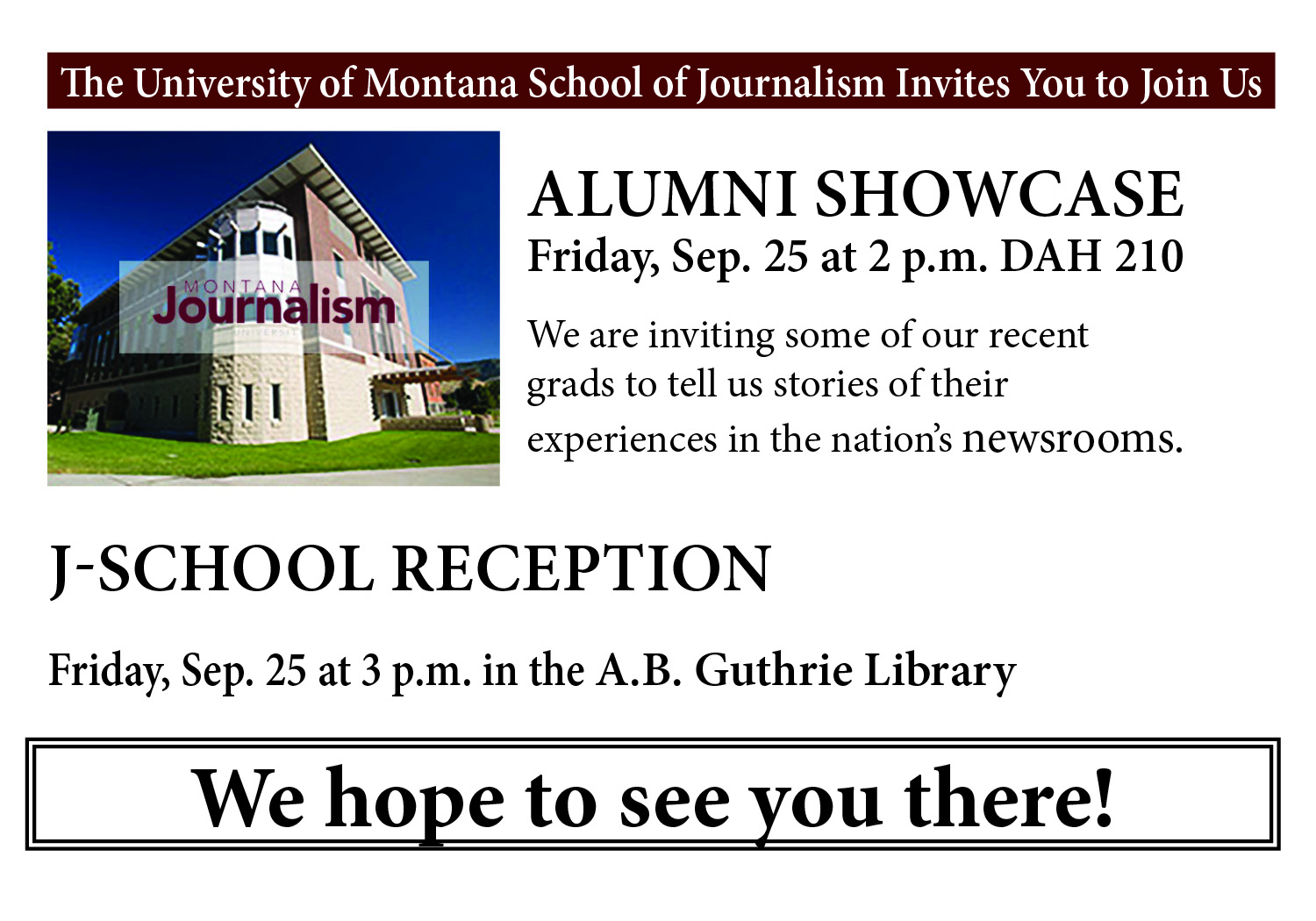
The year is off to a fantastic start here at the UM J-School. The smoke from the summer fires has cleared, and we’re enjoying blue skies and cool fall weather. Our students and faculty are hard at work already.Postcard which reads: Alumni Showcase, Friday, Sept. 25 at 2 p.m. in DAH 210. J-School Reception , Sept. 25 at 3 p.m. in the A.B. Guthrie Library. We hope to see you there!

Our student produced show, “Business: Made in Montana,” will air Oct. 22 at 7:30 p.m. on MontanaPBS. The Kaimin, our school newspaper, is moving more content online, while the printed edition has become a full-color weekly publication. The Montana Journalism Review is off to a strong start with a new staff, and a wealth of new stories to produce.

This year’s Pollner professor is Kevin Van Valkenburg. He is a distinguished reporter and known for his work with the Baltimore Sun, ESPN.com and ESPN the Magazine. He will present a talk titled “The Art of Storytelling Will Always Be What Matters, Not the Medium.” The annual lecture will take place Oct. 19th at 7:00 p.m. and, as always, the event is free and open to the public.

As we move forward into the new school year, we invite you to celebrate with us. The festivities begin this homecoming weekend.

Join us for our alumni showcase and J-School reception. The showcase is Friday, September 25 at 2 p.m. in Don Anderson Hall, room 210. As usual, we are inviting some of our recent grads to tell us stories of their experiences in the nation’s newsrooms. This is a great chance to see how our students are adapting to the changes in our ever-evolving industry. As we move into the digital age, our students must learn new skills and we must modify our idea of traditional media. We teach our students to maintain the same level of integrity and ethical conduct as we have taught our alums for the past 100 years.

We hope to see you after the showcase. Join us for a reception in the A.B. Guthrie Library (3 – 4 p.m.). We look forward to sharing a libation, catching up on your news, and talking football.

--UM J-School Dean Larry Abramson