
ESPN’s Kevin Van Valkenburg speaks on the importance of storytelling

For Kevin Van Valkenburg, Senior Writer at ESPN the Magazine, stories are “a time machine that can heal the world.”
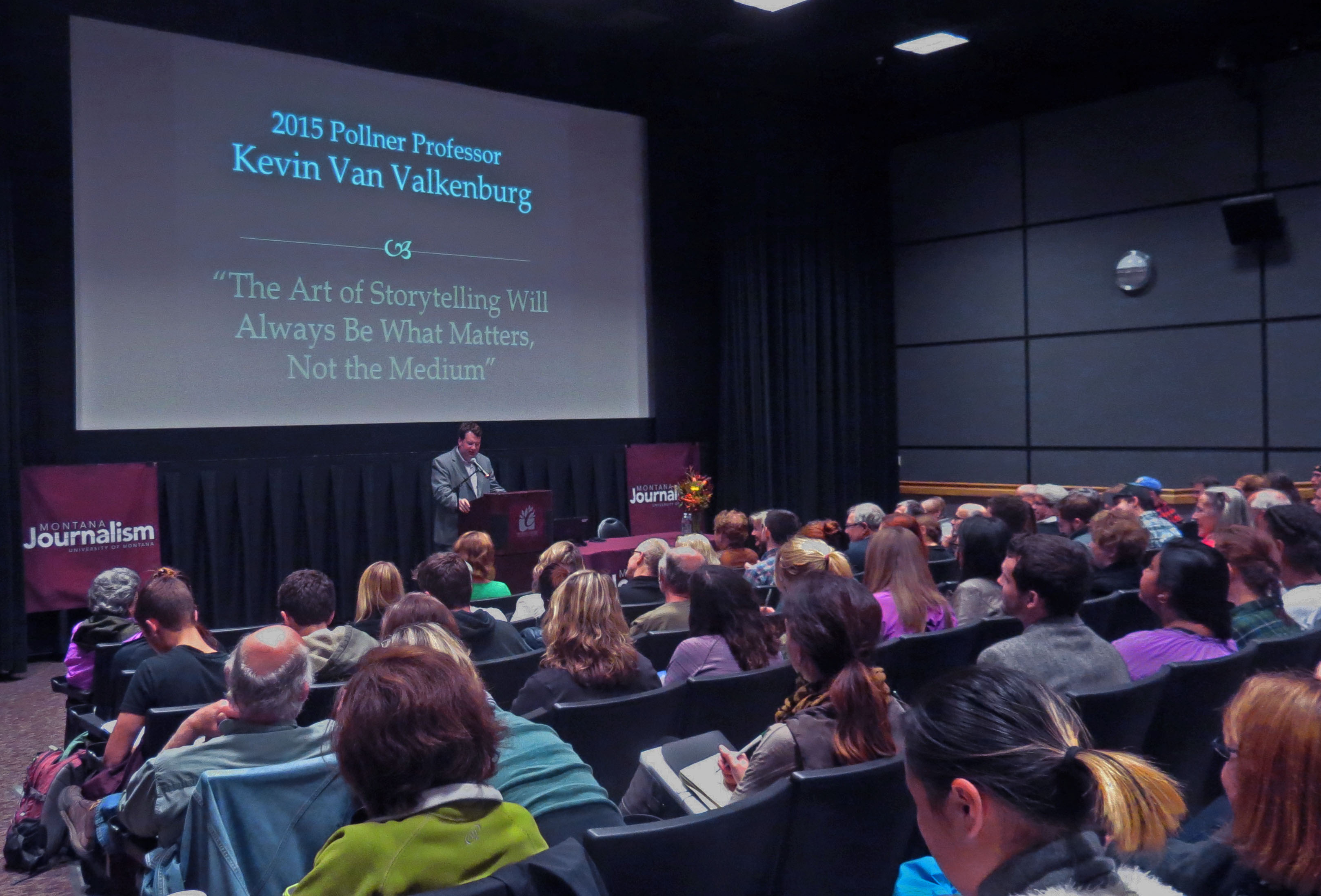
Kevin Van Valkenburg speaks to a crowded theater
ESPN’s Kevin Van Valkenburg attracted a large crowd for the J-School’s annual Pollner Lecture. Photo by Alyssa Rabil

Van Valkenburg, who graduated from the UM School of Journalism in 2000 and has come back as this semester’s T. Anthony Pollner Distinguished Professor. He spoke to an audience that filled both the seats and the stairwells on Monday night. His speech focused on the continued value of good storytelling, in an evolving landscape for media.

“It doesn’t matter the format you tell it in, as long as you tell it true and you tell it well,” Van Valkenburg said, advising students to reject the negative outlook some are pinning to written journalism, which he called “a cynical narrative.” Van Valkenburg said changes have come not to storytelling itself but to the economic model that supports it. Despite the distractions of modern life, he said, people remain hungry for heart-felt stories.

Speaking with clear reverence for the power of good narrative writing to explain, humanize and heal the challenges of the day, he extolled students to think about why stories are told and search hard to find them. “There are no stories to be told in life’s safe harbors,” he said.
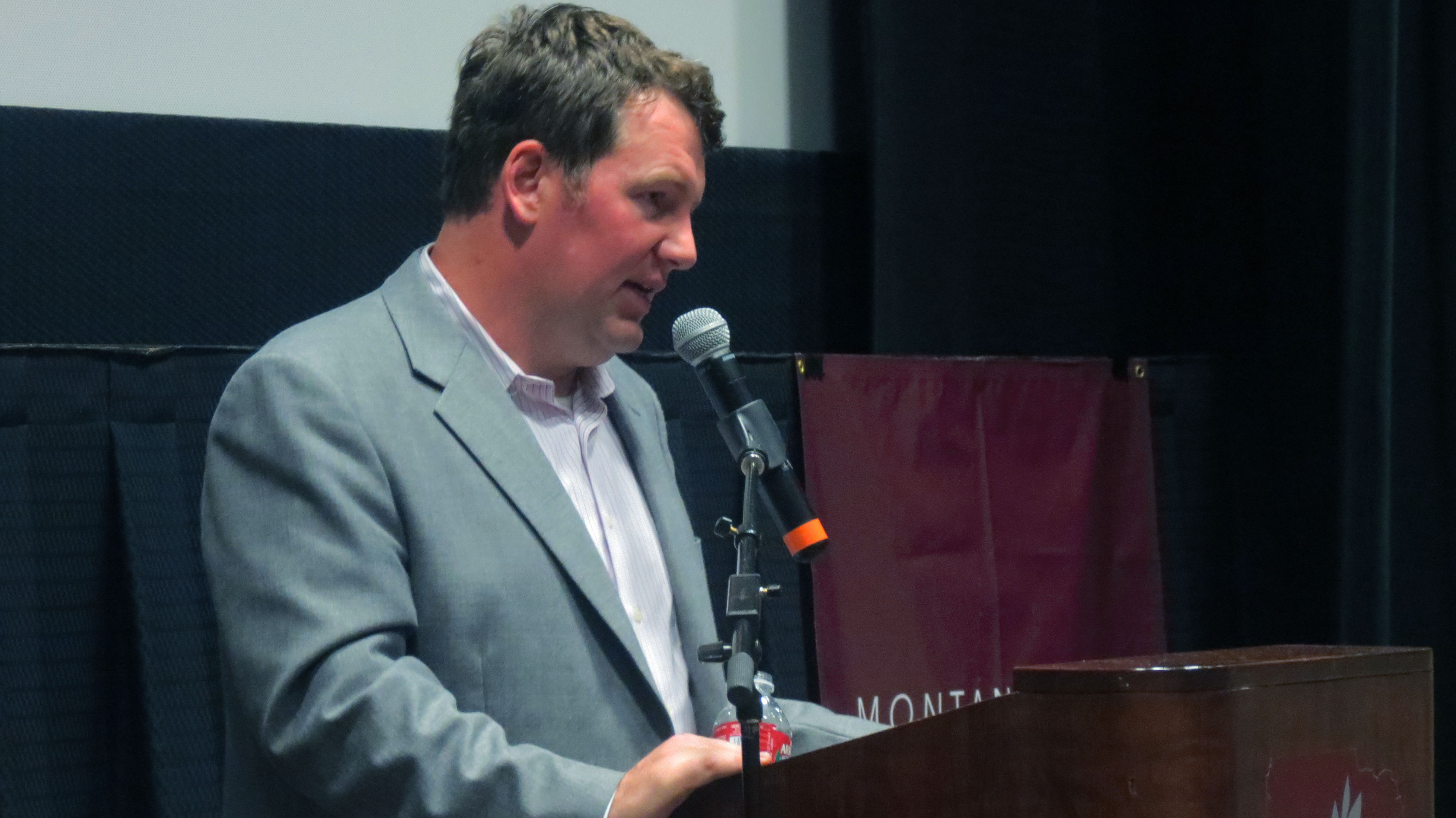
Kevin Van Valkenburg speaking from the podium
Photo by Alyssa Rabil

A native of Missoula, Van Valkenburg is the first alumnus of the school to hold a Pollner Professorship, a program which brings talented journalism professionals to the J-School for a semester. The program began in 2001, when Anthony Pollner, a graduate and former staff member on the Montana Kaimin, died in a motorcycle accident.

Van Valkenburg and Pollner were friends and co-workers at the Montana Kaimin during their shared time at the University. At several points in his speech Van Valkenburg referenced the spirit Pollner had brought to his journalism studies, and how it had inspired Van Valkenburg in his own career.

Recounting some of the more memorable stories of his career, first with the Baltimore Sun and then with ESPN the Magazine and ESPN.com, Van Valkenburg spoke about learning lessons on what stories can do for their subjects, as well as their readers. He recounted an early story he wrote about a girl’s suicide, and how her mother had thanked him, saying she could now explain her daughter’s life and death to friends by sending them Van Valkenburg’s article.

It’s a two way street however, Van Valkenburg noted. In response to a question from the audience, he said that whether to use sensitive information given by a source can depend on both its content and impact. If there are larger societal questions at stake, Van Valkenburg said, “I’m going to upset the source and I’m going to reach for the truth because that’s more important.”

Van Valkenburg concluded his speech by speaking directly to Anthony Pollner’s friends and family, who sat amongst the first rows of seats. He shared stories and memories of Pollner from their university days, which he said his return to campus has helped to bring back.

“Few things in my life have ever seemed less fair,” Van Valkenburg said, speaking on the passing of his friend, “but by telling those stories I keep a piece of him alive forever.”

The full text of the speech can be found here.

By Andrew Graham
J-School student balances classes and full-time broadcasting job

When classes end each afternoon for Ariana Lake, age 21, her day as a budding broadcast journalist is only just beginning. Since the beginning of the semester, Ariana has been balancing a full course load at school with a 40 hour a week job as news anchor and producer at the television station KAJ, Channel 18. Leaving campus early-afternoon, Lake races to the studio each day to get her 5 o’clock broadcast ready. She broadcasts at 5:30 p.m. and again at 10 p.m. Mondays through Fridays.

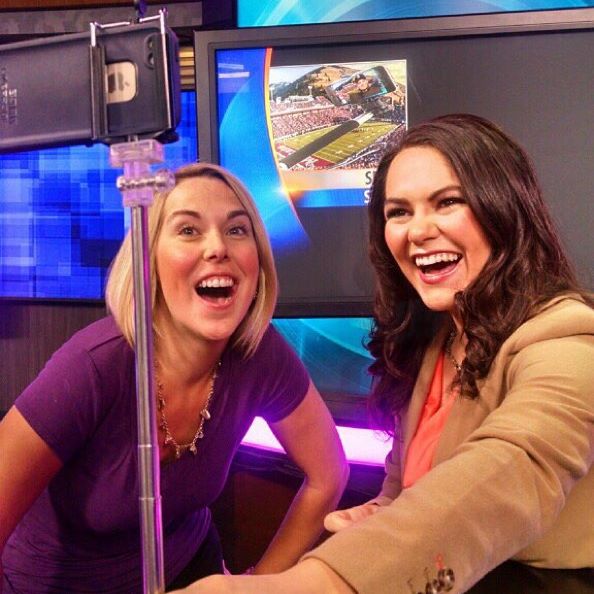
Chief Meteorologist Erin Yost (left) and Ariana Lake (right)  on set before their 5:30 show on selfie sticks at Griz games.
Chief Meteorologist Erin Yost (left) and Ariana Lake (right) on set before their 5:30 show on selfie sticks at Griz games.

KAJ serves the Flathead Valley area, and the stories Lake produces are reported by two correspondents, both her senior in age. They pitch her the day’s stories in the morning, which Lake helps review via either email, text or phone call while she goes about her school day. Although her market is the Flathead, her broadcast is produced at the KPAX studio in Missoula. KPAX and KAJ are sister stations and CBS Affiliates.

Journalism Professor Ray Ekness said it’s rare to have a student anchoring their own show Monday through Friday this early in their career. Despite her youth, Ekness said that on her show “she comes across as very mature, very knowledgeable about everything that’s going on.”

Lake was hired as a part time reporter for KPAX last year. When she saw the anchor and producer job open up in August, she wasn’t going to bother applying, certain she didn’t have enough experience. Then, after receiving some encouragement from a co-worker and her parents, she decided to go for it. She was hired within a few weeks.

For Lake, working at KAJ is a great chance to develop her broadcast skills in a supportive environment. “I’m not doing it completely on my own but it’s my show,” Lake said, “responsibility falls completely on me.”

She says that getting in the 5 o’clock broadcast, which has to be taped by 4 p.m., is a challenge. Some days she reaches the studio at 1:45 p.m., leaving her less than three hours to meet her deadline. Still, it’s a challenge Lake says she welcomes: “If you’re passionate about what you’re doing it’s not that hard,” she said.

After her second broadcast wraps around 10 p.m., Lake finally heads home, where she usually does around two hours of homework.

To see what Ariana Lake’s been producing, you can follow her on twitter: @ariana_lake or check out her broadcasts online at KAJ’s website. 

By Andrew Graham

UM J-School Professor to lead Native American Journalists Association

This fall University of Montana School of Journalism Professor Jason Begay returned with important new extracurriculars on his plate. He’s taken a long history with the Native American Journalists Association (NAJA) to the next step by becoming the organization’s President.

NAJA official logo

When Begay was starting out as a journalism student, NAJA provided him scholarships and summer projects producing news during its annual conference. Over the last three years he has served on the board as Vice President and Treasurer, and in July the board voted him in as President.

Founded in 1983, NAJA’s mission is to empower Native American journalists, enrich journalism itself and promote Native American cultures. The organization has two main tasks, according to Begay. One is to promote 1st amendment rights throughout Indian country. It takes effort to establish independent journalism when many Native American papers are owned by Tribal Governments, Begay said.

NAJA’s other goal is to recruit and foster more young Native American journalists. With discouraging reports of less journalism jobs and industry upheaval, Begay said it can be a challenge, but a worthy one, to nudge new Native American students towards journalism school.

Begay graduated from the J-School in 2002, and took on an internship at the New York Times. From there, he moved on to a two year fellowship at the Oregonian, an award winning daily paper in Portland, Oregon. After the fellowship, he returned home to the Navajo Nation, where he worked for six years as a reporter at the Navajo Times.

Although both prior papers had prestigious national reputations, Begay felt out of place at them. “I left the New York Times and the Oregonian because I really couldn’t feel a strong connection with who I was writing about and what it was for,” he said.

Returning home to write about issues on the reservation where he grew up changed that for him. “I remembered why I love journalism,” said Begay.

To provide these same chances for a new generation of Native journalists, Begay faces fresh challenges in his new role as President. NAJA has seen a revenue streams dry up, and Begay said he’ll have to find new ways to raise money. One way to do so, Begay said, is to create projects attractive to donors, like expanding the conference newspaper into a year round project with an online presence.

Fresh from completing an MBA program in the spring, Begay is excited to apply his business training to NAJA’s real world problems. “I really, really think that the board has a great opportunity to make something new,” he said. That’s what Begay believes it will take to move NAJA forward.

By Andrew Graham