
Students uncover Montana voices about race

In the UC Ballroom on Thursday, November 5th, a group of seven students and their professor talked about what they’d learned over a semester spent exploring questions of race in Montana. The students have created the Montana Race Project, in which they drew in six-word essays from around the state that touched modern questions of race and diversity in Montana and beyond.
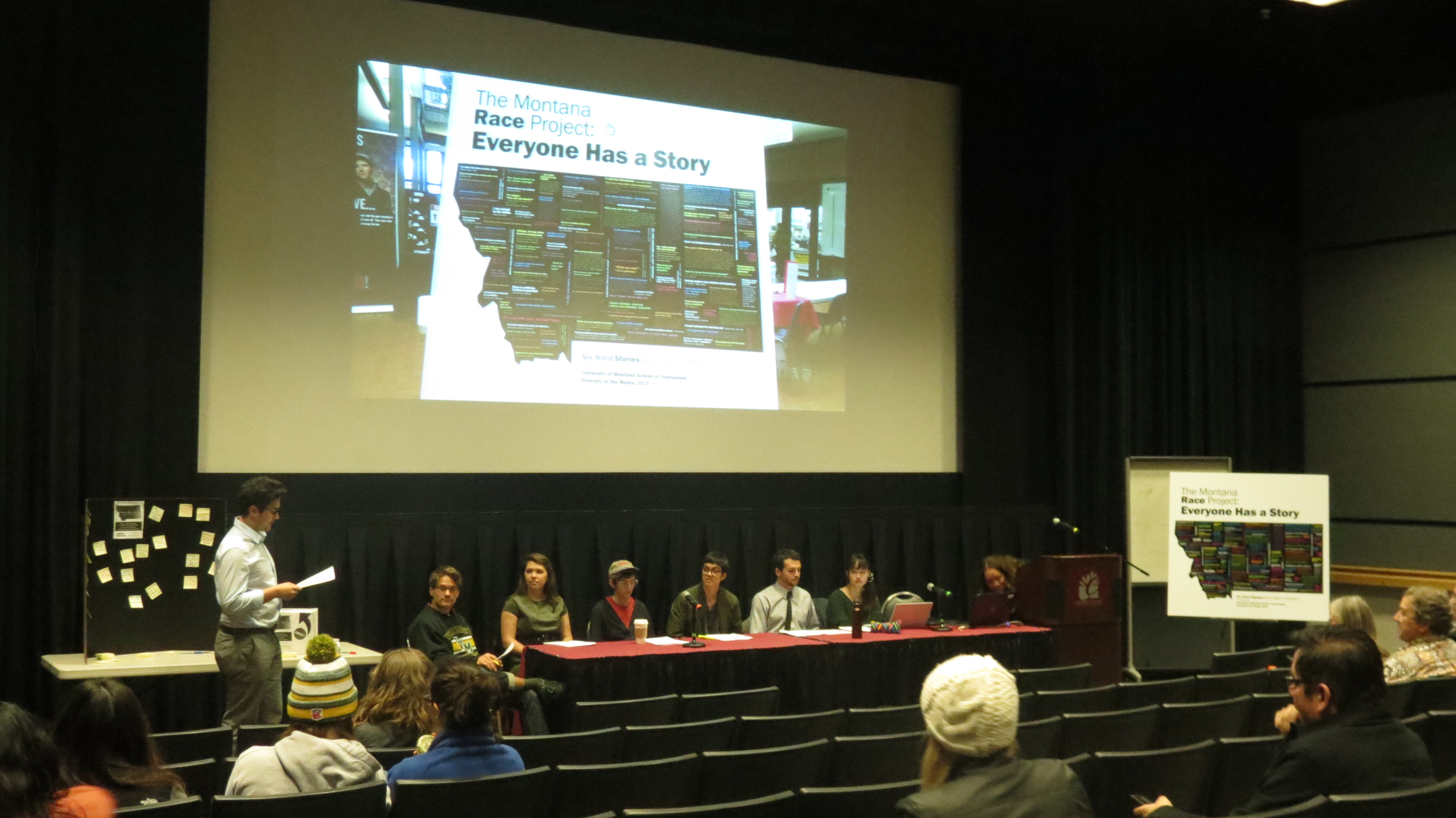
Photo showing student panel at the presentation of the 6 word essays.
Students took turns reading their favorite submissions from the project. Photo by Alyssa Rabil.

The professor, Kathy Weber-Bates, is an adjunct instructor at the School of Journalism, and the project was created through her Diversity in the Media course. To introduce Thursday’s panel discussion, Weber-Bates talked about her frustration with the idea that it was difficult to talk about diversity in a state that was not that diverse in comparison to others. That idea, she said, is misleading.

“It made an assumption that the state doesn’t have a multitude of voices,” and that’s not true, Weber-Bates said.

For her and her students, a focus that arose over the course of the experience was on the importance of conversations about race and diversity even, or perhaps especially, in institutions or places that are predominantly white. The students on the panel said they were surprised by how often the sentiment that Montana didn’t have a race issue and had no need to discuss the subject seemed to come up.

To uncover the real concerns about race in Montana, the class created an online form where anyone could submit a six-word essay, which they then promoted as a class via social media. By November 5th they had received over 300 essays from all over the state.

The idea of the six-word essay may have been born from Ernest Hemingway, Weber-Bates said, who was a firm believer in the value of saying much with few words. When challenged by his peers, Hemingway allegedly wrote the following six-word story:

“For sale: baby shoes, never worn.”

Whether that story is true or not, the form carries a lot of power. This held true for the stories brought in by the Montana Race Project. Here are just five examples of stories the students chose to read at Thursday’s event:

“Columbus day shouldn’t be a holiday.”

“Don’t tell me there’s no problem.”

“Half Peruvian, looks white, strange world.”

“Blind eyes can’t fix the past.”

“When will Native American lives matter?”

Some stories showed ignorance, others hope and optimism and still others expressed challenges of self-identity in today’s world. All showed a state where questions of race are very much alive.

Five of the students on the panel study journalism. They’re certain this experience will help guide their future work in a profession based around the idea that telling stories, everyone’s stories, matters. “The stories that I choose to tell and how I choose to tell them can bring things to light or bury them,” said Mia Soza, who is co-news director at the student run radio station KBGA.

Chloe Reynolds, another journalism student, said she learned the value of casting a wide net with her reporting, in order to find stories in unlikely places. “You don’t know somebody’s story unless you ask them,” she said.

To read more about The Montana Race Project and submit your own six word story, you can visit their website or search for them on Facebook.

By Andrew Graham
Behind the scenes with broadcast students

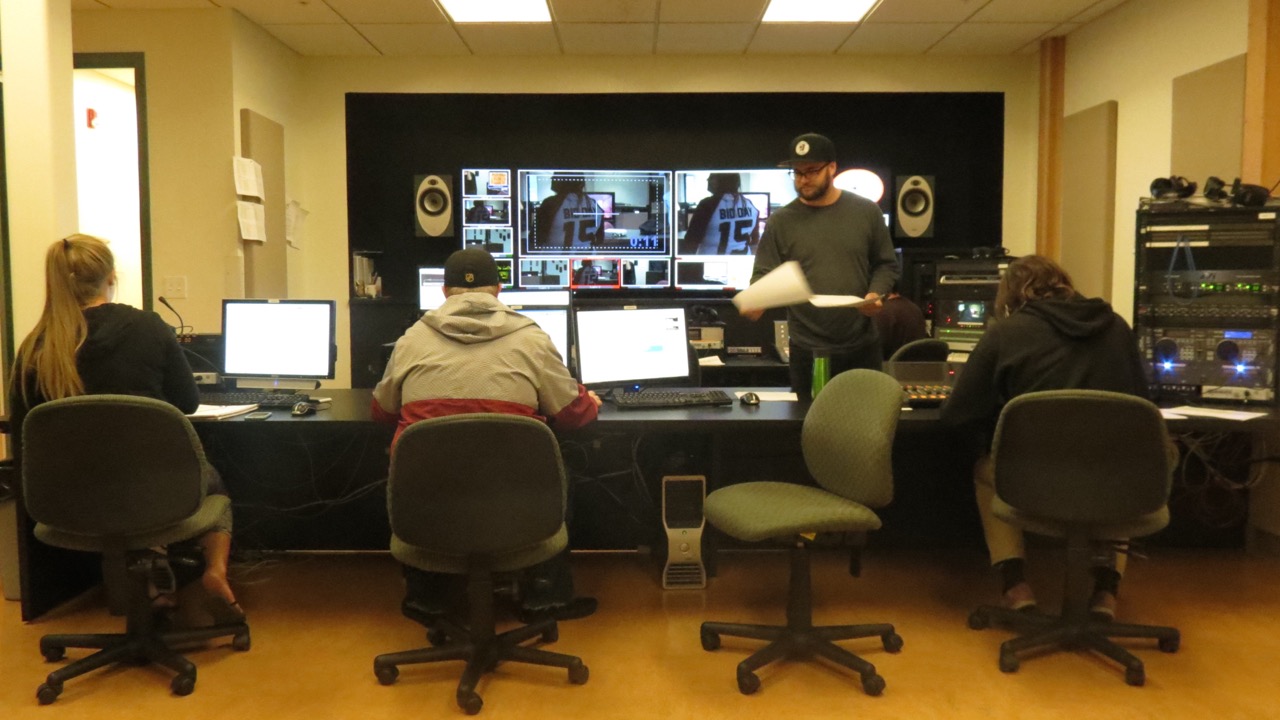
Seven journalism students face a bank of screens, and with only a few minutes to go before recording starts, the atmosphere is busy and tense. This is the control room of UM News, a weekly news segment staffed by senior broadcast journalism students.

photo of j-school broadcast students working on video production on their screens.

Though the students are producing their broadcast in the Don Oliver Television Studios on the first floor of the journalism building, the segment airs each week on KPAX-TV and ABC Montana.

“Are we almost ready to go?” Sean Robb asks his colleagues, who are busy cueing instruments. Robb, who is from California and will graduate next spring, is working as a producer today. Other days he is chasing stories as a reporter, in front of the camera as an anchor, or behind it as a cameraman.

“It’s really good experience to do something over and over each week,” Robb says, adding that the practice makes him more efficient at reporting and producing. The pressure to produce in UM News is intense, he says, in a way that reflects the working world of a broadcast journalist.

Associate Professor Ray Ekness, a former broadcast journalist himself, agrees that the program simulates the pressures of the working world. Students do get the buffer of two dry runs before they record the broadcast that will air on television, which is a safety net for the learning students he said. The semester in UM News includes a broadcast filmed without dry runs as well.

Silence descends on the control room as the team keys in the cameras. Today’s director is Joe Hodgson, a senior from Great Falls, Montana who spent his summer interning at Comcast Sports in San Francisco. “Go ahead and pan to the right ever so slightly,” he directs his cameraman, watching on the screens in front of him.

On Friday, the students will meet with professionals from KPAX-TV and ABC Montana for a review of the week’s broadcast. They’ll learn the tricks of the trade and how to streamline their next show.

“Go ahead and roll thunder, full sound!” Hodgson orders, and the broadcast is under way.

UM J-School professor to speak about immigration and refugee influx to Germany

Wednesday, October 28th at 12 p.m. UM J-School professor Henriette Löwisch will speak about her home country Germany as a part of ‘Walking on Water: The Refugee Crisis and European Contradictions,’ a presentation sponsored by the Central & Southwest Asian Studies Center. Löwisch’s talk is focused on Germany’s leadership role in the European refugee crisis, and echoes efforts in the journalism school to tell stories of immigration and human movement.

Professor Henriette Lowisch
Professor Henriette Löwisch

Löwisch came to the journalism school after a career with the international wire service Agence France-Presse, and will be co-leading a study abroad program in Berlin this summer, where she lives when not in Missoula. The trip is directed by the School of Journalism and will focus on telling stories from the refugee influx to Germany.

“The trip will be a model for how future study abroad programs can work: follow the news to tell big stories around the world,” Löwisch said. Seventeen students have signed up for the program thus far.

Stories of human migration are also present in Montana, and this fall semester students in the Advanced Multimedia class have been seeking out immigrants in Montana to report on what brought them here and on adjusting to a new life in the state. The project includes past refugees, as well as those who immigrated to Montana for other reasons.

Shanti Johnson, a graduate student in the class, has been working with a family of Vietnamese refugees in Missoula. “I’m being led into a world of Southeast Asian traditions and histories I never expected to find this far north,” she said.

As for Löwisch upcoming talk, she believes that Germany and its Chancellor Angela Merkel are at the epicenter of a refugee crisis of historic proportions, reshaping the country as well as Europe. “Merkel has undergone a dramatic transformation in terms of political goals. I’m looking looking forward to explaining Merkel to my fellow Montanans,” Löwisch said.

Find out more about the event here.

By Andrew Graham