
Award-Winning Documentary Director, Chad A. Stevens, Speaks At J-School

Chad A. Stevens, director of the documentary “Overburden,” tried out two other titles for his film before settling on the third. Appropriately, Stevens’ presentation at the UM School of Journalism on Wednesday, February 24th, also came with three potential titles: “The Life, Death & Afterlife of a Documentary,” “How in the World did I Survive this Thing?” and “Thank God for Talented Friends and Box Wine.”

“Overburden” played at the Wilma Theater as part of the 2016 Big Sky Documentary Film Festival later that same day. The film follows two women in the heart of Appalachian coal country and their fight to save Coal River Mountain from the Massey Energy Company after an underground fire kills 29 miners.

Stevens said the first iteration of this project began while he was working on his master’s thesis at Ohio University. However, his moment of inspiration began several years earlier, in 2003, during his time as a photojournalist-in-residence at Western Kentucky University. One day, Stevens and a friend were driving through the hills when they crested a ridge and Stevens got his first look at a mountain top removal site. “There was a shocking amount of destruction,” he said.
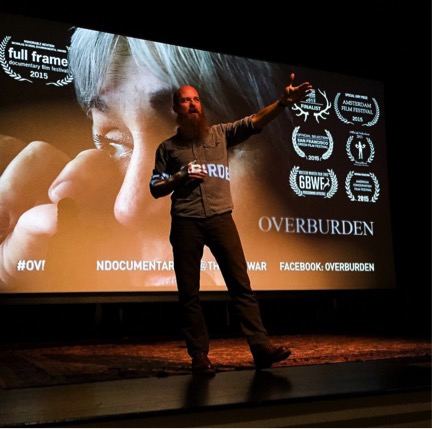
Chad A. Stevens speaks to the audience a screening of “Overburden” in Boulder, Colorado.
Chad A. Stevens speaks to the audience a screening of “Overburden” in Boulder, Colorado. Photo by Erin Hull.

Originally Stevens focused on the environmental aspects of coal mining. He photographed events at the Mountain Justice summer convergence and followed the activists who chained themselves to bulldozers at the top of Coal River Mountain. Yet Stevens realized that this story lacked the intimacy to connect with a broader audience. He looked to the valley where people lived right below the mining sites, whose blasts shook their homes’ foundations.

“I started to have this idea that maybe it could be more,” Stevens said. “I was like, 100% heart. I have to do this no matter what.”

It took Stevens about two years to gain the trust of one of his main characters, Lorelei Scarbro, who had seen plenty of journalists disappear after getting their pictures and quotes from the community. Yet Stevens referred to time as a gift and said it allowed him to understand what mattered most to Scarbro and her battle against coal.

“I was so damn stubborn and wouldn’t leave,” Stevens said, and his patience paid off. “To be there when her grandson was born—that never would’ve never happened without that time.”

One of the project’s major turning points came on April 5th, 2010, when a methane leak and an errant spark caused an explosion in the nearby Upper Big Branch mine.

“As you can imagine, that deeply impacted the community,” Stevens said. “And of course, it changed the film as well.”

A second main character emerged—a pro-coal activist whose brother died in the explosion and spurred her to join Scarbro’s fight.

Stevens also realized that the film’s central theme switched from an environmental perspective to more economy-based story, which explored how extraction-based economies limit local communities.

During the production process, Stevens licensed some of his footage and sold it to organizations that were working on tangential stories, as long as he knew they wouldn’t overlap with “Overburden.”

“I actually paid an editor to edit my film because I felt too close to it,” Stevens said.

Looking back on this ten-year project, Stevens reminded the room full of UM Journalism students about the importance of reaching out to others for help and the importance of remaining humble, because “it’s always bigger than just us.”

Stevens also spoke of the potential that comes from “opportunity blindness.” He said, “When you first start off, there’s no way to know what doors will open down the road. You just got to put it out there.”

While funding such projects remains a challenge for today’s journalists, one of Stevens’ teachers once told him, “Sometimes you do what you gotta do to feed your belly. And sometimes you do what you gotta do to feed your soul.”

Now a tenured professor at the School of Journalism and Mass Communication at the University of North Carolina in Chapel Hill, Stevens has his own mantra for students to learn.

“It’s all about collaboration and community,” Stevens said. “When we care, we as the story-tellers care, that care transfers.”


“Overburden” is currently available for rent on iTunes, Amazon, Google Play and Vudu. Check the film’s website or follow its Facebook or Twitter accounts for details about upcoming screenings.

To learn more about UM J-school affiliates reporting on coal communities in Montana, check out second-year graduate student, Andrew Graham’s contributions to National Geographic’s blog The Great Energy Challenge, and adjunct professor, Matthew Frank’s publications on Mountain West News.

By Jana Wiegand
J-School Alum Makes Top 10 List For Hearst Radio Awards

Emily Proctor talked with Vietnam War veteran Roger Cox for an hour and a half with the recorder running. She cut these 90 minutes down to three minutes and thirty-seven seconds of Cox’s own narrative, not adding a word of her own. The final piece, “Roger Cox’s Vietnam,” was one of two stories she submitted to the 2015 Hearst Journalism Awards Program. On February 3rd, 2016, the Hearst Radio News and Features competition ranked Proctor 9th in the nation.

hearst logo

“I had an ah-ha moment with this piece,” Proctor said. “It totally changed what I wanted to do with my career.”

Over the course of the interview Proctor probed deeper into Cox’s memories as a marine in the Vietnam War. As she edited the piece, she listened to the moments where Cox’s stolid replies began to falter. Proctor felt the power of Cox’s voice and the emotion it carried without needing any extra narrative.

Assistant Professor Jule Banville, who worked with Proctor on the story as part of her Intermediate Audio class, watched Proctor’s interest in radio grow. “He was just really honest with her about what happened there and what he thinks about it now,” Banville said. “And because what she produced was his voice telling his story, it had so much more power for her than any journalism she’d done before. It just clicked.”

The story aired on the podcast Last Best Stories, and the full interview can be accessed through the Veterans History Project.

Since graduating last May, Proctor’s been working on some independent radio projects, including a Montana-themed piece about the modern cowboy. This summer she will be doing more radio work in Alaska and potentially connecting with J-school alum Ruth Eddy, who works at a public radio station in Ketchikan. However, Proctor’s next major goal involves going to graduate school for audio design, hopefully in Germany or New Zealand, she said.

When Proctor studied abroad in Athens, Greece, she shot a short documentary about the smoking culture and its importance to their society. She also tried to produce some audio stories, but said, “The language barrier made it hard to do good radio.”

Proctor addressed this issue again in the second story she submitted to the 2015 Hearst Awards, a piece called “Language Is No Barrier For Senior Companions.” The story centers on Frank Havlik, a native from the Czech Republic who now lives in Missoula and volunteers as a Senior Companion. Coming from Stanford, Montana, Proctor was conscious of the fact that her Montana audience wasn’t used to hearing a heavy Czech accent, so she took care choosing the most enunciated sound bites.

“I wanted to cover all my bases and make sure people understood the story,” Proctor said. She added her own voice-over narrative and provided a complete transcript when the story aired on MTPR on April 28th, 2015.

“I’m pretty insanely proud of her,” Banville said. “She went on to intern at Montana Public Radio, so she’s got some news chops too, and I’m so glad the judges recognized her talent.”

By Jana Wiegand

Alum Alexandra Schwier Brings Journalism to Albania

At eight o’clock on a Thursday evening, Alexandra Schwier is building a fire in her home in Kukes, Albania. She’s been serving in the Peace Corps there for almost 11 months now, and her DLSR camera has come along for the ride. “I usually have my camera wherever I am,” Schwier said. “You start to pick up an ear for things, and think, hey, that would make a great sound bite.”

Schwier takes pictures during a recycling event in Kukes, where she is currently living.

So far, Schwier’s documented traditional Albanian dances, a youth environmental outreach program called Outdoor Ambassadors and a local Cardboard Challenge based off of the premise of Cain’s Arcade, which originated in California.

However, Schwier’s also teaching what she knows about journalism to Albanian youth in her village and letting them experiment with video equipment to tell stories that they find important. Outside of her own initiatives, the U.S. Embassy also invited Schwier to the capital in Tirana to talk with journalism students about reporting ethics.

When Schwier graduated from the University of Montana in December 2012, she hadn’t planned on entering the Peace Corps. During school she worked at KPAX-TV in Missoula as a reporter and web producer, where she gained hands-on experience from the techniques she learned in the classroom.

Photo of Schwier after winning the Fox News Award
Schwier won the Fox News Award in 2012 and flew to New York to accept it.

“One of the things I really loved about the journalism program was that you had to take photo, video and print, regardless of your major,” Schwier said. At first she wasn’t too excited to learn photography, “But I fell in love with it.”

As a double major in Journalism and Spanish, with a Latin American Studies minor, Schwier practiced reporting abroad while on a Political Science trip to Mexico. She produced a video piece called “Breaking down Barriers” about the perceived disparity between Mexico and the United States regarding immigrants and culture. Schwier did all of the production, editing and translation by herself.

Yet, the piece she’s most attached to is video she produced with a fellow journalism student, Kyle Schmauch, about wolf hunting. Schwier called the video “a labor of love” and is proud of the fair representation it gave to both sides of this controversial issue in Montana. As a result, Schwier won the 2012 National Fox News Challenge, which led to an internship with Fox News and later, a job in New York City.

While Schwier was working for Fox News in New York, she also volunteered for an organization called New York Cares. Teaching photography to kids in Brooklyn gave her a satisfaction with which her day job couldn’t compete, so she applied to the Peace Corps.

“Journalism in Albania is more politically driven,” Schwier said. “There’s an agenda for what they’re covering and why.”

But Schwier’s found that people are interested in her projects and also surprised at her attention to their culture—something that they take for granted, but the majority of the outside world knows very little about. Her current projects include a documentary piece about Roma Egyptians in Albania and another video that preserves local memories of communism.

Stay up to date with Schwier’s work by following her vimeo account.