
Sarah Yovetich: Covering Breaking News & Winning A Hearst Award Too

selfie of Sarah Yovetich
Photo by Sarah Yovetich.

Commercial radio may be Sarah Yovetich’s first love, but a story she produced for UM News in the fall semester won 12th place in the Hearst Awards TV News category. The piece, “Budget Cuts Result From Decreased Enrollment, State Funding at University of Montana,” took three weeks of research, interviews and editing to compact the news into a minute and 36-second long story.

Yovetich’s photographer for the piece, Peter Riley, pitched the idea after the budget cuts were released right before Thanksgiving break. “We never thought anything was going to come out of it,” Yovetich said. But the campus unrest that followed proved otherwise.

“It’s not just teachers that care, but students,” Yovetich said. “It proved enrollment’s a thing to be worried about.”

However, her research took a step back from the students and staff responding to the university’s proposed budget cuts capture a broader perspective and ask the question, “were the budget cuts out of line?”

“This was a strong story because Sarah found a new angle on UM’s budget cuts by digging into the history of state funding for higher education,” said Ray Fanning, associate professor who co-teaches UM News. “She discovered that at the same time enrollment was falling, the state legislature was reducing its allocation to UM.”

Ray Ekness, who co-teaches UM News with Fanning, agreed. “Sarah did some really good work in UM News this past semester, and it’s nice to see that she’s being recognized for that.”

Yovetich’s worked with Ekness ever since her first introductory journalism class, and she dropped her political science and business majors to switch to journalism. “I loved him and everyone in the journalism department,” Yovetich said. “I really lucked out finding journalism.”

During the summer between her freshman and sophomore year, Yovetich worked as a campus anchor for Montana Public Radio, and since then she’s transitioned to other commercial radio stations in Missoula. She covers news stories for KGVO during the week as an on-air broadcaster and reporter. “Some of the newscasts I do everyday are sent state-wide, so you’ll be able to hear me in different cities, which is kind of cool.”

On weekends, she turns into a DJ for the show “Campus Connection” on 107.5 ZooFM. Yovetich said, “I love relating my life to others and connecting with the community.”

Back on campus, Yovetich just finished serving a full year as the president of the Alpha Phi sorority’s Chi Chapter. The sorority’s helped her with scholarships and academics, as well as serving as a second family to her. Yovetich helped return the support to her sisters through motivational Instagram posts that share her dedication to power-lifting regimes. She now holds five state records in the squat, bench press, and dead lift.

“It’s hard being a senior and balancing that stuff,” Yovetich said. “School’s definitely taking a precedence this year.”

When she graduates in May, Yovetich’s ready to take her journalism skills beyond Missoula. She’s staying open to opportunities in both broadcast and radio fields to continue gaining more experience.

“She’s always been working in things like radio,” Ekness said. “Now she’s stepping out in television, so it’s kind of exciting for us.”

Tune into 107.5 ZooFM on Saturdays and Sundays from 10am-3pm to hear Sarah Yovetich hosting the “Campus Connection.”

By Jana Wiegand
Montana Kaimin Editors Explore Data Journalism In Denver

Montana native, Kayla Robertson, originally wanted to go out of state for college, but her tour of the UM J-school with Denise Dowling helped change her mind. “Denise showed me the Kaimin office, and I thought, I need to work here,” Robertson said.

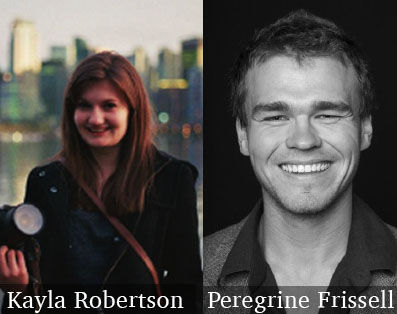
True to word, Robertson has since become the Montana Kaimin’s design editor and has shifted her attention from print to web design. Robertson and fellow Kaimin colleague, Peregrine Frissell, recently attended a data journalism conference in Denver, Colorado to learn more about this subset of reporting.

head shots of Robertson and Frissell

The Investigative Reporters and Editors (IRE) sponsors a program called the National Institute for Computer-Assisted Reporting (NICAR). These two organizations share the mission of fostering excellence in journalism, and NICAR specifically focuses on data journalism by making government datasets available to journalists and holding annual conferences that support their community of reporters.

In order to attend the 2016 conference, Frissell and Robertson needed funding, so they pitched their joint goals to the Dean of the School of Journalism and to the Provost. Robertson felt confident about their pitch because of Frissell’s experience as a hard news reporter and her own specialization on interactive graphics.

“Kayla and Peregrine have taken the initiative to build their skills in the area of data analysis and visualization, key areas for future students,” Dean Larry Abramson said. “These students serve as role models for others, and they help steer our curriculum in the right direction. I was glad to be able to back their research trip, thanks to the generous support of our donors.”

Faculty advisor of the Kaimin, Nadia White, said she’s glad Frissell and Robertson were able to attend the conference. “They learned the most important thing we can teach,” she said. “You have to learn how to learn and to seek what you want to know.”

For Robertson, learning the technical skills proved to be most valuable. Programs like JavaScript, which helps visualize data and makes things “look pretty” on a website, connected all of her interests as both a writer and a designer. At the conference, Robertson said, “I learned a ton of hard news skills, and now I can go in any direction I want from here.”

As the Kaimin’s web editor, Frissell preferred database management to design. “The conference better equipped me to work in a newsroom and understand the work that goes into creating these pieces,” he said. “There are people out there that dedicate their lives to doing this.”

Since Robertson and Frissell were some of the only college students attending the IRE conference, they used that opportunity to network with representatives of major media outlets like the New York Times, Washington Post and Buzzfeed.

Frissell graduates in May, but Robertson still has another year to finish her journalism degree. This summer she will participate in the Missoula-to-Berlin international reporting trip, and she hopes to produce some maps and infographics along with the written stories.

However, Robertson’s already started to use the skills she picked up at the IRE conference for her work at the Kaimin. She developed interactive graphics for the current edition’s feature story, “The Ides of April,” by Hunter Pauli, and with help from Niklaas Dumroese.

As the Kaimin puts more effort into its online stories, Robertson will shift more attention from print to online design. “We can do some cool stuff,” Robertson said. “It’s the same great journalism, but we’re making it available to more people.”

Follow the latest news with Peregrine Frissell on Twitter, and stay up to date with Kayla Robertson’s design projects on her website.

By Jana Wiegand

Accomplished Journalist, Ken Wells, Speaks About The Evolution Of Newspapers

Ken Wells, a seasoned business journalist, watched print news outlets evolve from traditional printing presses to the Internet’s 24-hour news cycle. At the first newspaper where Wells worked in Bayou Black, Louisiana, he used to run downstairs and smell the ink of the first papers coming off the press. In today’s world, he considers himself agnostic on which medium to use for publication, as long as people continue to tell these news stories.

Ken Wells speaks to a crowded room
“The best business stories aren’t about business,” Wells said. “But about their use as an interface for the human condition.” Photo by Alyssa Rabil.

Yet when Wells first started college, he didn’t dream about becoming a journalist. “I liked biology, and my father was a marine, so I decided to become a marine biologist,” Wells said.

He quickly became disillusioned with his classes and dropped out of college. Wells started working as a short-order cook at a 24-hours diner, but he quit that job after intervening in a late-night fight between customers. “I decided that breaking up attempted murder for minimum wage was not a good career,” Wells said.

He found an ad in his hometown newspaper, the Houma Courier, that read “Wanted: Part-Time Reporter, $1.87 / hour.” After the Courier hired Wells, his editor sent him off with a Polaroid camera to report on a bartender who had caught a 300-pound snapping turtle. Wells spent several years at the Courier before getting his master’s degree at the University of Missouri School of Journalism in 1977. From there, Wells worked at the Miami Herald, The Wall Street Journal and Bloomberg News.

Wells spoke to J-school members as part of the Jeff Cole Distinguished Lecture, which honors Cole’s dedication to the journalism field after his death, on-assignment, on January 24th, 2001. Cole graduated from the UM J-school in 1980 and had worked his way up to The Wall Street Journal by 1992 as an editor and reporter. Participating in this lecture series had personal meaning for Wells, who met Cole through The Wall Street Journal. Wells said, “He was a great writer, a great reporter and always in amiable spirits.”

Both Wells and Cole followed their editors’ mantra “We can fix your writing, but we can’t fix your reporting.” Since then, Wells developed his own idioms for today’s journalists: “Google might run the news, but it won’t write it” and “You can break news on Twitter, but Twitter won’t save the world.”

Over the years, Wells’ reporting proved to him how strongly business relations influence science, culture and other important fields. He said, “Outside of terrorism, the business stories are probably the most important of our lives.”

During the question and answer session at the end of the lecture, second-year graduate student Andrew Graham asked Wells about approaching his first non-fiction books after his lengthy career writing for newspapers.

“There a few things you should never do for money,” Wells replied. “Get married, make love and write a book.”

Wells enjoyed the reporting stage so much that he didn’t become a diligent writer until he confronted his first 80,000-word deadline. He said he had to lock himself in the attic for 12 hours a day to write. “I stopped talking to my wife, I stopped taking showers and I started kicking the dog.”

Regardless of the medium, Wells said that business journalists must embrace their responsibility as public watchdogs to be the truth-sayers in society. “There are stories growing on trees,” he said. “I think that we have a bright future in front of us.”

Learn more about Ken Wells’ work as a journalist, author (fiction and non-fiction), photographer and musician from his website.

To catch up with live coverage of Ken Wells’s delivery of the annual Jeff Cole Distinguished Lecture, follow the University of Montana School of Journalism’s Twitter and Instagram accounts.

By Jana Wiegand