J-School Alum Wins Hearst Journalism Award

February 10th, the Hearst Journalism Awards Program released its top ten winners in the Multimedia One/Features category, ranking Kaci Felstet’s piece “Late Start” 6th in the nation. Felstet produced the multimedia piece last spring as part of the class Native News, co-taught by Assistant Professor Jason Begay and Associate Professor Jeremy Lurgio.

“Late Start” tackles attendance issues at Rocky Boy Elementary School located in the center of the Rocky Boy Reservation in north-central Montana. Originally, Felstet and her reporting partner Courtney Anderson had been researching teacher retention rates, but they realized that the story’s core remained with the students.

Photo shows a darkly shadowed mug of tea sitting on a railing with a bright orange sunset in the distance
Taken during a photo-a-week challenge. By Kaci Felstet.

“Kids weren’t getting the education that they needed,” Felstet said. “And that was something really close to our hearts.”

Begay and Lurgio chose the theme “Relationships” for Native News in spring 2015. They challenged students to find unique, personal bonds that explored “how people on reservations connect with each other,” Begay said.

“It left a lot of room for us to branch out and find our own stories,” Felstet said.

She and Anderson traveled to the Rocky Boy reservation during spring break and spent several days following their characters and gathering classroom footage at the elementary school. Felstet said the kindergarten kids needed some time to get used to the cameras and stop making funny faces at them, but that their patience paid off in the end.

“The hardest thing is that you can’t go back,” Felstet said. “You have to get everything you need in three or four days.”

That was where working as a team came in handy. Despite extensive background research and planning, Felstet and Anderson knew that they need to stay both flexible and focused while in the field, so that they could find the true story even if it was different from the one they had envisioned. Lurgio said, “Kaci was very organized. She knew what she needed and she got enough to be able to adapt.”

Felstet’s first exposure to video came from a summer internship with KRTV in her hometown of Great Falls, Montana, but she considers herself more of a photojournalist these days. She’s currently pursuing a master’s in Economics here at UM, which will not only diversify her education but also open up new doors to her as a journalist, especially regarding business and finance beats, “which not everyone wants to cover,” she laughed.
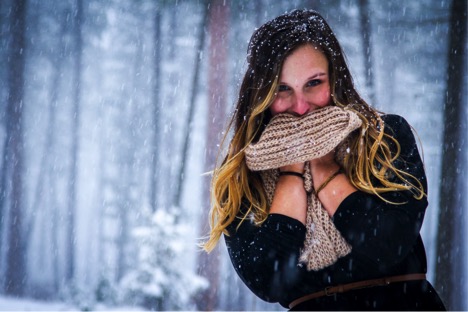
A self portrait of Felstet clutching a scarf to her face while standing in the snow
Felstet’s self-portrait from her photo-a-week challenge. By Kaci Felstet.

To stay familiar with her camera, Felstet decided to create a photo-a-week challenge for herself to keep her creativity fresh. The recent recognition of “Late Start” serves as another boost from the journalism world.

“Kaci has a great eye for shooting and producing multimedia packages,” Lurgio said. “She works extremely hard, and she was very dedicated to producing a professional caliber story. And that’s just what she did.”

Kaci Felstet and Courtney Anderson’s collaborative piece can be found on the Native News website, which features more stories from reservations in Montana.

By Jana Wiegand
UM Journalism Student Ranks Among Top 20 Hearst Finalists

University of Montana School of Journalism photography student Evan Frost placed among the top 20 finalists in the national Hearst Journalism Awards Photo One Competition.

Frost’s portfolio placed 18th in the Photojournalism I: News and Feature Photography category. UM journalism professors Keith Graham and Jeremy Lurgio said they knew Frost’s work was worthy of placing among the best students in the nation.

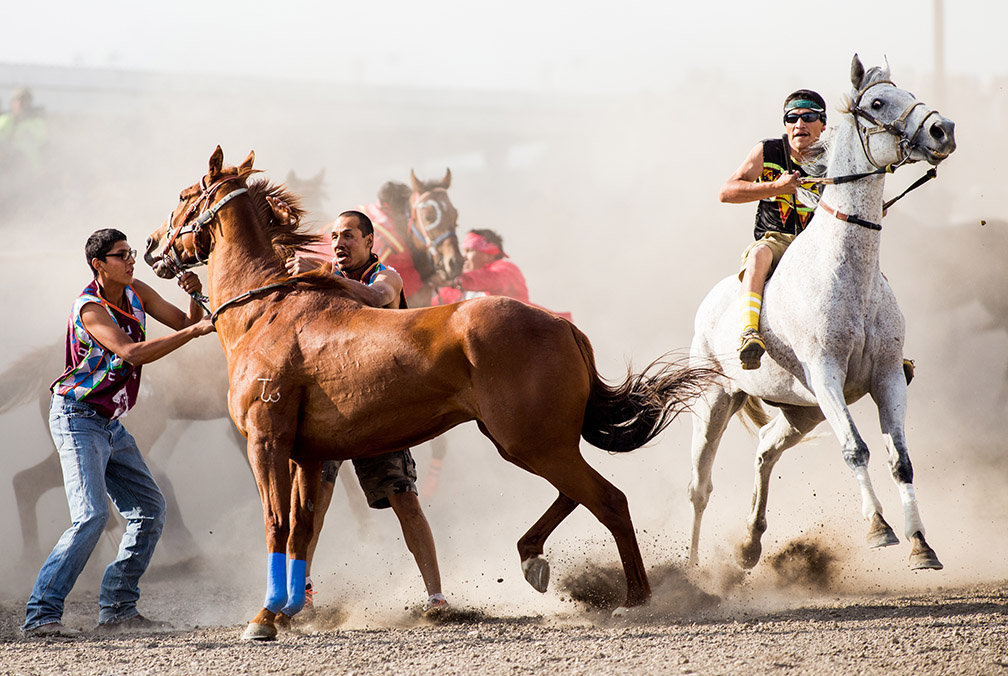
Pictured: a winning photo from Frost's portfolio. Pikunii Express team members try to gain control of one of their horses as a member of team whitecap takes off  during the Indian Relays at the North American Indian Days in Browning, Montana on July 11, 2015.  Photo by Evan Frost
Pictured: a winning photo from Frost’s portfolio. Pikunii Express team members try to gain control of one of their horses as a member of team whitecap takes off during the Indian Relays at the North American Indian Days in Browning, Montana on July 11, 2015. Photo by Evan Frost

“His submission of eight images showed vision, humor, action and impact,” Lurgio said.
Above all they were solid storytelling images.”

Lurgio said Frost was able to put his skills to the test through a summer internship at the Great Falls Tribune.

“That hard work in the professional world rewarded him with a group of solid images that earned him a top-20 finish,” he said. “This is a testament to the importance of the professional internship experiences our students pursue.”

Frost worked as the photo and video editor at the Montana Kaimin during fall semester of 2015, as well as the multimedia editor for the 2016 edition of the Montana Journalism Review. Montana Kaimin adviser and UM journalism Professor Nadia White worked with Frost during fall semester.

“Evan combines a keen eye with a sense of community,” she said. “He’s the kind of student that rolls up his sleeves and gets things done.”

To see Frost’s work and recent projects, visit his website at http://www.evanfrostphoto.com/.

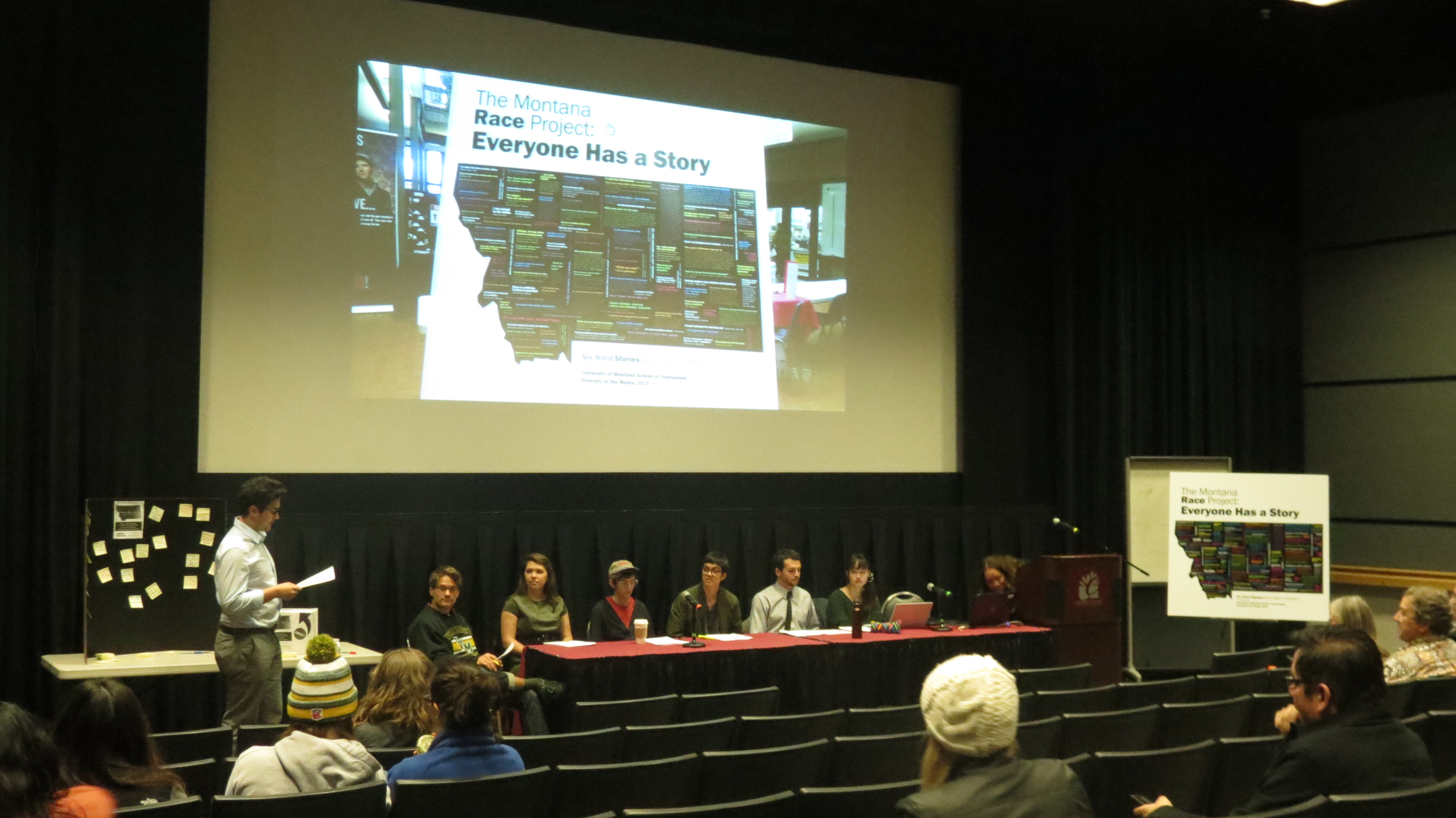
Students uncover Montana voices about race

In the UC Ballroom on Thursday, November 5th, a group of seven students and their professor talked about what they’d learned over a semester spent exploring questions of race in Montana. The students have created the Montana Race Project, in which they drew in six-word essays from around the state that touched modern questions of race and diversity in Montana and beyond.

Photo showing student panel at the presentation of the 6 word essays.
Students took turns reading their favorite submissions from the project. Photo by Alyssa Rabil.

The professor, Kathy Weber-Bates, is an adjunct instructor at the School of Journalism, and the project was created through her Diversity in the Media course. To introduce Thursday’s panel discussion, Weber-Bates talked about her frustration with the idea that it was difficult to talk about diversity in a state that was not that diverse in comparison to others. That idea, she said, is misleading.

“It made an assumption that the state doesn’t have a multitude of voices,” and that’s not true, Weber-Bates said.

For her and her students, a focus that arose over the course of the experience was on the importance of conversations about race and diversity even, or perhaps especially, in institutions or places that are predominantly white. The students on the panel said they were surprised by how often the sentiment that Montana didn’t have a race issue and had no need to discuss the subject seemed to come up.

To uncover the real concerns about race in Montana, the class created an online form where anyone could submit a six-word essay, which they then promoted as a class via social media. By November 5th they had received over 300 essays from all over the state.

The idea of the six-word essay may have been born from Ernest Hemingway, Weber-Bates said, who was a firm believer in the value of saying much with few words. When challenged by his peers, Hemingway allegedly wrote the following six-word story:

“For sale: baby shoes, never worn.”

Whether that story is true or not, the form carries a lot of power. This held true for the stories brought in by the Montana Race Project. Here are just five examples of stories the students chose to read at Thursday’s event:

“Columbus day shouldn’t be a holiday.”

“Don’t tell me there’s no problem.”

“Half Peruvian, looks white, strange world.”

“Blind eyes can’t fix the past.”

“When will Native American lives matter?”

Some stories showed ignorance, others hope and optimism and still others expressed challenges of self-identity in today’s world. All showed a state where questions of race are very much alive.

Five of the students on the panel study journalism. They’re certain this experience will help guide their future work in a profession based around the idea that telling stories, everyone’s stories, matters. “The stories that I choose to tell and how I choose to tell them can bring things to light or bury them,” said Mia Soza, who is co-news director at the student run radio station KBGA.

Chloe Reynolds, another journalism student, said she learned the value of casting a wide net with her reporting, in order to find stories in unlikely places. “You don’t know somebody’s story unless you ask them,” she said.

To read more about The Montana Race Project and submit your own six word story, you can visit their website or search for them on Facebook.

By Andrew Graham