
J-School Grad Student Wins Best In Festival For Radio Piece

photo of Ouellet working in the studio
Photo by Shanti Johnson.

From the blue lights and glow-sticks at The Great Northern Bar in Whitefish, Montana, graduate student Nicky Ouellet followed a band backstage to understand the mission behind their music. Ouellet’s subsequent radio story, “An ‘80s Cover Band With Global Dreams,” recently won Best in Festival in the student news competition for the Broadcast Education Association’s Festival of Media Arts.

“This is one of my first audio pieces,” Ouellet said. “For it to receive national recognition like this is really overwhelming, and I’m really honored.”

The story emerged from Assistant Professor Jule Banville’s Advanced Audio Skills class, when Banville prompted her students to incorporate music into a radio piece. “I wanted mine to be more than just a story about a band,” Ouellet said. “And the New Wave Time Trippers immediately came to mind.”

While the band came together for their mutual love for ‘80s music, they also wanted to find a way to be able to live off their “Rocky Horror Picture Show” style performances. Members of the New Wave Time Trippers told Ouellet that they hoped to turn these occasional night gigs into a full-time job by playing at corporate events and landing a regular show in Las Vegas.

“I thought it was a really interesting combination of the artsy, but also the business savvy,” Ouellet said.

For her, capturing a sense of place was equally as important as recording the essence of the Time Tripper’s music. Ouellet plugged a Marantz kit directly into the bar’s sound system to record clean copies of the songs and set up a secondary recorder to capture the crowd’s experience. After taping two of their shows, one in Whitefish and one in Missoula, Ouellet spent hours listening to the footage, recording her own narration and trying to keep the story under five minutes.

“Most of the challenges were really just keeping it tight and clean and focused,” Ouellet said. “That’s where Jule, my professor, came in and helped me kill all of my darlings, which was a really tough process because there were a lot of good ones.”

“I loved that story, and it will make you happy if you listen to it,” Banville said. “It had this signature mix where Nicky blended her writing and narration with interviews, and of course, great songs.”

The intimacy of radio originally drew Ouellet to the medium. She said the power of each story to delve inside someone else’s head made her change the way she saw the world. “You kind of lose sense of the thing directly in front of you, and it’s like this whole world of your mind and that of the story-teller are blended,” Ouellet explained.

Since the Time Tripper piece, she and Banville have been working closely together on Ouellet’s professional portfolio, which she will defend in May to receive her master’s degree in journalism. Her portfolio includes both written and audio pieces, examining how Native Americans manage natural resources on tribal lands. Ouellet is currently applying to jobs and fellowships for after graduation, and she hopes to find a position that lets her continue to use both print and radio.

“I’ve met very few people who work a story like Nicky Ouellet,” Banville said. “She’s going to do amazing things and just kill it as a journalist who can do it all.”

To hear more about Nicky Ouellet’s Best in Festival piece and the production process, watch her video interview on the School of Journalism’s Vimeo account, or click here to read the transcript of her interview. See more of Nicky Ouellet’s work in print and radio on her blog’s portfolio.

Stay up to date with more UM J-School radio pieces by listening to Jule Banville’s podcast series Last Best Stories.

By Jana Wiegand
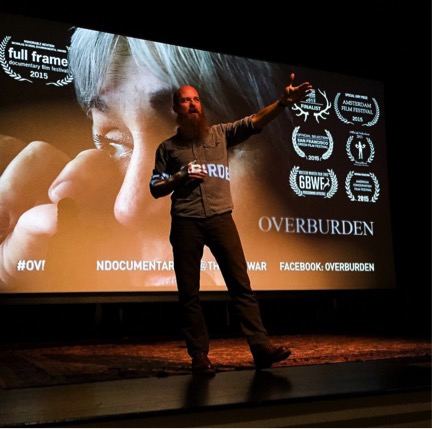
Award-Winning Documentary Director, Chad A. Stevens, Speaks At J-School

Chad A. Stevens, director of the documentary “Overburden,” tried out two other titles for his film before settling on the third. Appropriately, Stevens’ presentation at the UM School of Journalism on Wednesday, February 24th, also came with three potential titles: “The Life, Death & Afterlife of a Documentary,” “How in the World did I Survive this Thing?” and “Thank God for Talented Friends and Box Wine.”

“Overburden” played at the Wilma Theater as part of the 2016 Big Sky Documentary Film Festival later that same day. The film follows two women in the heart of Appalachian coal country and their fight to save Coal River Mountain from the Massey Energy Company after an underground fire kills 29 miners.

Stevens said the first iteration of this project began while he was working on his master’s thesis at Ohio University. However, his moment of inspiration began several years earlier, in 2003, during his time as a photojournalist-in-residence at Western Kentucky University. One day, Stevens and a friend were driving through the hills when they crested a ridge and Stevens got his first look at a mountain top removal site. “There was a shocking amount of destruction,” he said.

Chad A. Stevens speaks to the audience a screening of “Overburden” in Boulder, Colorado.
Chad A. Stevens speaks to the audience a screening of “Overburden” in Boulder, Colorado. Photo by Erin Hull.

Originally Stevens focused on the environmental aspects of coal mining. He photographed events at the Mountain Justice summer convergence and followed the activists who chained themselves to bulldozers at the top of Coal River Mountain. Yet Stevens realized that this story lacked the intimacy to connect with a broader audience. He looked to the valley where people lived right below the mining sites, whose blasts shook their homes’ foundations.

“I started to have this idea that maybe it could be more,” Stevens said. “I was like, 100% heart. I have to do this no matter what.”

It took Stevens about two years to gain the trust of one of his main characters, Lorelei Scarbro, who had seen plenty of journalists disappear after getting their pictures and quotes from the community. Yet Stevens referred to time as a gift and said it allowed him to understand what mattered most to Scarbro and her battle against coal.

“I was so damn stubborn and wouldn’t leave,” Stevens said, and his patience paid off. “To be there when her grandson was born—that never would’ve never happened without that time.”

One of the project’s major turning points came on April 5th, 2010, when a methane leak and an errant spark caused an explosion in the nearby Upper Big Branch mine.

“As you can imagine, that deeply impacted the community,” Stevens said. “And of course, it changed the film as well.”

A second main character emerged—a pro-coal activist whose brother died in the explosion and spurred her to join Scarbro’s fight.

Stevens also realized that the film’s central theme switched from an environmental perspective to more economy-based story, which explored how extraction-based economies limit local communities.

During the production process, Stevens licensed some of his footage and sold it to organizations that were working on tangential stories, as long as he knew they wouldn’t overlap with “Overburden.”

“I actually paid an editor to edit my film because I felt too close to it,” Stevens said.

Looking back on this ten-year project, Stevens reminded the room full of UM Journalism students about the importance of reaching out to others for help and the importance of remaining humble, because “it’s always bigger than just us.”

Stevens also spoke of the potential that comes from “opportunity blindness.” He said, “When you first start off, there’s no way to know what doors will open down the road. You just got to put it out there.”

While funding such projects remains a challenge for today’s journalists, one of Stevens’ teachers once told him, “Sometimes you do what you gotta do to feed your belly. And sometimes you do what you gotta do to feed your soul.”

Now a tenured professor at the School of Journalism and Mass Communication at the University of North Carolina in Chapel Hill, Stevens has his own mantra for students to learn.

“It’s all about collaboration and community,” Stevens said. “When we care, we as the story-tellers care, that care transfers.”


“Overburden” is currently available for rent on iTunes, Amazon, Google Play and Vudu. Check the film’s website or follow its Facebook or Twitter accounts for details about upcoming screenings.

To learn more about UM J-school affiliates reporting on coal communities in Montana, check out second-year graduate student, Andrew Graham’s contributions to National Geographic’s blog The Great Energy Challenge, and adjunct professor, Matthew Frank’s publications on Mountain West News.

By Jana Wiegand

Preview: UM J-School at the Big Sky Documentary Film Festival

The 13th Annual Big Sky Documentary Film Festival (BSDFF) kicks off in Missoula on Friday, February 19th and runs through Sunday, February 28th. This year’s theme revolves around “impact.” Executive Director of the Big Sky Film Institute, Gita Saedi Kiely, describes this topic as a lens to examine “the impact of the stories we tell, the impact we have on the planet and the impact we can have on society.”

Big Sky Doc Film Fest logoOver 200 independent films will be showcased during the 10-day festival, and the University of Montana serves as more than just a sponsor for the event. Dean of the UM School of Journalism, Larry Abramson, is one of 12 members of the festival jury. “It’s my first time judging the Big Sky,” Abramson said. “I’m going to try to watch as a regular person, and then look at what makes them compelling and their journalistic sensibility.”

The jury will chose the winning films based on four different categories: Best Feature, Best Short, Best Mini, and the Big Sky Award, which specifically deals with films about the American West. Abramson’s thirty years as a reporter and editor at National Public Radio will help him evaluate the sense of balance and fairness in the films, “to make sure they back up what they say,” he said.

Abramson will also be leading a workshop for high school journalism students on Friday, February 26th. He plans to talk to the students about interviewing skills, including the importance of using their questions as a story arc for the interview. “A lot of kids that age are afraid to talk to important people,” Abramson said. He hopes this workshop will give these budding journalists more confidence.

UM will also be hosting a series of workshops in the University Center as part of the festival’s DocShop conference. In keeping with the theme of “impact,” DocShop will focus on FILMS FOR CHANGE and explore the power of documentaries and media activism to serve as catalysts for positive change. All of the workshops will be free to students and faculty at UM, as well those from MSU.

Keep following the blog on the UM School of Journalism’s website for more updates on their involvement at the festival.

To view the complete schedule of events, film trailers and other additional information, visit

the 2016 Big Sky Documentary Film Festival’s website.

By Jana Wiegand
