Biogeochemistry Professor and J-school Collaborate through NSF Grant

When University of Montana biogeochemistry Professor Cory Cleveland begins a new project in Panama this summer, a young journalist will be coming along for the ride.

Cleveland will build on his long-held conviction that “a fundamental piece of good science is to communicate it effectively,” when he embeds a graduate student from UM’s Master’s program in Environmental Science and Natural Resource Journalism with his research team to document their fieldwork at the Smithsonian Tropical Research Institute.

A lift-out quote reading “It’s an innovative model of collaboration between journalism and the sciences that we hope will serve as a model for other research efforts at the University of Montana.” Scientists often struggle to convey the meaning of their work to the general public. Cleveland says the approach of bringing in a journalist from the beginning helped his proposal stand out and get funding from the National Science Foundation in a highly competitive application process. It will allow him to focus on his research while at the same time helping to create better communication. “I’m never going to do as well at that as someone who’s an expert and a professional journalist,” he said.

The collaboration benefits both sides. For the School of Journalism, the opportunity to document all phases of the research will allow a student to produce compelling stories about a rigorous scientific experiment that has large potential impacts on humanity, said Associate Professor Henriette Lowisch, the UM J-School’s graduate program director, who collaborated with Cleveland on his proposal.

“This will be a huge challenge for an emerging journalist, who will be able to practice all they’ve learned about making complex research accessible to the public,” Lowisch said. “It’s an innovative model of collaboration between journalism and the sciences that we hope will serve as a model for other research efforts at the University of Montana.” Together, Lowisch and Cleveland will select a journalism graduate student to accompany the research team.

In Panama, Cleveland will be testing whether tropical plants are able to get more nutrients from the soil than scientists have previously thought. Tropical forests are among the most productive on Earth, and remove significant amounts of the greenhouse gas carbon dioxide (CO2) from the atmosphere. The plants use CO2 as food to grow, but their growth is ultimately limited by the presence of other nutrients, such as phosphorous, which is scarce in tropical soils. Cleveland’s NSF grant will allow him to study whether tropical plant species have evolved novel ways around this limitation.

The research not only questions conventional wisdom about what plants are capable of, it also carries implications for a world coming to terms with climate change. If Cleveland is right and tropical forests are able to match growing amounts of CO2 in the atmosphere with phosphorous and other nutrients in the soil, they’ll act as better carbon sinks, which could help mitigate the effects of burning fossil fuels.

It’s a good story for an up-and-coming journalist, but how to cover it will be a choice the graduate student will make on the ground in Panama. The result will go beyond the traditional press release that tries to explain scientific research to the public, and instead use story, the craft of journalism, to showcase science.

Both Lowisch and Cleveland said that the project leaves the journalism student room to tell the story as he or she best sees fit.

We’re just going to say here’s an opportunity, come do something,” Cleveland says. “Hopefully that benefits them and they can tell something interesting about what we’re doing, or maybe not. There’s no agenda.”

Lowisch said that part of the reason she is excited about doing this collaboration with Cleveland is exactly that understanding. “Both journalism and science are disciplines of verification, and to be able to do that you need to be independent and Cory Cleveland has understood that.”

Adapted from UM news release by Andrew Graham
UM Journalism Student Ranks Among Top 20 Hearst Finalists

University of Montana School of Journalism photography student Evan Frost placed among the top 20 finalists in the national Hearst Journalism Awards Photo One Competition.

Frost’s portfolio placed 18th in the Photojournalism I: News and Feature Photography category. UM journalism professors Keith Graham and Jeremy Lurgio said they knew Frost’s work was worthy of placing among the best students in the nation.

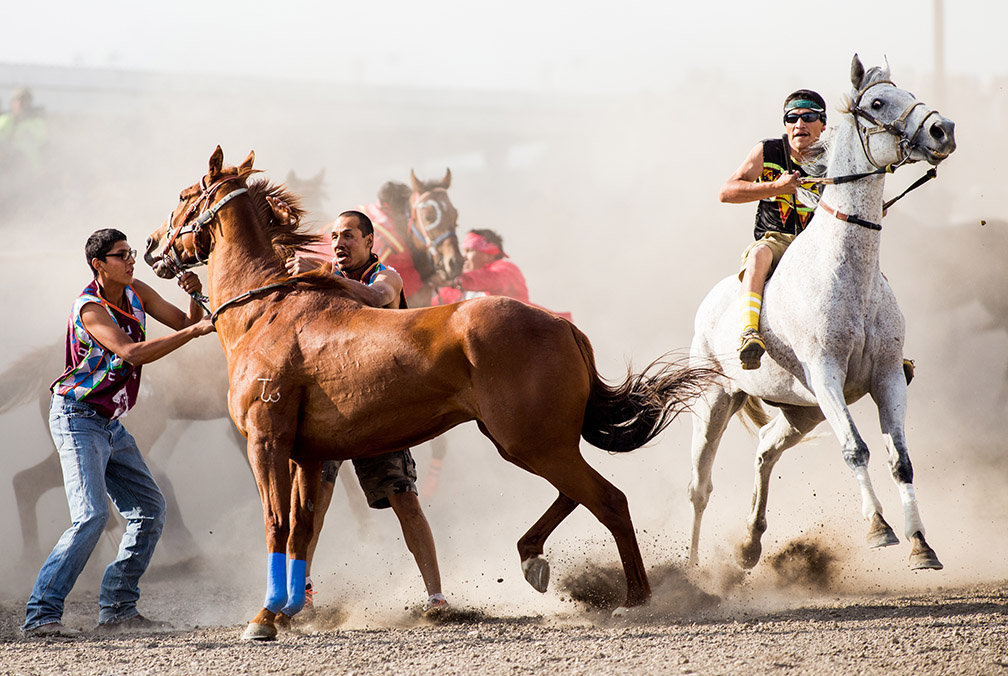
Pictured: a winning photo from Frost's portfolio. Pikunii Express team members try to gain control of one of their horses as a member of team whitecap takes off  during the Indian Relays at the North American Indian Days in Browning, Montana on July 11, 2015.  Photo by Evan Frost
Pictured: a winning photo from Frost’s portfolio. Pikunii Express team members try to gain control of one of their horses as a member of team whitecap takes off during the Indian Relays at the North American Indian Days in Browning, Montana on July 11, 2015. Photo by Evan Frost

“His submission of eight images showed vision, humor, action and impact,” Lurgio said.
Above all they were solid storytelling images.”

Lurgio said Frost was able to put his skills to the test through a summer internship at the Great Falls Tribune.

“That hard work in the professional world rewarded him with a group of solid images that earned him a top-20 finish,” he said. “This is a testament to the importance of the professional internship experiences our students pursue.”

Frost worked as the photo and video editor at the Montana Kaimin during fall semester of 2015, as well as the multimedia editor for the 2016 edition of the Montana Journalism Review. Montana Kaimin adviser and UM journalism Professor Nadia White worked with Frost during fall semester.

“Evan combines a keen eye with a sense of community,” she said. “He’s the kind of student that rolls up his sleeves and gets things done.”

To see Frost’s work and recent projects, visit his website at http://www.evanfrostphoto.com/.

J-School student finds new opportunity to report from abroad

On December 8th, graduate student Katie Riordan was recognized for her promise as an international correspondent when she received the Overseas Press Club Foundation Scholar Award. The recognition was accompanied by the chance to spend her summer break doing international reporting, through a fellowship at a foreign bureau.

photo of Katie Riordan
Katie Riordan is a graduate student at the University of Montana School of Journalism. Photo by Katy Spence.

Bureaus run by the Associated Press, Reuters, Forbes, the Wall Street Journal or the Global Post are all possibilities for Riordan. Wherever she ends up, it won’t be her first time filing stories from foreign soil.

Riordan completed her undergraduate studies at the University of Colorado Boulder, where she majored in broadcast journalism. Post graduation, she did a few stints at community newspapers in New York City.

In 2012, she left the United States to take a job as an editor at an English language paper in Yemen, which borders Saudi Arabia. Riordan had traveled and lived abroad before, but says the move wasn’t a calculated decision. Her reasons for moving to Yemen reveal a deep wanderlust and interest in other cultures.

“You can read all about it but being there, living there and reporting there is the experience,” Riordan said.

After more than a year at the English language newspaper, Riordan left and began freelancing. Over the course of six months she wrote stories on women’s rights, refugees and migrants and a variety of human interest stories. Her work was published in the Christian Science Monitor, Al Jazeera, the Economist and the Middle East Eye, an online news organization based out of England.

Riordan continues to contribute to the Christian Science Monitor, with an article on Syrian refugees in Somaliland published just days before she received her award.

Freelancing was a challenge at first, but being on the ground in countries of international interest helped her. “It’s hard to build relationships with editors, but once you do and can demonstrate that you can produce work from your location things start to snowball,” she said.

Returning to the U.S., she came to the Environmental Science and Natural Resource Journalism Masters program to hone her reporting skills and develop a specialty in environmental reporting. While Riordan says she misses life abroad, she’s been enjoying her classes and has a story in the upcoming 2016 Montana Journalism Review about tensions between the Department of Defense and reporters in war zones.

Next semester Riordan hopes to supplement her journalism and environmental science coursework with classes in Arabic, in order to build on her language base and improve her eligibility for reporting from the Middle East.

But today, she’s excited at being recognized by the Overseas Press Club, and anticipates a productive summer abroad, wherever in the world it may take her.

“It’s a really prestigious organization, and I’m looking forward to getting back overseas to do some reporting on the ground,” Riordan said.

You can get an advanced read of Riordan’s upcoming story in the Montana Journalism Review here.