Reporting On Reservations: Native News Sends Students Into The Field

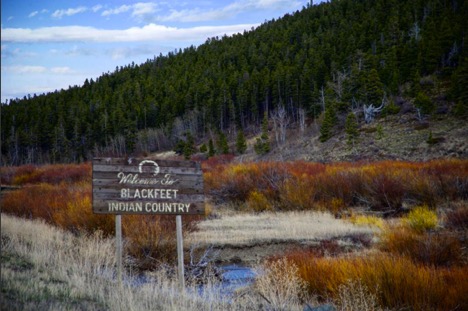
Landscape photo with a sign in the foreground that reads "Welcome to Blackfeet Indian Country."
J-school students divide into teams and travel to visit different reservations across the state. Photo by Courtney Gerard.

After weeks of planning and preparation, UM journalism students in the class Native News are spending spring break reporting on their stories. The students work in teams of two that pair photojournalists with print reporters to create a complete multimedia story.

With the upcoming presidential election in November, Native News professors Jeremy Lurgio and Jason Begay decided this year’s project should focus on politics. “The President has a lot of influence over Indian country,” Begay said.

Yet Begay said the theme is not just about seeing how people on reservations vote. He posed the question, “What do they consider when thinking about politics?”

“Voting on reservations tends to be less bipartisan, especially when it comes to internal politics,” Lurgio said.

However, the reporting teams have chosen stories that dig into the specific political issues that impact their designated reservations, instead of covering the national influence. The students reporting on the Crow Reservation recently followed tribal leader Darrin Old Coyote to the 2016 Montana Energy Convention in Billings to hear him speak about how coal affected jobs on his reservation.

On Fort Belknap, Sophie Tsairis and Lenny Peppers are investigating access to voting and the satellite voting offices on the reservation. Tsairis has been posting reporting updates from Fort Belknap on Instagram.

On the Blackfeet Reservation, Courtney Gerard and Peter Friesen are digging into constitution reform. However, their trip also aligns with the arrival of 88 bison from Elk Island in Canada returning to the reservation, as part of a cultural and ecological relocation effort. To see live updates from the Blackfeet, follow Gerard’s posts on Instagram.

When the students return from the reservations, the pairs will start synthesizing their individual stories into a collaborative, multimedia piece. The final projects from each team will appear on the Native News website in May and circulate the state in the annual print edition.
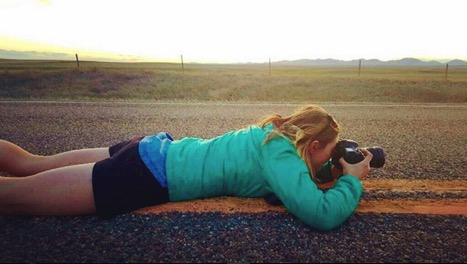
Native News photographer Sophie Tsairis lays in the middle of a deserted highway to snap a photo of the landscape.
Native News photographer Sophie Tsairis tries to find the best angle to capture a spectacular landscape to illustrate her story. Photo by Lenny Peppers .

To catch the latest updates from the Native News reporting teams, follow their accounts on Facebook, Instagram and Twitter.

By Jana Wiegand

Accomplished Journalist, Ken Wells, Speaks About The Evolution Of Newspapers

Ken Wells, a seasoned business journalist, watched print news outlets evolve from traditional printing presses to the Internet’s 24-hour news cycle. At the first newspaper where Wells worked in Bayou Black, Louisiana, he used to run downstairs and smell the ink of the first papers coming off the press. In today’s world, he considers himself agnostic on which medium to use for publication, as long as people continue to tell these news stories.

Ken Wells speaks to a crowded room
“The best business stories aren’t about business,” Wells said. “But about their use as an interface for the human condition.” Photo by Alyssa Rabil.

Yet when Wells first started college, he didn’t dream about becoming a journalist. “I liked biology, and my father was a marine, so I decided to become a marine biologist,” Wells said.

He quickly became disillusioned with his classes and dropped out of college. Wells started working as a short-order cook at a 24-hours diner, but he quit that job after intervening in a late-night fight between customers. “I decided that breaking up attempted murder for minimum wage was not a good career,” Wells said.

He found an ad in his hometown newspaper, the Houma Courier, that read “Wanted: Part-Time Reporter, $1.87 / hour.” After the Courier hired Wells, his editor sent him off with a Polaroid camera to report on a bartender who had caught a 300-pound snapping turtle. Wells spent several years at the Courier before getting his master’s degree at the University of Missouri School of Journalism in 1977. From there, Wells worked at the Miami Herald, The Wall Street Journal and Bloomberg News.

Wells spoke to J-school members as part of the Jeff Cole Distinguished Lecture, which honors Cole’s dedication to the journalism field after his death, on-assignment, on January 24th, 2001. Cole graduated from the UM J-school in 1980 and had worked his way up to The Wall Street Journal by 1992 as an editor and reporter. Participating in this lecture series had personal meaning for Wells, who met Cole through The Wall Street Journal. Wells said, “He was a great writer, a great reporter and always in amiable spirits.”

Both Wells and Cole followed their editors’ mantra “We can fix your writing, but we can’t fix your reporting.” Since then, Wells developed his own idioms for today’s journalists: “Google might run the news, but it won’t write it” and “You can break news on Twitter, but Twitter won’t save the world.”

Over the years, Wells’ reporting proved to him how strongly business relations influence science, culture and other important fields. He said, “Outside of terrorism, the business stories are probably the most important of our lives.”

During the question and answer session at the end of the lecture, second-year graduate student Andrew Graham asked Wells about approaching his first non-fiction books after his lengthy career writing for newspapers.

“There a few things you should never do for money,” Wells replied. “Get married, make love and write a book.”

Wells enjoyed the reporting stage so much that he didn’t become a diligent writer until he confronted his first 80,000-word deadline. He said he had to lock himself in the attic for 12 hours a day to write. “I stopped talking to my wife, I stopped taking showers and I started kicking the dog.”

Regardless of the medium, Wells said that business journalists must embrace their responsibility as public watchdogs to be the truth-sayers in society. “There are stories growing on trees,” he said. “I think that we have a bright future in front of us.”

Learn more about Ken Wells’ work as a journalist, author (fiction and non-fiction), photographer and musician from his website.

To catch up with live coverage of Ken Wells’s delivery of the annual Jeff Cole Distinguished Lecture, follow the University of Montana School of Journalism’s Twitter and Instagram accounts.

By Jana Wiegand

Student Profile: Joe Lesar, Master Behind The Camera & Devoted Runner

Senior broadcast major, Joe Lesar, could have graduated in the fall, but he didn’t want to pass up all the great opportunities the J-school offered in the spring semester. During Fall 2015, Lesar took UM News, where the students produced weekly televised and online stories. As a photographer, Lesar not only supported his reporters, but also produced some of his own “one-man-band” segments for the program.

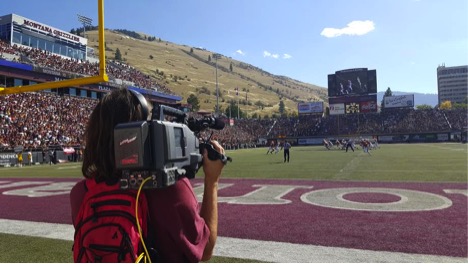
Joe Lesar in the end zone during the Griz v. NAU, September 2015. Photo by Peter Riley.

Every spring, the J-school offers an upper-level elective called Student Documentary, where the students produce an hour-long documentary for Montana PBS. Lesar wanted to experiment with different forms of narrative story-telling; plus, when he realized that most of his cohorts from UM News were feeding into Student Doc, Lesar said, “We worked so well together, I would’ve felt left out if I didn’t do Doc with them.”

Spring 2016 also marked the last semester when Lesar could compete as at student athlete at UM. Lesar ran track at McQueen High School in his hometown of Reno, Nevada, and he wanted to finish his collegiate career as a runner on a strong note. While Track & Field is Lesar’s strongest sport (notably the 400m, 800m and Triple Jump), he also joined the Cross Country team, where the standard men’s 8K race stretches 10 times farther than his longest track event.

However, sports provided an important entryway into another avenue of journalism for Lesar. One day, he was walking through the Adams Center and happened to run into the director of Griz Vision, Abe Kurien. From a simple conversation about shared July birthdays, Lesar landed a job as a videographer for Griz games—football, basketball and volleyball.

Kurien told Lesar, “Come in and check it out, shadow us at some games, and if you’re interested, come back and we’ll have a job for you.”

Now Lesar’s on his second season shooting with Griz Vision and he runs a floor camera right under the basketball hoop. His ability to know what shots Kurien wants covered, without receiving direction via earpiece, means that Kurien can depend on Lesar to get the job done well.

“Joe, in particular, having already anticipated that shot, means so much,” Kurien said. “Because he knows what’s coming during the plays.”

By now, Lesar considers it second nature.

“You just follow the ball,” he said. “If someone scores, you zoom in on them and get the Hero Shot.”

This work can become more challenging during home Griz games in football season because of the variable weather conditions. Yet fellow J-school senior, Peter Riley, who also works for Griz Vision, said, “It’s a great way for the Journalism community to be involved with the greater campus community.”

“I’m getting paid to go to the home games and be on the ground, with all the action,” Riley added. “That’s a nice reward.”

Lesar agrees that he enjoys being close to the action and seeing the interactions between coaches, players and referees. During basketball games, “The coaches get super-animated, and they scream a lot, which is pretty entertaining,” Lesar said. “I always keep an eye on them.”

Kurien said that Griz Vision is an excellent opportunity for broadcast journalism students to work hands on with the cameras. He added, “Joe, I think, enjoys what he does and wants to be a part of every game.”

Scheduled to graduate in Spring 2016, Lesar hopes to stay in Missoula for a while and keep working for Griz Vision, while looking for jobs at local news stations. “I don’t see myself going home,” Lesar said. “There are so many opportunities from here.”

Learn more about J-school student experiences with Griz Vision here, as documented by Sojin Josephson, sports reporter for the Montana Kaimin.

Further interest and inquiries about Griz Vision can be directed to Abe Kurien, via email, agkurien@gmail.com, or via phone, at 406-207-6370.

By Jana Wiegand