NPR producer, award-winning science writer to mentor 2016 Crown fellows

Two science journalists with a national reputation and a knack for working with young reporters will mentor this year’s recipients of the Crown Reporting Fellowship.

npr crown

NPR Senior Health and Science Producer Jane Greenhalgh will work with Nicky Ouellet, a second-year graduate student at the UM J-School, while Hillary Rosner, an independent science and environment writer, will mentor first-year graduate student Katy Spence.

“Both mentors are stellar journalists who know the region and have ample experience in covering science and the environment,” said Henriette Lowisch, director of the Master’s Program in Environmental Science and Natural Resource Journalism at The University of Montana. “Their guidance and example will be invaluable to our student fellows as they report, produce and pitch their stories from the Crown of the Continent.”

Ouellet’s radio feature will look at how decisions made by forest supervisors affect individuals and communities that depend on the Crown’s forest products for their livelihoods, while

Spence will report on how citizens on both sides of the US-Canadian border perceive the link between beavers and climate change.

While the students will report their stories in the field, their mentors will recommend sources, edit drafts and help place the final product in a regional or national publication.

Greenhalgh, a Portland-based producer and editor for National Public Radio who specializes in science and health coverage, said mentoring younger reporters was one of her favorite things at NPR. “I loved Nicky’s pitch so I’m excited at the prospect of working with her,” she said.

Rosner, an award-winning journalist who covers science and the environment for National Geographic, Wired, Scientific American and other publications, said she was excited about the chance to work on an important story with a young writer one-on-one. “Katy seems like a sharp and talented reporter, and I’m looking forward to seeing her project unfold,” the Colorado-based writer said.

Now in its second year, the Crown Reporting Project aims to advance quality storytelling on landscape-level conservation, conflicting demands for natural resources and community efforts to build climate resilience. It was inspired by Ted Smith, a pioneer of large-landscape conservation who recognized a need for journalists trained to engage communities by explaining the science behind the policies that affect our backyards.

In 2015, graduate students Ken Rand and Celia Talbot Tobin worked with Chris Joyce, of National Public Radio, and Ted Alvarez, of Grist and Backpacker Magazine, to report stories on aquatic invasive species and mining waste.

By Henriette Lowisch
Reporting On Reservations: Native News Sends Students Into The Field

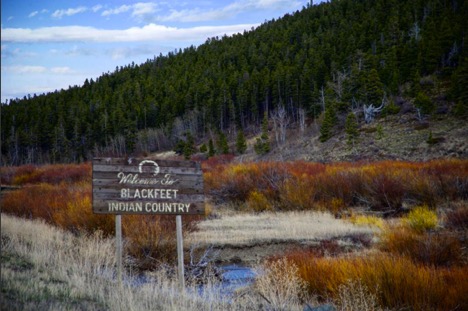
Landscape photo with a sign in the foreground that reads "Welcome to Blackfeet Indian Country."
J-school students divide into teams and travel to visit different reservations across the state. Photo by Courtney Gerard.

After weeks of planning and preparation, UM journalism students in the class Native News are spending spring break reporting on their stories. The students work in teams of two that pair photojournalists with print reporters to create a complete multimedia story.

With the upcoming presidential election in November, Native News professors Jeremy Lurgio and Jason Begay decided this year’s project should focus on politics. “The President has a lot of influence over Indian country,” Begay said.

Yet Begay said the theme is not just about seeing how people on reservations vote. He posed the question, “What do they consider when thinking about politics?”

“Voting on reservations tends to be less bipartisan, especially when it comes to internal politics,” Lurgio said.

However, the reporting teams have chosen stories that dig into the specific political issues that impact their designated reservations, instead of covering the national influence. The students reporting on the Crow Reservation recently followed tribal leader Darrin Old Coyote to the 2016 Montana Energy Convention in Billings to hear him speak about how coal affected jobs on his reservation.

On Fort Belknap, Sophie Tsairis and Lenny Peppers are investigating access to voting and the satellite voting offices on the reservation. Tsairis has been posting reporting updates from Fort Belknap on Instagram.

On the Blackfeet Reservation, Courtney Gerard and Peter Friesen are digging into constitution reform. However, their trip also aligns with the arrival of 88 bison from Elk Island in Canada returning to the reservation, as part of a cultural and ecological relocation effort. To see live updates from the Blackfeet, follow Gerard’s posts on Instagram.

When the students return from the reservations, the pairs will start synthesizing their individual stories into a collaborative, multimedia piece. The final projects from each team will appear on the Native News website in May and circulate the state in the annual print edition.

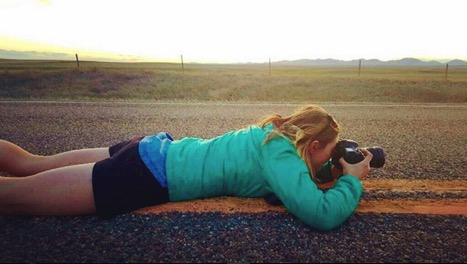
Native News photographer Sophie Tsairis lays in the middle of a deserted highway to snap a photo of the landscape.
Native News photographer Sophie Tsairis tries to find the best angle to capture a spectacular landscape to illustrate her story. Photo by Lenny Peppers .

To catch the latest updates from the Native News reporting teams, follow their accounts on Facebook, Instagram and Twitter.

By Jana Wiegand

Dogged Reporter, Peregrine Frissell Wins Hearst Award For Athletic Investigation

Montana Kaimin web editor and reporter, Peregrine Frissell, had never written a sports story before when he started investigating UM’s controversial compliance efforts with NCAA regulations this past October. After being published in the Kaimin on November 4th, 2015, his story, “Unsportsmanlike Conduct,” won 7th in the Hearst Awards competition for Sports Reporting.

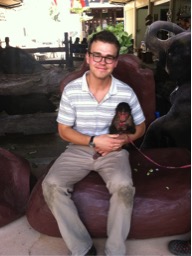
photo of Peregrine Frissell holding a small monkey.
Frissell takes a moment to pose for a photo while reporting abroad in Nepal. Photo by Peregrine Frissell.

“Peregrine did a great job of looking at athletics on the UM campus beyond just the scoreboard,” said Nadia White, faculty advisor to the Kaimin. “His story looked at NCAA rules and regulations and examined what those mean for student athletes.”

Frissell’s research involved digging into those regulations and interviewing UM athletic officials and the NCAA representatives to whom they report any infringements. Violations included anything from coaches recruiting high school athletes too aggressively to convictions of current athletes who commit off-the-field incidents. Frissell said talking to public representatives of those departments was challenging because they wanted to keep control of the information they told him during interviews.

Kevin Van Valkenburg, the fall 2015 Pollner professor and advisor to the Kaimin, said, that a lot of journalists would have dropped the story when they heard officials use the term ‘minor infractions’. “Don’t let the administration convince you it’s no big deal. Ask the right questions,” he said. “UM mis-reported and mis-understood the facts, but Peregrine understood the bigger picture here, and he pursued that to explain it in context.”

“I needed every minute I got,” Frissell said, since he only had two weeks to get the story to print. “I’m really thankful to get recognized.”

Yet Frissell has plenty of reporting experience, both in Montana and abroad. He’s been a Global Leadership Initiative fellow at UM and completed studies in the UK and Thailand, as well as working as a reporting intern for the Nepali Times. “I arrived a month after the earthquake and spent much of my time outside of Katmandu, covering earthquake recovery,” he said. “The earthquake was tragic, but I enjoyed my experience there.”

Back on the UM campus, Frissell has worked with the Montana Journalism Review (MJR) as both an editor and a reporter, and he’s now pursing political stories on the Crow Indian Reservation in Montana as part of the class Native News.

“Peregrine is a dogged reporter. He’s critical and curious, and his instincts are spot on,” Nicky Ouellet said. As a graduate student, she’s overseen his work at MJR and now for Native News. “He’s the type of reporter an editor hopes for—capable of following a tip to create a deeply reported and contextualized story. I’ve enjoyed working with him and can’t wait to see what he pops out in the future.”

Scheduled to complete his journalism degree in May, Frissell said he wants to report in the US for a couple of years and then go back abroad. “I’m still waiting to hear back about potential jobs and internships,” he said.

However, Van Valkenburg has high hopes for Frissell’s future. “He reads a lot and is interested in things of public interest and importance,” he said. “Peregrine will make a great investigative reporter.”

Catch the latest news updates with Peregrine Frissell via Twitter.

By Jana Wiegand