Superfund Tour Sets Tone for Graduate Journalism Studies

You know you’re in the right journalism program when, before the semester has even started, you race to campus at 6:55 am, jump into cars with 10 strangers and drive two hours just to get a close and personal look at the largest toxic waste cleanup project in the country.

And instead of being the slightest bit grumpy, you feel like you have finally found birds that share your particular brand of nerdy feather.

Group photo of journalists students standing at the Berkley Pit in Butte, MT.
The 2018 class of UM’s Graduate Journalism program listens closely as reclamation specialist Tom Malloy describes the future plan for the Berkeley Pit. Photo by Doug Simpson.

Staring into the Berkeley Pit may not be everyone’s idea of a good time, but it tends to be right up the alley of new graduate students in the University of Montana’s graduate program in Environmental Science and Natural Resource Journalism.

It’s become a tradition to kick off the program with what Professor Nadia White calls the “Super Fun Superfund Tour” – a daylong immersion into Montana’s storied mining and extraction history.

This year, the new cohort moved backwards through time and space, tracing the Clark Fork River upstream from Missoula toward its headwaters near the Continental Divide.

The Clark Fork and its tributaries are the veins through which toxic pollutants from a century of copper mining near Butte have spread. Each mile of the river is in a different state of restoration, reclamation, stagnancy or conflict.

Our first stop was Dry Cottonwood Creek ranch – a working cattle ranch owned by the non-profit Clark Fork Coalition located on the Upper Clark Fork. It’s a living laboratory for river and soil reclamation.

Rancher Maggie Schmidt showed students the sections of the river that are in the process of being cleaned up and explained the impact the reclamation project is having on her ranching operation. The visit was a window into how the federal government’s Superfund program plays out with private landowners and the agriculture sector on the ground.

Our caravan then wound through the town of Opportunity, which continues to be the dumping ground for other places’ hazardous waste. Brad Tyer, one of our chaperones and author of the book “Opportunity, Montana: Big Copper, Bad Water, and the Burial of an American Landscape” offered insight as to how some communities, lands, and rivers in Montana may be restored, but there is almost always another one that becomes a kind of sacrificial lamb in exchange.

We stopped for lunch in Anaconda, which is famous for its remnant landmarks from its smelting days. At Smoke Stack State Park, I looked around to see my fellow graduate students clambering over a brick wall to touch slag from the old copper smelter with their bare hands.

Finally, we landed in Butte, the “black heart of Montana,” to meet up with Tom Malloy, the reclamations manager for Butte-Silver Bow County. Malloy lives and breathes environmental reclamation. He knows more sneaky passageways to mining sites than just about anyone else in the county, or maybe the entire country.

Malloy treated students not only to a bird’s-eye view of the Berkeley Pit, but also to a once-in-a-lifetime visit to Yankee Doodle Tailings Pond, which is hidden from the general public’s direct sight.

Seeing the legacy of extraction helped some students ground their ideas about these infamous places.

Journalism student Matt Blois’ only prior connection to the Pit was from hearing about it on Radio Lab. “I expected it to be much more sinister looking – bubbly, green and horrible looking,” he said. “It was strange to see it and know it was so acidic, because it looks so benign.”
J-School students stand in the grass near the pit.
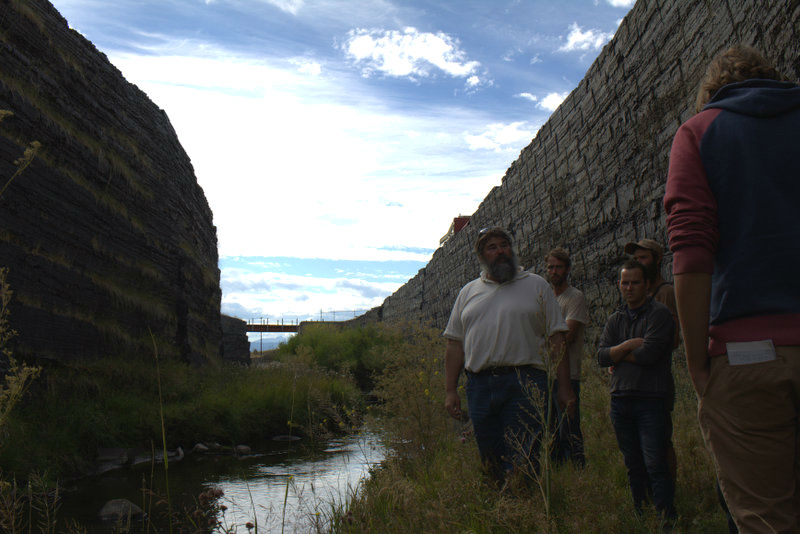
Tom Malloy leads students through Slag Wall Canyon outside Butte – the last stop of the Super Fun Superfund tour. Photo by Olga Kreimer.

Tromping around with Malloy was like having an all-access pass to the behind-the-scenes drama of Butte. I knew he had saved the best for last when he said he was going to take us to “Slag Wall Canyon”, a first for students as well as for our chaperones.

We pulled up next to a trickle of water outside of town and ducked under a crumbling archway. Soon, we were watching Silver Bow Creek meander between 30-foot walls constructed of bricks made from smelting waste. To the untrained eye, it was beautiful and eerie at the same time.

But to Malloy, it was another environmental disaster waiting to happen. He told us that toxic tailings are buried just beneath the slag walls. Meaning that if a big flood were to occur, or the slag walls proved structurally unsound, the old chemicals would be unleashed into the creek, enter the Clark Fork and make a dash for the Columbia. All of the reclamation and healing efforts at places like Maggie’s ranch would be undone, and the water supply of this area would be severely compromised once again.

As Malloy pointed out this risk, we thought hard about what it meant in the big scheme of things. As emergent journalists, how can we talk about slag walls and this one creek in a way that connects our audience to the hard and complex choices we all have to make? What about the ones we don’t make, but are implicated in? And how do we do that gracefully, without scaring the public away?

For his part, Malloy advocated for the creek to be re-routed away from danger. He made it sound as if changing the path of an entire creek was a relatively quick-and-easy fix, and to a reclamations specialist, perhaps it is.

But long after we arrived back in town, a little late and very hungry, I kept thinking about progress. I wondered how someone like Tom Malloy defines progress in his work on a daily basis when he is surrounded by problems created decades ago and solutions that will take a century. And how we are willing to define “solutions” themselves – when it’s so much easier to wish some of these harms had never been caused in the first place.

I hope the questions that bubbled to the surface that day will stay present as we willingly and bravely enter the fray as journalists, listeners, storytellers and witnesses.

Story by Nora Saks

Welcome Back from Dean Abramson

Don Anderson Hall building exterior
Don Anderson Hall, home of the J-School

Boy, what a summer it’s been. Could there be any doubt that we need caring, smart journalists now more than ever?

As we prepare to open the doors for another year at the UM J-School, I keep asking myself that question. Just take one news story as an example: we have a presidential election before us between two people who seem to have a very troubled relationship with the truth. How could the average citizen possibly scrutinize statements by Hillary Clinton and Donald Trump, without professional help from reporters, editors and researchers? Reporters remain, despite the turmoil in our industry, our election ghostbusters: they are uniquely qualified to train their ray guns on statements like Trump’s assertion that the real unemployment rate is closer to 42 percent than 5 percent. And we still need someone to jump on distortions like Hillary’s insistence that the FBI Director called her statements about her email server “truthful.”

While the need for good reporting remains clear, the way to pay for it is not—the crystal ball remains cloudy on that point. As comedian John Oliver pointed out recently, even he ruthlessly rakes through the work of journalists in the search for joke material, without signing up for a subscription. Oliver’s appeal to recognize the work of journalists got a lot of play, but I predict it will have zero impact on the financial plight of the news biz. That’s because pity is not going to help us make news profitable again. Only innovation and hard work will.

So, as we start the year I will present our students with this simple challenge: come help us save the world from a flood of lies. It’s our job.

By Larry Abramson

Professor Matthew Frank Uses New Mediums to Cover Stories of Changing Regions

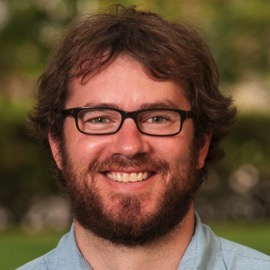
Portrait photo of Matt Frank
Frank is an adjunct professor for the UM J-School.

When Mountain West News launched 17 years ago, it went by the name Headwater News and it served as an aggregation site for news in the region. Over the years, important Montanans and environmental journalists like Tracy Stone-Manning and her husband, Richard Manning, have worked for the outlet.

Matthew Frank has imagined a whole new look for Mountain West News. He collaborated with the school’s dean as well as Larry Swanson, the director of the O’Conner Center for the Rocky Mountain West, to expand the potential of this journalism platform.

“Matt Frank’s gotten involved and re-designed our various programs, re-designed the entire site, and created it in a way that can be more easily accessible,” said Swanson.

Frank integrated the radio component, Mountain West Voices, with the rest of the news site, and then expanded their social media presence include Twitter and Facebook. However, Frank uses Medium as the main outlet for Mountain West News’s written stories.

“I love Medium, because as a writer, it’s a really great writing platform, and it also displays stories in a very clean, visually-appealing way,” said Frank. “When you’re reading a physical magazine, there’s the serendipity of flipping the page and coming across a story that you never though you would read, but there you are, reading this incredible story.”

Medium offers the same potential for readers and writers to discover new stories. All of Mountain West News’s work becomes embedded into their website, so people can find their content in one central location, as well as other places online. Frank said, “It’s about leveraging the virality of these different platforms.”

The other key element Frank introduced to Mountain West News was the ability for the group to produce its own original content, instead of merely curating the work of other journalists.

“When we played around with the idea, we realized that we needed our own content, and I consider him [Frank] one of the best news-writers in the state,” said Swanson. “He’s brought a lot, both in terms of being a good writer and reporter, but also an investigator.”

Both Swanson and Frank share the goal of reporting on issues that shape the economy and the lives of those in the Rocky Mountain West. So far, Frank’s stories have examined topics such as the Bakken boom and bust, the Tongue River Railroad’s connection to today’s coal market, and the impacts of solar panels on residential housing.

“There’s no better way to understand the nuances of energy policy and how they affect people, than to go to a coal mine and meet coal miners who have had friends lose their jobs, it’s a really powerful thing and it changes your perspective,” said Frank. “You can look at charts all day long…but you have to think about the people to make sure your journalism has a certain empathy about it.”

The new version of Mountain West News wants to continue its collaboration with UM’s School of Journalism, and it’s currently in fundraising-mode to make sure the project continues to capitalize on its potential. It already syndicates content for free to outlets like High Country News, Inside Climate News and the Missoula Independent, to make sure the stories reach the communities where the issues most matter. With financial support, Frank could create an internship or fellowship position for graduate students to work with him and produce more investigative pieces.

“Ultimately, we want to add other contributors because in-depth feature-length stories take time to produce,” Swanson said. “This would be a great place for journalism students to get background and experience, and it would help weave together the trends on the environment and natural resources in the region.”

Stay up to date with Mountain West News on Twitter @MTWestNews, Facebook and its homepage, and check out the latest stories with Matt Frank on his Twitter account, @mfrank406. This summer he’ll be tweeting and story-telling from his tent, as he bikes across the state, teaching a class through the Wild Rockies Field Institute called “Cycle the Rockies: Energy and Climate Change in Montana.”

By Jana Wiegand