
UM J-school Prof. Lee Banville Writes Encyclopedia About Media and Politics

Back in July 2014, Associate Professor Lee Banville mapped out all of the best coffee shops in Missoula after signing the contract for his next book. His romantic vision as a writer disappeared when he realized that his 10,000 word-per-week quota could only be met from the basement of the Maureen and Mike Mansfield Library at the University.

“Sometimes, as a treat, I’d sit on the third floor,” Banville said. “There are windows there, and I could look outside.”

Now, 788 pages later, Banville’s work is in the hands of Praeger Press, who will release the two-volume encyclopedia in October 2016. Titled Covering American Politics in the 21st Century: An Encyclopedia of News Media Titans, Trends, and Controversies, the book tackles topics like the role of money in elections, how social media has increased the personalization of the Internet and the roles of female reporters on the campaign trail.
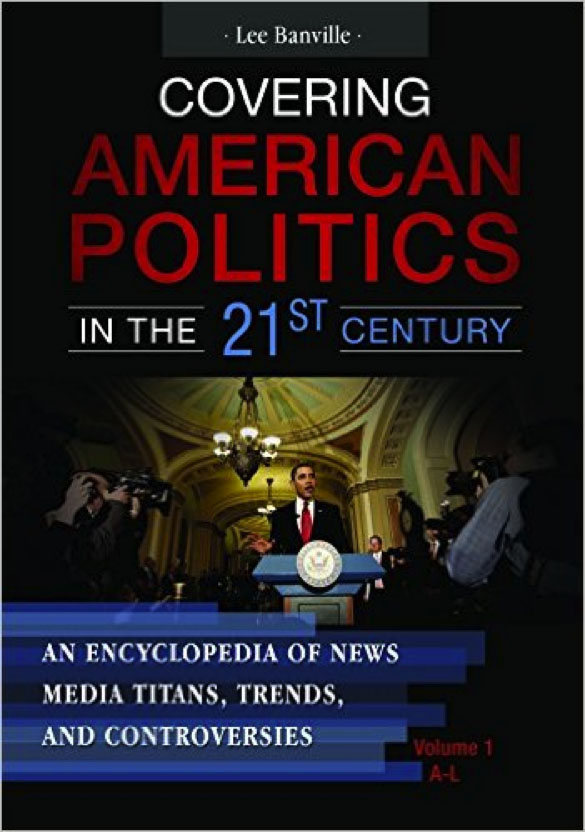
banville-book

Banville witnessed the digital revolution first hand, between the 1996 National Convention in San Diego, covered with “traditional media by the nth-degree,” and the 2008 elections, when he was at Grant Park in Chicago and saw President Obama give his victory speech.

“By the end of that, information was treated differently,” Banville said. “I wanted to dig into all of these things I was affected by and was seeing, but hadn’t spent much time thinking about.”

While he said technology and society have shaped politics and the media, Banville continued, “It’s part of a larger story that’s not changing as fast as we think.”

Banville started working in the newsroom when he was 22 and living in Washington, D.C. He spent 14 years with PBS NewsHour as an online editor, but realized he missed working with people who were still “pretty green to journalism” and could adapt more quickly to evolving technologies. The constant bustle of Washington, D.C. also made Banville wistful for the mountains, so when a teaching position opened up at the University of Montana in 2008, he seized the opportunity, joining the School of Journalism the following year. Banville said the move definitely paid off.

“I still get a twinge during election season,” Banville said. “But it’s nice not to have to wait up for the final results anymore.”

However, he still finds himself awake at midnight, watching the polls and eating frosted animal cookies during the primaries. This election season Banville will be serving as an on-air political analyst for ABC FOX Montana to keep audiences informed about the issues at stake and their historical context.

“There’s a spectacle to politics, like nerd sports. It’s fun to report on,” Banville said. “There’s competition, winners and losers, bizarre personalities and civic good.”

Stay up to date with Lee Banville on Twitter: @banville

UM School of Journalism Assistant Professors Jule Banville and Jason Begay, as well as alumni Michael Wright, helped contribute to Covering American Politics in the 21st Century: an Encyclopedia of News Media Titans, Trends, and Controversies.

Lee Banville is also the author of Debating Our Destiny: Presidential Debate Moments that Shaped History.

By Jana Wiegand
UM Junior, Kate Shea Wins Dow Jones News Fund Internship

One phone call completely changed Kate Shea’s summer plans. She had been preparing for an international reporting trip to Berlin, Germany, when she received a call from the Dow Jones News Fund offering her a paid copy-editing internship for the same period.

While the decision to go to Texas instead was a hard one, Shea admitted, “I’m kind of a copy nerd.”

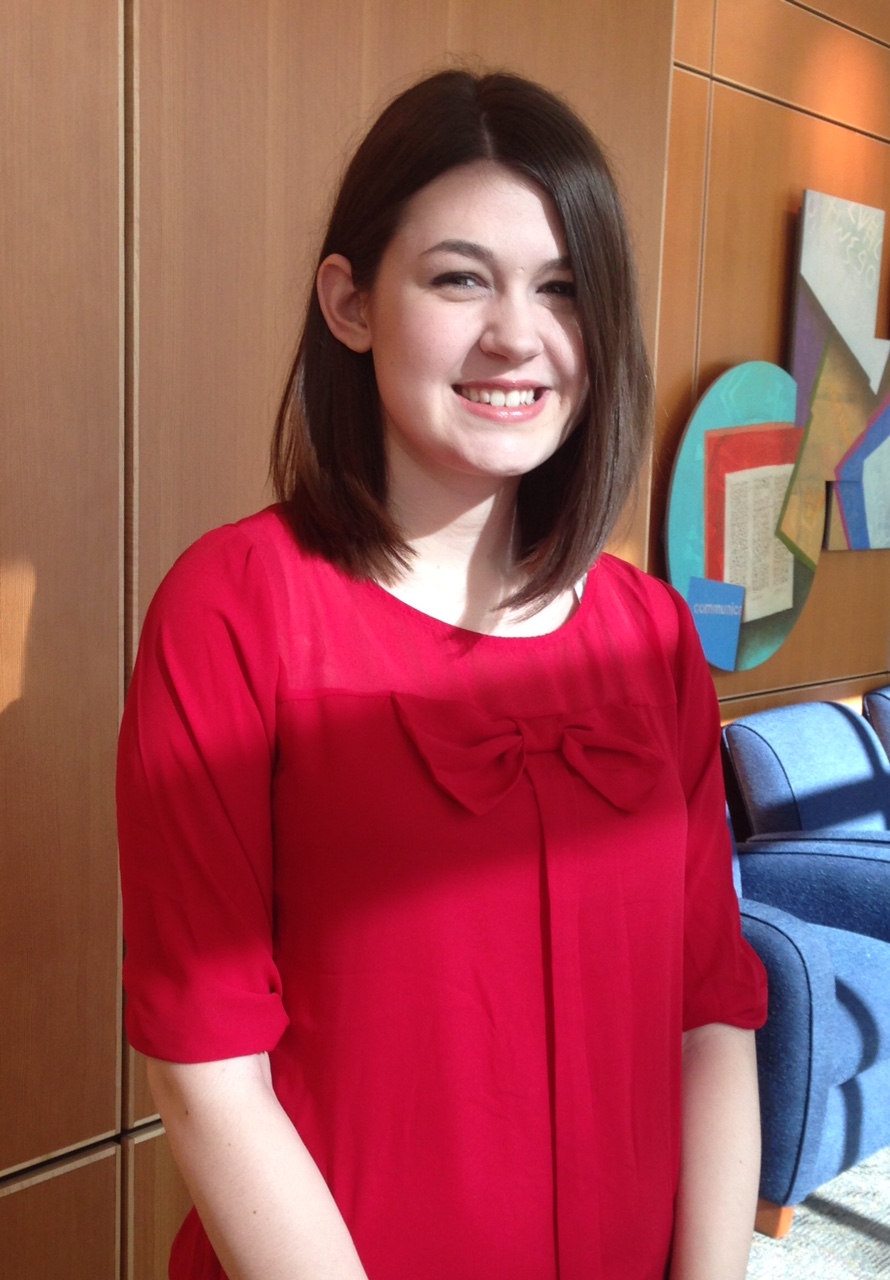
photo of Kate Shea
“In journalism, there’s still a bias against women, and women face different expectations where their looks are more important than their reporting ability,” Shea said. Photo by Jana Wiegand.

Shea currently works as the copy chief at the Montana Kaimin, UM’s weekly student-run newspaper. At her high school in Helena, Mont., she was one out of two students who worked on both their newspaper and their yearbook.

Assistant Professor Joe Eaton, recognized her drive and talent as soon as she entered the J-School. “Pretty much from Day One here it was clear that Kate was going to take on the world,” he said.

In News Editing class last fall, Eaton encouraged Shea to apply for the Dow Jones internship and take their editing test, which Shea described as “the SAT for copy editors.”

The internship will take Shea to Austin, Texas for a ten-day training program about the specific Dow Jones style of copy-editing before she enters the newsroom at The Corpus Christi Caller Times.

While Shea enjoys the journalism world, she ultimately wants to go to law school and delve into another field that will allow her to effect change in the world.

Her passion for politics comes from interning with Sen. John Tester (D-Mont.) in high school, as well as from her experience winning the Distinguished Young Woman of Montana award in 2013. In Mobile, Alabama, Shea met the winners from other states—all very well-rounded, intelligent and well-spoken women, she said, and she wants to make their voices heard.

“In journalism, there’s still a bias against women, and women face different expectations where their looks are more important than their reporting ability,” Shea said. “Sometimes you hear things like women should be on the cops beat because men will talk to pretty girls.”

However, Shea said that’s never been the case at the Montana Kaimin and that “there’s no gender bias there.” And while the Kaimin keeps her busy, especially with the switch to a weekly, more magazine-style publication, she said it’s been a great experience.

“I thought about moving out of state for college,” Shea said. “But there’s a top-ten journalism program right here in Montana.”

UM immediately recognized Shea’s strength as a leader even when she applied to the program, awarding her the Presidential Leadership Scholarship in 2013.

“She’s a very talented and hard-working journalist. I’m sure that showed through in her application,” Eaton said. For him it was no surprise when Dow Jones offered Shea the copy-editing internship. “She’s going to do a great job.”

By Jana Wiegand

Biogeochemistry Professor and J-school Collaborate through NSF Grant

When University of Montana biogeochemistry Professor Cory Cleveland begins a new project in Panama this summer, a young journalist will be coming along for the ride.

Cleveland will build on his long-held conviction that “a fundamental piece of good science is to communicate it effectively,” when he embeds a graduate student from UM’s Master’s program in Environmental Science and Natural Resource Journalism with his research team to document their fieldwork at the Smithsonian Tropical Research Institute.

A lift-out quote reading “It’s an innovative model of collaboration between journalism and the sciences that we hope will serve as a model for other research efforts at the University of Montana.” Scientists often struggle to convey the meaning of their work to the general public. Cleveland says the approach of bringing in a journalist from the beginning helped his proposal stand out and get funding from the National Science Foundation in a highly competitive application process. It will allow him to focus on his research while at the same time helping to create better communication. “I’m never going to do as well at that as someone who’s an expert and a professional journalist,” he said.

The collaboration benefits both sides. For the School of Journalism, the opportunity to document all phases of the research will allow a student to produce compelling stories about a rigorous scientific experiment that has large potential impacts on humanity, said Associate Professor Henriette Lowisch, the UM J-School’s graduate program director, who collaborated with Cleveland on his proposal.

“This will be a huge challenge for an emerging journalist, who will be able to practice all they’ve learned about making complex research accessible to the public,” Lowisch said. “It’s an innovative model of collaboration between journalism and the sciences that we hope will serve as a model for other research efforts at the University of Montana.” Together, Lowisch and Cleveland will select a journalism graduate student to accompany the research team.

In Panama, Cleveland will be testing whether tropical plants are able to get more nutrients from the soil than scientists have previously thought. Tropical forests are among the most productive on Earth, and remove significant amounts of the greenhouse gas carbon dioxide (CO2) from the atmosphere. The plants use CO2 as food to grow, but their growth is ultimately limited by the presence of other nutrients, such as phosphorous, which is scarce in tropical soils. Cleveland’s NSF grant will allow him to study whether tropical plant species have evolved novel ways around this limitation.

The research not only questions conventional wisdom about what plants are capable of, it also carries implications for a world coming to terms with climate change. If Cleveland is right and tropical forests are able to match growing amounts of CO2 in the atmosphere with phosphorous and other nutrients in the soil, they’ll act as better carbon sinks, which could help mitigate the effects of burning fossil fuels.

It’s a good story for an up-and-coming journalist, but how to cover it will be a choice the graduate student will make on the ground in Panama. The result will go beyond the traditional press release that tries to explain scientific research to the public, and instead use story, the craft of journalism, to showcase science.

Both Lowisch and Cleveland said that the project leaves the journalism student room to tell the story as he or she best sees fit.

We’re just going to say here’s an opportunity, come do something,” Cleveland says. “Hopefully that benefits them and they can tell something interesting about what we’re doing, or maybe not. There’s no agenda.”

Lowisch said that part of the reason she is excited about doing this collaboration with Cleveland is exactly that understanding. “Both journalism and science are disciplines of verification, and to be able to do that you need to be independent and Cory Cleveland has understood that.”

Adapted from UM news release by Andrew Graham