UM J-school Prof. Lee Banville Writes Encyclopedia About Media and Politics

Back in July 2014, Associate Professor Lee Banville mapped out all of the best coffee shops in Missoula after signing the contract for his next book. His romantic vision as a writer disappeared when he realized that his 10,000 word-per-week quota could only be met from the basement of the Maureen and Mike Mansfield Library at the University.

“Sometimes, as a treat, I’d sit on the third floor,” Banville said. “There are windows there, and I could look outside.”

Now, 788 pages later, Banville’s work is in the hands of Praeger Press, who will release the two-volume encyclopedia in October 2016. Titled Covering American Politics in the 21st Century: An Encyclopedia of News Media Titans, Trends, and Controversies, the book tackles topics like the role of money in elections, how social media has increased the personalization of the Internet and the roles of female reporters on the campaign trail.
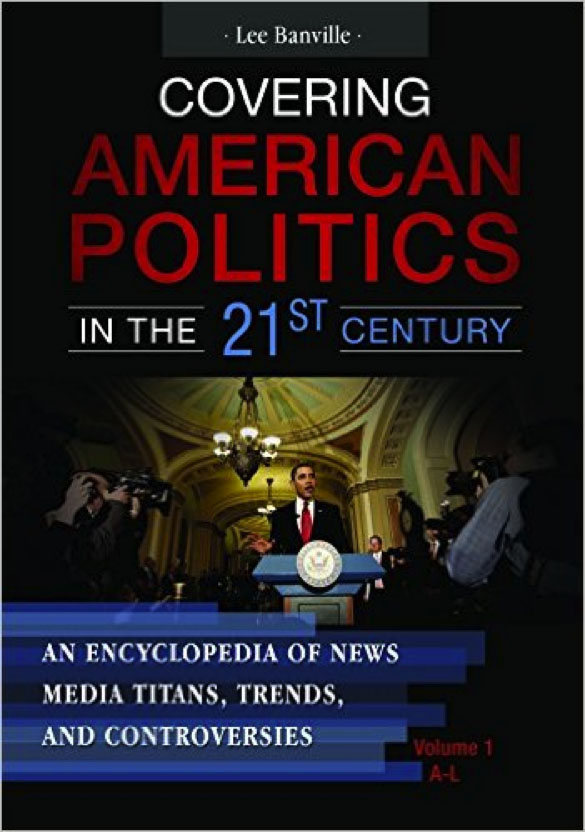
banville-book

Banville witnessed the digital revolution first hand, between the 1996 National Convention in San Diego, covered with “traditional media by the nth-degree,” and the 2008 elections, when he was at Grant Park in Chicago and saw President Obama give his victory speech.

“By the end of that, information was treated differently,” Banville said. “I wanted to dig into all of these things I was affected by and was seeing, but hadn’t spent much time thinking about.”

While he said technology and society have shaped politics and the media, Banville continued, “It’s part of a larger story that’s not changing as fast as we think.”

Banville started working in the newsroom when he was 22 and living in Washington, D.C. He spent 14 years with PBS NewsHour as an online editor, but realized he missed working with people who were still “pretty green to journalism” and could adapt more quickly to evolving technologies. The constant bustle of Washington, D.C. also made Banville wistful for the mountains, so when a teaching position opened up at the University of Montana in 2008, he seized the opportunity, joining the School of Journalism the following year. Banville said the move definitely paid off.

“I still get a twinge during election season,” Banville said. “But it’s nice not to have to wait up for the final results anymore.”

However, he still finds himself awake at midnight, watching the polls and eating frosted animal cookies during the primaries. This election season Banville will be serving as an on-air political analyst for ABC FOX Montana to keep audiences informed about the issues at stake and their historical context.

“There’s a spectacle to politics, like nerd sports. It’s fun to report on,” Banville said. “There’s competition, winners and losers, bizarre personalities and civic good.”

Stay up to date with Lee Banville on Twitter: @banville

UM School of Journalism Assistant Professors Jule Banville and Jason Begay, as well as alumni Michael Wright, helped contribute to Covering American Politics in the 21st Century: an Encyclopedia of News Media Titans, Trends, and Controversies.

Lee Banville is also the author of Debating Our Destiny: Presidential Debate Moments that Shaped History.

By Jana Wiegand
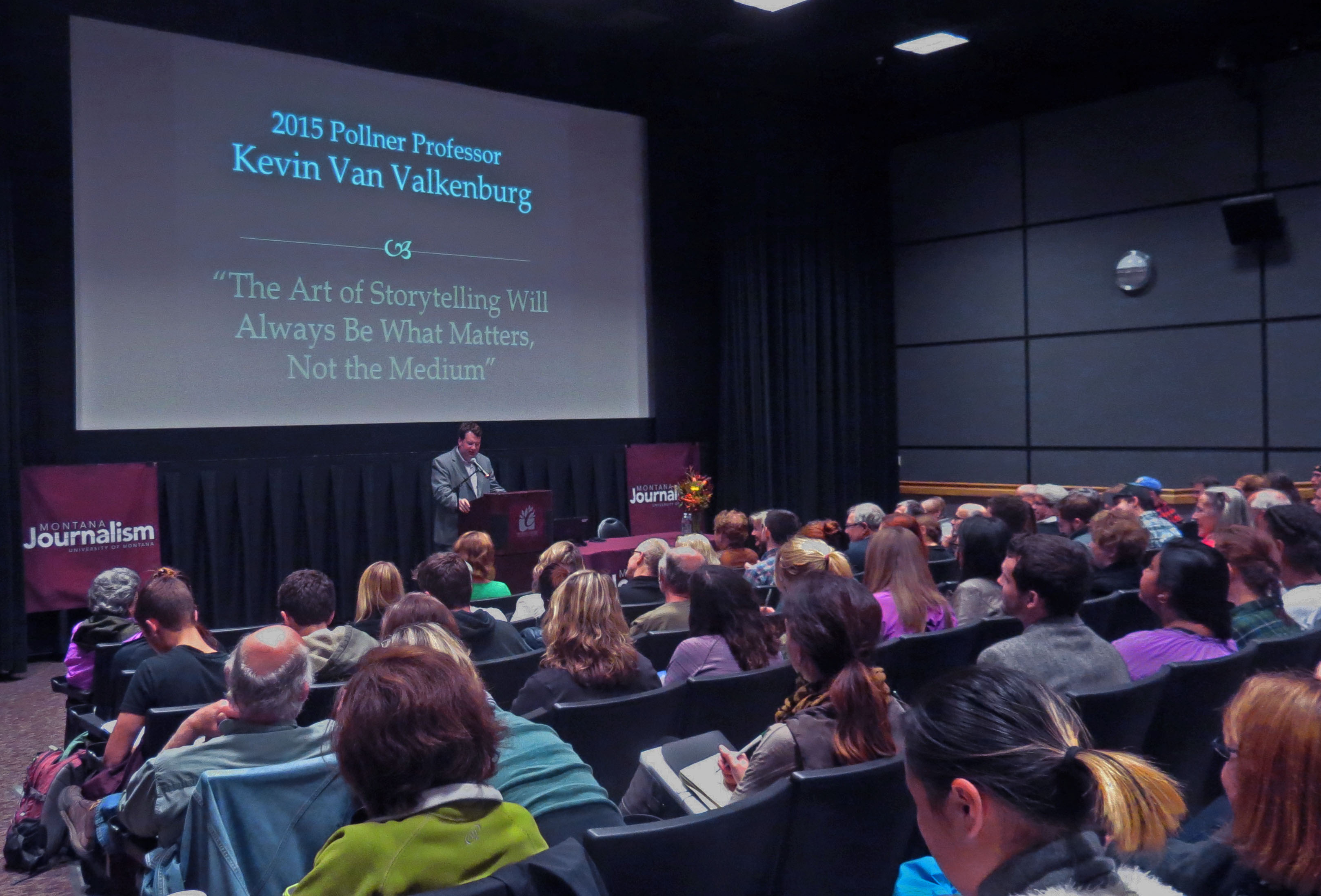
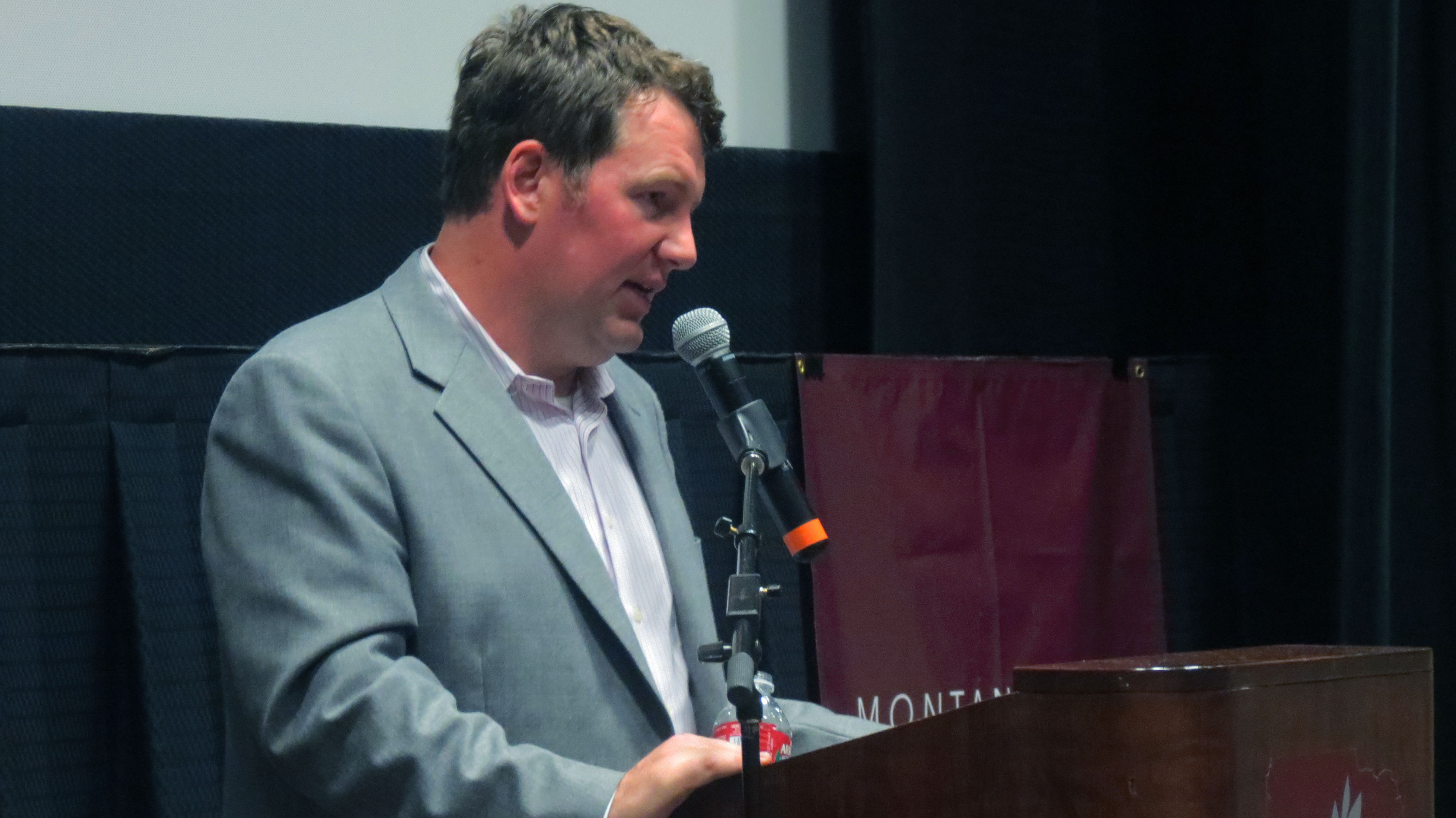
ESPN’s Kevin Van Valkenburg speaks on the importance of storytelling

For Kevin Van Valkenburg, Senior Writer at ESPN the Magazine, stories are “a time machine that can heal the world.”

Kevin Van Valkenburg speaks to a crowded theater
ESPN’s Kevin Van Valkenburg attracted a large crowd for the J-School’s annual Pollner Lecture. Photo by Alyssa Rabil

Van Valkenburg, who graduated from the UM School of Journalism in 2000 and has come back as this semester’s T. Anthony Pollner Distinguished Professor. He spoke to an audience that filled both the seats and the stairwells on Monday night. His speech focused on the continued value of good storytelling, in an evolving landscape for media.

“It doesn’t matter the format you tell it in, as long as you tell it true and you tell it well,” Van Valkenburg said, advising students to reject the negative outlook some are pinning to written journalism, which he called “a cynical narrative.” Van Valkenburg said changes have come not to storytelling itself but to the economic model that supports it. Despite the distractions of modern life, he said, people remain hungry for heart-felt stories.

Speaking with clear reverence for the power of good narrative writing to explain, humanize and heal the challenges of the day, he extolled students to think about why stories are told and search hard to find them. “There are no stories to be told in life’s safe harbors,” he said.

Kevin Van Valkenburg speaking from the podium
Photo by Alyssa Rabil

A native of Missoula, Van Valkenburg is the first alumnus of the school to hold a Pollner Professorship, a program which brings talented journalism professionals to the J-School for a semester. The program began in 2001, when Anthony Pollner, a graduate and former staff member on the Montana Kaimin, died in a motorcycle accident.

Van Valkenburg and Pollner were friends and co-workers at the Montana Kaimin during their shared time at the University. At several points in his speech Van Valkenburg referenced the spirit Pollner had brought to his journalism studies, and how it had inspired Van Valkenburg in his own career.

Recounting some of the more memorable stories of his career, first with the Baltimore Sun and then with ESPN the Magazine and ESPN.com, Van Valkenburg spoke about learning lessons on what stories can do for their subjects, as well as their readers. He recounted an early story he wrote about a girl’s suicide, and how her mother had thanked him, saying she could now explain her daughter’s life and death to friends by sending them Van Valkenburg’s article.

It’s a two way street however, Van Valkenburg noted. In response to a question from the audience, he said that whether to use sensitive information given by a source can depend on both its content and impact. If there are larger societal questions at stake, Van Valkenburg said, “I’m going to upset the source and I’m going to reach for the truth because that’s more important.”

Van Valkenburg concluded his speech by speaking directly to Anthony Pollner’s friends and family, who sat amongst the first rows of seats. He shared stories and memories of Pollner from their university days, which he said his return to campus has helped to bring back.

“Few things in my life have ever seemed less fair,” Van Valkenburg said, speaking on the passing of his friend, “but by telling those stories I keep a piece of him alive forever.”

The full text of the speech can be found here.

By Andrew Graham