J-School Students Set to Premiere Documentary Examining Autism in Montana

Every Monday morning, adjunct professor John Twiggs started class with a countdown, reminding the students how much time remained for them to finish their documentary. That number started with 15 weeks, but on the first day of finals week, the countdown hit the final 48 hours of production.
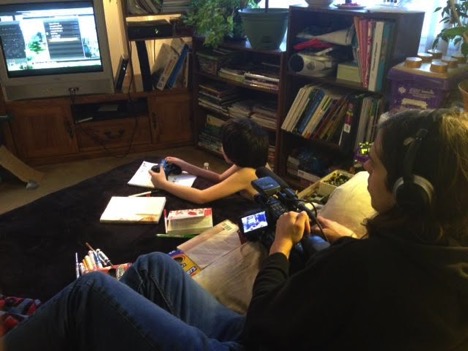
A student films the subjects of the documentary in the behind the scenes photo.
J-School students work closely with their subjects as seen in this behind the scenes pic. Photo by Jana Wiegand.

The documentary, “Aging Out: Autism in Montana,” will premiere at the University Center Theater on Friday, May 13, at 7 p.m. as part of the Senior Showcase. However, the rest of the state will get to see the show on MontanaPBS on Tuesday, May 24, at 8 p.m.

Upper-level journalism students have the option to take the Student Documentary Unit every spring semester. However, this year’s group started researching ideas for the show back in December. A class vote revealed an overwhelming decision to pursue the topic of autism and how it impacts the lives of Montanans.

After more research, the students noticed a significant gap in autism care as individuals with autism spectrum disorder (ASD) transitioned from school-age to adulthood. With the number of individuals being diagnosed with autism on the rise, they realized that the stress placed on the limited number of current care options for adults with ASD was ill-prepared to meet the needs of the incoming wave of adults on the spectrum.

“I want to do something that’s worthwhile, and I feel we have a good group to do it,” said senior Peter Riley, the director of the show. “Everybody knows we have each other’s back as a team, and everyone’s really stepped up and come to the table with some fresh ideas and some talents.”

The students traveled across Montana to follow the lives of four families, each with a child on the autism spectrum. As a class, they chose their main characters to reflect a diversity of ages, abilities, finances and access to care. The class spent quality time at home with their characters, attending therapy sessions and time at the workplace too. Students also interviewed autism specialists to shed insight on autism itself, the diversity care options and relevant legislation in Montana.

Once the group made the transition from shooting to editing, Twiggs told the class, “It’s time to take a hard look at what you do and don’t have. Get everything on the table that shows your best moments.”

Since then, the students have rewritten their scripts and finessed the edited footage to tell a story that speaks to the unique situations of each family, while also capturing the overarching struggles that unites them all.

“It’s definitely the most worthwhile thing I’ve done at the J-school,” said Andy Anderson, the director of photography. “It’s also been the hardest project I’ve worked on, without a doubt, but I think we have a really good pairing of people with skills. We just have killer writers and awesome videographers.”

The majority of the members in Student Doc will graduate the day after the documentary premieres on campus.

“I think Doc is a wonderful experience. We may not get the chance to do this thing for quite a while, if ever again, so let’s step out strong and leave with a product that we can be proud of,” Riley said. “I’m so thankful to be surrounded by a group of individuals that thinks that way too.”

SDU2016

Check out the 30-second and 60-second trailers for the documentary on the Facebook page, “Aging Out: Autism in Montana,” which will also air on MontanaPBS in the days leading up to the television premiere. Students also plan to post behind-the-scenes footage from the making the documentary, providing exclusive insight to their process and the families they followed.

The complete documentary will be available via the MontanaPBS website after the scheduled air date on Tuesday, May 24, at 8 p.m. Past documentaries from the Student Documentary Unit can also be accessed from their website.

By Jana Wiegand
Rest Stop Radio: The Newest J-School Podcast

rest-stop-radio-logoThe Advanced Audio class at the J-school just launched a podcast called Rest Stop Radio, telling the stories of human beings on the road. The stories come from people driving along Montana’s section of I-90, which covers the most miles of the longest interstate in the US.


Students talked with travelers at I-90 rest stops and recorded the conversations to get each story. In case of a lull, students carried playing cards with questions written on them that their traveler could choose to answer too. The class voted on a set of questions prior to reporting that helped set them up for success. Asking anything from ‘what do you miss the most?’ to ‘what’s the deal with those pants?’ the cards led to more genuine and intimate reactions and opened the door to some reporting fun.

Cole Grant, a junior in the class, came up with the premise for the podcast at the beginning of the semester. “I’m used to traveling. I’m used to going up to random people and talking to them when I’m out and about, so it’s pretty normal, you just have the recorder.”

“The rejection they get out at the rest stop is really true to life as a journalist,” professor Jule Banville said. “It’s a great thing to interview strangers and get them to tell you intimate things about their lives.”

The recorder chased away a few potential travelers who were only willing to talk off-the-record. However, making a compelling radio piece out of a 15-minute conversation proved to be the most challenging aspect.

“It’s all kind of flying by the seat of your pants,” Grant said. “The roughest part is trying to bounce off what they’re saying and figure out if that’s the story. Usually you have the story and then you find the quotes, but here you’re finding the quotes and then digging in from there.”

The same week Rest Stop Radio premiered, NPR correspondent Susan Stamberg was in Missoula to deliver the annual J-school Dean Stone Lecture, and she stopped by Banville’s class.

“She was absolutely curious about what the students were up to. She listened to parts of the first and second episodes of Rest Stop Radio and was truly complimentary and supportive, but still told them what they could do to improve it,” Banville said. “She also loved the same thing I love about what the students are doing—how they’re doing these quick interviews that are actually meaningful because they’re getting people to talk about their lives.”

Grant hopes to continue the podcast over the summer when he’s not busy with his internship at MTPR. “It’s fun. I see no reason to stop, you could just do it yourself,” he said.

“It’s such a flexible idea. I think this project has tremendous potential,” Banville said. “Even Susan Stamberg said the students’ work sounds professional and fancy, and she would know!”

Rest Stop Radio’s first episode features a motorcyclist who used to run drugs on I-90, but turned his life around after an arrest. The pilot also includes a moving interview with a traveling IT professional who’s no longer able to spend much time with his kids. According to Banville, “The show ends on a funnier note—you’ll have to hear it for yourself.”

Tune in to Rest Stop Radio via their website, iTunes or SoundCloud, and be sure to check out Jule Banville’s podcast series Last Best Stories.

By Jana Wiegand

Award-Winning Documentary Director, Chad A. Stevens, Speaks At J-School

Chad A. Stevens, director of the documentary “Overburden,” tried out two other titles for his film before settling on the third. Appropriately, Stevens’ presentation at the UM School of Journalism on Wednesday, February 24th, also came with three potential titles: “The Life, Death & Afterlife of a Documentary,” “How in the World did I Survive this Thing?” and “Thank God for Talented Friends and Box Wine.”

“Overburden” played at the Wilma Theater as part of the 2016 Big Sky Documentary Film Festival later that same day. The film follows two women in the heart of Appalachian coal country and their fight to save Coal River Mountain from the Massey Energy Company after an underground fire kills 29 miners.

Stevens said the first iteration of this project began while he was working on his master’s thesis at Ohio University. However, his moment of inspiration began several years earlier, in 2003, during his time as a photojournalist-in-residence at Western Kentucky University. One day, Stevens and a friend were driving through the hills when they crested a ridge and Stevens got his first look at a mountain top removal site. “There was a shocking amount of destruction,” he said.

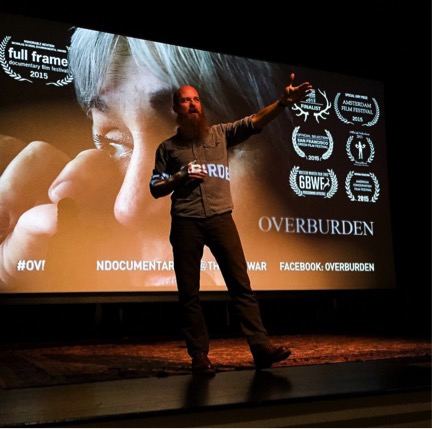
Chad A. Stevens speaks to the audience a screening of “Overburden” in Boulder, Colorado.
Chad A. Stevens speaks to the audience a screening of “Overburden” in Boulder, Colorado. Photo by Erin Hull.

Originally Stevens focused on the environmental aspects of coal mining. He photographed events at the Mountain Justice summer convergence and followed the activists who chained themselves to bulldozers at the top of Coal River Mountain. Yet Stevens realized that this story lacked the intimacy to connect with a broader audience. He looked to the valley where people lived right below the mining sites, whose blasts shook their homes’ foundations.

“I started to have this idea that maybe it could be more,” Stevens said. “I was like, 100% heart. I have to do this no matter what.”

It took Stevens about two years to gain the trust of one of his main characters, Lorelei Scarbro, who had seen plenty of journalists disappear after getting their pictures and quotes from the community. Yet Stevens referred to time as a gift and said it allowed him to understand what mattered most to Scarbro and her battle against coal.

“I was so damn stubborn and wouldn’t leave,” Stevens said, and his patience paid off. “To be there when her grandson was born—that never would’ve never happened without that time.”

One of the project’s major turning points came on April 5th, 2010, when a methane leak and an errant spark caused an explosion in the nearby Upper Big Branch mine.

“As you can imagine, that deeply impacted the community,” Stevens said. “And of course, it changed the film as well.”

A second main character emerged—a pro-coal activist whose brother died in the explosion and spurred her to join Scarbro’s fight.

Stevens also realized that the film’s central theme switched from an environmental perspective to more economy-based story, which explored how extraction-based economies limit local communities.

During the production process, Stevens licensed some of his footage and sold it to organizations that were working on tangential stories, as long as he knew they wouldn’t overlap with “Overburden.”

“I actually paid an editor to edit my film because I felt too close to it,” Stevens said.

Looking back on this ten-year project, Stevens reminded the room full of UM Journalism students about the importance of reaching out to others for help and the importance of remaining humble, because “it’s always bigger than just us.”

Stevens also spoke of the potential that comes from “opportunity blindness.” He said, “When you first start off, there’s no way to know what doors will open down the road. You just got to put it out there.”

While funding such projects remains a challenge for today’s journalists, one of Stevens’ teachers once told him, “Sometimes you do what you gotta do to feed your belly. And sometimes you do what you gotta do to feed your soul.”

Now a tenured professor at the School of Journalism and Mass Communication at the University of North Carolina in Chapel Hill, Stevens has his own mantra for students to learn.

“It’s all about collaboration and community,” Stevens said. “When we care, we as the story-tellers care, that care transfers.”


“Overburden” is currently available for rent on iTunes, Amazon, Google Play and Vudu. Check the film’s website or follow its Facebook or Twitter accounts for details about upcoming screenings.

To learn more about UM J-school affiliates reporting on coal communities in Montana, check out second-year graduate student, Andrew Graham’s contributions to National Geographic’s blog The Great Energy Challenge, and adjunct professor, Matthew Frank’s publications on Mountain West News.

By Jana Wiegand