J-School Alum Wins Hearst Journalism Award

February 10th, the Hearst Journalism Awards Program released its top ten winners in the Multimedia One/Features category, ranking Kaci Felstet’s piece “Late Start” 6th in the nation. Felstet produced the multimedia piece last spring as part of the class Native News, co-taught by Assistant Professor Jason Begay and Associate Professor Jeremy Lurgio.

“Late Start” tackles attendance issues at Rocky Boy Elementary School located in the center of the Rocky Boy Reservation in north-central Montana. Originally, Felstet and her reporting partner Courtney Anderson had been researching teacher retention rates, but they realized that the story’s core remained with the students.

Photo shows a darkly shadowed mug of tea sitting on a railing with a bright orange sunset in the distance
Taken during a photo-a-week challenge. By Kaci Felstet.

“Kids weren’t getting the education that they needed,” Felstet said. “And that was something really close to our hearts.”

Begay and Lurgio chose the theme “Relationships” for Native News in spring 2015. They challenged students to find unique, personal bonds that explored “how people on reservations connect with each other,” Begay said.

“It left a lot of room for us to branch out and find our own stories,” Felstet said.

She and Anderson traveled to the Rocky Boy reservation during spring break and spent several days following their characters and gathering classroom footage at the elementary school. Felstet said the kindergarten kids needed some time to get used to the cameras and stop making funny faces at them, but that their patience paid off in the end.

“The hardest thing is that you can’t go back,” Felstet said. “You have to get everything you need in three or four days.”

That was where working as a team came in handy. Despite extensive background research and planning, Felstet and Anderson knew that they need to stay both flexible and focused while in the field, so that they could find the true story even if it was different from the one they had envisioned. Lurgio said, “Kaci was very organized. She knew what she needed and she got enough to be able to adapt.”

Felstet’s first exposure to video came from a summer internship with KRTV in her hometown of Great Falls, Montana, but she considers herself more of a photojournalist these days. She’s currently pursuing a master’s in Economics here at UM, which will not only diversify her education but also open up new doors to her as a journalist, especially regarding business and finance beats, “which not everyone wants to cover,” she laughed.
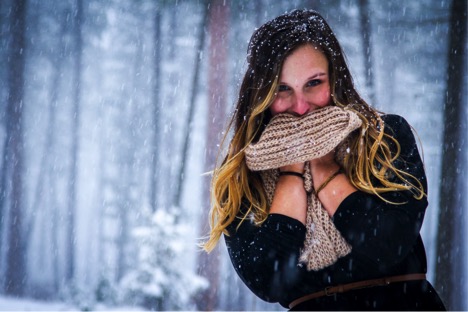
A self portrait of Felstet clutching a scarf to her face while standing in the snow
Felstet’s self-portrait from her photo-a-week challenge. By Kaci Felstet.

To stay familiar with her camera, Felstet decided to create a photo-a-week challenge for herself to keep her creativity fresh. The recent recognition of “Late Start” serves as another boost from the journalism world.

“Kaci has a great eye for shooting and producing multimedia packages,” Lurgio said. “She works extremely hard, and she was very dedicated to producing a professional caliber story. And that’s just what she did.”

Kaci Felstet and Courtney Anderson’s collaborative piece can be found on the Native News website, which features more stories from reservations in Montana.

By Jana Wiegand

Alum Alexandra Schwier Brings Journalism to Albania

At eight o’clock on a Thursday evening, Alexandra Schwier is building a fire in her home in Kukes, Albania. She’s been serving in the Peace Corps there for almost 11 months now, and her DLSR camera has come along for the ride. “I usually have my camera wherever I am,” Schwier said. “You start to pick up an ear for things, and think, hey, that would make a great sound bite.”

Schwier takes pictures during a recycling event in Kukes, where she is currently living.

So far, Schwier’s documented traditional Albanian dances, a youth environmental outreach program called Outdoor Ambassadors and a local Cardboard Challenge based off of the premise of Cain’s Arcade, which originated in California.

However, Schwier’s also teaching what she knows about journalism to Albanian youth in her village and letting them experiment with video equipment to tell stories that they find important. Outside of her own initiatives, the U.S. Embassy also invited Schwier to the capital in Tirana to talk with journalism students about reporting ethics.

When Schwier graduated from the University of Montana in December 2012, she hadn’t planned on entering the Peace Corps. During school she worked at KPAX-TV in Missoula as a reporter and web producer, where she gained hands-on experience from the techniques she learned in the classroom.

Photo of Schwier after winning the Fox News Award
Schwier won the Fox News Award in 2012 and flew to New York to accept it.

“One of the things I really loved about the journalism program was that you had to take photo, video and print, regardless of your major,” Schwier said. At first she wasn’t too excited to learn photography, “But I fell in love with it.”

As a double major in Journalism and Spanish, with a Latin American Studies minor, Schwier practiced reporting abroad while on a Political Science trip to Mexico. She produced a video piece called “Breaking down Barriers” about the perceived disparity between Mexico and the United States regarding immigrants and culture. Schwier did all of the production, editing and translation by herself.

Yet, the piece she’s most attached to is video she produced with a fellow journalism student, Kyle Schmauch, about wolf hunting. Schwier called the video “a labor of love” and is proud of the fair representation it gave to both sides of this controversial issue in Montana. As a result, Schwier won the 2012 National Fox News Challenge, which led to an internship with Fox News and later, a job in New York City.

While Schwier was working for Fox News in New York, she also volunteered for an organization called New York Cares. Teaching photography to kids in Brooklyn gave her a satisfaction with which her day job couldn’t compete, so she applied to the Peace Corps.

“Journalism in Albania is more politically driven,” Schwier said. “There’s an agenda for what they’re covering and why.”

But Schwier’s found that people are interested in her projects and also surprised at her attention to their culture—something that they take for granted, but the majority of the outside world knows very little about. Her current projects include a documentary piece about Roma Egyptians in Albania and another video that preserves local memories of communism.

Stay up to date with Schwier’s work by following her vimeo account.

UM J-school Prof. Lee Banville Writes Encyclopedia About Media and Politics

Back in July 2014, Associate Professor Lee Banville mapped out all of the best coffee shops in Missoula after signing the contract for his next book. His romantic vision as a writer disappeared when he realized that his 10,000 word-per-week quota could only be met from the basement of the Maureen and Mike Mansfield Library at the University.

“Sometimes, as a treat, I’d sit on the third floor,” Banville said. “There are windows there, and I could look outside.”

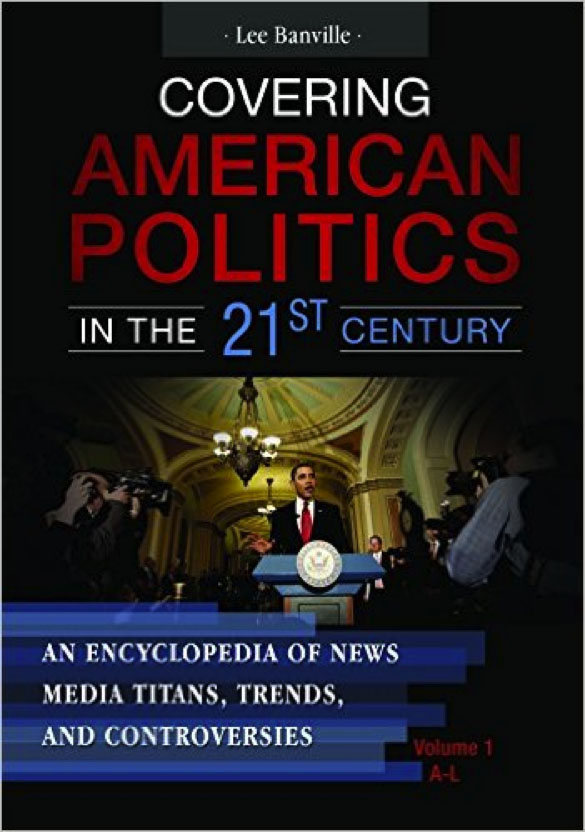
Now, 788 pages later, Banville’s work is in the hands of Praeger Press, who will release the two-volume encyclopedia in October 2016. Titled Covering American Politics in the 21st Century: An Encyclopedia of News Media Titans, Trends, and Controversies, the book tackles topics like the role of money in elections, how social media has increased the personalization of the Internet and the roles of female reporters on the campaign trail.

banville-book

Banville witnessed the digital revolution first hand, between the 1996 National Convention in San Diego, covered with “traditional media by the nth-degree,” and the 2008 elections, when he was at Grant Park in Chicago and saw President Obama give his victory speech.

“By the end of that, information was treated differently,” Banville said. “I wanted to dig into all of these things I was affected by and was seeing, but hadn’t spent much time thinking about.”

While he said technology and society have shaped politics and the media, Banville continued, “It’s part of a larger story that’s not changing as fast as we think.”

Banville started working in the newsroom when he was 22 and living in Washington, D.C. He spent 14 years with PBS NewsHour as an online editor, but realized he missed working with people who were still “pretty green to journalism” and could adapt more quickly to evolving technologies. The constant bustle of Washington, D.C. also made Banville wistful for the mountains, so when a teaching position opened up at the University of Montana in 2008, he seized the opportunity, joining the School of Journalism the following year. Banville said the move definitely paid off.

“I still get a twinge during election season,” Banville said. “But it’s nice not to have to wait up for the final results anymore.”

However, he still finds himself awake at midnight, watching the polls and eating frosted animal cookies during the primaries. This election season Banville will be serving as an on-air political analyst for ABC FOX Montana to keep audiences informed about the issues at stake and their historical context.

“There’s a spectacle to politics, like nerd sports. It’s fun to report on,” Banville said. “There’s competition, winners and losers, bizarre personalities and civic good.”

Stay up to date with Lee Banville on Twitter: @banville

UM School of Journalism Assistant Professors Jule Banville and Jason Begay, as well as alumni Michael Wright, helped contribute to Covering American Politics in the 21st Century: an Encyclopedia of News Media Titans, Trends, and Controversies.

Lee Banville is also the author of Debating Our Destiny: Presidential Debate Moments that Shaped History.

By Jana Wiegand