J-School Grad Student Wins Best In Festival For Radio Piece

photo of Ouellet working in the studio
Photo by Shanti Johnson.

From the blue lights and glow-sticks at The Great Northern Bar in Whitefish, Montana, graduate student Nicky Ouellet followed a band backstage to understand the mission behind their music. Ouellet’s subsequent radio story, “An ‘80s Cover Band With Global Dreams,” recently won Best in Festival in the student news competition for the Broadcast Education Association’s Festival of Media Arts.

“This is one of my first audio pieces,” Ouellet said. “For it to receive national recognition like this is really overwhelming, and I’m really honored.”

The story emerged from Assistant Professor Jule Banville’s Advanced Audio Skills class, when Banville prompted her students to incorporate music into a radio piece. “I wanted mine to be more than just a story about a band,” Ouellet said. “And the New Wave Time Trippers immediately came to mind.”

While the band came together for their mutual love for ‘80s music, they also wanted to find a way to be able to live off their “Rocky Horror Picture Show” style performances. Members of the New Wave Time Trippers told Ouellet that they hoped to turn these occasional night gigs into a full-time job by playing at corporate events and landing a regular show in Las Vegas.

“I thought it was a really interesting combination of the artsy, but also the business savvy,” Ouellet said.

For her, capturing a sense of place was equally as important as recording the essence of the Time Tripper’s music. Ouellet plugged a Marantz kit directly into the bar’s sound system to record clean copies of the songs and set up a secondary recorder to capture the crowd’s experience. After taping two of their shows, one in Whitefish and one in Missoula, Ouellet spent hours listening to the footage, recording her own narration and trying to keep the story under five minutes.

“Most of the challenges were really just keeping it tight and clean and focused,” Ouellet said. “That’s where Jule, my professor, came in and helped me kill all of my darlings, which was a really tough process because there were a lot of good ones.”

“I loved that story, and it will make you happy if you listen to it,” Banville said. “It had this signature mix where Nicky blended her writing and narration with interviews, and of course, great songs.”

The intimacy of radio originally drew Ouellet to the medium. She said the power of each story to delve inside someone else’s head made her change the way she saw the world. “You kind of lose sense of the thing directly in front of you, and it’s like this whole world of your mind and that of the story-teller are blended,” Ouellet explained.

Since the Time Tripper piece, she and Banville have been working closely together on Ouellet’s professional portfolio, which she will defend in May to receive her master’s degree in journalism. Her portfolio includes both written and audio pieces, examining how Native Americans manage natural resources on tribal lands. Ouellet is currently applying to jobs and fellowships for after graduation, and she hopes to find a position that lets her continue to use both print and radio.

“I’ve met very few people who work a story like Nicky Ouellet,” Banville said. “She’s going to do amazing things and just kill it as a journalist who can do it all.”

To hear more about Nicky Ouellet’s Best in Festival piece and the production process, watch her video interview on the School of Journalism’s Vimeo account, or click here to read the transcript of her interview. See more of Nicky Ouellet’s work in print and radio on her blog’s portfolio.

Stay up to date with more UM J-School radio pieces by listening to Jule Banville’s podcast series Last Best Stories.

By Jana Wiegand

Live Reporting Via Social Media: Grad Students Experiment At Vandana Shiva Lectures

Graduate students in the Environmental Science and Natural Resource Journalism program used several social media platforms for reporting live coverage of Vandana Shiva’s lectures at the University of Montana last week.

By reporting live, via Twitter, Instagram and Periscope, the grad students tried to engage with a broader audience and instigate a conversation with people who weren’t physically present to hear Shiva speak. Prior to Shiva’s talks, to gain journalistic insight on Shiva’s influence, Associate Professor Nadia White had the grad students read a controversial profile on Shiva that the New Yorker published in August 2014 and the consequent responses from Shiva, the New Yorker’s editor and outside journalists.

Vandana Shiva speaks at the Dennison Theater
Vandana Shiva speaks at the Dennison Theater on Wednesday, February 24th, 2016. Photo by Courtney Gerard.

Vandana Shiva, an environmental activist who passionately opposes genetically modified organisms (GMOs), spoke at the University of Montana on Wednesday, February 24th. During the afternoon she led a seminar called “Living Seed, Living Soil, and Earth Democracy”. Then, in the evening Shiva spoke as part of the Brennan Guth Memorial Lecture series, sponsored by both the Environmental Philosophy and Environmental Studies programs. Both presentations were part of the on-going President’s Lecture Series at UM.

Shiva’s evening lecture, “We Are All Seeds: Food Security and Environmental Sustainability,” followed the metaphor of humans as seeds, as Shiva spoke about the need to preserve the diversity and health of both physical and metaphorical seeds. Her presentation was met with a packed theater and three standing ovations. More people queued up for the Question & Answer sections than she had time to address.

From Shiva’s hotel room in Missoula, she said that looking out at the Clark Fork River reminded her of where she grew up in India. Over the years, she watched a swimming stream dry into a trickle and a natural forest turn into cultivated apple orchards. “I realized how vitally our ecosystems are under threat,” Shiva said. “And how much we took them for granted.”

Some J-school graduate students took Shiva’s quotes to Twitter—capturing both the questions Shiva raised as well as her prolific statements about how industrialization has changed humans’ relationship with nature. Katy Spence received an immediate like when she captured Shiva’s message, “We’ve been brainwashed to believe we are separated from nature…that nature is dead.”

Courtney Gerard also felt quick support from Instagram after posting pictures of Shiva speaking in the Dennison Theater. Gerard also had an eye on the crowd and captured a few people thinking more critically of Shiva’s message. While she snapped pictures of the audience and Shiva from center stage, Gerard left her tape recorder running so she could accurately quote the lecture in further stories.

Benjamin Alva Polley noted Shiva’s efforts to make a connection with UM community members. Polley tweeted Shiva’s opinion, “Campuses are not just about education anymore, but about life.” At the evening lecture, a researcher at UM asked Shiva what she would tell academics researching GMOs and furthermore, what evidence would she need to change her absolutist stance against GMOs.

“My scientific background tells me this is not the future,” Shiva said. She continued to speak about the corporations promoting GMOs “only to collect royalties,” and called GMO research an “inaccurate science” and “failed technology.”

Looking out at the full auditorium, Shiva asked, “How long do these corporate benefactors take care of you or the planet?”

Graduate student Matt Roberts noticed the lack of verifiable, scientific facts backing up Shiva’s prolific speech. He produced a multimedia article via Storify that addressed the disconnect between Shiva’s anti-GMO beliefs and the vague scientific facts she cited. In Roberts’ editorial “Going Through The GMOtions” he wrote, “If you attended the event to gain a deeper level of understanding about how GMO’s work and why they might be bad other than “because it’s unnatural and people say so,” then you were probably left a little confused.”

During one example, Shiva cited the rates of autism prevalence in the United States as 1 in 35 people and faulted BT toxins and GMOs in gut bacteria. She predicted that ratio would rise to 1 in 2 in the next hundred years.

However, current autism research reflects a ratio of 1 in 68, and to understand autism’s role in the brain, current research focuses more on the neurological and genetic causes. Additionally, autism experts think that the recent rise in both awareness and diagnoses programs also contribute to the rising rates of people who experience autism spectrum disorder (ASD), so Shiva’s prediction reflects more on scare-tactics than scientific fact.

Coming from a journalist perspective, the main challenge came not from any controversial opinions about GMOs or Shiva’s personal beliefs, but from the lack of her ability to answer the basic and specific “who, what, where, when, why and how” questions.

While Robert acknowledged Shiva as a notable scholar, the tone of her lecture made him feel like he was reporting on a politician instead of a scientist. Roberts said, “The whole evening was an anti-GMO pep rally.”

The next event in the Presidential Lecture Series, will take place on Monday, March 21st and feature Roald Hoffmann, who won the Nobel Prize in Chemistry in 1981.

By Jana Wiegand

Student Profile: Joe Lesar, Master Behind The Camera & Devoted Runner

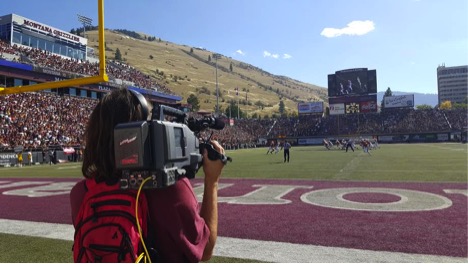
Senior broadcast major, Joe Lesar, could have graduated in the fall, but he didn’t want to pass up all the great opportunities the J-school offered in the spring semester. During Fall 2015, Lesar took UM News, where the students produced weekly televised and online stories. As a photographer, Lesar not only supported his reporters, but also produced some of his own “one-man-band” segments for the program.

Joe Lesar in the end zone during the Griz v. NAU, September 2015. Photo by Peter Riley.

Every spring, the J-school offers an upper-level elective called Student Documentary, where the students produce an hour-long documentary for Montana PBS. Lesar wanted to experiment with different forms of narrative story-telling; plus, when he realized that most of his cohorts from UM News were feeding into Student Doc, Lesar said, “We worked so well together, I would’ve felt left out if I didn’t do Doc with them.”

Spring 2016 also marked the last semester when Lesar could compete as at student athlete at UM. Lesar ran track at McQueen High School in his hometown of Reno, Nevada, and he wanted to finish his collegiate career as a runner on a strong note. While Track & Field is Lesar’s strongest sport (notably the 400m, 800m and Triple Jump), he also joined the Cross Country team, where the standard men’s 8K race stretches 10 times farther than his longest track event.

However, sports provided an important entryway into another avenue of journalism for Lesar. One day, he was walking through the Adams Center and happened to run into the director of Griz Vision, Abe Kurien. From a simple conversation about shared July birthdays, Lesar landed a job as a videographer for Griz games—football, basketball and volleyball.

Kurien told Lesar, “Come in and check it out, shadow us at some games, and if you’re interested, come back and we’ll have a job for you.”

Now Lesar’s on his second season shooting with Griz Vision and he runs a floor camera right under the basketball hoop. His ability to know what shots Kurien wants covered, without receiving direction via earpiece, means that Kurien can depend on Lesar to get the job done well.

“Joe, in particular, having already anticipated that shot, means so much,” Kurien said. “Because he knows what’s coming during the plays.”

By now, Lesar considers it second nature.

“You just follow the ball,” he said. “If someone scores, you zoom in on them and get the Hero Shot.”

This work can become more challenging during home Griz games in football season because of the variable weather conditions. Yet fellow J-school senior, Peter Riley, who also works for Griz Vision, said, “It’s a great way for the Journalism community to be involved with the greater campus community.”

“I’m getting paid to go to the home games and be on the ground, with all the action,” Riley added. “That’s a nice reward.”

Lesar agrees that he enjoys being close to the action and seeing the interactions between coaches, players and referees. During basketball games, “The coaches get super-animated, and they scream a lot, which is pretty entertaining,” Lesar said. “I always keep an eye on them.”

Kurien said that Griz Vision is an excellent opportunity for broadcast journalism students to work hands on with the cameras. He added, “Joe, I think, enjoys what he does and wants to be a part of every game.”

Scheduled to graduate in Spring 2016, Lesar hopes to stay in Missoula for a while and keep working for Griz Vision, while looking for jobs at local news stations. “I don’t see myself going home,” Lesar said. “There are so many opportunities from here.”

Learn more about J-school student experiences with Griz Vision here, as documented by Sojin Josephson, sports reporter for the Montana Kaimin.

Further interest and inquiries about Griz Vision can be directed to Abe Kurien, via email, agkurien@gmail.com, or via phone, at 406-207-6370.

By Jana Wiegand