15 J-School Students Win Awards from the SPJ

A week ago, the Society of Professional Journalists (SPJ) released its Mark of Excellence awards, and 15 UM journalism students were announced as category winners in Region 10, encompassing Alaska, Idaho, Montana, Oregon and Washington. Yet even more J-school students received acknowledgment for their work, recognized as finalists in those same categories.

SPJ logo

“The wide range of projects that we’re being noticed for includes the entire spectrum of journalism, covered in these awards, and that’s pretty cool,” Ray Ekness said, professor and director of student success.

Professor and director of faculty affairs, Dennis Swibold agreed. “It just seems like the whole gamut of what we teach is getting national honors,” he said. “If we’re not just good, but good at lots of things, that proves we have a well-rounded program.”

SPJ set their standards high and stated that in their contests, if none of the entries received rose to a level of journalistic excellence, they would refrain from giving out that award. However, UM students rose to the challenge and received recognition in categories that covered photography, reporting, writing, radio, online and television pieces. Six of these students were selected for at least two different projects, and some even received awards in different mediums.

“To see it happening across the range is very rewarding. We’ve encouraged them to be more than one kind of journalist and it shows,” Swibold said. “Students are becoming ambidextrous and proving that they work well across different mediums.”

Swibold cited senior Sojin Josephson as the apex example for accomplishing exactly that. Josephson won in the sports writing category and was a finalist in the television feature and television general news reporting categories. Her winning piece, “Kicking and breathing: Daniel Sullivan’s body quit football, but Sullivan couldn’t quit the game,” which she wrote for the Montana Kaimin, will go on to compete at the national level.

The 14 other winners also compete at the national level against students from different regions and recognized in the same category.

Not only were students’ individual projects honored, but the SPJ recognized UM’s Student Documentary Unit and the UM News class for their collective work.

“In class, students aren’t just talking about doing journalism, they’re going out there and doing it—class work is extended beyond class,” Swibold said. “I’m proud to see the fruits of last year’s labor pay off. There’s a lot of excitement in the department right now. We’re small, but we know the students and we’re very accessible to them.”

The UM School of Journalism is currently ranked 8th in the nation and celebrated its centennial birthday in 2014. National winners in the SPJ 2015 Mark of Excellence Awards will be announced later this spring, and will be honored at the Excellence in Journalism convention in New Orleans, running from September 18th-20th.

The complete list of Region 10 SPJ awards results is available on their website.

ACLU Executive Director Reveals the Lives Behind the Laws

When Anthony Romero joined the list of guest speakers for the President’s Lecture Series at UM, the dean of the School of Journalism, Larry Abramson, asked for the honor of introducing him. Romero has been the executive director of the American Civil Liberties Union (ACLU) since September 2001, and Abramson had spoken with him over the years while working on stories for NPR.

“I did a lot of work on privacy and surveillance issues, and the ACLU is pretty central to that,” Abramson said. “Since he’s the head, they’d often give him to me when I called.”

The ACLU also defends freedom of speech issues, which makes them handy resource for journalists. Media coverage of the ACLU’s projects shows that the benefits can go both ways.

“The moments when I really despaired were when I felt like no one was listening, that the huge, important issues were not getting the attention they deserved,” Romero said. “The most important thing is to engage in these issues, especially for students, because these issues determine your future.”

quote reading "When you want to glaze over rhetoric and statistics, imagine all those faces and don’t allow yourself to fall into the cynicism."

During his lecture, Romero focused on the civil liberties pertaining to the current state of the prison system in America. Romero shared the stories that he learned from visiting prisons like the Los Angeles Country Men’s Jail, which he rated worse than Guantanamo Bay. He said the problems were worse than just overcrowding and violence, but included issues such as restrooms that were inaccessible to disabled detainees and outing gay prisoners by making them wear powder-blue jumpsuits. As one such man told Romero, “Every day’s open hunting day here.”

“Prisons are very strange things and that’s why I force myself to go to them. It’s our tax money put to our purported use, like building roads or bridges, but prisons are such removed from the public psyche and public sight that we have to crack open these black boxes so that they’re less opaque,” Romero said. “I often find my sleep troubled after I’ve been there.”

Romero also spoke about how the prison system lacks opportunities for people to redeem themselves, especially if they’re poor. Even a one-time, minor crime could stick someone in an endless cycle of growing dept and imprisonment. He said, “It’s hard to imagine a more Kafka-esque, Catch-22 type situation.”

Yet his motive for talking about so many specific people remained the same. “I wanted to talk about real people and use their stories to paint a picture of what’s wrong and what needs to be fixed,” he said.

“I like reading legal briefs because lawyers are like journalists in that they like to tell stories,” Abramson said. “The ACLU’s gotten engaged in the issues, fostered national debated and they speak true to power. I think students can learn from them and take things one step further.”

However, while the ACLU takes a stance on the issues, it doesn’t take a stand on political parties. Romero said that working across political boundaries and tackling issues from multiple viewpoints was crucial to their progress. Romero warned the audience to be wary of whistle-dog metaphors like ‘act tough on crime’ that can imply situations are intractable or that something is inherently wrong with the individuals swept under those labels.

“When you want to glaze over rhetoric and statistics, imagine all those faces and don’t allow yourself to fall into the cynicism,” Romero said.

“Anthony’s a very good speaker,” Abramson said. “He made some very eloquent arguments, and I think he found a vein of sympathy in the Missoula community.”

By Jana Wiegand

Reporting On Reservations: Native News Sends Students Into The Field

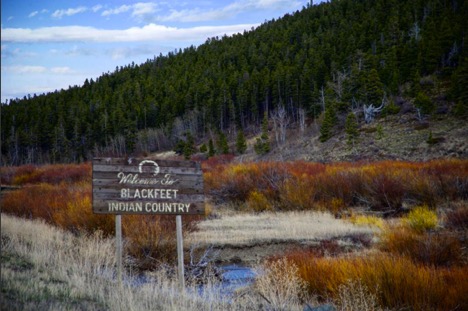
Landscape photo with a sign in the foreground that reads "Welcome to Blackfeet Indian Country."
J-school students divide into teams and travel to visit different reservations across the state. Photo by Courtney Gerard.

After weeks of planning and preparation, UM journalism students in the class Native News are spending spring break reporting on their stories. The students work in teams of two that pair photojournalists with print reporters to create a complete multimedia story.

With the upcoming presidential election in November, Native News professors Jeremy Lurgio and Jason Begay decided this year’s project should focus on politics. “The President has a lot of influence over Indian country,” Begay said.

Yet Begay said the theme is not just about seeing how people on reservations vote. He posed the question, “What do they consider when thinking about politics?”

“Voting on reservations tends to be less bipartisan, especially when it comes to internal politics,” Lurgio said.

However, the reporting teams have chosen stories that dig into the specific political issues that impact their designated reservations, instead of covering the national influence. The students reporting on the Crow Reservation recently followed tribal leader Darrin Old Coyote to the 2016 Montana Energy Convention in Billings to hear him speak about how coal affected jobs on his reservation.

On Fort Belknap, Sophie Tsairis and Lenny Peppers are investigating access to voting and the satellite voting offices on the reservation. Tsairis has been posting reporting updates from Fort Belknap on Instagram.

On the Blackfeet Reservation, Courtney Gerard and Peter Friesen are digging into constitution reform. However, their trip also aligns with the arrival of 88 bison from Elk Island in Canada returning to the reservation, as part of a cultural and ecological relocation effort. To see live updates from the Blackfeet, follow Gerard’s posts on Instagram.

When the students return from the reservations, the pairs will start synthesizing their individual stories into a collaborative, multimedia piece. The final projects from each team will appear on the Native News website in May and circulate the state in the annual print edition.

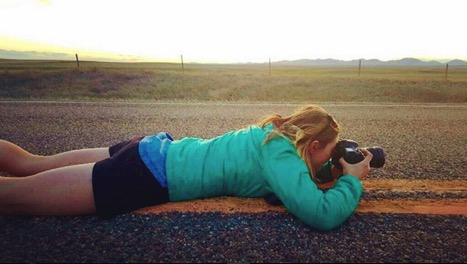
Native News photographer Sophie Tsairis lays in the middle of a deserted highway to snap a photo of the landscape.
Native News photographer Sophie Tsairis tries to find the best angle to capture a spectacular landscape to illustrate her story. Photo by Lenny Peppers .

To catch the latest updates from the Native News reporting teams, follow their accounts on Facebook, Instagram and Twitter.

By Jana Wiegand