Dogged Reporter, Peregrine Frissell Wins Hearst Award For Athletic Investigation

Montana Kaimin web editor and reporter, Peregrine Frissell, had never written a sports story before when he started investigating UM’s controversial compliance efforts with NCAA regulations this past October. After being published in the Kaimin on November 4th, 2015, his story, “Unsportsmanlike Conduct,” won 7th in the Hearst Awards competition for Sports Reporting.
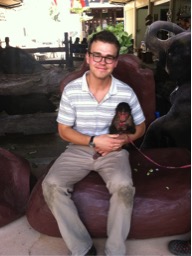
photo of Peregrine Frissell holding a small monkey.
Frissell takes a moment to pose for a photo while reporting abroad in Nepal. Photo by Peregrine Frissell.

“Peregrine did a great job of looking at athletics on the UM campus beyond just the scoreboard,” said Nadia White, faculty advisor to the Kaimin. “His story looked at NCAA rules and regulations and examined what those mean for student athletes.”

Frissell’s research involved digging into those regulations and interviewing UM athletic officials and the NCAA representatives to whom they report any infringements. Violations included anything from coaches recruiting high school athletes too aggressively to convictions of current athletes who commit off-the-field incidents. Frissell said talking to public representatives of those departments was challenging because they wanted to keep control of the information they told him during interviews.

Kevin Van Valkenburg, the fall 2015 Pollner professor and advisor to the Kaimin, said, that a lot of journalists would have dropped the story when they heard officials use the term ‘minor infractions’. “Don’t let the administration convince you it’s no big deal. Ask the right questions,” he said. “UM mis-reported and mis-understood the facts, but Peregrine understood the bigger picture here, and he pursued that to explain it in context.”

“I needed every minute I got,” Frissell said, since he only had two weeks to get the story to print. “I’m really thankful to get recognized.”

Yet Frissell has plenty of reporting experience, both in Montana and abroad. He’s been a Global Leadership Initiative fellow at UM and completed studies in the UK and Thailand, as well as working as a reporting intern for the Nepali Times. “I arrived a month after the earthquake and spent much of my time outside of Katmandu, covering earthquake recovery,” he said. “The earthquake was tragic, but I enjoyed my experience there.”

Back on the UM campus, Frissell has worked with the Montana Journalism Review (MJR) as both an editor and a reporter, and he’s now pursing political stories on the Crow Indian Reservation in Montana as part of the class Native News.

“Peregrine is a dogged reporter. He’s critical and curious, and his instincts are spot on,” Nicky Ouellet said. As a graduate student, she’s overseen his work at MJR and now for Native News. “He’s the type of reporter an editor hopes for—capable of following a tip to create a deeply reported and contextualized story. I’ve enjoyed working with him and can’t wait to see what he pops out in the future.”

Scheduled to complete his journalism degree in May, Frissell said he wants to report in the US for a couple of years and then go back abroad. “I’m still waiting to hear back about potential jobs and internships,” he said.

However, Van Valkenburg has high hopes for Frissell’s future. “He reads a lot and is interested in things of public interest and importance,” he said. “Peregrine will make a great investigative reporter.”

Catch the latest news updates with Peregrine Frissell via Twitter.

By Jana Wiegand

Accomplished Journalist, Ken Wells, Speaks About The Evolution Of Newspapers

Ken Wells, a seasoned business journalist, watched print news outlets evolve from traditional printing presses to the Internet’s 24-hour news cycle. At the first newspaper where Wells worked in Bayou Black, Louisiana, he used to run downstairs and smell the ink of the first papers coming off the press. In today’s world, he considers himself agnostic on which medium to use for publication, as long as people continue to tell these news stories.

Ken Wells speaks to a crowded room
“The best business stories aren’t about business,” Wells said. “But about their use as an interface for the human condition.” Photo by Alyssa Rabil.

Yet when Wells first started college, he didn’t dream about becoming a journalist. “I liked biology, and my father was a marine, so I decided to become a marine biologist,” Wells said.

He quickly became disillusioned with his classes and dropped out of college. Wells started working as a short-order cook at a 24-hours diner, but he quit that job after intervening in a late-night fight between customers. “I decided that breaking up attempted murder for minimum wage was not a good career,” Wells said.

He found an ad in his hometown newspaper, the Houma Courier, that read “Wanted: Part-Time Reporter, $1.87 / hour.” After the Courier hired Wells, his editor sent him off with a Polaroid camera to report on a bartender who had caught a 300-pound snapping turtle. Wells spent several years at the Courier before getting his master’s degree at the University of Missouri School of Journalism in 1977. From there, Wells worked at the Miami Herald, The Wall Street Journal and Bloomberg News.

Wells spoke to J-school members as part of the Jeff Cole Distinguished Lecture, which honors Cole’s dedication to the journalism field after his death, on-assignment, on January 24th, 2001. Cole graduated from the UM J-school in 1980 and had worked his way up to The Wall Street Journal by 1992 as an editor and reporter. Participating in this lecture series had personal meaning for Wells, who met Cole through The Wall Street Journal. Wells said, “He was a great writer, a great reporter and always in amiable spirits.”

Both Wells and Cole followed their editors’ mantra “We can fix your writing, but we can’t fix your reporting.” Since then, Wells developed his own idioms for today’s journalists: “Google might run the news, but it won’t write it” and “You can break news on Twitter, but Twitter won’t save the world.”

Over the years, Wells’ reporting proved to him how strongly business relations influence science, culture and other important fields. He said, “Outside of terrorism, the business stories are probably the most important of our lives.”

During the question and answer session at the end of the lecture, second-year graduate student Andrew Graham asked Wells about approaching his first non-fiction books after his lengthy career writing for newspapers.

“There a few things you should never do for money,” Wells replied. “Get married, make love and write a book.”

Wells enjoyed the reporting stage so much that he didn’t become a diligent writer until he confronted his first 80,000-word deadline. He said he had to lock himself in the attic for 12 hours a day to write. “I stopped talking to my wife, I stopped taking showers and I started kicking the dog.”

Regardless of the medium, Wells said that business journalists must embrace their responsibility as public watchdogs to be the truth-sayers in society. “There are stories growing on trees,” he said. “I think that we have a bright future in front of us.”

Learn more about Ken Wells’ work as a journalist, author (fiction and non-fiction), photographer and musician from his website.

To catch up with live coverage of Ken Wells’s delivery of the annual Jeff Cole Distinguished Lecture, follow the University of Montana School of Journalism’s Twitter and Instagram accounts.

By Jana Wiegand

Student Spotlight: David Detrick, Journalist & Entrepreneur

Ten years ago, if you asked UM Senior David Detrick what he would be doing today, he might have still pictured himself writing, but with his words grounded in music rather than in the news. He played with bands in Los Angeles, California before moving back home to Seattle, Washington. Detrick founded his own band in Seattle called Saving Arcadia, and he wrote all of the lyrics to the Green Day and NOFX style songs.

Detrick got his first taste of journalism at the South Puget Sound Community College (SPSCC) in Olympia, WA. He had been majoring in Political Science when he started working at the school’s paper The Sounds as a reporter and writer. The more he learned about the political system, the more he realized that wasn’t his dream career. “I don’t want to work for these people,” he said. “I want to expose these people.”

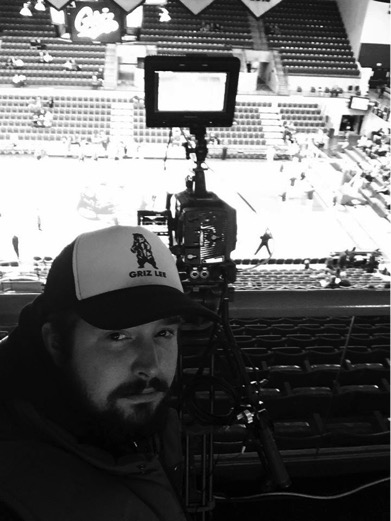
Detrick sports a Griz Lee hat and gets ready for a Griz basketball game on December 22nd, 2015, as part of Griz Vision.

With his newfound passion for journalism, Detrick had his eyes set on the School of Journalism at the University of Montana. His acceptance to the program also came with a Western Undergraduate Exchange Scholarship, based on his academic success at SPSCC.

The outdoor photography and sports journalism opportunities, ever popular in Montana media, aligned perfectly with Detrick’s interests. On February 11th, 2015, the Montana Kaimin published a feature-length piece that he wrote about a UM alumni football player who got signed to the Seattle Seahawks.

This past year Detrick photographed Griz football games and also filmed Griz and Lady Griz basketball games as part of a program called Griz Vision, which gives students professional experience with broadcasting sports live.

“It’s a lot of fun,” Detrick said. “I like being behind the camera.”

Outside of academics, Detrick started his own business in 2015 called Griz Lee, which he called “a Montana inspired clothing line with an attitude for anyone with a sense of humor to enjoy.” Around campus, most students are familiar with the Griz Lee logo, featuring Bruce Lee’s head on top of the body of a grizzly bear doing Kung Fu. Detrick gets a real sense of pride when he sees Griz Lee stickers slapped onto water bottles or laptops.

“Ever since I was a kid, I’d come up with T-shirt ideas, crazy ideas,” Detrick said, “But I never did anything about them.”

Yet he was determined to follow through this time around. Detrick pitched his product to the University Center Bookstore, and now says Griz Lee items sell out faster than they get re-ordered. Detrick has also spread his business around Missoula, thanks to social media platforms like Instagram and Facebook, as well as word-of-mouth. Now he’s answering orders from people as far away as Tennessee, which he suspects has to do with the Memphis Grizzlies, a professional basketball team.

In April 2015, Detrick won the Dean’s Award for his outstanding performance in Journalism. As a senior this year, he’s only been taking Journalism classes, and he knows that more doors open as he continues to gain experience—not just for him, but also his nearly four-year-old son.

“The sky’s the limit now,” Detrick said.

By Jana Wiegand