Standing Rock Reporting Trip Gets Big Attention

MJR students and J-School Professor Jason Begay on the road to Standing Rock.
Montana Journalism Review (MJR) students and J-School Professor Jason Begay on the road to Standing Rock.

Following a five-day trip to the Standing Rock Sioux Reservation, a team of journalism students and a professor have been at the center of a lot of media attention, a sign that coverage of the intertribal stand against the Dakota Access Pipeline is both sorely lacking but also highly sought after.

During Labor Day weekend, Associate Professor Jason Begay and three students—grad students Matt Roberts and Lailani Upham, and undergrad senior Olivia Vanni—drove to the North Dakota campsite where an estimated 250 tribes have gathered to stand against a massive oil pipeline project.

“The Journalism School faculty thought it made sense that we have a student presence at Standing Rock, since we consider ourselves to be leaders in Native American journalism,” said Begay, who teaches the Native News reporting teams to the Montana’s seven reservations every spring. “But I don’t think we anticipated the kid of attention we eventually found.”

The students were reporting for the Montana Journalism Review (MJR) and were looking to research how the media was covering the Standing Rock camp. Standing Rock Sioux tribal members have been camping at the site since May, as they challenge the construction of the Dakota Access Pipeline, which would pump nearly 1,200 barrels of oil from the Eastern North Dakota to Illinois.

Although the pipeline wouldn’t go into tribal lands, it would cross the Missouri River just upstream from the Standing Rock reservation, including through an area sacred to the tribe.

The campsite has been billed as a non-violent demonstration by participants, but during the MJR reporting trip, violence rocked the area as tribal supporters and pipeline employees and security guards clashed over the construction site.

“It wasn’t overt, but we could sense a shift in tone at the camp after that event,” Begay said. “Everyone was just a little more cautious about who to talk to and why so many media reps had finally showed up.”

Media attention increased exponentially for both the campsite and the reporting team. Before the team left North Dakota, they were interviewed for stories by both a Missoula TV and radio station. Begay was invited to write a story for the Butte Standard. Other programs that featured interviews and photos from the team include Public Radio International, Native America Calling and the Navajo Times.

Begay was also invited to talk about the trip on two panels at the Excellence in Journalism conference in New Orleans in mid-September.

“News media is really starved for any kind of on-the-ground coverage of the Standing Rock camp,” Begay said. “Most of the media present at the site have been either local to the Bismarck area or the big outlets. Smaller, regional news companies really seem interested, but lack the resources to send their own people.”

The Montana Journalism Review team is posting content from the trip on its Medium page and is expected to feature a longer story and media analysis

of the trip in its 2016 edition, due out later this year.

Welcome Back from Dean Abramson

Don Anderson Hall building exterior
Don Anderson Hall, home of the J-School

Boy, what a summer it’s been. Could there be any doubt that we need caring, smart journalists now more than ever?

As we prepare to open the doors for another year at the UM J-School, I keep asking myself that question. Just take one news story as an example: we have a presidential election before us between two people who seem to have a very troubled relationship with the truth. How could the average citizen possibly scrutinize statements by Hillary Clinton and Donald Trump, without professional help from reporters, editors and researchers? Reporters remain, despite the turmoil in our industry, our election ghostbusters: they are uniquely qualified to train their ray guns on statements like Trump’s assertion that the real unemployment rate is closer to 42 percent than 5 percent. And we still need someone to jump on distortions like Hillary’s insistence that the FBI Director called her statements about her email server “truthful.”

While the need for good reporting remains clear, the way to pay for it is not—the crystal ball remains cloudy on that point. As comedian John Oliver pointed out recently, even he ruthlessly rakes through the work of journalists in the search for joke material, without signing up for a subscription. Oliver’s appeal to recognize the work of journalists got a lot of play, but I predict it will have zero impact on the financial plight of the news biz. That’s because pity is not going to help us make news profitable again. Only innovation and hard work will.

So, as we start the year I will present our students with this simple challenge: come help us save the world from a flood of lies. It’s our job.

By Larry Abramson

Professor Matthew Frank Uses New Mediums to Cover Stories of Changing Regions

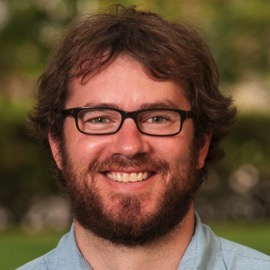
Portrait photo of Matt Frank
Frank is an adjunct professor for the UM J-School.

When Mountain West News launched 17 years ago, it went by the name Headwater News and it served as an aggregation site for news in the region. Over the years, important Montanans and environmental journalists like Tracy Stone-Manning and her husband, Richard Manning, have worked for the outlet.

Matthew Frank has imagined a whole new look for Mountain West News. He collaborated with the school’s dean as well as Larry Swanson, the director of the O’Conner Center for the Rocky Mountain West, to expand the potential of this journalism platform.

“Matt Frank’s gotten involved and re-designed our various programs, re-designed the entire site, and created it in a way that can be more easily accessible,” said Swanson.

Frank integrated the radio component, Mountain West Voices, with the rest of the news site, and then expanded their social media presence include Twitter and Facebook. However, Frank uses Medium as the main outlet for Mountain West News’s written stories.

“I love Medium, because as a writer, it’s a really great writing platform, and it also displays stories in a very clean, visually-appealing way,” said Frank. “When you’re reading a physical magazine, there’s the serendipity of flipping the page and coming across a story that you never though you would read, but there you are, reading this incredible story.”

Medium offers the same potential for readers and writers to discover new stories. All of Mountain West News’s work becomes embedded into their website, so people can find their content in one central location, as well as other places online. Frank said, “It’s about leveraging the virality of these different platforms.”

The other key element Frank introduced to Mountain West News was the ability for the group to produce its own original content, instead of merely curating the work of other journalists.

“When we played around with the idea, we realized that we needed our own content, and I consider him [Frank] one of the best news-writers in the state,” said Swanson. “He’s brought a lot, both in terms of being a good writer and reporter, but also an investigator.”

Both Swanson and Frank share the goal of reporting on issues that shape the economy and the lives of those in the Rocky Mountain West. So far, Frank’s stories have examined topics such as the Bakken boom and bust, the Tongue River Railroad’s connection to today’s coal market, and the impacts of solar panels on residential housing.

“There’s no better way to understand the nuances of energy policy and how they affect people, than to go to a coal mine and meet coal miners who have had friends lose their jobs, it’s a really powerful thing and it changes your perspective,” said Frank. “You can look at charts all day long…but you have to think about the people to make sure your journalism has a certain empathy about it.”

The new version of Mountain West News wants to continue its collaboration with UM’s School of Journalism, and it’s currently in fundraising-mode to make sure the project continues to capitalize on its potential. It already syndicates content for free to outlets like High Country News, Inside Climate News and the Missoula Independent, to make sure the stories reach the communities where the issues most matter. With financial support, Frank could create an internship or fellowship position for graduate students to work with him and produce more investigative pieces.

“Ultimately, we want to add other contributors because in-depth feature-length stories take time to produce,” Swanson said. “This would be a great place for journalism students to get background and experience, and it would help weave together the trends on the environment and natural resources in the region.”

Stay up to date with Mountain West News on Twitter @MTWestNews, Facebook and its homepage, and check out the latest stories with Matt Frank on his Twitter account, @mfrank406. This summer he’ll be tweeting and story-telling from his tent, as he bikes across the state, teaching a class through the Wild Rockies Field Institute called “Cycle the Rockies: Energy and Climate Change in Montana.”

By Jana Wiegand