Photojournalism students find global stories at home

In 1959 over a hundred thousand Tibetans left behind a homeland occupied by the Chinese military. After countless twists and turns some of them ended up in Montana. Now, years later, a few are sharing their stories with graduate student Matt Roberts.

The interviews Roberts is conducting are part of a project by the School of Journalism’s Advanced Photojournalism and Multimedia Storytelling. Roberts is producing a video piece along with fellow graduate student Jayme Dittmar, and they’ve interviewed families in both Missoula and Butte.
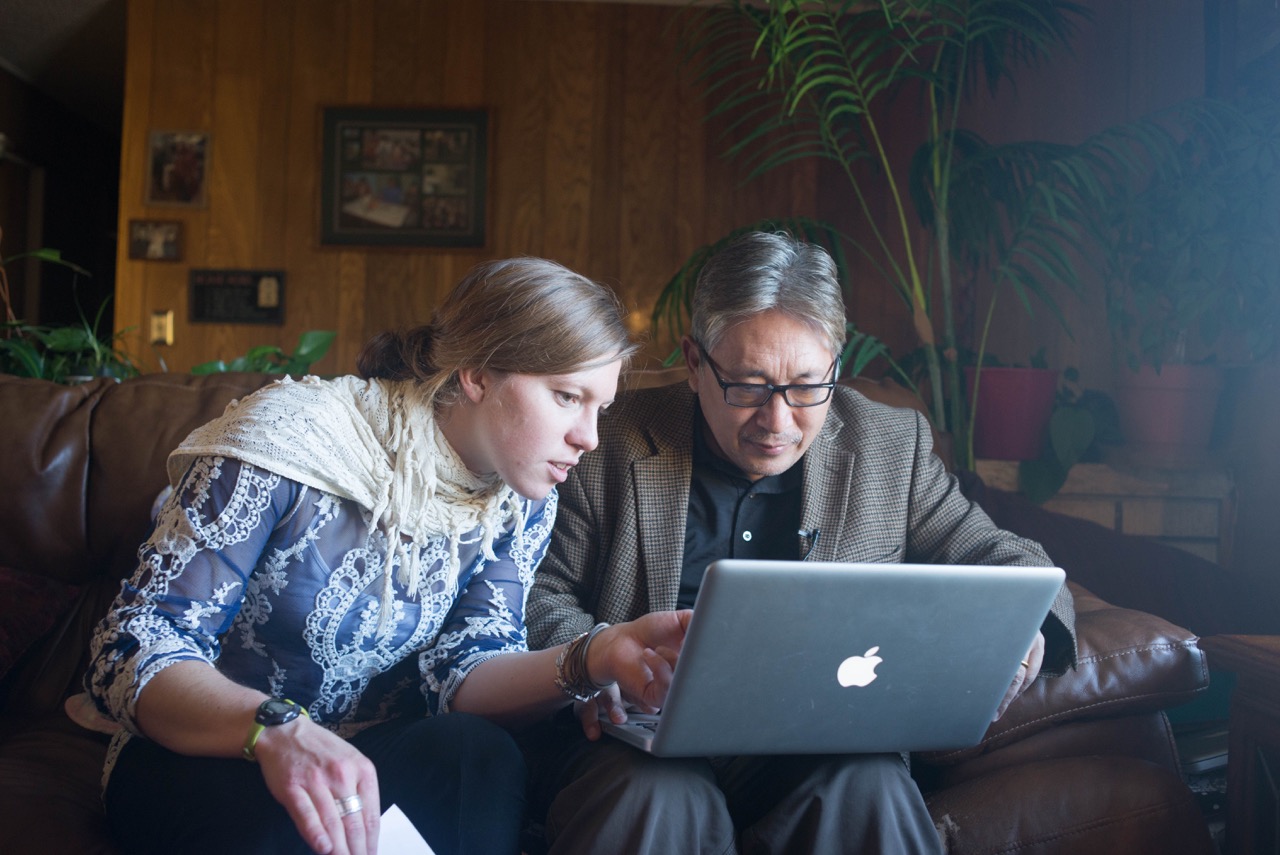
Graduate student Jayme Dittmar looks at old photos with Karma Tensum, Executive Director of the Tibetan Children’s Education Foundation.
Graduate student Jayme Dittmar looks at old photos with Karma Tensum, Executive Director of the Tibetan Children’s Education Foundation. Photo by Matthew Roberts.

The subjects Roberts and Dittmar are focusing on for their story were either young or not born yet when they left Tibet, but today, they still keep their culture alive. “You go in their houses and you would know it’s a Tibetan house,” Roberts said. He’s visited a family in Missoula and one in Butte.

The Tibetans are just one part of a multifaceted project that has sent journalism students, in pairs or on their own, out to find and interview refugees and immigrants from Cuba, Belarus, Iraq and Palestine, as well as countries in Africa and Southeast Asia.

Jeremy Lurgio, an associate professor at the School of Journalism, may teach the class, but it was his students who designed and continue to shape the project’s theme. Last year’s class did a multimedia project on Montana centenarians – those residents of the state who were still alive at age 100. Portraits from that project ran in the Montana Quarterly; an award-winning magazine out of Livingston.

“I like making my class all real-world if I can,” Lurgio said, noting that he’d enjoyed watching his students be challenged tracking down centenarians, and had hoped to push this fall’s class equally.

For 2015 his students decided to try and find a Montana based project that could reflect the global story of refugee crises in Europe and beyond.

As Lurgio notes however, Montana is not New York City, and is in fact one of the states with the least number of refugees in the country. As opposed to running out of time while trying to find recent refugees, the class decided instead to apply a wider lens. They’re examining the idea of Montana as a refuge, and exploring global diversity in the state. With the semester well into its second half students are now compiling the material they need for a compelling project. “There’s a rich diversity of stories you may find,” Lurgio said, even if they’re not as close to the surface in Montana as in areas more renowned for their cosmopolitanism.

For Roberts, tracking down and contacting those who treat Montana as a refuge was a challenge. Even once they did so, Roberts said they had to proceed slowly with their subjects, being aware that for some refugees the story of leaving their own country and arriving in Montana, as well as the obstacles they faced in assimilating here, is a sensitive one. Lurgio named this challenge as one reflective of the difficulties of reporting his students will face throughout their careers.

Roberts said that for their first interview they chose to show up without cameras or a microphone, and focus instead on getting to know their subjects and raising their comfort level.

“Once you get the ball rolling they have really interesting stories to share,” he said.

Bekah Welch, age 24, is another student in the class. As an undergraduate she double majors in journalism and Russian, and for her portion of the project decided to seek out a member of Missoula’s Belorussian population.

Belarus is an Eastern European country that shares aspects of language and culture with Russia, and was once a part of the Soviet Union. During the 1990s large numbers of Belorussians emigrated to the United States, and Missoula developed what Welch called a surprising subculture.

For her story, Welch has been spending time with the 20-year-old daughter of parents who fled Belarus to escape religious persecution. Finding her subject was also a challenge, Welch said, and she ended up spending a lot of time in the University’s Russian department, spreading her contact information around and looking for someone who could plug her in to the Belarus culture. Since then her reporting has brought her to a traditional Russian wedding, where she put her double major to work reporting and speaking Russian.

“Getting to exercise both of my interests and learning more about their culture was interesting,” Welch said. She takes inspiration from her subject’s parents’ long and often trying road to Missoula.

For both Welch and Roberts finding and getting to know their subjects, their respective cultures and stories was just the beginning. They still have more interviews to conduct and material to gather, and the long road of multimedia editing and production looming ahead of them.

For all members of the class, Lurgio noted, the end of the semester will be a busy time. But, he said, that’s also kind of the point: “Long form projects are really hard to do well, and it takes a lot of reporting.”

By Andrew Graham
Radio enthusiasts tune in to Missoula’s first podcast festival

While the crowd gathered for a sold out event at The Roxy Theater turned their eyes towards the big screen, it was their ears that did the work. This was the first Missoula Podcast Festival, and those in attendance were partaking in the unique experience of group listening as a full theater absorbed Montana centric radio stories.

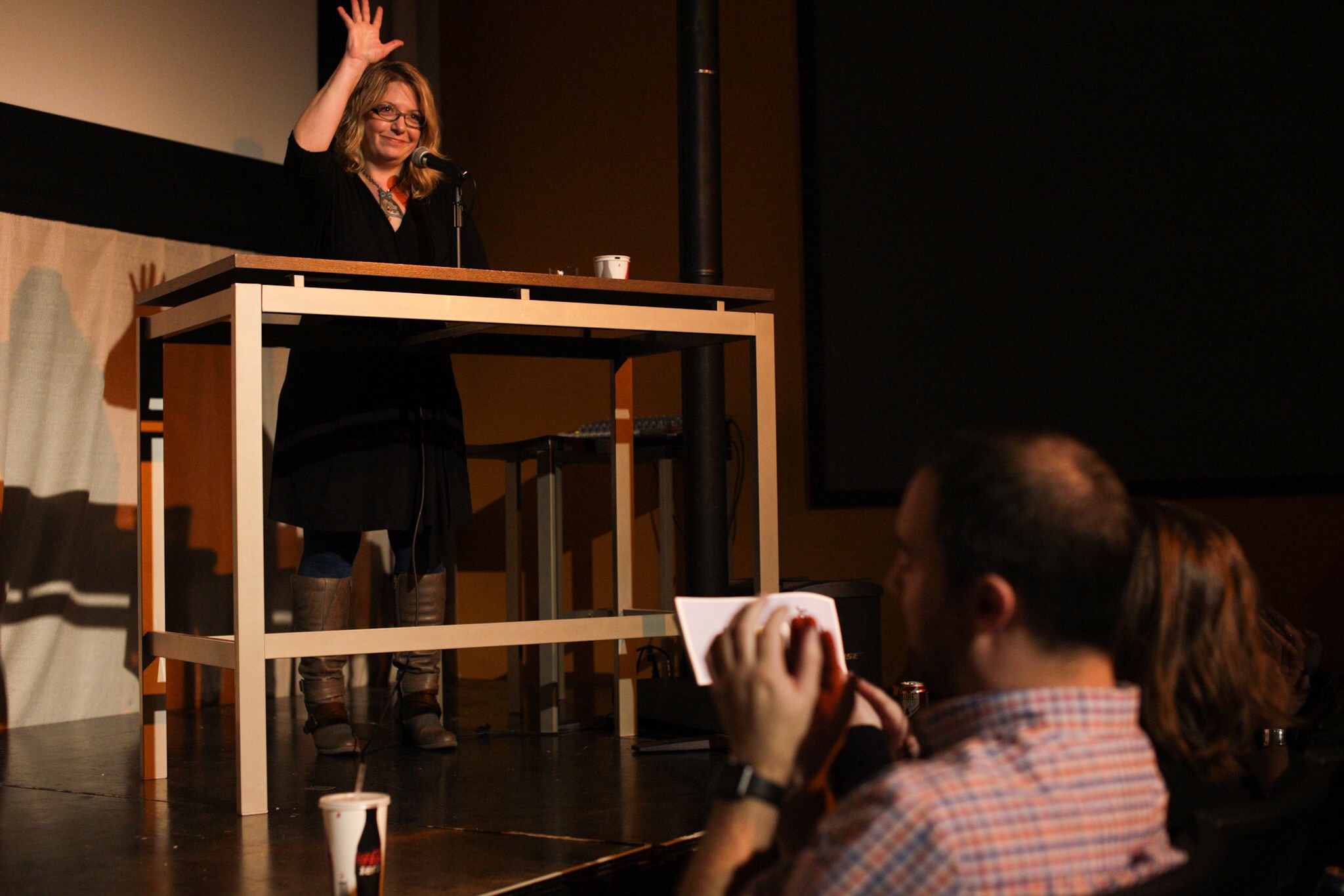
Jule Banivlle stands on stage at the festival and sets up the next group of stories.
Jule Banville introduces the next set of stories to the audience. Photo by Evan Frost.

The podcasts, which ranged in length and subject matter, were independently produced by authors with connections to Missoula and curated by Jule Banville, an assistant professor at the School of Journalism.

“I’m excited that we’re podcasting, and about where this is going,” Banville said to open the show. Many of the stories were produced by past and present students of Banville, who teaches audio reporting and feature writing. Banville said she first conceived the idea of the podcast festival as a showcase for student work, but later expanded it to include other producers.

“It’s about the stories,” she said. “There are too few places for people who are doing cool radio stories.” Banville also hosts a podcast of her own online called Last Best Stories, where she posts both her own work and others.

The stories she chose ran from the heartbreaking, like the story of an avid outdoorsman who lost the use of his legs, to the lighthearted, like a piece about a small town 80s cover band with very big dreams. The voices of every day and unique Montanans were well represented, as were issues of race, sexuality, and environmental change.

Creative visuals danced across a large screen, changing color and design with each story.
Creative visuals danced across a large screen, changing color and design with each story. Photo by Evan Frost.

In the theater on Thursday, an audio visualizer played on the big screen in ever changing colors. Between the story blocks producers talked about the art of creating podcasts. That was it for visuals however. The crowd mostly listened in silence, except when they gasped, laughed or sighed.

By Andrew Graham

Students uncover Montana voices about race

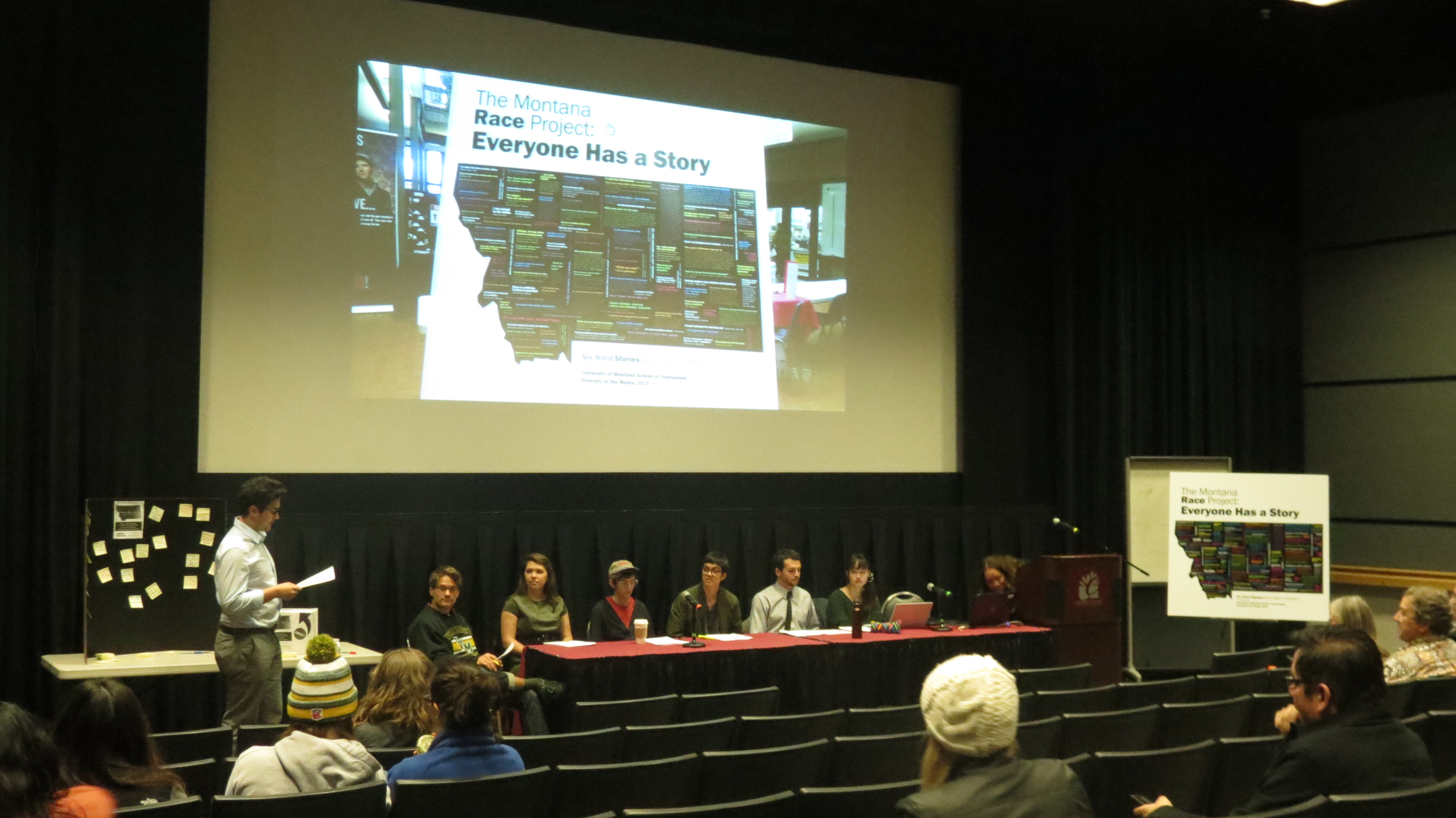
In the UC Ballroom on Thursday, November 5th, a group of seven students and their professor talked about what they’d learned over a semester spent exploring questions of race in Montana. The students have created the Montana Race Project, in which they drew in six-word essays from around the state that touched modern questions of race and diversity in Montana and beyond.

Photo showing student panel at the presentation of the 6 word essays.
Students took turns reading their favorite submissions from the project. Photo by Alyssa Rabil.

The professor, Kathy Weber-Bates, is an adjunct instructor at the School of Journalism, and the project was created through her Diversity in the Media course. To introduce Thursday’s panel discussion, Weber-Bates talked about her frustration with the idea that it was difficult to talk about diversity in a state that was not that diverse in comparison to others. That idea, she said, is misleading.

“It made an assumption that the state doesn’t have a multitude of voices,” and that’s not true, Weber-Bates said.

For her and her students, a focus that arose over the course of the experience was on the importance of conversations about race and diversity even, or perhaps especially, in institutions or places that are predominantly white. The students on the panel said they were surprised by how often the sentiment that Montana didn’t have a race issue and had no need to discuss the subject seemed to come up.

To uncover the real concerns about race in Montana, the class created an online form where anyone could submit a six-word essay, which they then promoted as a class via social media. By November 5th they had received over 300 essays from all over the state.

The idea of the six-word essay may have been born from Ernest Hemingway, Weber-Bates said, who was a firm believer in the value of saying much with few words. When challenged by his peers, Hemingway allegedly wrote the following six-word story:

“For sale: baby shoes, never worn.”

Whether that story is true or not, the form carries a lot of power. This held true for the stories brought in by the Montana Race Project. Here are just five examples of stories the students chose to read at Thursday’s event:

“Columbus day shouldn’t be a holiday.”

“Don’t tell me there’s no problem.”

“Half Peruvian, looks white, strange world.”

“Blind eyes can’t fix the past.”

“When will Native American lives matter?”

Some stories showed ignorance, others hope and optimism and still others expressed challenges of self-identity in today’s world. All showed a state where questions of race are very much alive.

Five of the students on the panel study journalism. They’re certain this experience will help guide their future work in a profession based around the idea that telling stories, everyone’s stories, matters. “The stories that I choose to tell and how I choose to tell them can bring things to light or bury them,” said Mia Soza, who is co-news director at the student run radio station KBGA.

Chloe Reynolds, another journalism student, said she learned the value of casting a wide net with her reporting, in order to find stories in unlikely places. “You don’t know somebody’s story unless you ask them,” she said.

To read more about The Montana Race Project and submit your own six word story, you can visit their website or search for them on Facebook.

By Andrew Graham