Sarah Yovetich: Covering Breaking News & Winning A Hearst Award Too

selfie of Sarah Yovetich
Photo by Sarah Yovetich.

Commercial radio may be Sarah Yovetich’s first love, but a story she produced for UM News in the fall semester won 12th place in the Hearst Awards TV News category. The piece, “Budget Cuts Result From Decreased Enrollment, State Funding at University of Montana,” took three weeks of research, interviews and editing to compact the news into a minute and 36-second long story.

Yovetich’s photographer for the piece, Peter Riley, pitched the idea after the budget cuts were released right before Thanksgiving break. “We never thought anything was going to come out of it,” Yovetich said. But the campus unrest that followed proved otherwise.

“It’s not just teachers that care, but students,” Yovetich said. “It proved enrollment’s a thing to be worried about.”

However, her research took a step back from the students and staff responding to the university’s proposed budget cuts capture a broader perspective and ask the question, “were the budget cuts out of line?”

“This was a strong story because Sarah found a new angle on UM’s budget cuts by digging into the history of state funding for higher education,” said Ray Fanning, associate professor who co-teaches UM News. “She discovered that at the same time enrollment was falling, the state legislature was reducing its allocation to UM.”

Ray Ekness, who co-teaches UM News with Fanning, agreed. “Sarah did some really good work in UM News this past semester, and it’s nice to see that she’s being recognized for that.”

Yovetich’s worked with Ekness ever since her first introductory journalism class, and she dropped her political science and business majors to switch to journalism. “I loved him and everyone in the journalism department,” Yovetich said. “I really lucked out finding journalism.”

During the summer between her freshman and sophomore year, Yovetich worked as a campus anchor for Montana Public Radio, and since then she’s transitioned to other commercial radio stations in Missoula. She covers news stories for KGVO during the week as an on-air broadcaster and reporter. “Some of the newscasts I do everyday are sent state-wide, so you’ll be able to hear me in different cities, which is kind of cool.”

On weekends, she turns into a DJ for the show “Campus Connection” on 107.5 ZooFM. Yovetich said, “I love relating my life to others and connecting with the community.”

Back on campus, Yovetich just finished serving a full year as the president of the Alpha Phi sorority’s Chi Chapter. The sorority’s helped her with scholarships and academics, as well as serving as a second family to her. Yovetich helped return the support to her sisters through motivational Instagram posts that share her dedication to power-lifting regimes. She now holds five state records in the squat, bench press, and dead lift.

“It’s hard being a senior and balancing that stuff,” Yovetich said. “School’s definitely taking a precedence this year.”

When she graduates in May, Yovetich’s ready to take her journalism skills beyond Missoula. She’s staying open to opportunities in both broadcast and radio fields to continue gaining more experience.

“She’s always been working in things like radio,” Ekness said. “Now she’s stepping out in television, so it’s kind of exciting for us.”

Tune into 107.5 ZooFM on Saturdays and Sundays from 10am-3pm to hear Sarah Yovetich hosting the “Campus Connection.”

By Jana Wiegand
J-School Alum Makes Top 10 List For Hearst Radio Awards

Emily Proctor talked with Vietnam War veteran Roger Cox for an hour and a half with the recorder running. She cut these 90 minutes down to three minutes and thirty-seven seconds of Cox’s own narrative, not adding a word of her own. The final piece, “Roger Cox’s Vietnam,” was one of two stories she submitted to the 2015 Hearst Journalism Awards Program. On February 3rd, 2016, the Hearst Radio News and Features competition ranked Proctor 9th in the nation.

hearst logo

“I had an ah-ha moment with this piece,” Proctor said. “It totally changed what I wanted to do with my career.”

Over the course of the interview Proctor probed deeper into Cox’s memories as a marine in the Vietnam War. As she edited the piece, she listened to the moments where Cox’s stolid replies began to falter. Proctor felt the power of Cox’s voice and the emotion it carried without needing any extra narrative.

Assistant Professor Jule Banville, who worked with Proctor on the story as part of her Intermediate Audio class, watched Proctor’s interest in radio grow. “He was just really honest with her about what happened there and what he thinks about it now,” Banville said. “And because what she produced was his voice telling his story, it had so much more power for her than any journalism she’d done before. It just clicked.”

The story aired on the podcast Last Best Stories, and the full interview can be accessed through the Veterans History Project.

Since graduating last May, Proctor’s been working on some independent radio projects, including a Montana-themed piece about the modern cowboy. This summer she will be doing more radio work in Alaska and potentially connecting with J-school alum Ruth Eddy, who works at a public radio station in Ketchikan. However, Proctor’s next major goal involves going to graduate school for audio design, hopefully in Germany or New Zealand, she said.

When Proctor studied abroad in Athens, Greece, she shot a short documentary about the smoking culture and its importance to their society. She also tried to produce some audio stories, but said, “The language barrier made it hard to do good radio.”

Proctor addressed this issue again in the second story she submitted to the 2015 Hearst Awards, a piece called “Language Is No Barrier For Senior Companions.” The story centers on Frank Havlik, a native from the Czech Republic who now lives in Missoula and volunteers as a Senior Companion. Coming from Stanford, Montana, Proctor was conscious of the fact that her Montana audience wasn’t used to hearing a heavy Czech accent, so she took care choosing the most enunciated sound bites.

“I wanted to cover all my bases and make sure people understood the story,” Proctor said. She added her own voice-over narrative and provided a complete transcript when the story aired on MTPR on April 28th, 2015.

“I’m pretty insanely proud of her,” Banville said. “She went on to intern at Montana Public Radio, so she’s got some news chops too, and I’m so glad the judges recognized her talent.”

By Jana Wiegand

J-School Alum Wins Hearst Journalism Award

February 10th, the Hearst Journalism Awards Program released its top ten winners in the Multimedia One/Features category, ranking Kaci Felstet’s piece “Late Start” 6th in the nation. Felstet produced the multimedia piece last spring as part of the class Native News, co-taught by Assistant Professor Jason Begay and Associate Professor Jeremy Lurgio.

“Late Start” tackles attendance issues at Rocky Boy Elementary School located in the center of the Rocky Boy Reservation in north-central Montana. Originally, Felstet and her reporting partner Courtney Anderson had been researching teacher retention rates, but they realized that the story’s core remained with the students.

Photo shows a darkly shadowed mug of tea sitting on a railing with a bright orange sunset in the distance
Taken during a photo-a-week challenge. By Kaci Felstet.

“Kids weren’t getting the education that they needed,” Felstet said. “And that was something really close to our hearts.”

Begay and Lurgio chose the theme “Relationships” for Native News in spring 2015. They challenged students to find unique, personal bonds that explored “how people on reservations connect with each other,” Begay said.

“It left a lot of room for us to branch out and find our own stories,” Felstet said.

She and Anderson traveled to the Rocky Boy reservation during spring break and spent several days following their characters and gathering classroom footage at the elementary school. Felstet said the kindergarten kids needed some time to get used to the cameras and stop making funny faces at them, but that their patience paid off in the end.

“The hardest thing is that you can’t go back,” Felstet said. “You have to get everything you need in three or four days.”

That was where working as a team came in handy. Despite extensive background research and planning, Felstet and Anderson knew that they need to stay both flexible and focused while in the field, so that they could find the true story even if it was different from the one they had envisioned. Lurgio said, “Kaci was very organized. She knew what she needed and she got enough to be able to adapt.”

Felstet’s first exposure to video came from a summer internship with KRTV in her hometown of Great Falls, Montana, but she considers herself more of a photojournalist these days. She’s currently pursuing a master’s in Economics here at UM, which will not only diversify her education but also open up new doors to her as a journalist, especially regarding business and finance beats, “which not everyone wants to cover,” she laughed.

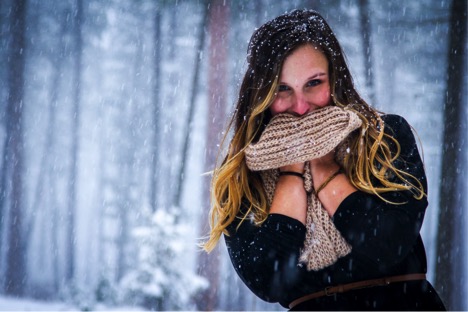
A self portrait of Felstet clutching a scarf to her face while standing in the snow
Felstet’s self-portrait from her photo-a-week challenge. By Kaci Felstet.

To stay familiar with her camera, Felstet decided to create a photo-a-week challenge for herself to keep her creativity fresh. The recent recognition of “Late Start” serves as another boost from the journalism world.

“Kaci has a great eye for shooting and producing multimedia packages,” Lurgio said. “She works extremely hard, and she was very dedicated to producing a professional caliber story. And that’s just what she did.”

Kaci Felstet and Courtney Anderson’s collaborative piece can be found on the Native News website, which features more stories from reservations in Montana.

By Jana Wiegand