J-School student balances classes and full-time broadcasting job

When classes end each afternoon for Ariana Lake, age 21, her day as a budding broadcast journalist is only just beginning. Since the beginning of the semester, Ariana has been balancing a full course load at school with a 40 hour a week job as news anchor and producer at the television station KAJ, Channel 18. Leaving campus early-afternoon, Lake races to the studio each day to get her 5 o’clock broadcast ready. She broadcasts at 5:30 p.m. and again at 10 p.m. Mondays through Fridays.
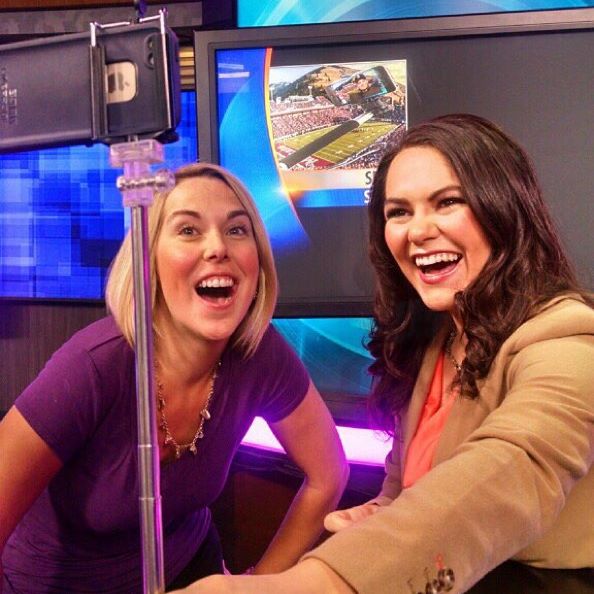
Chief Meteorologist Erin Yost (left) and Ariana Lake (right)  on set before their 5:30 show on selfie sticks at Griz games.
Chief Meteorologist Erin Yost (left) and Ariana Lake (right) on set before their 5:30 show on selfie sticks at Griz games.

KAJ serves the Flathead Valley area, and the stories Lake produces are reported by two correspondents, both her senior in age. They pitch her the day’s stories in the morning, which Lake helps review via either email, text or phone call while she goes about her school day. Although her market is the Flathead, her broadcast is produced at the KPAX studio in Missoula. KPAX and KAJ are sister stations and CBS Affiliates.

Journalism Professor Ray Ekness said it’s rare to have a student anchoring their own show Monday through Friday this early in their career. Despite her youth, Ekness said that on her show “she comes across as very mature, very knowledgeable about everything that’s going on.”

Lake was hired as a part time reporter for KPAX last year. When she saw the anchor and producer job open up in August, she wasn’t going to bother applying, certain she didn’t have enough experience. Then, after receiving some encouragement from a co-worker and her parents, she decided to go for it. She was hired within a few weeks.

For Lake, working at KAJ is a great chance to develop her broadcast skills in a supportive environment. “I’m not doing it completely on my own but it’s my show,” Lake said, “responsibility falls completely on me.”

She says that getting in the 5 o’clock broadcast, which has to be taped by 4 p.m., is a challenge. Some days she reaches the studio at 1:45 p.m., leaving her less than three hours to meet her deadline. Still, it’s a challenge Lake says she welcomes: “If you’re passionate about what you’re doing it’s not that hard,” she said.

After her second broadcast wraps around 10 p.m., Lake finally heads home, where she usually does around two hours of homework.

To see what Ariana Lake’s been producing, you can follow her on twitter: @ariana_lake or check out her broadcasts online at KAJ’s website. 

By Andrew Graham

The New Weekly Kaimin Starts Strong

By Andrew Graham

Wednesday morning, University of Montana students woke up to their first Montana Kaimin of the school year, in its new weekly and full color format. The change from a daily to weekly printed paper came at the end of last year, as the Kaimin adapted to industry wide changes in print journalism.

Official logo for the Montana Kaimin newspaper

The new format will feature 24 pages and be in news racks every Wednesday. The first issue paid homage to the Grizzlie’s come-from-behind thriller against North Dakota State, with a large cover photo of running back Joey Counts breaking into the end zone.

“It’s awesome, it’s beautiful,” said Editor-in-Chief Cavan Williams, “the colors really pop and we’ve got a great picture on the cover.” Inside a pair of feature stores from Sports Reporter Andrew Houghton support the cover, with one recapping the game and another describing University of Montana’s acquisition of new head football coach Bob Stitt.

Williams said he’s pleased to be at the helm of a paper going into a weekly format, where writers and editors for the print edition will always be thinking two weeks ahead. Breaking news will be covered from the Kaimin’s revamped website and social media platform.

Kevin Van Valkenburg, Senior Writer at ESPN the Magazine, is helping to guide the Kaimin’s transition as the visiting T. Anthony Pollner Professor for the fall semester. “I think it was great to see the Kaimin start strong with the new year, after all the change it underwent,” he said.

In the paper the change was greeted with excitement, as well as a certain amount of hat tipping to the new world of journalism today. “Change is often scary, exciting and chaotic, but to not embrace it is foolish,” Williams wrote to Kaimin readers in a Letter from the Editor. It’s a message journalism students especially can embrace.

We no longer control the video…

The recent tragedy at WDBJ in Roanoke, VA has prompted the usual journalistic introspection about violent imagery. Our industry has shown once again that we are a wild bunch, with no unified standards. Some outlets covering the shooting of Alison Parker and Adam Ward chose to show isolated snippets from the station’s own video of the shooting, which transpired live on air. Some held back. Others went so far as to show bits of the video recorded by the alleged shooter, Vester Flanagan. But some stayed away from those particular images. Decisions were all over the map.

quote lifted from text reading

There was a time when these judgments would have felt very weighty, but that time has passed. Personally, I think that is for the best.   I chose to view all the videos and can say they were truly horrifying.   That was my choice, and I am sure many people will choose differently. On this topic, the Internet truly is a democratic medium. I do not view those beheading videos—again, my choice, and I do not judge those who do look.

TV and newspapers no longer get to decide whether the public should be protected from grisly pictures. We can always go elsewhere. The debates in newsrooms about what to show seem quaint, almost dated. It’s true that TV viewers are in a unique position, because they might be surprised by a sudden gory video. That is why TV long faced tougher scrutiny from regulators.

You can argue that Internet videos feed such violence by guaranteeing an audience for the unstable. I cannot agree. Along with relics like the Fairness Doctrine, our editorial nanny state is being whittled away by YouTube and Twitter. You can avert your eyes, but you cannot stop the change. Journalists can now move on to the more serious business of covering violence and its causes, and stop focusing on ethics questions from a bygone era.

Larry Abramson