Student Profile: Joe Lesar, Master Behind The Camera & Devoted Runner

Senior broadcast major, Joe Lesar, could have graduated in the fall, but he didn’t want to pass up all the great opportunities the J-school offered in the spring semester. During Fall 2015, Lesar took UM News, where the students produced weekly televised and online stories. As a photographer, Lesar not only supported his reporters, but also produced some of his own “one-man-band” segments for the program.
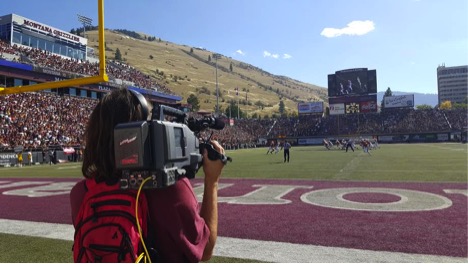
Joe Lesar in the end zone during the Griz v. NAU, September 2015. Photo by Peter Riley.

Every spring, the J-school offers an upper-level elective called Student Documentary, where the students produce an hour-long documentary for Montana PBS. Lesar wanted to experiment with different forms of narrative story-telling; plus, when he realized that most of his cohorts from UM News were feeding into Student Doc, Lesar said, “We worked so well together, I would’ve felt left out if I didn’t do Doc with them.”

Spring 2016 also marked the last semester when Lesar could compete as at student athlete at UM. Lesar ran track at McQueen High School in his hometown of Reno, Nevada, and he wanted to finish his collegiate career as a runner on a strong note. While Track & Field is Lesar’s strongest sport (notably the 400m, 800m and Triple Jump), he also joined the Cross Country team, where the standard men’s 8K race stretches 10 times farther than his longest track event.

However, sports provided an important entryway into another avenue of journalism for Lesar. One day, he was walking through the Adams Center and happened to run into the director of Griz Vision, Abe Kurien. From a simple conversation about shared July birthdays, Lesar landed a job as a videographer for Griz games—football, basketball and volleyball.

Kurien told Lesar, “Come in and check it out, shadow us at some games, and if you’re interested, come back and we’ll have a job for you.”

Now Lesar’s on his second season shooting with Griz Vision and he runs a floor camera right under the basketball hoop. His ability to know what shots Kurien wants covered, without receiving direction via earpiece, means that Kurien can depend on Lesar to get the job done well.

“Joe, in particular, having already anticipated that shot, means so much,” Kurien said. “Because he knows what’s coming during the plays.”

By now, Lesar considers it second nature.

“You just follow the ball,” he said. “If someone scores, you zoom in on them and get the Hero Shot.”

This work can become more challenging during home Griz games in football season because of the variable weather conditions. Yet fellow J-school senior, Peter Riley, who also works for Griz Vision, said, “It’s a great way for the Journalism community to be involved with the greater campus community.”

“I’m getting paid to go to the home games and be on the ground, with all the action,” Riley added. “That’s a nice reward.”

Lesar agrees that he enjoys being close to the action and seeing the interactions between coaches, players and referees. During basketball games, “The coaches get super-animated, and they scream a lot, which is pretty entertaining,” Lesar said. “I always keep an eye on them.”

Kurien said that Griz Vision is an excellent opportunity for broadcast journalism students to work hands on with the cameras. He added, “Joe, I think, enjoys what he does and wants to be a part of every game.”

Scheduled to graduate in Spring 2016, Lesar hopes to stay in Missoula for a while and keep working for Griz Vision, while looking for jobs at local news stations. “I don’t see myself going home,” Lesar said. “There are so many opportunities from here.”

Learn more about J-school student experiences with Griz Vision here, as documented by Sojin Josephson, sports reporter for the Montana Kaimin.

Further interest and inquiries about Griz Vision can be directed to Abe Kurien, via email, agkurien@gmail.com, or via phone, at 406-207-6370.

By Jana Wiegand
J-School Alum Makes Top 10 List For Hearst Radio Awards

Emily Proctor talked with Vietnam War veteran Roger Cox for an hour and a half with the recorder running. She cut these 90 minutes down to three minutes and thirty-seven seconds of Cox’s own narrative, not adding a word of her own. The final piece, “Roger Cox’s Vietnam,” was one of two stories she submitted to the 2015 Hearst Journalism Awards Program. On February 3rd, 2016, the Hearst Radio News and Features competition ranked Proctor 9th in the nation.

hearst logo

“I had an ah-ha moment with this piece,” Proctor said. “It totally changed what I wanted to do with my career.”

Over the course of the interview Proctor probed deeper into Cox’s memories as a marine in the Vietnam War. As she edited the piece, she listened to the moments where Cox’s stolid replies began to falter. Proctor felt the power of Cox’s voice and the emotion it carried without needing any extra narrative.

Assistant Professor Jule Banville, who worked with Proctor on the story as part of her Intermediate Audio class, watched Proctor’s interest in radio grow. “He was just really honest with her about what happened there and what he thinks about it now,” Banville said. “And because what she produced was his voice telling his story, it had so much more power for her than any journalism she’d done before. It just clicked.”

The story aired on the podcast Last Best Stories, and the full interview can be accessed through the Veterans History Project.

Since graduating last May, Proctor’s been working on some independent radio projects, including a Montana-themed piece about the modern cowboy. This summer she will be doing more radio work in Alaska and potentially connecting with J-school alum Ruth Eddy, who works at a public radio station in Ketchikan. However, Proctor’s next major goal involves going to graduate school for audio design, hopefully in Germany or New Zealand, she said.

When Proctor studied abroad in Athens, Greece, she shot a short documentary about the smoking culture and its importance to their society. She also tried to produce some audio stories, but said, “The language barrier made it hard to do good radio.”

Proctor addressed this issue again in the second story she submitted to the 2015 Hearst Awards, a piece called “Language Is No Barrier For Senior Companions.” The story centers on Frank Havlik, a native from the Czech Republic who now lives in Missoula and volunteers as a Senior Companion. Coming from Stanford, Montana, Proctor was conscious of the fact that her Montana audience wasn’t used to hearing a heavy Czech accent, so she took care choosing the most enunciated sound bites.

“I wanted to cover all my bases and make sure people understood the story,” Proctor said. She added her own voice-over narrative and provided a complete transcript when the story aired on MTPR on April 28th, 2015.

“I’m pretty insanely proud of her,” Banville said. “She went on to intern at Montana Public Radio, so she’s got some news chops too, and I’m so glad the judges recognized her talent.”

By Jana Wiegand

Student Spotlight: David Detrick, Journalist & Entrepreneur

Ten years ago, if you asked UM Senior David Detrick what he would be doing today, he might have still pictured himself writing, but with his words grounded in music rather than in the news. He played with bands in Los Angeles, California before moving back home to Seattle, Washington. Detrick founded his own band in Seattle called Saving Arcadia, and he wrote all of the lyrics to the Green Day and NOFX style songs.

Detrick got his first taste of journalism at the South Puget Sound Community College (SPSCC) in Olympia, WA. He had been majoring in Political Science when he started working at the school’s paper The Sounds as a reporter and writer. The more he learned about the political system, the more he realized that wasn’t his dream career. “I don’t want to work for these people,” he said. “I want to expose these people.”

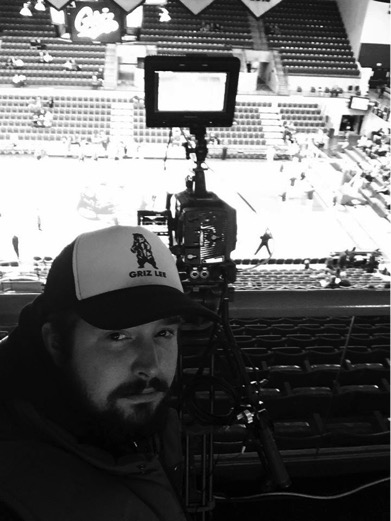
Detrick sports a Griz Lee hat and gets ready for a Griz basketball game on December 22nd, 2015, as part of Griz Vision.

With his newfound passion for journalism, Detrick had his eyes set on the School of Journalism at the University of Montana. His acceptance to the program also came with a Western Undergraduate Exchange Scholarship, based on his academic success at SPSCC.

The outdoor photography and sports journalism opportunities, ever popular in Montana media, aligned perfectly with Detrick’s interests. On February 11th, 2015, the Montana Kaimin published a feature-length piece that he wrote about a UM alumni football player who got signed to the Seattle Seahawks.

This past year Detrick photographed Griz football games and also filmed Griz and Lady Griz basketball games as part of a program called Griz Vision, which gives students professional experience with broadcasting sports live.

“It’s a lot of fun,” Detrick said. “I like being behind the camera.”

Outside of academics, Detrick started his own business in 2015 called Griz Lee, which he called “a Montana inspired clothing line with an attitude for anyone with a sense of humor to enjoy.” Around campus, most students are familiar with the Griz Lee logo, featuring Bruce Lee’s head on top of the body of a grizzly bear doing Kung Fu. Detrick gets a real sense of pride when he sees Griz Lee stickers slapped onto water bottles or laptops.

“Ever since I was a kid, I’d come up with T-shirt ideas, crazy ideas,” Detrick said, “But I never did anything about them.”

Yet he was determined to follow through this time around. Detrick pitched his product to the University Center Bookstore, and now says Griz Lee items sell out faster than they get re-ordered. Detrick has also spread his business around Missoula, thanks to social media platforms like Instagram and Facebook, as well as word-of-mouth. Now he’s answering orders from people as far away as Tennessee, which he suspects has to do with the Memphis Grizzlies, a professional basketball team.

In April 2015, Detrick won the Dean’s Award for his outstanding performance in Journalism. As a senior this year, he’s only been taking Journalism classes, and he knows that more doors open as he continues to gain experience—not just for him, but also his nearly four-year-old son.

“The sky’s the limit now,” Detrick said.

By Jana Wiegand