
Social Media Best Practices: Q&A with Content Creator Gil Shur

By Seth Pytleski

Gil Shur is an entertainment content creator who focuses on popular and indie films/television shows on his YouTube channel: OneTake. Shur has accumulated over 229,000 subscribers on YouTube for OneTake and his most popular video has more than 24,000,000 views. The channel has a variety of different types of content including entertainment news, recaps, analysis videos, and podcasts Shur hosts with his brothers.

UM Journalism student Seth Pytleski recently interviewed Shur over email about his use of social media and specifically the platform of YouTube, how he found success and what he has observed during his career. Below is a transcript of their conversation, edited slightly for brevity.

Q: Outlets/channels that cover entertainment often use outrageous controversies and celebrity gossip that surround a cultural product to get attention, have you ever been tempted to use this angle? Why or why not?

A: I’ve never been tempted to use that angle for a few reasons. One, I spent many years before YouTube working in jobs where I would often have to do things I do not enjoy. Part of my motivation for making YouTube my full-time job was to minimize the time I spend on things I do not enjoy. So, I have a very strong bias against compromising my integrity or desires for a potential short-cut to views.

I try to maintain a positive environment around myself and focusing on outrage, controversies, or gossip would achieve the opposite. Thankfully, in my experience with YouTube, there are basically infinite paths to success. So, as long as you are patient, committed, and always looking for ways to improve, you can select the best path for you. Not every day will be 100% positive or easy, but you can definitely avoid going out of your way into negativity.

Q: Your bigger videos are mostly related to huge franchises like Marvel or The Matrix, but you also find success in more niche categories, talking about smaller movies and television shows. How do you strike a balance between appealing to a wide audience and talking about things that are important to you?

A: Thankfully, my tastes are fairly broad, so it does not feel like a compromise when I talk about genre stuff like Marvel. Even when Marvel movies are dipping significantly in quality, I can still enjoy them as a puzzle (the problem solving part of me has a fun time trying to piece the movies together on a timeline, for example) or as an intellectual exercise (i.e., why don’t these movies work as well as some other ones?).

Having said that, my success in the big franchise stuff usually comes from my timeline videos. I enjoy making them but they are not as intellectually or creatively stimulating as video essays, reviews, or other analysis/opinion-based videos. That is where I do have to find a balance. So, I basically approach it the same way many filmmakers approach their careers with a “one for them, one for me” mentality. I’ll make a timeline or two since they bring in big audiences and I do enjoy making them, but before I tire of timelines, I change things up with a retrospective or WIRBA (What ___ Is Really About).

I often try to make a formula out of it with schedules/spreadsheets, but it also just comes down to listening to my feelings/energy levels. If I’m not up to making a particular video, or something smaller/more niche excites me, I don’t fight it, I follow that feeling. Thankfully, YouTube-ing is a career that allows for that kind of flexibility.

Q: The YouTube algorithm is infamously complex and constantly changing, what steps do you take to make sure your videos will find an audience?

A: I honestly do not think too much about the algorithm. Many big YouTubers and YouTube themselves will tell you to get rid of the world algorithm from your mind and instead use the word “audience.” At the end of the day, the algorithm is just trying to follow the audience and give them what they want. That makes things pretty simple for me strategically. It comes down to A-B testing. I started the channel by trying many different types of videos. Some of them worked better than others so I did more of them (at first this was reviews of individual episodes on a TV show). While continuing to do individual episode reviews, I continued experimenting with other formats, then found that theory videos were even more successful, so I started doing those too.

At that point, I did TV episode reviews and theory videos, then I continued to experiment… I eventually discovered that video essays/analysis videos were even more successful than theory videos. Not just in terms of views but also in terms of their relevance over time. I.e., a TV review is relevant for a week until the next episode, theory videos are relevant until the show proves or disproves your theory, but an analysis of a character or a show/movie’s themes is evergreen. That video will be relevant as long as people care about that show or movie. In business terms, it becomes part of a portfolio that can generate revenue for months or even years vs other videos that generate revenue for a day or a few weeks. This was a crucial discovery for transitioning into YouTube full time.

I could keep going but the bottom line is you will never understand the total inner-workings of the algorithm (I doubt YouTube themselves even understands it fully). But, you don’t need to. You show your audience different things. See what works. Do more of what works while continuing to experiment because even if thing A works, you never know if thing B will work even better.

Q: You have amassed almost a quarter million subscribers on YouTube, yet only have a little over 300 followers on X/Twitter—what is the reason for that discrepancy? How do the two platforms differ in terms of gaining a following?

A: That’s a great question. My theory is that in general, my most popular content is pretty impersonal. For example, I gained over 50K subscribers from my most popular video, the recap of every Spider-Man movie. Think of the people who watched that video: they do not know my name (only the name of my channel), they do not know any of my opinions, they’ve never heard me make a joke, they’ve never seen my face, etc. To them, I’m a disembodied voice who summarizes some movies they like. Twitter/X or Instagram, etc. are places you go to follow a personality: to hear their opinions, observations, etc. That’s a very different offering from the video which introduced me to those viewers.

In general, when people discover a new channel or personality they like, I think their instinct is to go looking for more of the content that got them hooked on that channel/person in the first place. So, if someone finds OneTake and enjoys my Spider-Man Recap, it’s an easy sell to say “Hey, you should also check out my MCU Timeline.” But, “Go follow me on X” is a harder sell. They know X will not provide more of the same (i.e., they will not get super detailed, long-form recaps on X).

To me, the proof is that almost all of my Twitter followers and Patrons came from 2 – 3 years ago when we were doing the podcast Saulcast. Podcasts are heavily personality-driven. It’s a casual conversion where our personalities, senses of humor, observations, etc. are fully on display. People connect with us as people in an almost social way. So, of course, this more readily lends itself to followers on social media.

My retrospective videos where I’m on camera more, offering opinions/analysis, and my recent attempt to start podcasting about movies are both attempts to cultivate more of a community/social presence.

Q: How important do you think marketing yourself on social media platforms outside of YouTube can be for content creators?

A: I think it totally depends on the type of content creator you are. As you can see with OneTake, I’ve been able to find success on YouTube with virtually no presence on other social media platforms. As much as people hate the algorithm, the beautiful thing about it is that it creates a discovery engine. I can put videos out on YouTube and it will do the work of getting it in front of people. So, in that sense, it has not been important to me at all. I think that is true for a lot of YouTubers.

However, I’m sure that depends on the type of content creator you are. I.e., if you are heavily opinion-based and discussing current events, I’m sure having a presence on X would help you gain even more followers.

There’s also the question of diversification: it’s a little scary having YouTube as a sole source of income. What if my channel were to get shut down tomorrow? I would essentially have to start building again from scratch. However, if I had a following on social media, I could start a new channel, potentially on another platform and some percentage of them would follow me there.

Q: How do you think some of your colleagues fail at using social media responsibly?

A: In real-life conversations, there is a lot of leeway to sort of “test” ideas outloud. If I’m talking to close friends, we might throw crazy ideas, theories, or opinions out there just to talk them out and see if they hold any merit. Or, if there’s some big news headline, we might say our immediate reaction/opinion out loud before actually reading the article and giving it real thought. After talking things out, reading more, or thinking about things further, we often come to a conclusion that differs totally from our original one.

However, on X or similar platforms, I think people follow the same impulse… They see a headline and throw an opinion out there without fully thinking it through. That might be okay in real-life between friends where you can change your opinion later, possibly even in the span of one conversation at no cost. But online, that initial reaction is there… People will respond to it, share it, retweet it, etc. Even if you change your opinion later and delete that original tweet/post, it still exists in everyone’s minds. That can change the way people look at you, contribute to the spread of inaccurate information, etc.

It’s hard to know where exactly to draw the line in terms of responsibility. There probably should be a degree of leeway in “talking things out” online the same way you do in-person. But, you can also cross a line of posting irresponsibly… I.e., it is okay to be ignorant on something, but on certain important topics, maybe if you are ignorant, you should not post with conviction until you have actually done the research or discussed it privately.

Q: Is there anything else you would like to share about your experiences working with the internet/social media?

A: Just that I love it. I love that it has democratized the media. Growing up, I loved to watch TV and Film. I loved the idea of making “content” myself but it felt impossible. I did not conceptualize human beings actually making this stuff, it just magically came out of my TV or movie screens. As I got older, sure I realized there were people working on these things but it was always presented as a “dream job”. Something not worth pursuing unless you are absolutely insane and special.

Things like YouTube have changed all that. There is now a path for virtually anyone to share their creativity with the world in a virtually infinite number of niches- as a hobby, part-time job, full-time job, or anything in-between. As much as people often focus on the dangers of social media, etc… There is also undoubtedly something amazing happening. We have to remember how new all of this is. In the grand scheme of human history, it is all so so new. I’m hopeful that over the next few decades, we’ll find a better balance and healthier ways to integrate the internet/technology into our lives. I’m picturing less phone addiction, less hate, etc. More education, creativity, and community.

This Q&A is part of a series created by students in Courtney Cowgill’s Social Media and Audience Engagement course at the University of Montana School of Journalism. Students sought out people in media who are doing social media for good to offer tips and insights into the ever-evolving landscape of social media.
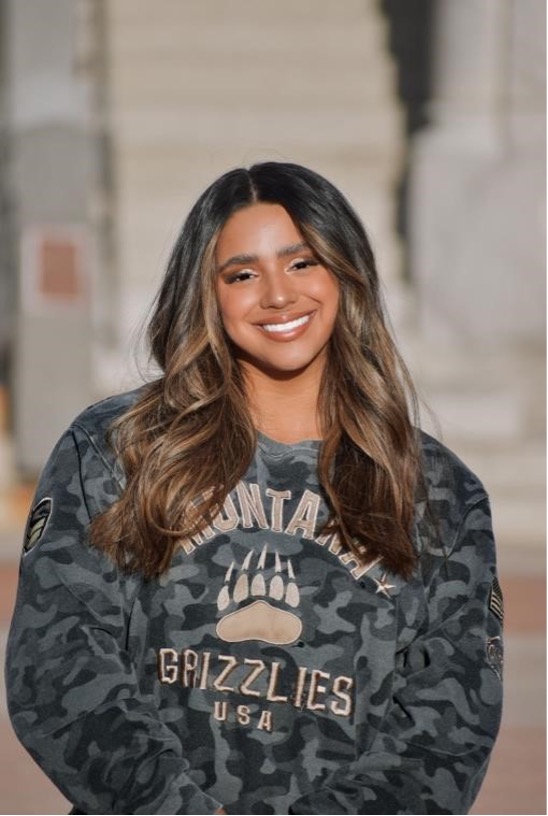
Social Media Best Practices: Q&A with Isabella Serrano

By Coral Scoles-Coburn 

Isabella Serrano has been freelancing as a content creator and photographer in Missoula, Montana, while also working as a marketing coordinator for Studio Sweat. After falling in love with Missoula and transferring to the University of Montana in 2020, she graduated in 2023 with a Bachelor of Science in Business Administration. Growing up between San Diego and Portland, Oregon, Serrano’s early life was centered around sports, which she played in college at the University of Nevada, Reno, before transferring to Missoula. Social media plays a huge role in her professional life and in her personal life. Serrano has always been drawn to various forms of art, including photography, drawing, calligraphy, and design, and social media gave her an outlet to be creative when she felt like she couldn’t in the sports world.

University of Montana journalism student and photographer Coral Scoles-Coburn interviewed Serrano with emailed questions and below is a transcript of Serrano’s answers, edited slightly for brevity and clarity. 

Q: Can you tell me about your overall take on social media? How has your perspective changed over the years? 

A: As a young teenager, my family was very restrictive with my social media access, and I never grasped the benefits and or damage it could do. When I went away to college, I had full access and quickly learned how beautiful, scary, funny, harsh, educational, and so much more social media can be. I have firsthand experienced the highest highs and lowest lows that come with using social media and I believe that if used correctly it could really be a beneficial tool to have in your back pocket. Over the years, I have primarily focused on all the positives that come from social platforms as it is my main work source and want to continue to love what I do. 

Q: What does social media mean to you as a photographer? Why do you think showcasing your work on platforms like Instagram is important? 

A: Social media is crucial to me as a photographer and freelance content creator. I do the majority of my marketing and showcasing through social media and without it my clientele would be minimal. In this generation, informal conversations and planning such as direct messaging has become the main form of communication for most. Even clientele in the older demographic have dm’d me through Instagram to set up meetings, ask for pricing, and plan photoshoots. Platforms such as Instagram grew exponentially and became a hub for a lot of creative personnel to showcase their art. It is important to use Instagram as a showcasing tool because it reaches audiences I wouldn’t be able to through other marketing outside of social media. It also allows me to follow my aesthetic and format I personally think draws an audience to my page. 

Q: How has your presence on social media helped you grow? How has it shaped professional opportunities for you?

A: My social media presence has exponentially grown for the fact I have more clientele as well as my passion and personal enjoyment for social media and content creation. The more I post, run ads, and collaborate with other individuals, the more Instagram and the algorithm will favor my page and push out my content to an audience interested in my work. I have not only seen the quality of my work get better due to a higher demand but I have drawn in higher clients who truly believe in me and my skills. 

Q: How does your personal identity shape the content you share on social media? What parts of your life do you think are important to show your audience, and why? 

A: As mentioned before, I grew up playing sports at the highest level and it instilled a driven work ethic as well as the constant need to perfect things in my life. When I set my mind on something I really strive to be the absolute best I can be and I really think it shows in the quality of work I produce. When it comes to my own personal social media, I tend to show the upbeat and aesthetic parts of my life. I really enjoy interior design and fashion as well so I play around with the fun carefree side of social media on my own page. 

Q: What factors influence your decision on what content makes it to your Instagram feed? Do you have specific criteria or strategies you use to curate your page? 

A: I can not stress this enough as someone who mainly runs her social media off her phone and creates a majority of user-generated content, DO NOT POST A VIDEO OR PICTURE OF LOW QUALITY!!!!!!! I have worked with so many businesses and individuals that want to post a video or picture but either the lighting is bad, the camera is smudged, the video is shaky, the subject is uncentered, countless little but major things that make a difference in a quality post. I mainly focus on getting clean, clear high-quality content first and then focus on what reels and carousels will be posted. It may seem like minuscule criteria but it truly makes a world of difference in how your audience views it. 

Q: Do you use Instagram’s analytics or other tools to keep track of your performance? If so, what metrics do you focus on, and how do they guide your content planning? 

A: I use Instagram analytics and insights as all pages I run are business pages. It is a free tool on Instagram that can really be beneficial when utilized. The pages I run have followings in the thousands so I stayed focused on the main metrics such as engagement rate, following count, impressions, and active times. These metrics aid my content planning by directing me toward which content interests our audience the most. Not all trends can be beneficial to your business but it never hurts to try something new and be bold because you never know exactly what content will resonate with your audience the most. 

Q: How do you handle changes in Instagram’s trends? Have you had to change your strategy to keep your audience engaged due to changing trends?

A: I thankfully haven’t had to change my style of creating but I have had to be more prepared to keep up with new trends. I now use Mondays as an informative and planning day. I look at my personal and business analytics and review what performed well and what didn’t. This helps with my planning for socials for the week so I can see what trends Instagram favors and which we can move on from. I use at least an hour or two to see which profiles, sounds, reels, and hashtags are trending and how I can implement them into my work. Trends are always going to be changing and it may seem difficult to stay on top of it but if you come prepared, it makes your future work easier and helps keep your audience engaged. 

Q: What advice would you give to others trying to build a fun, authentic, yet professional connection with their followers on social media? 

A: My biggest advice I would give to others building their social media presence is to FIND YOUR OWN STYLE!!!!!! There are so many creators, photographers, videographers, etc. that have worked to find a style that suits them, and copying someone else’s aesthetic will only delay your progress. Get out there, photograph people and everyday life for fun, reach out to mentors, use your resources, and truly just have fun creating. Art is beautiful in so many different forms and when you can create your own authentic work there is no better feeling.

This Q&A is part of a series created by students in Courtney Cowgill’s Social Media and Audience Engagement course at the University of Montana School of Journalism. Students sought out creatives who are doing social media for good to offer tips and insights into the ever-evolving landscape of social media.

Social Media Best Practices: Q&A with Freelance Writer Skylar Rispens

By Hannah Tyler

Skylar Rispens is a freelance journalist in Missoula, Montana and now she works with the University of Montana. Before she took a job at UM, Rispens worked at several news organizations as a reporter and writer. Her social media page consists of her photojournalism and stories that she writes.

University of Montana student Hannah Tyler recently interviewed Rispens about best practices on social media and what follows is a transcript of their conversation, edited lightly for brevity and clarity.

Q: What kind of journalism do you do when you write?

A: I am absolutely hooked on any sort of journalism about education. I graduated from the University of Montana School of Journalism in 2019 and immediately dove into the local news scene in Montana. I spent the summer of 2019 as a local reporter and photographer for the Seeley Swan Pathfinder (I even helped distribute papers to newsstands around the valley, and mailed them to subscribers who did not live locally). Once that wrapped up, I moved to work as a breaking news reporter at the Great Falls Tribune. It was there that I started picking up education stories from time to time, but once the pandemic hit and we had to move to fully remote work I cut my teeth on pretty much every beat you can think of to support my colleagues and community (I even doubled as a photographer on occasion). After about two years in Great Falls I moved back to Missoula to work as an education reporter for the Missoulian newspaper. For about two years, I covered everything related to education, my editor called it the “diapers to diplomas” beat, but I also wrote on issues around statewide education policy. I was unfortunately laid off from my position at the Missoulian in the spring of 2023. Last fall, I started a job as a reporter with StateScoop and EdScoop, which are publications for a Washington D.C.-based online tech news company, but left that role in June 2024. It’s worth mentioning though that while I was starting that job with Scoop News Group I was simultaneously completely a reporting fellowship through the Education Writers Association for my pitch on what works–and what doesn’t–when it comes to four-day school weeks in Montana (a story idea that had been rattling around in my head since I worked in Great Falls).

Q: What made you want to work for the University of Montana?

A: There were many factors that influenced my decision to work for the University of Montana, but I ultimately decided I needed to leave the full-time journalism industry because I craved a more stable work environment and I wanted a job that would allow me to continue living in the community I love. It wasn’t easy to make the jump to the “dark side,” but I was very familiar with the high-quality writing produced by the UM News Service and figured it would be a great opportunity for me to continue using my journalism skills while learning about an entirely new industry. Plus, I truly believe in the purpose and mission of higher education, so if I can write articles that ignite a passion for a student to further their education at our institution I think that’s a win.

Q: What would you say your target audience is for your writing?

A: My audience at UM ranges. The news articles produced by my team are published through a variety of channels including the UM website and social media, but we also distribute our articles to external media (depending on the article, they could be sent out to local, statewide or regional media lists) in hopes that it will be picked up by those journalists and editors. I also have tried my hand at some creative copywriting for unique social media channels for UM, so it’s been fun as a writer to tap into different voices and tones, which you can’t always do in traditional journalism. For any freelance journalism work I am doing, my audience also ranges. Generally, I would say that I am trying to write for either a local audience (Missoula or western Montana), but have written stories with a statewide audience in mind as well. But I just recently freelanced with a publication out of San Diego, California as a contributing reporter, so I didn’t actually write any copy for the article but I helped gather some information for the reporter.

Q: How has social media has helped (or hurt) your freelance journalism and your news writing for the university?

A: I’ve always been chronically online haha. During journalism school and then my full-time journalism career I cultivated a following of about 2,800 people consisting of folks from all corners of Montana and other education journalists who wanted to be connected to my work and news-sense. That following came in handy when I got laid off from my job with the Missoulian because it connected me to the editors with the Montana Free Press and I’ve written several stories for them in the last 18 months. It’s also what helped me land that freelance assignment with the publication in San Diego strangely enough. I wouldn’t say that social media ever really hurt my journalism career (whether as a full-time employee or freelancer) because I keep most of my channels pretty locked down. I made the decision to have any public-facing accounts focused on my career after some not-so-fun run-ins with crazy people on the internet who just want to harass young women working in journalism. My most active, public-facing professional account is definitely my Twitter. Now that I no longer work in full-time journalism that account is a bit more quiet, but I’ve taken a few more stabs at showcasing my personality there than I previously have.

This Q&A is part of a series created by students in Courtney Cowgill’s Social Media and Audience Engagement course at the University of Montana School of Journalism. Students sought out creatives who are doing social media for good to offer tips and insights into the ever-evolving landscape of social media.