Missoula to Berlin Update: The Optimistic Generation

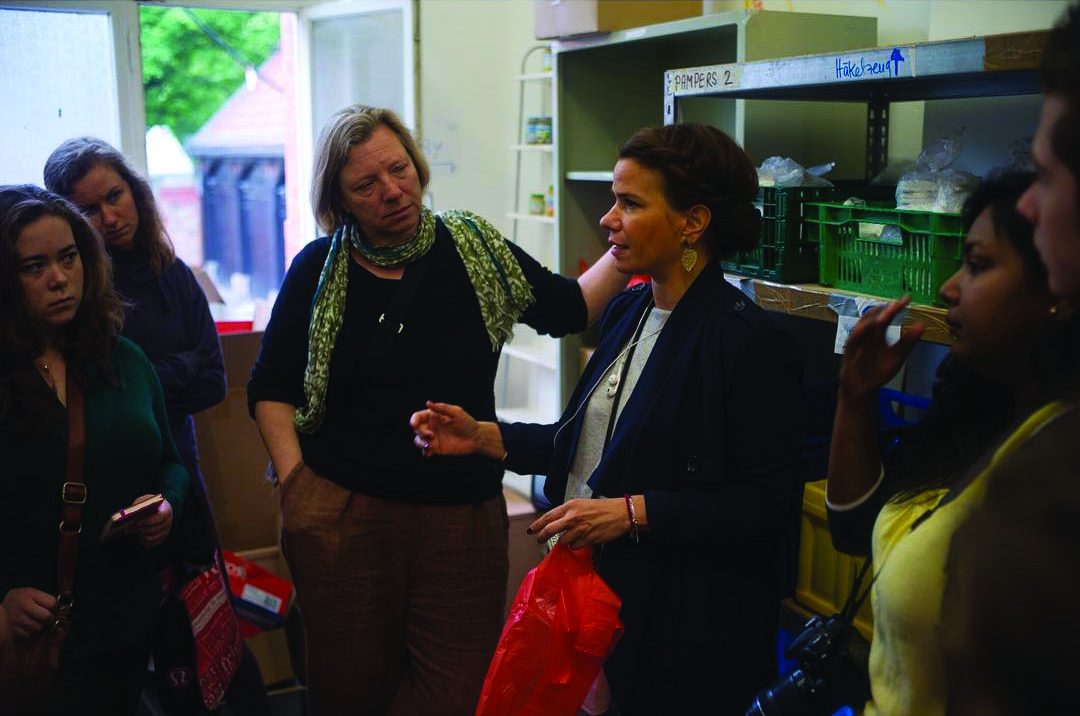
Montana Journalism students are shown around the headquarters of Moabit Hilft, where a team provides clothing, food, and basic amenities to refugees as they wait for their asylum claims to be processed.
Montana Journalism students are shown around the headquarters of Moabit Hilft, where a team provides clothing, food, and basic amenities to refugees as they wait for their asylum claims to be processed. Photo by Shane Thomas McMillan.

It’s hard to imagine what’s going on in Germany today. But try this: imagine you live in a country that has the opportunity to accomplish two earth-shattering, history-making achievements in the space of one generation. First, you are able to reunite a country divided completely by the Cold War, and you manage to do this while actually improving your status as the most powerful economy in a united Europe. Second, you have the chance to change your reputation as a creator of refugees (during World War II) to one known for its “Willkommenskultur,” and you attract about a million refugees from all over the planet. And rather than taking on this challenge with a sense of resignation or obligation, you do this with a sense of joy and optimism. It is that sense of hope that is greeting the 18 students from UM’s Journalism School, as they get to know Berlin and seek to understand the refugee crisis.

In the press, many of the stories about the refugee crisis focus on potential problems. And like good journalists, these are the kinds of issues our students are asking about: what if the growing number of Muslim families insist on expressing their culture by demanding accommodations in school? What happens if all these refugees stay, and if more arrive? What if the right wing resistance to immigration grows more powerful? These are the important issues students are probing as they visit refugee camps, immigrant neighborhoods, NGO’s and other groups who have been affected by the new arrivals.

Many immigrants of course are still unsure about whether this can be a permanent home, or whether they will want to stay. But we have already met dozens of Germans who seem convinced that immigration is their chance to do something good, perhaps even great. Young people in particular are seizing this chance to help immigrants and figure out solutions with a sense of creativity and fun that is hard to describe. But we will try to do that in a series of articles, videos, radio pieces and social media posts in the coming weeks.

Follow the group and their adventures on Instagram!

By Larry Abramson
Missoula to Berlin Update: May 26, 2016

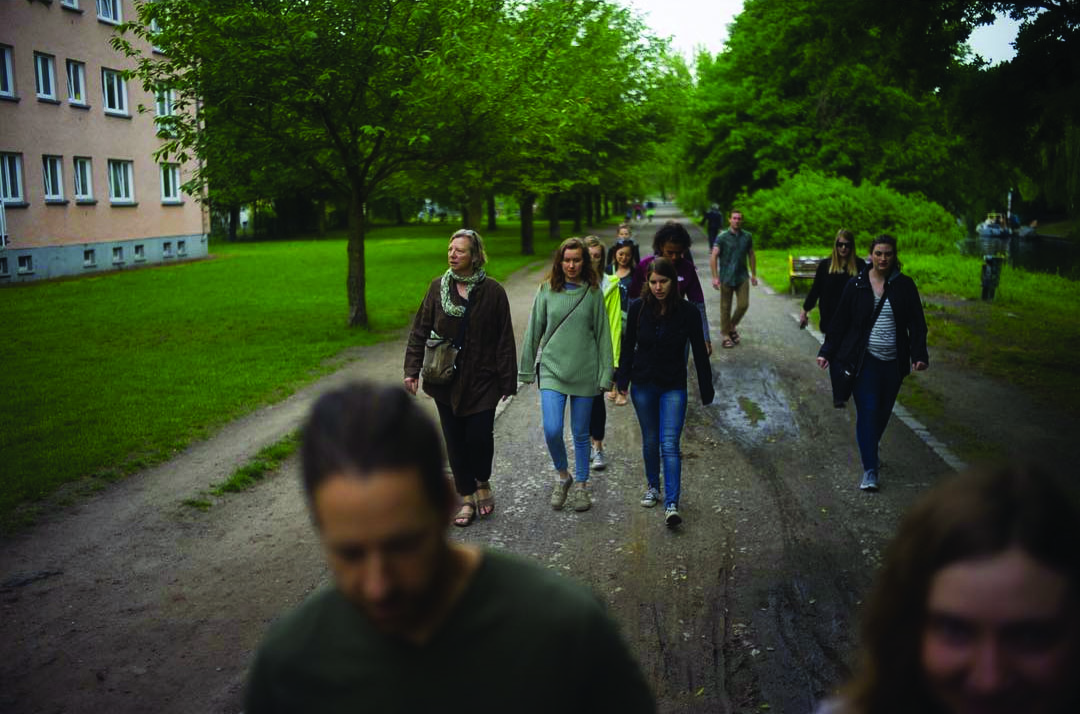
photo shows MT journalism students walking down a sidewalk.
The group explores their new neighborhood along the Landwehr Canal in Kreuzberg ,Berlin.

They came by plane and by train and by foot, a dozen and a half of them, carrying bundles and suitcases and keepsakes, looking tired but relieved to have arrived in Berlin. No, these are not refugees, they are UM Journalism students, 18 of them, here on a study-abroad trip for the next three weeks. The disorientation many of them feel will be helpful as they begin to meet and study the challenges facing thousands upon thousands of refugees who made their way to Germany. The refugees’ goal is to escape war and find peace. The students’ task, a bit simpler, is to produce a series of articles about how the refugees adjust to their new situation.

The students are staying in a neighborhood called Kreuzberg, which has long been a crossroads for immigrants to this country. For decades, it was home to the Turks who came here during a big labor shortage in the 1960’s and 70’s, and helped Germany recover from war and become Europe’s strongest economy. Once Kreuzberg was a ghetto, but it has turned into a multicultural experiment, a mixing bowl where no one stands out as an outsider. As students are learning, many new refugees are finding their way back to this neighborhood. Kreuzberg has resisted the commercialization that has seized much of Berlin since the reunification of Germany in 1990.

Since the refugee crisis spiked last year, things have calmed down quite a bit, and the number of new arrivals has dropped dramatically. But as one pro-refugee activist told students today, refugees face months or years of adjustment as they come to grips with their new lives in Germany, and learn whether or not they can stay and prosper. Our students will begin to chronicle that adjustment, with articles appearing in this space and elsewhere in the coming weeks. Stay tuned.

By Larry Abramson

J-School Students Set to Premiere Documentary Examining Autism in Montana

Every Monday morning, adjunct professor John Twiggs started class with a countdown, reminding the students how much time remained for them to finish their documentary. That number started with 15 weeks, but on the first day of finals week, the countdown hit the final 48 hours of production.

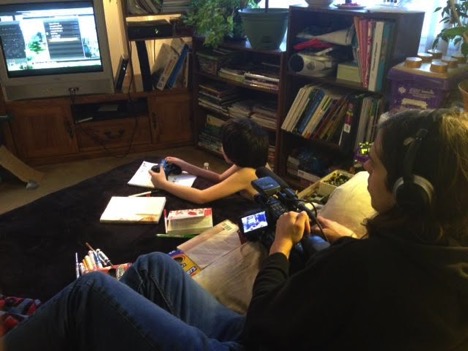
A student films the subjects of the documentary in the behind the scenes photo.
J-School students work closely with their subjects as seen in this behind the scenes pic. Photo by Jana Wiegand.

The documentary, “Aging Out: Autism in Montana,” will premiere at the University Center Theater on Friday, May 13, at 7 p.m. as part of the Senior Showcase. However, the rest of the state will get to see the show on MontanaPBS on Tuesday, May 24, at 8 p.m.

Upper-level journalism students have the option to take the Student Documentary Unit every spring semester. However, this year’s group started researching ideas for the show back in December. A class vote revealed an overwhelming decision to pursue the topic of autism and how it impacts the lives of Montanans.

After more research, the students noticed a significant gap in autism care as individuals with autism spectrum disorder (ASD) transitioned from school-age to adulthood. With the number of individuals being diagnosed with autism on the rise, they realized that the stress placed on the limited number of current care options for adults with ASD was ill-prepared to meet the needs of the incoming wave of adults on the spectrum.

“I want to do something that’s worthwhile, and I feel we have a good group to do it,” said senior Peter Riley, the director of the show. “Everybody knows we have each other’s back as a team, and everyone’s really stepped up and come to the table with some fresh ideas and some talents.”

The students traveled across Montana to follow the lives of four families, each with a child on the autism spectrum. As a class, they chose their main characters to reflect a diversity of ages, abilities, finances and access to care. The class spent quality time at home with their characters, attending therapy sessions and time at the workplace too. Students also interviewed autism specialists to shed insight on autism itself, the diversity care options and relevant legislation in Montana.

Once the group made the transition from shooting to editing, Twiggs told the class, “It’s time to take a hard look at what you do and don’t have. Get everything on the table that shows your best moments.”

Since then, the students have rewritten their scripts and finessed the edited footage to tell a story that speaks to the unique situations of each family, while also capturing the overarching struggles that unites them all.

“It’s definitely the most worthwhile thing I’ve done at the J-school,” said Andy Anderson, the director of photography. “It’s also been the hardest project I’ve worked on, without a doubt, but I think we have a really good pairing of people with skills. We just have killer writers and awesome videographers.”

The majority of the members in Student Doc will graduate the day after the documentary premieres on campus.

“I think Doc is a wonderful experience. We may not get the chance to do this thing for quite a while, if ever again, so let’s step out strong and leave with a product that we can be proud of,” Riley said. “I’m so thankful to be surrounded by a group of individuals that thinks that way too.”

SDU2016

Check out the 30-second and 60-second trailers for the documentary on the Facebook page, “Aging Out: Autism in Montana,” which will also air on MontanaPBS in the days leading up to the television premiere. Students also plan to post behind-the-scenes footage from the making the documentary, providing exclusive insight to their process and the families they followed.

The complete documentary will be available via the MontanaPBS website after the scheduled air date on Tuesday, May 24, at 8 p.m. Past documentaries from the Student Documentary Unit can also be accessed from their website.

By Jana Wiegand