Boy, what a summer it’s been. Could there be any doubt that we need caring, smart journalists now more than ever?
As we prepare to open the doors for another year at the UM J-School, I keep asking myself that question. Just take one news story as an example: we have a presidential election before us between two people who seem to have a very troubled relationship with the truth. How could the average citizen possibly scrutinize statements by Hillary Clinton and Donald Trump, without professional help from reporters, editors and researchers? Reporters remain, despite the turmoil in our industry, our election ghostbusters: they are uniquely qualified to train their ray guns on statements like Trump’s assertion that the real unemployment rate is closer to 42 percent than 5 percent. And we still need someone to jump on distortions like Hillary’s insistence that the FBI Director called her statements about her email server “truthful.”
While the need for good reporting remains clear, the way to pay for it is not—the crystal ball remains cloudy on that point. As comedian John Oliver pointed out recently, even he ruthlessly rakes through the work of journalists in the search for joke material, without signing up for a subscription. Oliver’s appeal to recognize the work of journalists got a lot of play, but I predict it will have zero impact on the financial plight of the news biz. That’s because pity is not going to help us make news profitable again. Only innovation and hard work will.
So, as we start the year I will present our students with this simple challenge: come help us save the world from a flood of lies. It’s our job.
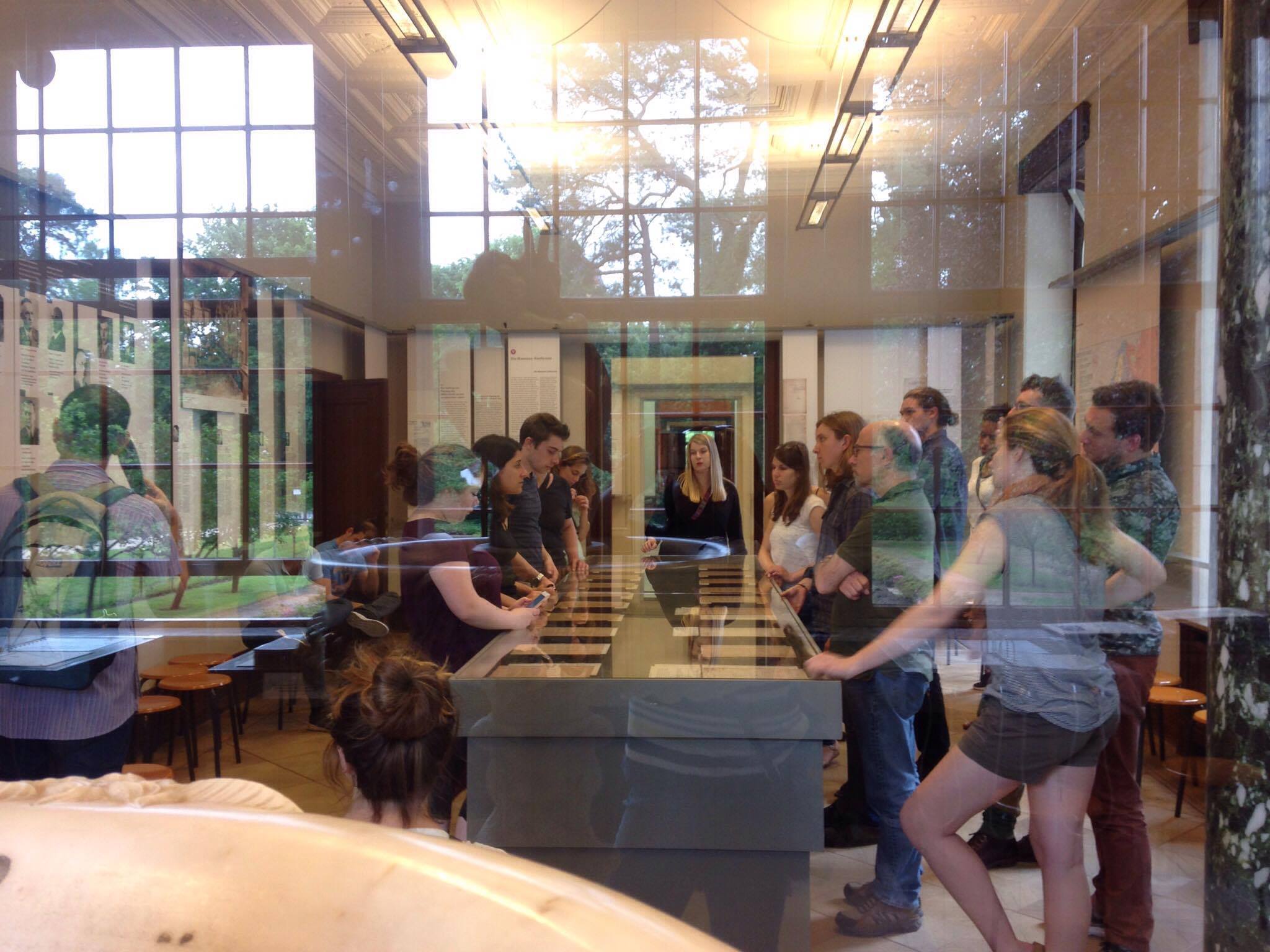
Missoula to Berlin members listen to tour guide Alischia Kusche in Berlin. Photo by Sachi Sinhara.
Today in Berlin, a new piece of journalism was born. Maybe that doesn’t qualify as news, but if you had the chance to be there at the birth, you might share my appreciation. 18 UM J School students put together a web site bursting with articles, photographs, graphs, charts and social media. Their focus is a major story on the world stage: the refugee crisis facing Germany, and specifically Berlin. The miracle is that many of them had never written for publication under deadline before, and no one had every done so in a foreign country. The quality of this work, and the experiences that led to it, is solid proof of what our school believes: the best way to train journalists is to put them in the field.
The UM J School backs trips overseas because they provide a concentrated version of the classic journalism encounter: stepping into a strange world, pulling back the veil and then making sense of it for an audience. Confronting that challenge in a foreign country raises the challenge to the tenth power, making the learning process is that much more intense. Here in Berlin, students have had to talk their way into asylum homes, youth shelters, burial facilities, bike cooperatives and many other nooks and crannies of the refugee world. They’ve struggled with setback after setback: interviews that were cancelled, crabby bureaucrats who refused to return their calls, and the endless challenge of working in foreign languages. They figured out how to move ahead, and save their stories. I can’t think of a better learning experience.
Last Saturday night was our deadline for filing our final stories, and our students experienced the Sturm and Drang of crunch time. Students kept the train on the track, contacting each other about final corrections, and editing copy over and over. At some points, the faculty went to bed, and the students took over. They took ownership of the enterprise, pushing each other to polish the final product. Once again, that’s a learning experience that’s hard to create in the classroom.
As we wrap up our work here, we’re sitting down with students to get their assessment of their three weeks in Berlin, and the months of preparation that got them here. Almost without fail, they remark on how different it is to work in the field versus doing classroom assignments. They all see how they could have been smarter and more successful if they had asked a few more questions, taken photos from different angles, or tried just a little harder. Those are the real lessons they will take into the newsroom, or to whatever field calls to them. You can see their work here. Thanks to everyone who helped our students get here, and watch this space for more news.
As a sports reporter at the Montana Kaimin, Sojin Josephson was used to fast turnover between stories. But when ESPN reporter Kevin Van Valkenburg joined the School of Journalism’s faculty as the fall 2015 Pollner professor, Josephson seized the opportunity to tell the stories that shaped some of UM’s star athletes, both in and out of the sports arena.
Photo by Andy Anderson.
Josephson’s feature story, “Finding Feller: A family on and off the court,” delved into the life of McCalle Feller, a senior player for Lady Griz. What interested Josephson most about Feller was not her impressive career stats, but the fact that Feller was adopted and had been trying to connect with her birth parents while at college. To understand her family’s history, Josephson interviewed Feller and her adoptive parents together.
“Between the three of them, they were just piecing together their story as it went along, and a lot of their story happened pre-Calle. She didn’t know a lot of that before, so that was pretty cool,” Josephson said. “If I hadn’t sat down with all three of them at the same time, I’m not sure how much of that would’ve come together.”
She paid careful attention to the dialogue and followed up the formal interview with detailed questions to help her recreate the scenes on paper. Josephson also managed to get in touch with Feller’s birth-father over the phone, adding his perspective to the story. After publishing the piece in the Kaimin in February, the story went on to win second place in the Hearst Awards personality/profile category, granting Josephson a $2,000 scholarship and national recognition.
“I have an unholy love for that story. That story seemed to take everything she’s learned from all her profs and from her peers at the Kaimin, and be the embodiment of what a feature’s supposed to do: make you feel something, make you care,” said professor Jule Banville, who helped edit the piece. “There’s a lot in there that no one can teach. It’s pure talent. And I’m pretty psyched the judges at Hearst recognized it.”
Josephson published another feature-length story in a Game Day edition of the Kaimin last November, called, “Kicking and breathing: Daniel Sullivan’s body quit football, but Sullivan couldn’t quit the game.” A talented kicker, Daniel Sullivan’s relationship with football changed after he suffered a stroke. While other media outlets had picked up on the story of Sullivan’s road to recovery, Josephson noticed gaps and became determined to get the full story from Sullivan.
“I feel like it’s a two-way street with all these long-from pieces, because if they’re not available to talk about the details or clarify the answers to your questions, you’re kind of limited to the story you can tell,” said Josephson. “The Sullivan story and the Calle story were by far my favorites from the entire year. They’re the stories that I was excited about telling, and I got so invested in the people and the stories themselves.”
This spring, the Society of Professional Journalists (SPJ) recognized the Sullivan story, and Josephson received first place in the sports reporting category. The SPJ Mark of Excellence awards also highlighted two of her broadcast pieces from UM News in the television reporting categories: “One-button video studio” and “Veteran dogs work with campus police.”
Professor Ray Fanning, who co-taught UM News, said, “She does a great job at personalizing the news, and she knows how to find a fun and interesting way to explain stories that could’ve become very complicated.”
Josephson’s genuine care for her characters came across even more as she made the switch from daily news reporting to documentary-making. This spring she worked as a reporter for the Student Documentary Unit, which tackled the topic of autism care in Montana. After spending days filming the documentary’s lead family, Josephson continued to stay in touch with them on a daily basis. She said, “You just fall in love with them and really want to make sure that you do their story justice.”
However, Josephson credits the power of the journalism community at UM for its support, whether they’re reporting from the field or spending late nights editing on campus.
“Honestly, the J-school’s been the best part of my whole entire life. I just never imagined loving it so much,” said Josephson. “The professors are the best people I know, and the critical thinking skills and the communication skills and the writing skills—this school teaches you everything to be successful in life.”
Josephson graduated on Saturday, May 14th with high honors and the Outstanding Senior Award in print journalism. She plans to spend a little bit of time at home in Big Timber, Montana, before moving to New York City. This summer she will attend the Summer Publishing Institute at NYU, giving her a professional boost to pursue her interests in the magazine world.
While the J-school community wishes Josephson luck, she’ll certainly be missed in her absence.
“She’s a great journalist, and she’s also a dreamy student to have in class, and just a thoughtful human being to have in your life,” said Banville. “Can we clone her?”


 Montana Journalism