UM Journalism Student Ranks Among Top 20 Hearst Finalists

University of Montana School of Journalism photography student Evan Frost placed among the top 20 finalists in the national Hearst Journalism Awards Photo One Competition.

Frost’s portfolio placed 18th in the Photojournalism I: News and Feature Photography category. UM journalism professors Keith Graham and Jeremy Lurgio said they knew Frost’s work was worthy of placing among the best students in the nation.

Pictured: a winning photo from Frost's portfolio. Pikunii Express team members try to gain control of one of their horses as a member of team whitecap takes off  during the Indian Relays at the North American Indian Days in Browning, Montana on July 11, 2015.  Photo by Evan Frost
Pictured: a winning photo from Frost’s portfolio. Pikunii Express team members try to gain control of one of their horses as a member of team whitecap takes off during the Indian Relays at the North American Indian Days in Browning, Montana on July 11, 2015. Photo by Evan Frost

“His submission of eight images showed vision, humor, action and impact,” Lurgio said.
Above all they were solid storytelling images.”

Lurgio said Frost was able to put his skills to the test through a summer internship at the Great Falls Tribune.

“That hard work in the professional world rewarded him with a group of solid images that earned him a top-20 finish,” he said. “This is a testament to the importance of the professional internship experiences our students pursue.”

Frost worked as the photo and video editor at the Montana Kaimin during fall semester of 2015, as well as the multimedia editor for the 2016 edition of the Montana Journalism Review. Montana Kaimin adviser and UM journalism Professor Nadia White worked with Frost during fall semester.

“Evan combines a keen eye with a sense of community,” she said. “He’s the kind of student that rolls up his sleeves and gets things done.”

To see Frost’s work and recent projects, visit his website at http://www.evanfrostphoto.com/.

MJR publishes its 2016 edition

The new issue of Montana Journalism Review (MJR) is fresh off the press, produced by an all student staff from the University of Montana’s School of Journalism. The magazine is dedicated to holding a mirror to the news media in Montana and other western states, reporting and interpreting trends that affect journalists in this part of the country.

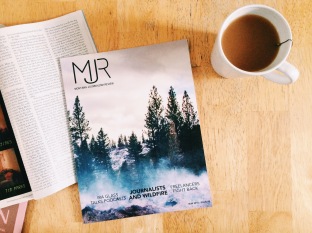
Photo of the printed edition of MJR 2016
Photo by Celia Tobin.

“Everyone who’s interested in journalism in the West must read this issue,” said Associate Professor Henriette Lowisch, who serves as MJR’s editor-in-chief. “It provides a fresh look at questions we media people obsess about, from wildfire coverage to free speech.”

Issue 45 is built around the theme “burn,” with a cover story analyzing what gets lost in often sensationalized coverage of the wildfires that are so much a part of the western landscape. Other features examine how newspapers cover anything from state politics to the new Cannabis beat. Cutting-edge scientists speak out on overlooked stories; freelancers get tips on how to make their work pay, and radio icon Ira Glass offers career advice.

Students on the staff of Montana Journalism Review receive a crash course into the world of producing a high quality magazine.

“Creating MJR is one of the most authentic experiences students can have while still in the classroom,” said Managing Editor Nicky Ouellet, a graduate student. “I’m really proud of what we’ve created, and the immense energy and dedication our staff poured into this issue.”

As other classes ramped up in September, some students of the capstone class that produces MJR were already reporting, writing and photographing on deadline. Others chased down outside contributors, who often had far more years of journalism experience than their newfound editors. For the first time, some of the stories were published on Medium.com, an alternative story platform that specializes in long-form work.

This year’s MJR team worked on improving the fact-checking and copy-editing system for increased accuracy and a more effective workflow. Corrections are now easy to find on the magazine’s newly designed website.

All stories, along with past issues of the magazine, are available online. The print magazine, which is sent to subscribers across the North America and even Europe, can be ordered through the website.

By Andrew Graham