Montana Kaimin Editors Explore Data Journalism In Denver

Montana native, Kayla Robertson, originally wanted to go out of state for college, but her tour of the UM J-school with Denise Dowling helped change her mind. “Denise showed me the Kaimin office, and I thought, I need to work here,” Robertson said.

True to word, Robertson has since become the Montana Kaimin’s design editor and has shifted her attention from print to web design. Robertson and fellow Kaimin colleague, Peregrine Frissell, recently attended a data journalism conference in Denver, Colorado to learn more about this subset of reporting.

head shots of Robertson and Frissell

The Investigative Reporters and Editors (IRE) sponsors a program called the National Institute for Computer-Assisted Reporting (NICAR). These two organizations share the mission of fostering excellence in journalism, and NICAR specifically focuses on data journalism by making government datasets available to journalists and holding annual conferences that support their community of reporters.

In order to attend the 2016 conference, Frissell and Robertson needed funding, so they pitched their joint goals to the Dean of the School of Journalism and to the Provost. Robertson felt confident about their pitch because of Frissell’s experience as a hard news reporter and her own specialization on interactive graphics.

“Kayla and Peregrine have taken the initiative to build their skills in the area of data analysis and visualization, key areas for future students,” Dean Larry Abramson said. “These students serve as role models for others, and they help steer our curriculum in the right direction. I was glad to be able to back their research trip, thanks to the generous support of our donors.”

Faculty advisor of the Kaimin, Nadia White, said she’s glad Frissell and Robertson were able to attend the conference. “They learned the most important thing we can teach,” she said. “You have to learn how to learn and to seek what you want to know.”

For Robertson, learning the technical skills proved to be most valuable. Programs like JavaScript, which helps visualize data and makes things “look pretty” on a website, connected all of her interests as both a writer and a designer. At the conference, Robertson said, “I learned a ton of hard news skills, and now I can go in any direction I want from here.”

As the Kaimin’s web editor, Frissell preferred database management to design. “The conference better equipped me to work in a newsroom and understand the work that goes into creating these pieces,” he said. “There are people out there that dedicate their lives to doing this.”

Since Robertson and Frissell were some of the only college students attending the IRE conference, they used that opportunity to network with representatives of major media outlets like the New York Times, Washington Post and Buzzfeed.

Frissell graduates in May, but Robertson still has another year to finish her journalism degree. This summer she will participate in the Missoula-to-Berlin international reporting trip, and she hopes to produce some maps and infographics along with the written stories.

However, Robertson’s already started to use the skills she picked up at the IRE conference for her work at the Kaimin. She developed interactive graphics for the current edition’s feature story, “The Ides of April,” by Hunter Pauli, and with help from Niklaas Dumroese.

As the Kaimin puts more effort into its online stories, Robertson will shift more attention from print to online design. “We can do some cool stuff,” Robertson said. “It’s the same great journalism, but we’re making it available to more people.”

Follow the latest news with Peregrine Frissell on Twitter, and stay up to date with Kayla Robertson’s design projects on her website.

By Jana Wiegand
UM Junior, Kate Shea Wins Dow Jones News Fund Internship

One phone call completely changed Kate Shea’s summer plans. She had been preparing for an international reporting trip to Berlin, Germany, when she received a call from the Dow Jones News Fund offering her a paid copy-editing internship for the same period.

While the decision to go to Texas instead was a hard one, Shea admitted, “I’m kind of a copy nerd.”

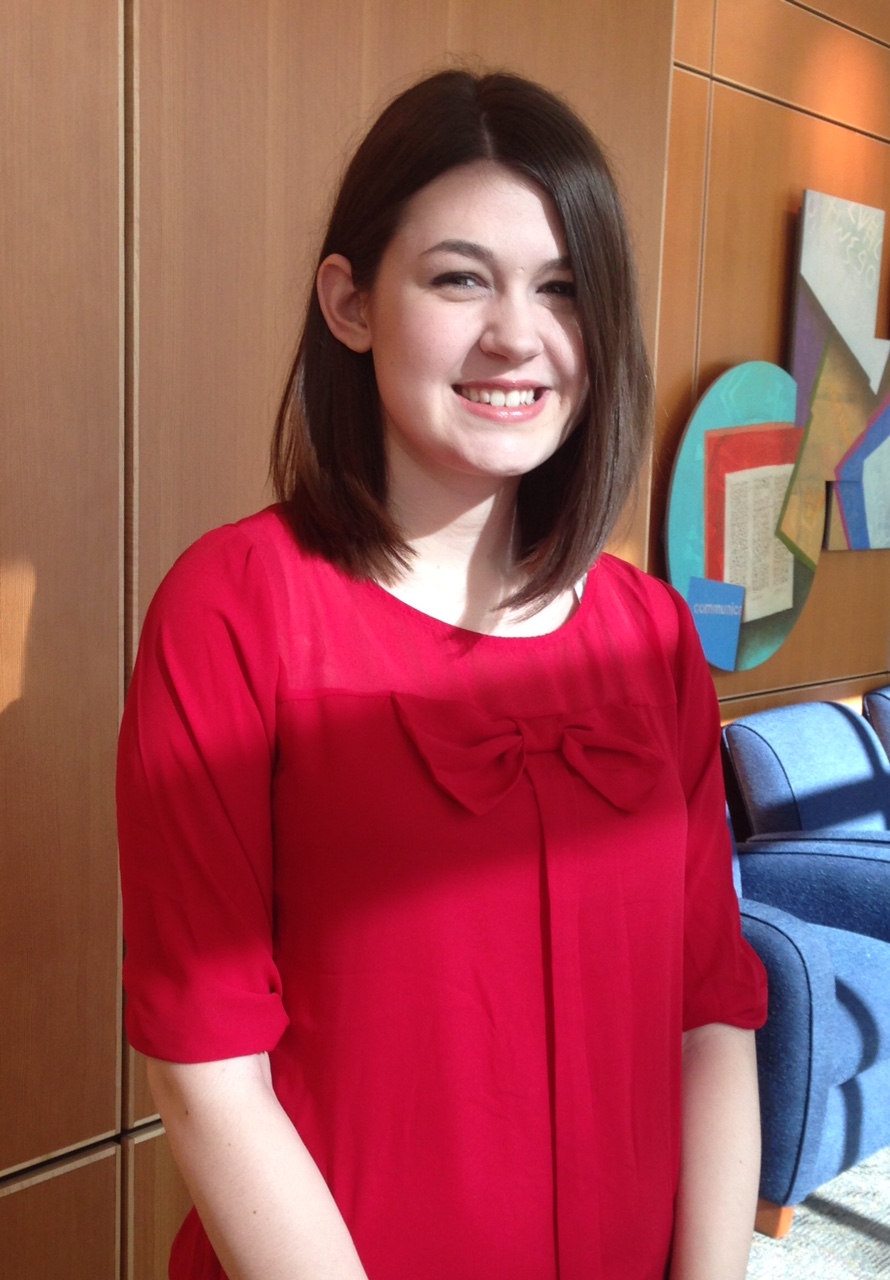
photo of Kate Shea
“In journalism, there’s still a bias against women, and women face different expectations where their looks are more important than their reporting ability,” Shea said. Photo by Jana Wiegand.

Shea currently works as the copy chief at the Montana Kaimin, UM’s weekly student-run newspaper. At her high school in Helena, Mont., she was one out of two students who worked on both their newspaper and their yearbook.

Assistant Professor Joe Eaton, recognized her drive and talent as soon as she entered the J-School. “Pretty much from Day One here it was clear that Kate was going to take on the world,” he said.

In News Editing class last fall, Eaton encouraged Shea to apply for the Dow Jones internship and take their editing test, which Shea described as “the SAT for copy editors.”

The internship will take Shea to Austin, Texas for a ten-day training program about the specific Dow Jones style of copy-editing before she enters the newsroom at The Corpus Christi Caller Times.

While Shea enjoys the journalism world, she ultimately wants to go to law school and delve into another field that will allow her to effect change in the world.

Her passion for politics comes from interning with Sen. John Tester (D-Mont.) in high school, as well as from her experience winning the Distinguished Young Woman of Montana award in 2013. In Mobile, Alabama, Shea met the winners from other states—all very well-rounded, intelligent and well-spoken women, she said, and she wants to make their voices heard.

“In journalism, there’s still a bias against women, and women face different expectations where their looks are more important than their reporting ability,” Shea said. “Sometimes you hear things like women should be on the cops beat because men will talk to pretty girls.”

However, Shea said that’s never been the case at the Montana Kaimin and that “there’s no gender bias there.” And while the Kaimin keeps her busy, especially with the switch to a weekly, more magazine-style publication, she said it’s been a great experience.

“I thought about moving out of state for college,” Shea said. “But there’s a top-ten journalism program right here in Montana.”

UM immediately recognized Shea’s strength as a leader even when she applied to the program, awarding her the Presidential Leadership Scholarship in 2013.

“She’s a very talented and hard-working journalist. I’m sure that showed through in her application,” Eaton said. For him it was no surprise when Dow Jones offered Shea the copy-editing internship. “She’s going to do a great job.”

By Jana Wiegand

Montana Kaimin staff reflect on a semester of change

Wednesday, December 2nd, the Montana Kaimin put out its last issue for fall 2015. For the all-student staff, it was the culmination of a semester of learning on the job as they guided the newspaper through its recent transition from a daily paper into a weekly print edition with daily online present, all while facing financial issues from years prior.

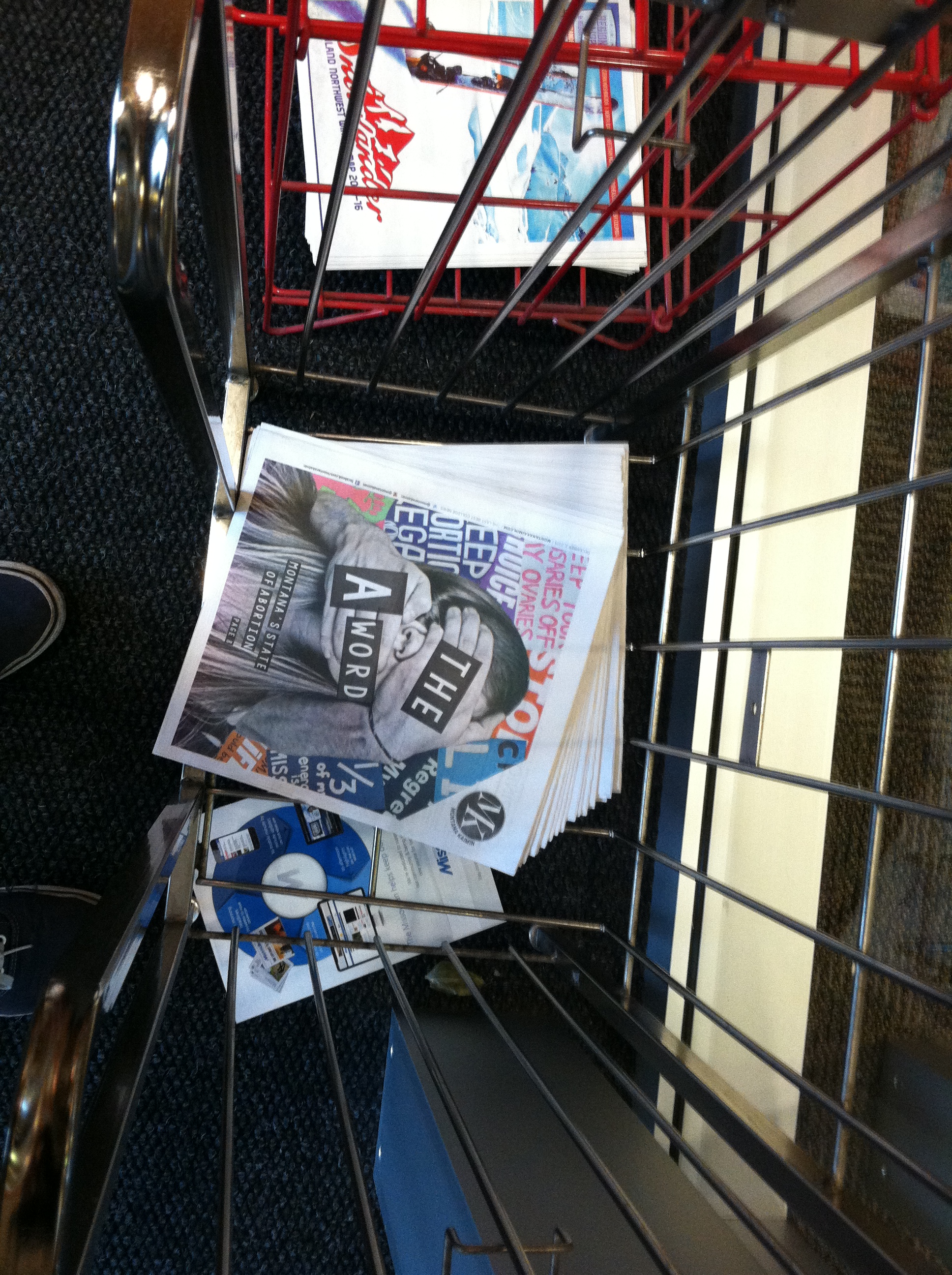
Photo of the last stack of printed Kaimin papers for 2015.
The Montana Kaimin’s last issue for the fall semester went quickly off the rack. Photo by Andrew Graham.

“For drastically restructuring something that was essentially broken I think it went really well,” said editor-in-chief Cavan Williams. He led the paper into its new format, which meant establishing a new workflow from reporters and photographers through editors and the copy team. “The whole thing was just an experiment,” Williams said, and they’ll carry on making adjustments and applying what they’ve learned to production this coming spring. That the fall went well isn’t to be confused with perfect, he noted.

The weekly edition implied more time for reporters to report and write feature length stories. Some of them, Williams said, have really taken to the long form style.

Tess Haas, a 22 year old senior from Bozeman, Montana, has worked as an arts and culture reporter for the last two semesters. She wrote two features that ran as cover stories this fall. The first was about Montana female DJs overcoming sexism in their profession, and the second, which ran in Wednesday’s final issue, was about the dearth of information and clinics for women seeking abortions in Montana.

“For people who are trying to be creative in presenting these important issues it’s really awesome to see them have the space to do it,” she said of the weekly format. Haas revels in the new style, which she says she’s used to expand on the ideas she had last spring, but couldn’t accomplish under tight daily deadlines.

Her latest story was inspired by listening to a friend talk about the difficulties of getting an abortion in Montana. The issue aroused her passion as a young female journalist. “As a young woman in Montana I think it’s extremely relative to me, and that’s what my friends talk about and that’s what I want to write about,” Haas said.

She spent a month working on the story, and says one of the challenges was finding sources that would speak about a sensitive topic. The article centered around the story of an anonymous woman who had an abortion following her first semester at the University of Montana. Having her editors allow her a month to work the story made all the difference.
Haas will rejoin the Kaimin staff for the spring semester, her last at UM, but this time around will work as the Arts and Culture editor.

For Hunter Pauli, 24 and also a senior, producing a paper with features like Haas’ was “difficult but doable.” Pauli is the Kaimin’s Managing Editor, and next semester hopes to improve their new format even further by smoothing out what he calls “anachronisms and holdovers from the daily version”

Pauli writes op-eds for the paper, and the one he is most proud of this semester listed a litany of critiques of University administration under the wry headline ‘Recent scandals this editorial is not about.’ His favorite weekly issue of the semester featured the story ‘Left Behind’ by news editor Erin Loranger, which profiled the Office of Residence Life’s ill fated attempt at establishing a Living Learning Community for veterans.

In general, Pauli is proud of his newspaper’s watchdog role over the University. “We’ve completely led the way on stories for the enrollment and budget crisis,” he said, adding that local newspapers like the Missoulian and the Missoula Independent have often followed Kaimin reporting.

By mid morning on Wednesday the last issue was already down to the bottom of the racks in the School of Journalism, but next semester students across campus can look forward to the return of the Kaimin’s independent and in-depth journalism.

You can read Tess Haas’ feature length story on abortion in Montana here.

Read the editorial Hunter Pauli is most proud of here.

By Andrew Graham