Student Work Lights Up The Summer

We say our students “learn by doing” at the School of Journalism at the University of Montana and spring and summer are prime time for many of our students to practice what we teach here. They’ve been out on assignment, finishing capstone projects, traveling abroad and doing big internships.

So, we thought we’d give you a quick recap of some of the stellar student work out there in the world right now:

In late May, the student documentary unit premiered “Montana Jails: Slammed for Solutions,” a deep dive into the overcrowding in Montana’s corrections system. Watch the documentary on Montana PBS here.
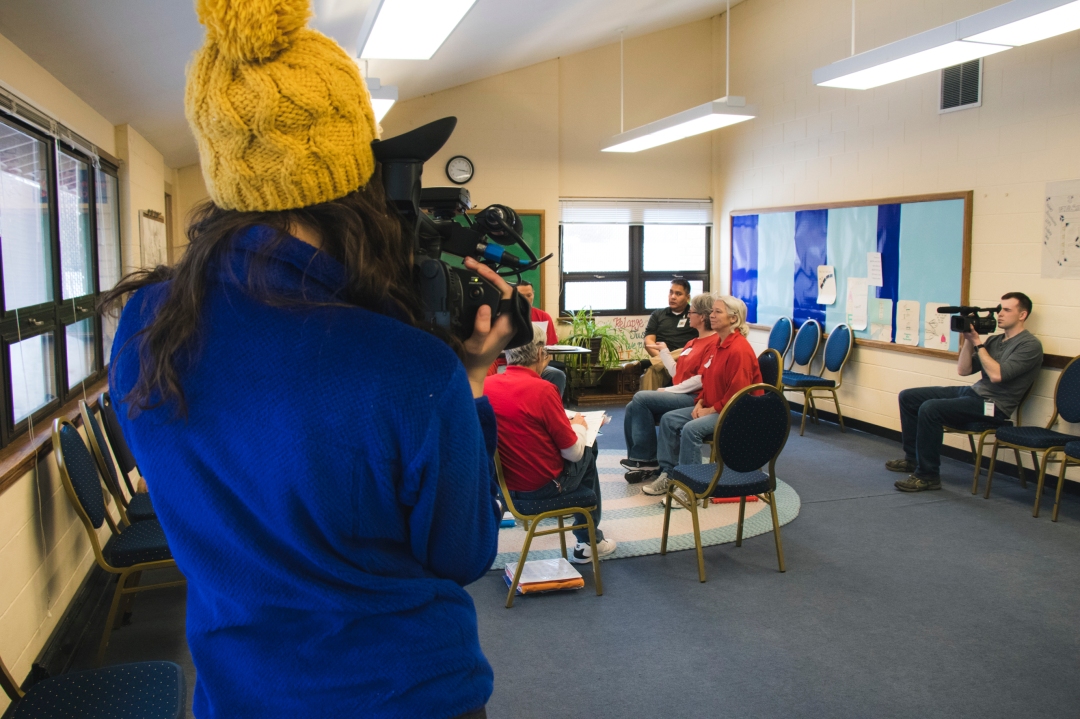
And, the Montana Native News Project, which sends teams of journalism students out across the state to cover stories with big impact on the state’s seven Indian reservations, covered the issue of sovereignty this spring. In their words: “With seven vastly different reservations across the state of Montana, each tribe has the tedious task of navigating a relationship with bureaucracy from several levels: federal, state, county, while keeping their culture intact. The 2018 Montana Native News Honors Project takes an in-depth look at those relationships and the meaning of tribal sovereignty.” The team, led by Professors Jason Begay and Keith Graham, publishes their work in print in the Missoulian and online, reaching about 60,000 readers. See their work here and here’s a snippet:

“In Their Hands” – Nearly a century after the Indian Reorganization Act, Montana’s tribes are still molding self-governance from Montana Journalism on Vimeo.

In June, “Business Made in Montana,” a 25-year-old program that looks at businesses in the Big Sky state, aired on Montana PBS. The project is produced by students in Professor Kevin Tompkins’ intermediate videography and editing class, who find and research the businesses, set up shoots, shoot, produce and edit the five pieces that make up this half-hour show. See the show on PBS here.

Photojournalism student, Jiakai Lou takes photos of a food booth owner in Gwangjang market, a traditional Korea food market. A team of University of Montana students traveled this spring on an international reporting trip in Korea through Montana Journalism Abroad. See more of their work: https://mjakorea.com/ and on Instagram: https://www.instagram.com/mt_journalism_abroad/ 📷: Ian.Baldessari.

Across the globe, the Montana Journalism Abroad team, led by Professor Joe Eaton, traveled to Korea to cover urban issues for The Atlantic’s CityLab site. Their work covered the aftermath of the Olympics, Seoul’s “war preppers” and they were there to report on reaction to President Donald Trump cancelling the North Korea summit in late May. See their work here.

Last summer, the Montana Journalism Abroad team covered the aftermath of the nuclear disaster in Fukushima, Japan. That project took home a Society of Professional Journalists award for online news reporting this year.


A group of University of Montana Journalism students conduct an interview in Japan as part of the 2017 Montana Journalism Abroad reporting trip. Photo by Tate Samata.

Closer to home, students in Professor Jule Banville’s advanced audio class spent spring semester going back to high school to produce a podcast about and with students at Willard Alternative High School in Missoula. Students dug into stereotypes and stigma, school counselors and vampires. Yes, vampires. You can listen and subscribe on iTunes, or at the student-produced Willard Podcast site. The work also aired on Montana Public Radio this summer.

(Last year’s advanced audio project, “The Meth Effect,” co-led by Professors Jule and Lee Banville won a Society of Professional Journalists award for in-depth reporting.)

Also this summer, the fall UM News team, which produces a weekly television and online news show that airs on Missoula-based KPAX-TV and ABC Montana, took home three Awards of Excellence at the 55th Annual Northwest Regional Emmy® Awards in June. Maria Anderson and Tiffany Folkes won for their piece on the Farm-to-College program at the University of Montana; Sophie Trouw, Maria Anderson and Rene Sanchez won for their piece “Vietnam to Montana: Memories of War,” and the entire UM News team won in the overall newscast category.

2018 grads Maria Anderson, Meri DeMarois, and Tiffany Folkes representing at the #NWEmmys ceremony in Seattle.

Finally, a new team of graduate student fellows in the Crown Reporting Project got out into the field this summer. The Crown project seeks to inform public understanding of landscape-level conservation, conflicting demands for natural resources and community efforts to build climate resilience. Students head into the field backed by a mentor — a veteran journalist familiar with their area of work. The Crown Reporting Project bridges journalism, science, policy and conservation, helping students develop specialized expertise that can lead to careers in science or environmental journalism. This summer, fellow Samantha Weber has been reporting on the vast landscape and history of the Blackfeet Nation and how leaders there are dealing with balancing conservation with record visitation to Glacier National Park and the surrounding area. Meanwhile, fellow Breanna Roy is reporting (by hiking with conservationists into the high alpine terrain of British Columbia) on efforts to save the threatened white bark pine. 
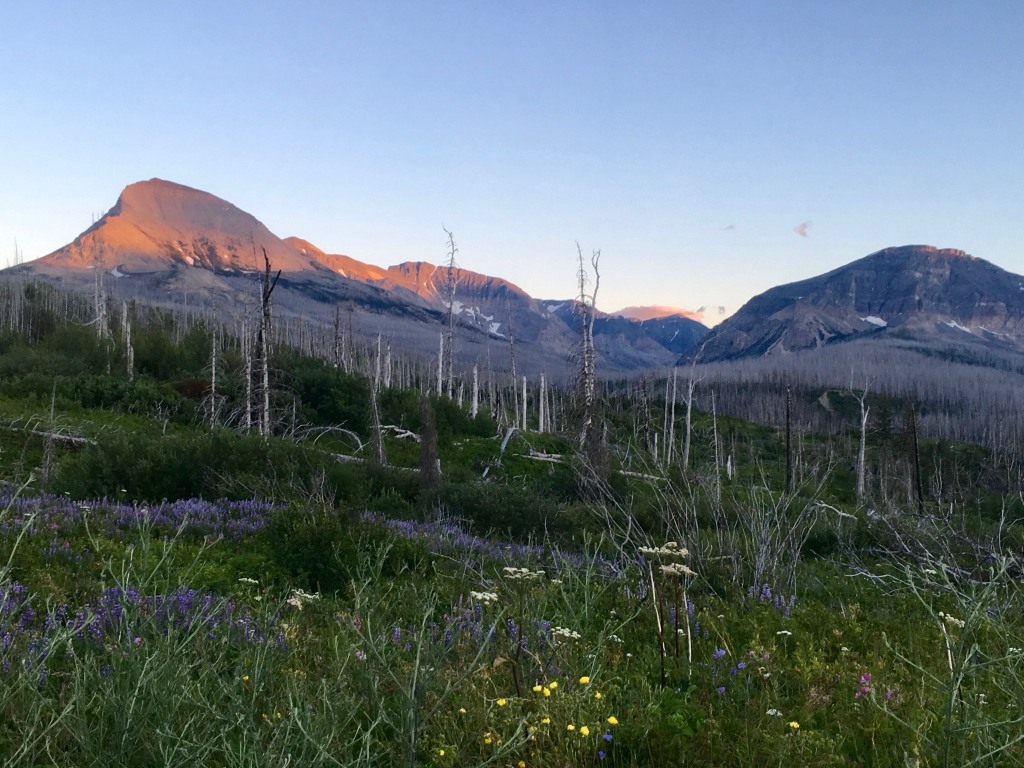
Photo by Samantha Weber.

Why Student Work Matters

We’re firm believers that one of the best measures of a journalism school is the quality, breadth and reach of the work produced by students while they’re in college. And, the best way to get to know a program is through the eyes, and work, of the students in that program. So, take some time to dive into the stories, videos, photos and audio our students have worked so diligently on this last year and there you’ll find clues as to what’s possible for you too.

We have a great year ahead of us making media that matters here at the J-School. Until then, have a great rest of the summer.
 

UM Journalism Graduate Wins Fulbright To Report on Syrian Women Seeking Refuge in Germany, Professor Joe Eaton Wins Fulbright to Teach in Vietnam

Lucy Tompkins, who graduated in December, will study Syrian women who have become refugees in Germany.

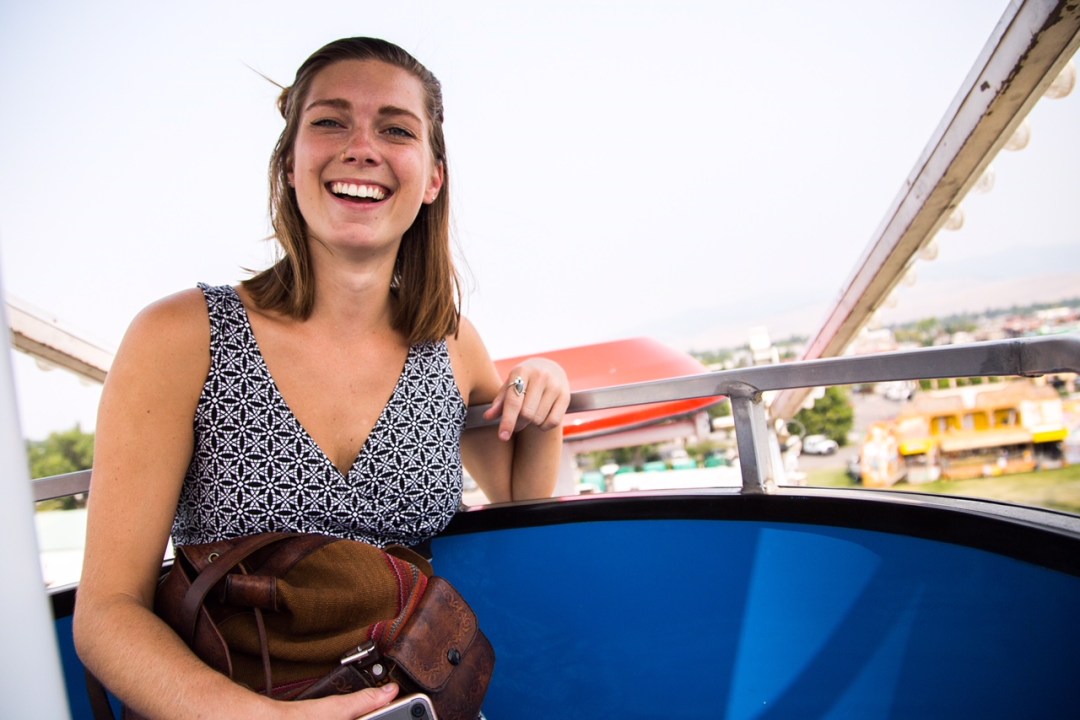
Recent University of Montana School of Journalism graduate Lucy Tompkins will spend a year in Germany studying and reporting on the experiences of Syrian women who have become refugees in Berlin as part of a Fulbright Young Professional Journalist Program fellowship.

Tompkins currently works at the Missoulian as the K-12 reporter, and in September will begin her Fulbright fellowship in Berlin, where she’ll combine her interest in women’s and refugee issues.

“The J-School prepared me so well to pursue stories of global importance, and I’m so excited for the opportunity to put what I’ve learned to work,” Tompkins said.

Tompkins was born in Seattle and lived for three years in central Mexico before moving up to Wyoming and then Montana in middle school. Her parents live in Bozeman, which she considers her hometown. Lucy graduated in December and majored in anthropology and journalism. She worked for the student newspaper, the Montana Kaimin, as a features and admin and finance reporter, following the progress of the University’s budget and enrollment issues. Her favorite school reporting projects include a series on addiction services for pregnant women in Montana, and the Native News project on health care on Montana Indian reservations. She also spent three weeks in Berlin for a summer trip through Montana Journalism Abroad reporting on the refugee crisis, where she wrote a story about atheist refugees in refugee camps.

For her Fulbright fellowship, she plans to investigate the path of Syrian Muslim women to Germany, asking “Does it offer a promise of liberation from patriarchal Islamists, an encounter with new variations of oppression and prejudice, an opportunity for self-actualization, or a challenging environment that combines all of this?”

In her proposal, she writes that her project will fill a gap in media coverage of the Syrian refugee issue, writing, “Since the refugee crisis of 2015, we have read little about what female refugees themselves think about their situation as Muslim women in a largely secular country like Germany. Often, they are traumatized by what they experienced during their flight. They tend to be the last in their families to learn German or socialize with the locals. If they continue to wear the traditional clothes of their native countries, they are likely to be marginalized by dominant feminist thought, which advocates secularism.”

Her work will involve doing in-depth interviews and photographing Syrian women. She will work with professionals who will mentor her in the research and writing of this project, and will finish the grant with an internship at a paper in Germany.

Tompkins also joined several Journalism School students in winning a Society of Professional Journalists’ Mark of Excellence Award this year. Tompkins won in the feature writing category for a piece she wrote for the Montana Kaimin on how Montana law fails to protect victims of so-called “revenge porn.”

Assistant Professor Joe Eaton also won a Fulbright grant this year. Eaton will teach journalists and professors at Tra Vinh University in Vietnam for a month this summer with his grant.

Eaton joined the Journalism School’s faculty in the fall of 2013. He is a freelance writer for magazines and websites including National Geographic, The Atlantic, Pacific Standard and Wired. Eaton teaches courses in public affairs reporting, investigative reporting and editing. He is also leading students on a summer international reporting trip to Korea this summer through the Journalism School’s Montana Journalism Abroad program.


Alumni Spotlight: Erin Billings, Senior Vice President of Communications and Public Affairs, Global Strategy Group

Graduates of the University of Montana School of Journalism go on to do great things, in journalism and beyond. They direct newsrooms, report on international issues, photograph history, inform the public on air, start their own businesses, influence public policy, publish books and become leaders in their communities. Here, we spotlight some of our alumni who showcase just how powerful, and versatile, a journalism degree from UM can be. 

This installment spotlights Erin Billings, who graduated in 1995. Billings worked as a political reporter in Montana and then in Washington D.C., where she spent 10 years reporting and editing for Roll Call. She then moved into public affairs and strategic communications and is now the Senior Vice President of Communications and Public Affairs for Global Strategy Group.

Question: Was this the type of work you thought you’d be doing when you went to school? Share any details you’d like on your work trajectory?

Answer: When I graduated from J-School, I thought I would spend my career in journalism. But after nearly 15 years, I was ready for a change, and decided to pursue a career in communications and public affairs. I’ve now been a communications consultant for six years, and I’ve found that the skills I honed as a journalist are wildly transferrable. Now I help clients navigate the media world so they know what to expect, when to expect it and how best to tell their stories.

Can you describe an average day on the job?

There’s no average day on the job in public relations, which is perhaps why I find it so rewarding. I work on a diverse and broad client portfolio – from nonprofits, to corporations to trade associations. Each client need is different (and evolving), and the issues and challenges change day-to-day.

What experiences at the J-School were notable in preparing you for your work?

Journalism School taught me the fundamentals – writing, editing, strategic thinking, all of which I use every day. The practical side of journalism, and the skills I learned at UM, taught me the importance of deadlines, responsiveness and decisiveness. It was one of the best building blocks I could have had in this career.

What are the skills you learned in J-School that you use on a daily basis? In your work? In your life?

Writing is one of the most important skills for any professional, no matter what path they choose. The J-School taught me how to write well, write thoughtfully, with precision and accuracy. The J-School also taught me to be curious, ask the right questions, and arrive at smart solutions. I use these skills every day, both professionally and personally.

What do you think makes the J-School special? Do you have any particularly fond memories of your time at the J-School?

The J-School is special, not only for the quality of the programs and the professors, but also because of the community it creates. The relationships and experiences I had on campus made such an impact on me personally and professionally. Some of my fondest memories were while working on the Kaimin, until all hours of the night, with an amazing group of students who wanted to work hard, loved the news, and who wanted to tell the most interesting stories in the most thought-provoking ways.

What do you wish you would have learned at the J-School?

I wished I had more time at the J-School so I could have explored some of the other aspects of journalism, including photo journalism. If I were to go back today, I would want to spend time learning about digital analytics and the sophisticated tools therein. I would also like to learn more about paid media strategies.

What advice would you give a student just starting out in journalism school? Or, what advice would you give to someone considering journalism school?

I would tell any prospective journalism school student to appreciate the range of possibilities a degree can offer. Journalism school is not just for someone interested in becoming a reporter; it offers a baseline of skills for a variety of careers (communications, journalism, public affairs, political work, advocacy, etc.). The fundamentals learned in journalism school can put any student on a successful professional path.