
Faculty Q&A: Professor Keith Graham on the Growth of Multimedia During his Career

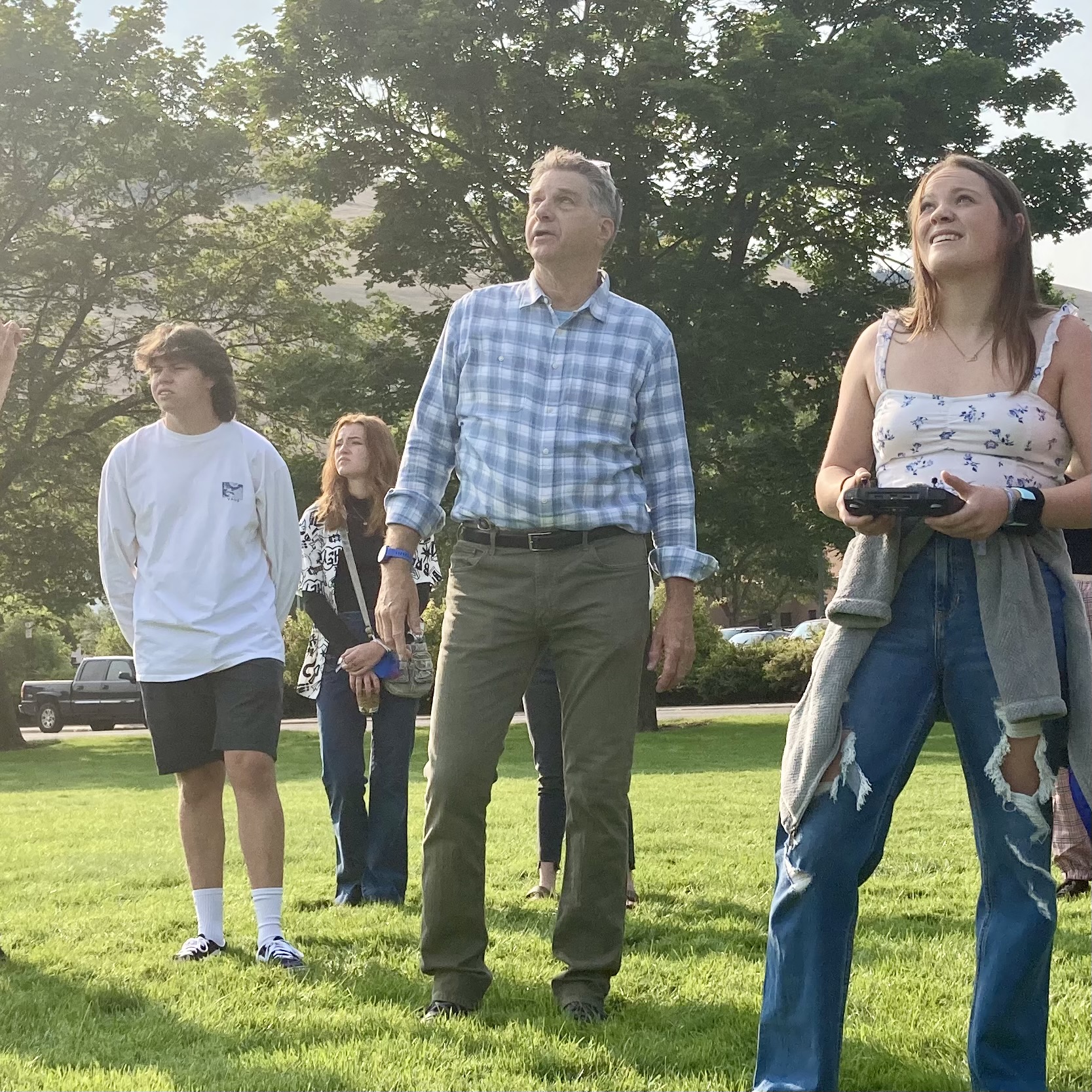
Professor Keith Graham helps a student pilot a drone during new student orientation this year.
Photo by Kathleen Shannon.

As far as anyone can calculate, Keith Graham has been a professor in the J-School for 22 years. For many graduates, when they think of the faculty of the J-School, Keith is the first name and face they see. Before he came to UM, he worked at the Miami Herald, San Jose Mercury News and the Roanoke Times.

Keith teaches photography, multimedia and graphic design courses and with his compatriot Jeremy Lurgio, leads the photo side of many of the school’s professional capstone classes. This semester at UM, he’s teaching the Byline Magazine capstone, which will publish a magazine next month, a freelance photography class and a design class.

Keith recently sat down with graduate student Kathleen Shannon. They talked about his journalism career, what it was like being part of a newspaper’s very first website and more. The transcript of their conversation has been edited for length and clarity. 

Q: I didn’t realize how multimedia focused you are. You’ve worked with a lot of media!

A: As video and audio came into more prominence, [Jeremy Lurgio and I] picked up more of that because, well, one: it’s fun, but two: it’s a needed piece of the visual reporting that journalists [do] today. Even in our [introductory] class, [we’re] trying to teach those skills. [We’re] trying to get people to understand what’s the best way to tell the story. So that’s when I look at multimedia. Audio can work great when you’re trying to get emotion and listen to background history stories.

Q: Yeah, I recently watched a ProPublica video about environmental justice for class and I learned so much in two and a half minutes.

A: So, it was an explainer video? Then that’s also when you’re saying: “well, this graphic helped me remember that seven out of 10 people did x,” right? So the graphic is what’s going to allow us to process visually.

Q: Right. I noticed that your background is more in print. Can you tell me a little bit about your path in journalism?

A: I started as a photographer. I was an English and history major in undergrad at Vanderbilt. We didn’t have journalism. My second year of college there, a fellow photographer said, “Hey, we need people [to] come work for the yearbook. Come work for the paper.” And I think that was my first taste of journalism. So I left school with English and history degrees, freelanced for three years, studied in Switzerland, came back and did grad school in photo-j, did a book for my master’s project. And so that was the first part of writing and photographing, and then also try[ing] to learn the art of interviewing. Then I got hired at the Miami Herald [as] a photographer and also did some photo editing [and] design work. I wore three hats there.

When I moved from East Coast to West Coast, I [worked in] San Jose and that was a very sophisticated paper. They were fabulous reporters. I mean, I worked with at least two people who had Pulitzers that were great teachers [as a result]. When a lot of big stories came up, because I could photograph and edit, I would go on as a photographer, but be a photo editor on-site. [I’d] cover the World Series, Super Bowls, things like that. I picked up the love of seeing the bigger picture of journalism: how words and images work together.

Then my wife got tired of the fast lane [and we] moved to Roanoke. I was there as a picture editor, photographer and then, at the end, director of photography. And that’s where the Vice President came in one day and [said] we were going to start this thing called a website for our paper. This was just a couple of years after papers were getting online. And he said “I don’t care if you lose money the first year, I want you to start.” I remember the first piece we did. That was a true multimedia piece. We interviewed the remaining World War I Vets that were alive at the time.

Q: Wow. How many were there?

A: Twenty. Before we published, the only woman [of the group] died. You’ve got to remember the tools were rudimentary. We didn’t have apps. Adobe Audition didn’t exist. We actually had to go to a studio in town to do all the audio pieces.

Having done that World War I piece, it was like: This is what you can do online. This is what you can’t do in the paper. You can’t hear the voice of the World War I Jimmy. And I remember to this day [a photographer] walking down the road with Jimmy and interviewing him. And that was like: “Wow, this is different. We used to just be in print.” We can now tell a different story.

So that was the first piece. But here [at UM], as video became more important, and audio became more important and multimedia storytelling became more important, we just moved in that direction.

Q: That sounds like a really exciting time to be at the helm in the newsroom.

A: Oh, yeah. We got to do everything. We got to do anything. In Miami, literally after the first time they called me to go out of town, I had a suitcase packed. I got called one day and they go: “You need to be in the Miami Airport within 45 minutes, if you can.”

“Where am I going?”

“Out of the country, we’ll tell you later.”

That was part of the joy of being in that. It wasn’t: can we? It was: who’s going?

Q: Yeah. I know that the [newsroom] culture is a little different now.

A: Well, the culture is different. But the storytelling is still there. [The trick is] finding what’s relevant and finding a niche for yourself and an audience. Good stories need to be told. Good storytellers need to tell those stories, in whatever form.

Q: Is there a part of your academic year that’s really exciting for you?

A: Well, when we teach capstones [like the] Byline magazine class, this is when the time gets fun and crazy. Tuesday, we [did] our first copy slam.

When I’m teaching a freelance photo class, it’s so different because it’s not just editorial. It’s the only class where I expand past journalism, if you will. Because you want to train people here to be [able to freelance] when they want to work [both] in [and] also outside of journalism. So that class is fun, because it’s different assignments. They just turned in nature and wildlife. They’ll do portraits, we’ll do food, we’ll do products, we’ll do fashion, we’ll do travel and adventure sports portraits. We’ll do drones. Then we talk about business. I talk about copyright. I talk about contracts. It’s different every week. There are so many things we can do.

Then I teach a design class, too. I customized that class for Illustrator and InDesign, and then content management systems. I used to teach HTML and Dreamweaver in there. But I’ll leave that for a coding class. It’s a fun class because, again, it’s custom. Do you want to do more concert posters and book covers? Or do we want to do more magazines and social media graphics? We always do websites, but we also talk about theory of typography and color. It’s a different mindset, too. People get to have the creative part, but they’re graphic journalists. You were talking about the graphics earlier. You know, those are a part of storytelling. And why we’re attracted to that and how we need to display that. So people will look at, read, consume and understand [it]. And educate along the way.

Q: My last question is a light-hearted one. What would you get up to on an average Saturday?

A: Oh, well, depending on the week, it’ll be mowing the lawn and raking leaves. If [it’s the right] time, we’ll be at the Griz game! But also working. Most of my projects are rural. That’s what I love. I’m looking at a project on 150 years of livestock brands in Montana. The first livestock brand book: 1873. So [2023] would be the 150th anniversary. So that’s why I’m looking. It’s still being a journalist and it’s a lot of fun.
Faculty Q&A: Professor Elisabeth Kwak-Hefferan on Her Freelance Career and the Power of ‘Campus Energy’

By Kathleen Shannon

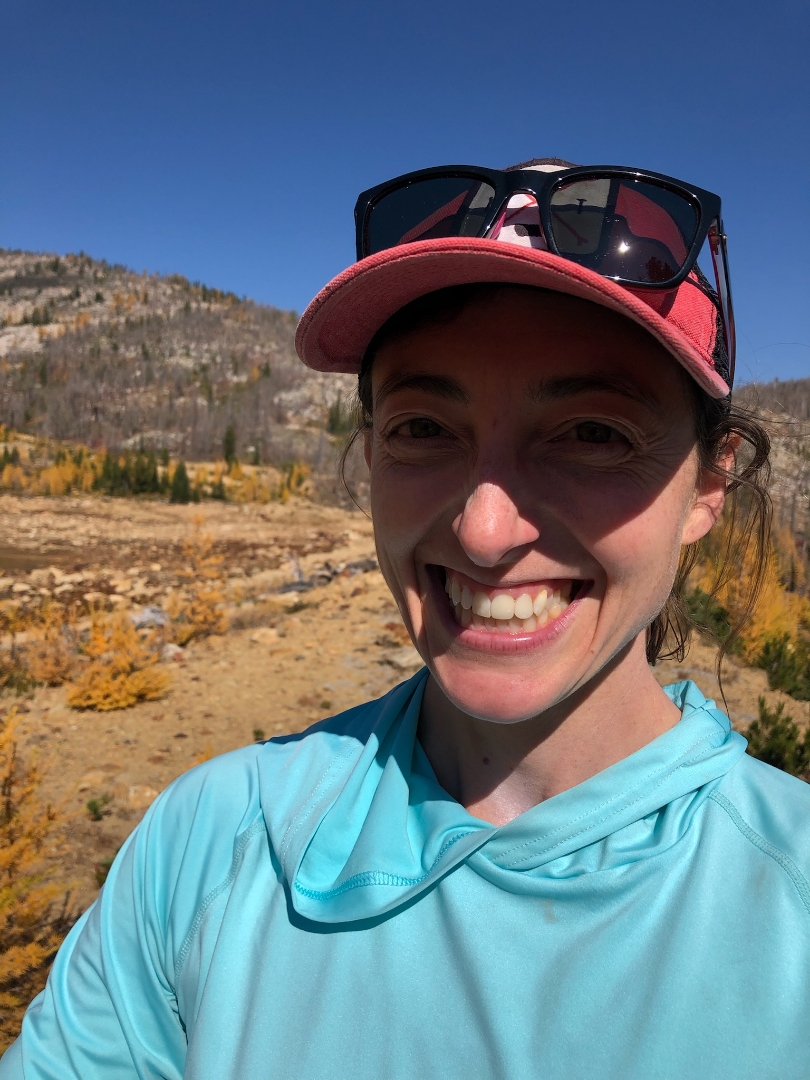
Courtesy photo.

Elisabeth Kwak-Hefferan is an adjunct professor teaching a foundational seminar for new graduate students called Journalism and Society. She has done a variety of writing as a freelance journalist and she works as the deputy editor of Outside Business Journal’s print magazine.

Below is a lightly-edited transcript of Elisabeth’s conversation with graduate student Kathleen Shannon. Read to the end to find out how Elisabeth likes to spend her Saturdays in Missoula.

Q: Tell me about your background in journalism. 

A: I started out as a reporter working in a very small rural town in northwest Colorado at the Moffat County Morning News. I loved the job and I hated the town. I decided to go to graduate school after that, and applied to Northwestern and got in there and decided to specialize in magazine journalism. Because that was always my dream: to have a little bit of extra time versus [being] a daily newspaper reporter. I interviewed with Backpacker [Magazine] and got an internship. Right around that time, they were bought by Active Interest Media. They had been in Pennsylvania and they moved to Boulder, Colorado, so I was super excited about the chance to move [there]. I worked there as an intern for eight or nine months and then one of the junior editors happened to leave and so that opened up an assistant editor job that I got. So I started out editing the “Skills” section of Backpacker, [which] still remains near and dear to my heart. Then I decided to try a job [at an] educational media company and learned a bunch of video stuff and also learned that that wasn’t really where my heart was. So I got back into print and magazine journalism as a freelancer and I’ve worked on a variety of things over the past decade or so. I’ve done some freelance editing, I worked as the editor of Yellowstone Journal Magazine, which has turned into National Park Journal since I left. I have written all types of stories for Backpacker, 5280 Magazine, Women’s Adventure, The New York Times. I am also the deputy editor of Outside Business Journal’s print magazine, which we launched about three years ago. I’ve been doing that on a contract basis ever since. 

Q: That was probably a really cool learning process. 

A: Yeah, it was. We really had to build a magazine from the ground up. And we had to do it fast because the company really wanted to distribute it at the outdoor retailer show that year. When we started [it was] early fall and it was done by January. That’s kind of our timeline now for an existing magazine. Doing that plus also deciding what it even was, was crazy. But it was really fun. And it’s been really well-received. We’ve gotten a whole bunch of awards and award nominations. So it feels really good to be a part of it. 

Q: What are some of your most fun duties as an editor? 

A: The best part of any production cycle is always the beginning. It’s the brainstorming phase when [we] have kind of a blank canvas and we have to figure out what we’re going to put on there. It’s like piecing together a puzzle because you have specific topics and areas that you want to hit like, for example, DEI (Diversity, Equity and Inclusion resources). Inclusion is a really big part of our magazine, so we always want to make sure that we’re representing that topic in some way. Sustainability is a huge part of it. We want to make sure we have a good mix of writers and a good mix of types of stories. You know, we’ve got 80 pages to fill and we meet together and brainstorm different ways to do it. We bring in our art team and they talk about the different ways that we can visually put these together, which is always really fun because that’s not my strong suit.  

Q: I bet having 80 pages to fill feels like a big moment of possibility. 

A: [Then] you kind of get into the grind of actually doing it. That’s fun: to work with individual writers. Particularly with a less-experienced person who’s got a lot of potential, it’s really rewarding to kind of help them figure out how to find their own voice and how to put a story together. Then you get to the last couple of weeks [when you’re] just reading the same thing over and over again. It’s really daunting. 

Q: How does it feel to be back on a campus and teaching here at UM? 

A: It feels great. I always was just a big fan of school, in general. I loved college, I loved going back to grad school and just being back in that environment because you don’t really have the same, you know, business pressures. Really, it’s a place where you’re supposed to just dedicate yourself to learning and getting better and talking about big ideas and figuring out what you want to do with your life. I think that environment is just very invigorating and inspiring. So it’s really nice to be back among students who are in the middle of that. And it’s fun to just be on the campus and feel the energy of the campus scene. 

Q: Who are some writers that you admire and like to read? 

A: I love Susan Orlean. She’s awesome. A colleague and friend of mine who I think is brilliant is Tracy Ross. She writes about everything, but she does a lot of outdoor journalism. And she’s wonderful. Bruce Barcott. He’s out of the Pacific Northwest, and he does a lot of really interesting kind of environmental and outdoor stuff. 

Q: Tell me about a project from your career that you’re proud of.  

A: My very first big feature story was a neurology and outdoor piece that I did for Backpacker. I think we ended up calling it “Hiking makes you smarter.” It was about research in the Utah desert. There’s a researcher who is at the University of Utah who was look[ing] at how wilderness immersion changes the way the brain works, specifically relating to [how it] restores your executive function. So I got to shadow him and a couple of his co-researchers as they went on a trip in southeastern Utah, [while] they were coming up with the way they wanted to tackle it. It was such a cool way to bring hard science into a magazine like Backpacker and a great way for me to learn how to handle a bigger story. 

Q: What kind of fun thing do you find yourself doing on an average Saturday in Missoula? 

A: We almost always are out on a local trail with the kiddos. You know, they’re not super fast. It’s not usually a hardcore hike, but we take them somewhere beautiful and let them run free. And everybody’s in a good mood and everybody gets tired. 

Q: Great! That’s like me and my dog. 

A: Four-year-olds and dogs are very similar. You gotta work ‘em out. 

Fall T. Anthony Pollner Distinguished Professor Jan Winburn Says Even When the News is Bad, It Pays to Stay Engaged

Editor’s note: You can listen to and download Jan Winburn’s full lecture on Soundcloud here. You can also listen to the full lecture here or with the video below.

By Kathleen Shannon

Jan Winburn, this semester’s T. Anthony Pollner Distinguished Professor, understands why people may be feeling burned out on the news.  

“I was not surprised to learn that the word ‘doom scrolling’ was added to the Oxford American Dictionary in 2020,” she said to a crowd of about eighty students, professors and community members in the University Center Theater on Monday, September 27. 

But, in her lecture titled “Don’t Tune Out: How the Barrage of Bad News can Make You a Better Person,” she said there may be benefits to staying engaged.  

“Research shows that the traumatic and the tragic are avenues to connection and compassion. And what do we need more in this polarized world?” she asked. 

Winburn’s interest in trauma reporting began on the worst day of her own life — when she learned her brother, Jim, had died in a military plane crash.  

She was at the start of her own career in journalism when she was interviewed by a journalist about her loss. 

“[The journalist] was in pursuit of a story like so many, a headline that marks an ending. It was the ending of a search, the end of my brother’s life and the end of our hope. But sometime after that day, and the years that followed, I began to understand personally and as a journalist, that where every headline marks an ending, a new beginning was about to unfold,” she said. “And those were the stories I became interested in telling.” 

Frank Ochberg, founder of the Dart Center for Journalism and Trauma, calls this reporting  “Act Two” journalism — “Act One” as the witnessing, “Act Two” as reporting on what comes after. Winburn said this is where journalists have the opportunity to report in a “better and more humane way.” 

Act Two journalism “is often the product of what I call ‘slow journalism,’ in which a reporter can give survivors time to process what has happened to them, and perhaps make some sense of it,” Winburn said.  

“Let me be clear, these stories do not deny or erase the suffering. But telling them seems [as] important as bringing you the news. They give a fuller, more balanced account of human trauma and recovery. They convey complexity and subtlety. They aren’t just informational. They are experiential. They touch the heart, as well as the head,” Winburn said. 

“Sometimes the story can be told within days of a tragedy. More often it takes weeks, months or years. This type of storytelling has its own effect on readers, listeners and viewers. Research has shown that the more information the brain absorbs about a person, the more empathy grows for that person. In other words, deeply told narrative stories—stories that put you in someone’s shoes—can spark feelings of empathy,” she said. 

Winburn referred to the work of Harvard professor and social scientist, Arthur Brooks, who has said some people who have been through trauma may later experience “post-traumatic growth.”  

“We’ve all known somebody who’s gone through some terrible trial, and yet, says: ‘that was the worst time in my life and it was the best time in my life.’ They’ve survived a devastating trauma, but they report feeling transformed: changed in some positive way,” Winburn said. 

Winburn witnessed that very phenomenon in her own family in 2009. Thirty years after her brother Jim died, an Air Force friend of his called Winburn’s family to tell them about the recent local effort to clean up the crash site where Jim had died, which was high up in the Utah mountains. The work crew had found a watch, the owner of which they could identify by a serial number.  

It was Jim’s. 

Winburn, her parents, and her brother, Jack, took a trip to visit the site two years later. They were guided by locals and followed a GPS to find the exact site — a scar on the mountain still visible after three decades. The family left a small, granite marker on the site. Winburn said she was comforted by the beauty of the place. 

“The next morning at breakfast in the hotel, my mother recalled being awakened in the middle of the night on December 3, 1977,” Winburn said. “My father [had been] traveling and she was home alone when the two Air Force officers knocked on the door. My dad listened quietly. He’d always regretted not being there with my mother in that awful moment.”  

“But soon, he was caught up in his own reverie. He replayed for us every moment of our journey from Georgia to Utah and Nevada, to the Goshute Reservation, to the peak known as Haystack Mountain. It was, he told us, one of the best days ever.” 

Winburn encouraged listeners to curate their news by looking for these “Act Two” journalism stories: 

 “Students who graduated from this university, people who teach here or have taught here, and students learning the ropes today: they tell these stories. Or, they will. Because these are the stories that matter.” 

The Pollner professorship was created in 2001 by the family and friends of T. Anthony Pollner, a 1999 School of Journalism alumnus who died in a motorcycle accident. You can learn more about the professorship here. Winburn is the 28th Pollner professor at the School of Journalism. You can read more about Winburn’s background in Kathleen Shannon’s recent Q&A with her.

Kathleen Shannon is a first-year graduate student in the School of Journalism’s Environmental Science and Natural Resource Journalism Master’s program.