
Good Work Wednesday: Oct. 26, 2022

by Jocelyn Harris

Editor’s Note: In an effort to celebrate and highlight some of the best journalism happening in Montana, in environmental and science journalism as well as the good work being produced by our UM J-School alumni, each week, the School of Journalism is compiling these stories in this new feature: Good Work Wednesday. Look for it every week and if you have suggestions of journalism works we should highlight, email Good Work Wednesday curator and grad student Jocelyn Harris at jocelyn.harris@umconnect.umt.edu.

Top Montana News Stories:

1. The long road home: Missoula leaders reflect on plan to end homelessness (by Bret Anne Serbin / Missoulian)

Serbin checks up on Missoula’s 10-year plan to end homelessness enacted in 2012. Her sources acknowledge they were unlikely to ever meet such a lofty goal, but various Missoula services can still help many unhoused Missoulians along the way.

2. Montana’s vaccine mandate ban goes on trial (by Sam Wilson / Helena Independent Record)

Sam Wilson, covers the ongoing trial of the controversial Montana law prohibiting most businesses and employers from mandating vaccinations. Of particular concern for the plaintiffs are health care facilities, where employees can refuse the vaccine and refuse to disclose their vaccine status.

3. Montana-based online platform showcases Native American artists and their work (by Aline Hauter / KPAX)

Hauter writes about TRIIA, an online platform for Native American artists that gives them a way to tell their own stories. She quotes Billings-based artist Ben Pease as saying, “For so many years, our stories as indigenous people have always been told by somebody else than ourselves and I think it’s powerful being able to tell our stories ourselves.” 

4. Bozeman residents count cars running red lights at intersection (by Edgar Cedillo / KBZK)

Cedillo reports on the local push to increase traffic safety in Bozeman. Residents counted 12 cars running red lights in 30 minutes at the intersection where Kelly Fulton, a Bozeman High School teacher, was fatally struck by a vehicle earlier this month.

5. Public comment sought for Owen Sowerwine conservation easement (by Hayden Blackford / Daily Inter Lake)

In this story, UM alumnus Hayden Blackford brings attention to the 442 acres of floodplain east of Kalispell playing host to over 150 bird species. Awaiting community feedback and State Land Board approval, the Flathead Land Trust seeks to purchase the easement to secure the environment in perpetuity for wildlife, public enjoyment and educational opportunities.

Science and Environmental Stories:

1. The world’s biggest marine reserve seems to be doing its job (by Tim Vernimmen / National Geographic)

Vernimmen conveys the findings of a new study on the expanded marine protection area in Hawaii. A good sign for fish and people who depend on them, the catch rate near the reserve has gone up, suggesting that the expansion had the desired effect of restoring fish populations. He quotes Alan Friedlander, chief scientist for the National Geographic Society’s Pristine Seas project, as saying, “This is one of the few studies to show actual spillover benefits, which are often difficult to prove. That is great news as it suggests a robust approach we can use to evaluate and improve protected areas elsewhere.”

2. EPA to further slash emissions from climate super-pollutants (by Allyson Chiu / The Washington Post)

Chiu covers the EPA’s newly proposed plan to phase down the use and production of hydrofluorocarbons, super-pollutants that contribute to global warming. In her reporting, Chiu spoke to EPA Administrator Michael Regan, the Environmental Investigation Agency, and the Air-Conditioning, Heating and Refrigeration Institute, and all seem to agree that the plan is a solid step in the right direction.

Student/Alumni Story of the Week:

Historic white bison Big Medicine to be returned to Flathead Indian Reservation (by Eric Jochim, ’07 / KPAX)

In his story about Big Medicine, UM alumnus Eric Jochim writes about the agreement to return the sacred white bison to the Flathead Indian Reservation. He quotes Shane Morigeau, Confederated Salish and Kootenai Tribes Deputy Executive Officer, who said that Big Medicine “holds tremendous traditional, cultural, and historical significance to us. He’s an ongoing source of pride and his medicine represents the past that had carried forward to the present and the work yet to be done to protect our identity, culture, and well-being into the future.”
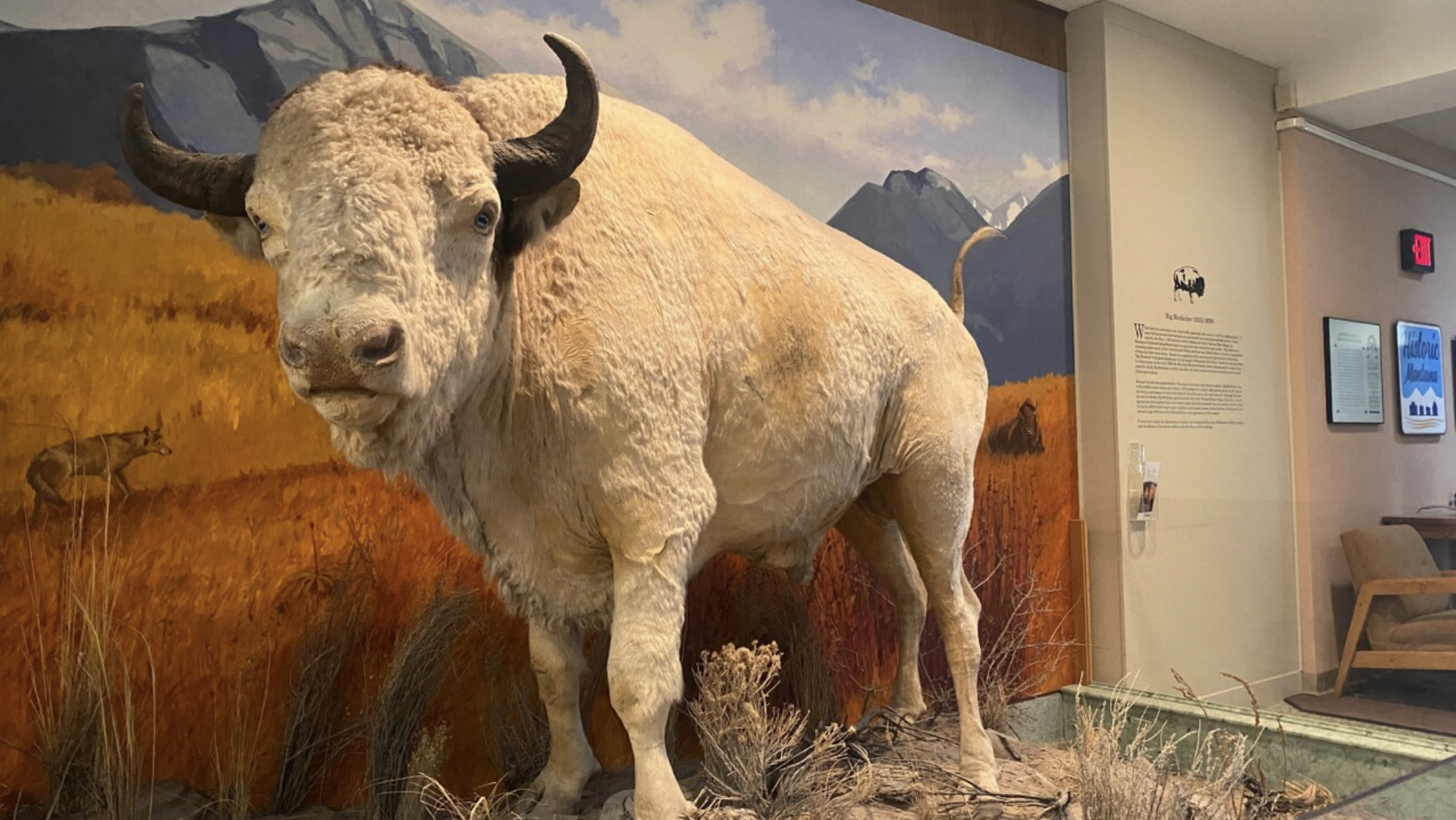
Big Medicine, the sacred white bison born at the National Bison Range in 1933, is on display at the Montana Historical Society (MHS) in Helena where he has resided since 1961. Under the new agreement, he will be returned to the Flathead Indian Reservation once a proper space is secured for him. 
Photo credit: SAM HOYLE / MTN News 

Editor’s Note: A previous version of this post incorrectly identified Sam Wilson as a graduate of the UM J-School. We apologize for the errror.
Good Work Wednesday: Oct. 19, 2022

by Jocelyn Harris

Editor’s Note: In an effort to celebrate and highlight some of the best journalism happening in Montana, in environmental and science journalism as well as the good work being produced by our UM J-School alumni, each week, the School of Journalism is compiling these stories in this new feature: Good Work Wednesday. Look for it every week and if you have suggestions of journalism works we should highlight, email Good Work Wednesday curator and grad student Jocelyn Harris at jocelyn.harris@umconnect.umt.edu.

Top Montana News Stories:

1. Visits to the Big Sky Food Bank more than tripled over the summer season (by Jack Reaney / Explore Big Sky)

Reaney’s story looks at the increased need for food bank resources this year in Big Sky. The spike in food bank visitation could be the result of inflation and tourism growth bringing more seasonal workers to the Big Sky area. Reaney quotes Sarah Gaither Bivins, operations manager and services navigator of the food bank, as saying, “Before COVID, we used to allow people to shop once a month—not that we ever turned anyone away. Now, you can shop up to once a week if you need to.” With Fall in full swing and winter around the corner, Reaney notes the food bank’s need for canned food during its annual Great Pumpkin Giveaway and winter clothing for adults, according to Bivins.

2. Tranel stakes election pitch on a return to the ‘middle’ (by Holly Michels, ’06 / Helena Independent Record)

UM alumna Holly Michels covers Monica Tranel’s campaign as she seeks to become the first Democrat Montanans send to the U.S. House of Representatives in almost 30 years. Republican opponent Ryan Zinke paints Tranel as an extremist liberal, but Michels’ reporting shows that Tranel is first and foremost a Montanan. “In the Montana I grew up in, nobody talked about (political) parties. We didn’t mention it. We talked about each other, we talked about the basketball game,” Tranel said.

3. ‘A little chaotic’: Fromberg family still rebuilding months after flood (by Paul Hamby, ’20 / Billings Gazette)

J-School alum Hamby describes one Fromberg family’s struggles after the June 13 flood forced them out of their home. In the face of climate change, this tale could become an all-too-familiar one. He writes, “A cold May packed the Beartooth Mountains with fresh snow. Warmer temperatures through June turned snow melt into a water cannon that shot down into waterways spreading through Park, Stillwater and Carbon counties.” Rebecca and James Shaw and their two sons have been dealing with chaos ever since, sometimes helped by relatives and volunteers. Hamby quotes Rebecca as saying, “Everyone wants to help that first week, first month, but some of it’s long-haul stuff.” She urged anyone still interested in volunteering to check in with https://www.rlacf.org/.

4. Plein air painters from across the US gather in Hamilton for workshop (by Jessica Abell / Ravalli Republic)

In between environmental disaster headlines, it’s nice to see Abell’s story about plein air painters dedicating their time to admiring and capturing the natural beauty of Hamilton’s Bitterroot River. Attracted by YouTuber Turner Vinson’s third Hamilton workshop, about 20 artists from cities like Atlanta, Boston and Chicago came to Montana to balance the hubbub of their daily city lives. Abell quotes one participant, Matthew Johnson, a Chicago-based Kung Fu teacher, as saying, “So this is definitely more yin to all of the yang in my daily life.”

5. Migration accumulation: Report highlights importance of wildlife corridors (by Brett French, ’85 / Missoulian)

For his story about wildlife migration corridors, UM alumnus Brett French spoke with Matt Skroch, project director for U.S. Public Lands and Rivers Conservation at the nonprofit Pew Charitable Trusts, who said Montana’s population growth is imposing bigger strains on wildlife populations. French examines a recent report by Skroch and Leslie Duncan, which considered several migration studies and their implications for conservation efforts. He quotes Skroch as saying, “The report is a call to action, really,” Skroch said in a phone interview. “It’s a call for using the latest and greatest in scientific insights to preserve these populations of incredibly important wildlife into the future.”

Science and Environmental Stories:

1. Truck makers tout an electric future. Privately, they’re stalling it. (by Anna Phillips / The Washington Post)

Phillips holds truck manufacturers to account in this story about the disconnect between public and private actions. On the surface, the truck industry is amenable to mounting pressures to electrify large trucks, but behind closed doors, their lobbyists are fighting to delay this goal. Hammering home the significance of this issue, Phillips writes, “Policymakers are targeting the sector because it accounts for nearly a quarter of all greenhouse gas emissions from vehicles in the United States and generates harmful pollutants that cost thousands of lives each year. A recent American Lung Association report estimates switching to zero-emission trucks would prevent 66,800 premature deaths over the next 30 years.”

2. Indigenous Leaders in Texas Target Global Banks to Keep LNG Export Off of Sacred Land at the Port of Brownsville (by Dylan Baddour / Inside Climate News)

Baddour tells the story of Indigenous leaders fighting environmental injustices and staving off the development of liquified natural gas (LNG) facilities in Texas. Juan Mancias, chairman of the Carrizo Comecrudo tribe, is working to protect the Rio Grande Valley from such developments, which are re-energized by the war in Ukraine. Baddour quotes Mancias, 68, as saying, “When you steal the land, you’re stealing us. And you’re taking away our identity, because you fence it off and you don’t allow us into the land where our ancestors are buried, where we remember our ceremonies and rituals.”

Student/Alumni Story of the Week:

Land Board approves purchase of Big Snowy Mountains Wildlife Management Area (by Tom Kuglin, ’06 and ’14 / Montana Standard)

Tom Kuglin earned a BA in english and Master’s in environmental science and natural resource journalism from UM. In this story, he covers the Montana Land Board’s approval of an $8.22 million purchase of 5,700 acres in the Big Snowy Mountains to be managed by Montana Fish, Wildlife & Parks. The sale of this property, previously owned by Shodair Children’s Hospital, will provide funds for hospital construction, and open new land to the public. However, the decision was not without some controversy. Kuglin quotes Attorney General Austin Knudsen, who casted the only dissenting vote, as saying, “I do think Fish, Wildlife & Parks has an empire-building problem. I do think they have a problem with maintenance and management of a lot of land that they already own.”

UM Journalism Unveils Women’s Wall to Honor Pioneering Women in Journalism

By Josie Harris

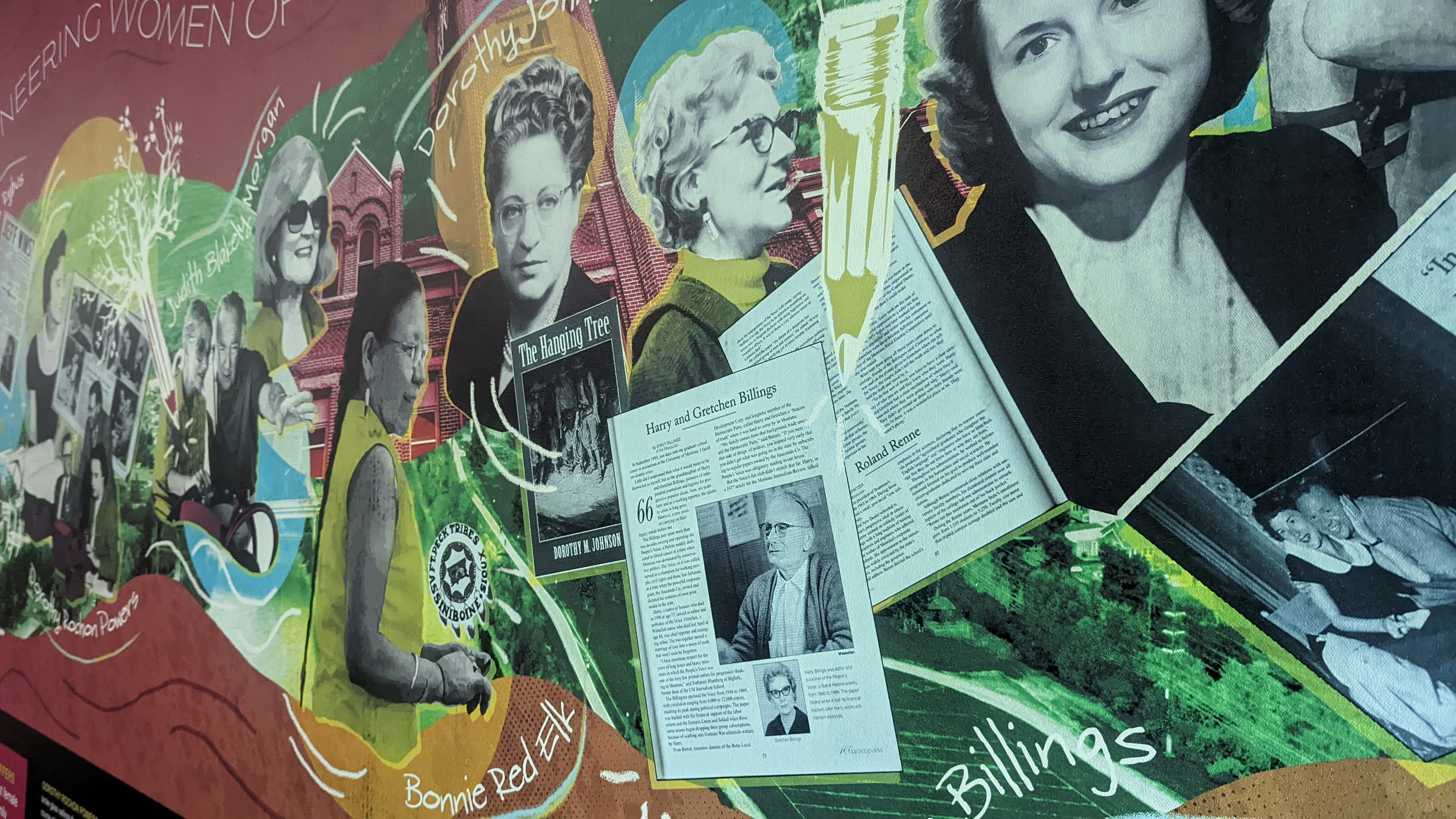
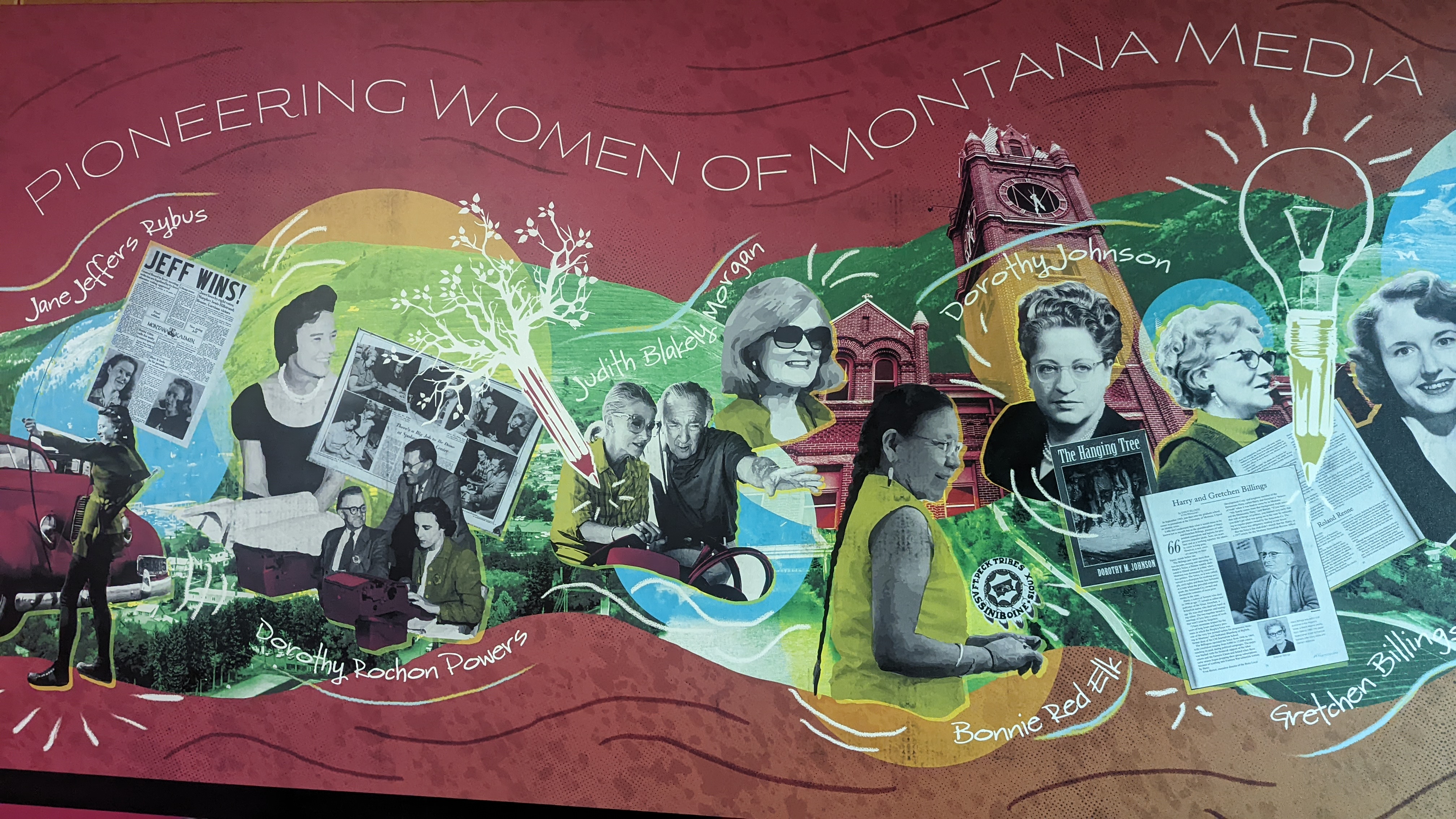
Alumni and friends gathered at the University of Montana School of Journalism on Friday, September 23 to celebrate the unveiling of  new, large-scale, vibrant piece of art hanging in Don Anderson Hall designed to honor women pioneers in Montana’s journalism history. The piece features seven trail-blazing women and artifacts related to their work.

The idea for the women’s wall was conceived shortly after Jane Jeffers Rybus ’46 passed away in October 2018. As a Griz, she was known around campus as “Jeff” and during World War II became UM’s first woman student body president.

Her death moved Tom and Pam Rybus, her son and daughter-in-law and supporters of the Montana Media Lab, to approach then interim Dean and later Director of the J-School Denise Dowling and then Development Director Gita Saedi Kiely to explore how Jeff and her legacy could be honored.

Together, they developed the idea to create a piece of art celebrating Montana women who made ground-breaking achievements in journalism and media.

In addition to Rybus, Dowling and Kiely thought to pay tribute to other women journalists in Montana’s history. After a year-long search including hours of research, faculty input and discussion, they selected six more women to be featured on the wall including Dorothy Rochon Powers, Judith Blakely Morgan, Bonnie Red Elk, Dorothy Johnson, Gretchen Billings, and Aline Mosby.

To make their vision a reality, they commissioned artist and alumna Amber Bushnell McBath ’11, an innovative media artist, to curate the glowing homage to the seven honorees.

Viewers gathered on Friday to admire the completed work for the first time. Found on the first floor of the School of Journalism—suitably located near the Montana Media Lab, which is devoted to innovation, experimentation and emerging media—the women’s wall greets students along the popular gathering and studying spot that stretches across the J-School’s south entrance.

At the dedication event, Dowling invited family members of the honorees to speak.

Erin Billings ’95, who was herself a dogged and acclaimed political journalist and now works in strategic communications,  spoke passionately of her grandmother, Gretchen Billings, who wrote and edited for the People’s Voice, a progressive Helena-based paper. In the 1940s-60s, Gretchen didn’t just cover controversial topics, she ran into them.

“She broke the glass ceiling for women in political journalism,” Billings said..

Kristofer Boyd, Bonnie Red Elk’s nephew, who worked alongside Red Elk at her self-started paper, the Fort Peck Journal, expressed great appreciation for her influence and devotion to holding tribal government officials to account, and for standing out in an industry often dominated by men.

“I’m glad things are changing, I really am,” Boyd said.

Following the dedication, Lee Banville, the new director of the School of Journalism, held a panel discussion with three young women in journalism: Maritsa Georgiou ’07, Katheryn Houghton ’15 and Madison Dapcevich ’17. They each shared insights into their very different careers.

Georgiou, a national correspondent for Newsy and award-winning broadcast journalist, spoke of her dedication to getting across the whole story.

“Even if it takes seven minutes to tell,” she said, “I want everyone else to know everything I learned, too.”

Covering all things healthcare as the Montana correspondent for the nonprofit Kaiser Health News, Houghton challenged the assertion that healthcare is an uninteresting, dry topic. “When you talk about access to healthcare, you’re talking about people’s most personal moments,” Houghton said.

As a science reporter and fact-checker at Lead Stories and former science communication fellow with the Ocean Exploration Trust aboard the E/V Nautilus, Dapcevich hardly struggles to make her beat interesting. Instead, Madison said her challenge as a science fact-checker stems from the complicated process of science. She can’t always deliver the answers people want when they want them.

The women’s wall and the dedication represents a great collaborative effort to honor the inspirational women who “blazed a trail for our young female and male students,” Dowling said.

Follow the J-School here and on Instagram @umjschool in the coming days and weeks as we profile each of the outstanding women honored in this dedication.