Montana Kaimin staff reflect on a semester of change

Wednesday, December 2nd, the Montana Kaimin put out its last issue for fall 2015. For the all-student staff, it was the culmination of a semester of learning on the job as they guided the newspaper through its recent transition from a daily paper into a weekly print edition with daily online present, all while facing financial issues from years prior.
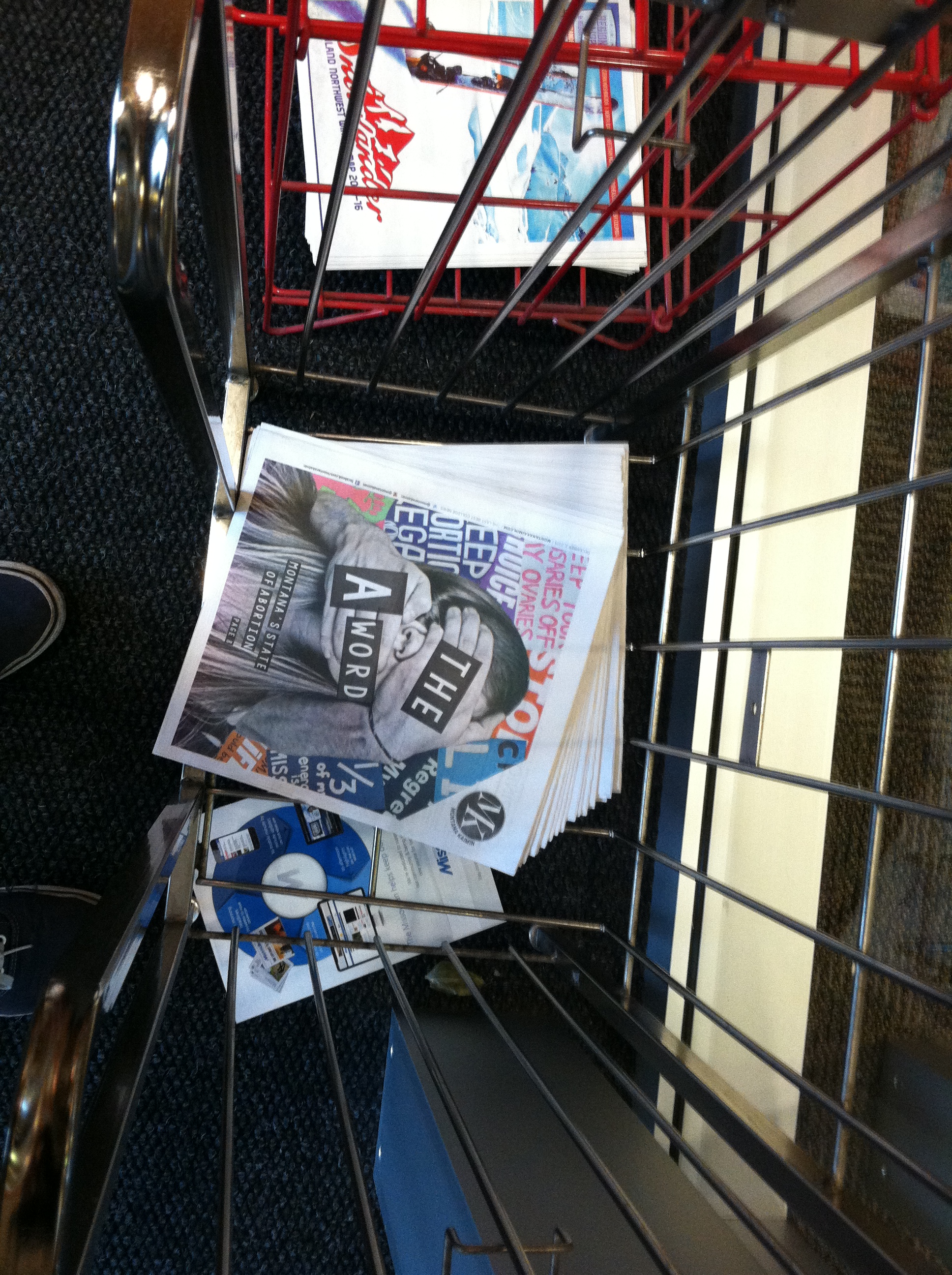
Photo of the last stack of printed Kaimin papers for 2015.
The Montana Kaimin’s last issue for the fall semester went quickly off the rack. Photo by Andrew Graham.

“For drastically restructuring something that was essentially broken I think it went really well,” said editor-in-chief Cavan Williams. He led the paper into its new format, which meant establishing a new workflow from reporters and photographers through editors and the copy team. “The whole thing was just an experiment,” Williams said, and they’ll carry on making adjustments and applying what they’ve learned to production this coming spring. That the fall went well isn’t to be confused with perfect, he noted.

The weekly edition implied more time for reporters to report and write feature length stories. Some of them, Williams said, have really taken to the long form style.

Tess Haas, a 22 year old senior from Bozeman, Montana, has worked as an arts and culture reporter for the last two semesters. She wrote two features that ran as cover stories this fall. The first was about Montana female DJs overcoming sexism in their profession, and the second, which ran in Wednesday’s final issue, was about the dearth of information and clinics for women seeking abortions in Montana.

“For people who are trying to be creative in presenting these important issues it’s really awesome to see them have the space to do it,” she said of the weekly format. Haas revels in the new style, which she says she’s used to expand on the ideas she had last spring, but couldn’t accomplish under tight daily deadlines.

Her latest story was inspired by listening to a friend talk about the difficulties of getting an abortion in Montana. The issue aroused her passion as a young female journalist. “As a young woman in Montana I think it’s extremely relative to me, and that’s what my friends talk about and that’s what I want to write about,” Haas said.

She spent a month working on the story, and says one of the challenges was finding sources that would speak about a sensitive topic. The article centered around the story of an anonymous woman who had an abortion following her first semester at the University of Montana. Having her editors allow her a month to work the story made all the difference.
Haas will rejoin the Kaimin staff for the spring semester, her last at UM, but this time around will work as the Arts and Culture editor.

For Hunter Pauli, 24 and also a senior, producing a paper with features like Haas’ was “difficult but doable.” Pauli is the Kaimin’s Managing Editor, and next semester hopes to improve their new format even further by smoothing out what he calls “anachronisms and holdovers from the daily version”

Pauli writes op-eds for the paper, and the one he is most proud of this semester listed a litany of critiques of University administration under the wry headline ‘Recent scandals this editorial is not about.’ His favorite weekly issue of the semester featured the story ‘Left Behind’ by news editor Erin Loranger, which profiled the Office of Residence Life’s ill fated attempt at establishing a Living Learning Community for veterans.

In general, Pauli is proud of his newspaper’s watchdog role over the University. “We’ve completely led the way on stories for the enrollment and budget crisis,” he said, adding that local newspapers like the Missoulian and the Missoula Independent have often followed Kaimin reporting.

By mid morning on Wednesday the last issue was already down to the bottom of the racks in the School of Journalism, but next semester students across campus can look forward to the return of the Kaimin’s independent and in-depth journalism.

You can read Tess Haas’ feature length story on abortion in Montana here.

Read the editorial Hunter Pauli is most proud of here.

By Andrew Graham
ESPN’s Kevin Van Valkenburg speaks on the importance of storytelling

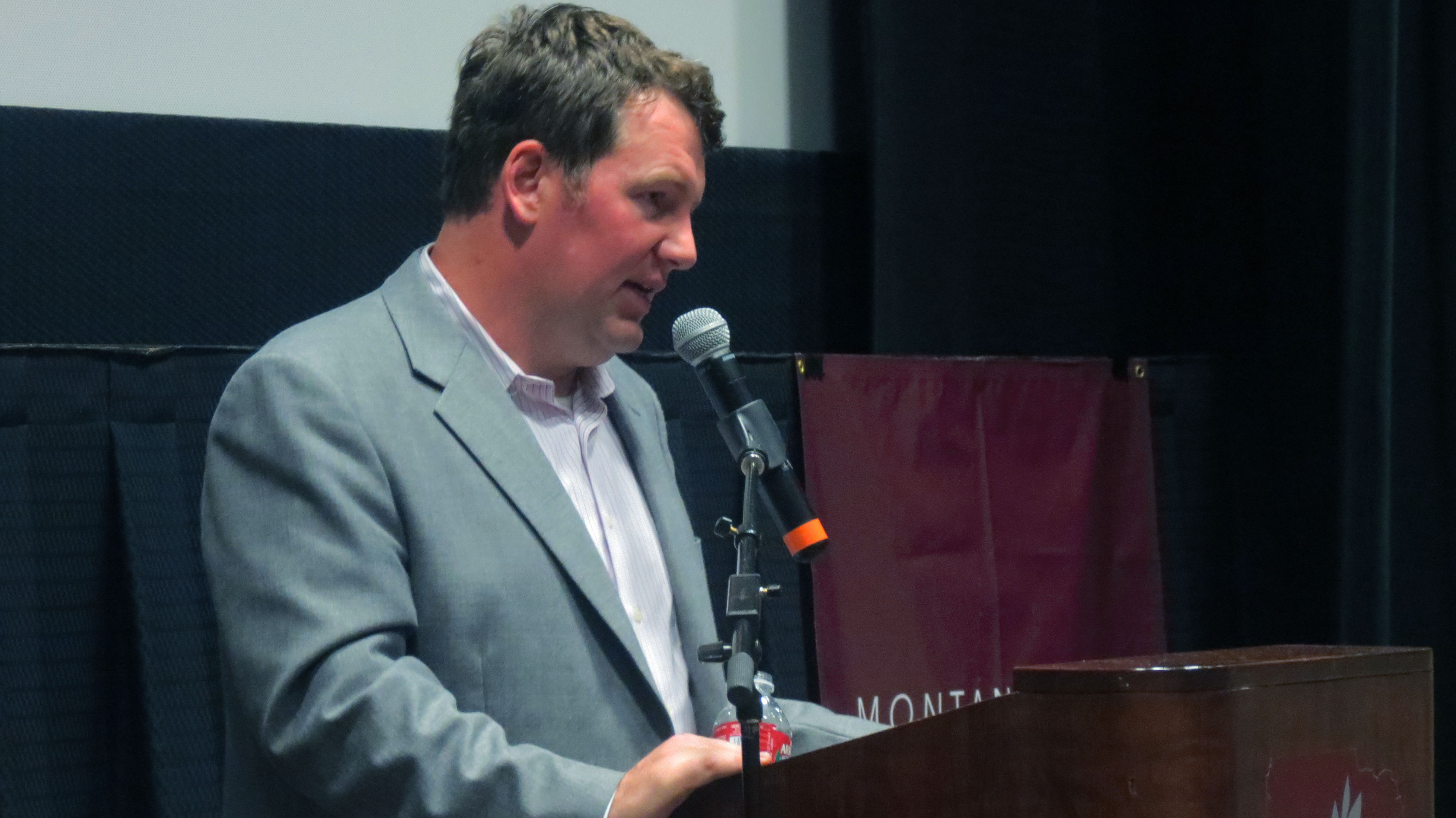
For Kevin Van Valkenburg, Senior Writer at ESPN the Magazine, stories are “a time machine that can heal the world.”

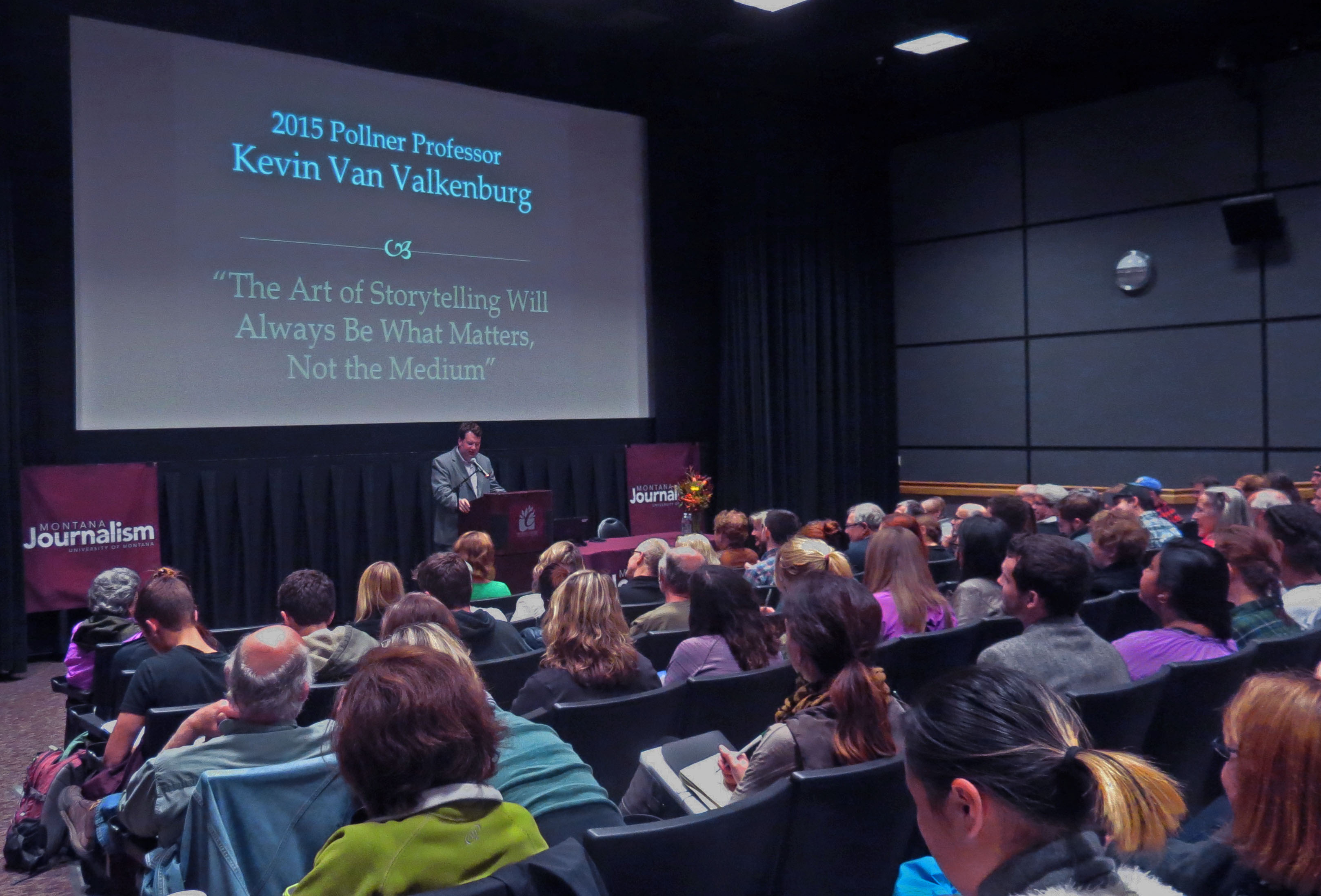
Kevin Van Valkenburg speaks to a crowded theater
ESPN’s Kevin Van Valkenburg attracted a large crowd for the J-School’s annual Pollner Lecture. Photo by Alyssa Rabil

Van Valkenburg, who graduated from the UM School of Journalism in 2000 and has come back as this semester’s T. Anthony Pollner Distinguished Professor. He spoke to an audience that filled both the seats and the stairwells on Monday night. His speech focused on the continued value of good storytelling, in an evolving landscape for media.

“It doesn’t matter the format you tell it in, as long as you tell it true and you tell it well,” Van Valkenburg said, advising students to reject the negative outlook some are pinning to written journalism, which he called “a cynical narrative.” Van Valkenburg said changes have come not to storytelling itself but to the economic model that supports it. Despite the distractions of modern life, he said, people remain hungry for heart-felt stories.

Speaking with clear reverence for the power of good narrative writing to explain, humanize and heal the challenges of the day, he extolled students to think about why stories are told and search hard to find them. “There are no stories to be told in life’s safe harbors,” he said.

Kevin Van Valkenburg speaking from the podium
Photo by Alyssa Rabil

A native of Missoula, Van Valkenburg is the first alumnus of the school to hold a Pollner Professorship, a program which brings talented journalism professionals to the J-School for a semester. The program began in 2001, when Anthony Pollner, a graduate and former staff member on the Montana Kaimin, died in a motorcycle accident.

Van Valkenburg and Pollner were friends and co-workers at the Montana Kaimin during their shared time at the University. At several points in his speech Van Valkenburg referenced the spirit Pollner had brought to his journalism studies, and how it had inspired Van Valkenburg in his own career.

Recounting some of the more memorable stories of his career, first with the Baltimore Sun and then with ESPN the Magazine and ESPN.com, Van Valkenburg spoke about learning lessons on what stories can do for their subjects, as well as their readers. He recounted an early story he wrote about a girl’s suicide, and how her mother had thanked him, saying she could now explain her daughter’s life and death to friends by sending them Van Valkenburg’s article.

It’s a two way street however, Van Valkenburg noted. In response to a question from the audience, he said that whether to use sensitive information given by a source can depend on both its content and impact. If there are larger societal questions at stake, Van Valkenburg said, “I’m going to upset the source and I’m going to reach for the truth because that’s more important.”

Van Valkenburg concluded his speech by speaking directly to Anthony Pollner’s friends and family, who sat amongst the first rows of seats. He shared stories and memories of Pollner from their university days, which he said his return to campus has helped to bring back.

“Few things in my life have ever seemed less fair,” Van Valkenburg said, speaking on the passing of his friend, “but by telling those stories I keep a piece of him alive forever.”

The full text of the speech can be found here.

By Andrew Graham

Photojournalism students learn the reality of freelancing

Journalism school students and others received a crash course in how to run a photography business, when Judy Herrmann, past president of the trade association American Society of Media Photographers (ASMP), spoke to a large crowd Wednesday evening.

Close up of Judy Herrmann speaking to students and faculty
Judy Herrmann spoke to budding photojournalists and told them how to make it in the business. Photo by Katy Spence.

Although with a show of hands the vast majority of the audience identified themselves as aspiring photojournalists, that didn’t stop Herrmann from starting her talk with a dose of industry reality. “As much as all of you that raised your hand for photojournalism are thinking ‘I’m getting a staff job,’ you’re probably not,” she said.

Given the changing nature of the business, with staff jobs disappearing but opportunities for self employment increasing, Herrmann said it’s likely most people in the audience will at some point start their own photography business. She then proceeded to give a highly practical, nuts and bolts seminar on how to do so.

She began at the first step and covered most aspects of running a freelance businesses. Throughout her talk, Herrmann emphasized the benefits of speaking with and hiring professionals for business advice, from accountants to lawyers. “Photographers are not lawyers,” she said, “as much as some of them would like to think they are.”

Judy Herrmann speaks to students and faculty in large lecture hall.
Photo by Katy Spence.

Herrmann, who has won numerous awards for her own business, Herrmann + Starke, brought years of experience to the topic. She is aware of the hidden pitfalls that await freelancers starting out; bad contracts, unforeseen disasters like equipment theft (for which she recommends a careful choice in insurance), and losing control and copyright of your own work.

Erik Petersen, an adjunct photojournalism professor and long time freelancer, weighed in on her advice. “The material she covered,” he said, “is essential to anyone wanting to run a successful freelance photography business.”

At the core of her message was the importance of being a professional. By conveying professionalism at the beginning of a client relationship a freelancer ensures they’ll receive professionalism, and a fair deal, in return, Herrmann said.

By Andrew Graham