Graduate student focuses on reservations, natural resources

On a Wednesday, which is Veterans Day and a welcome day off for most students, Nicky Ouellet is reporting on the Flathead Indian Reservation for a story about the Kerr Hydroelectric Dam, now renamed the Se̓liš Ksanka Qĺispe̓ Project and managed by Energy Keepers, a tribally owned corporation of the Confederated Salish and Kootenai Tribes.
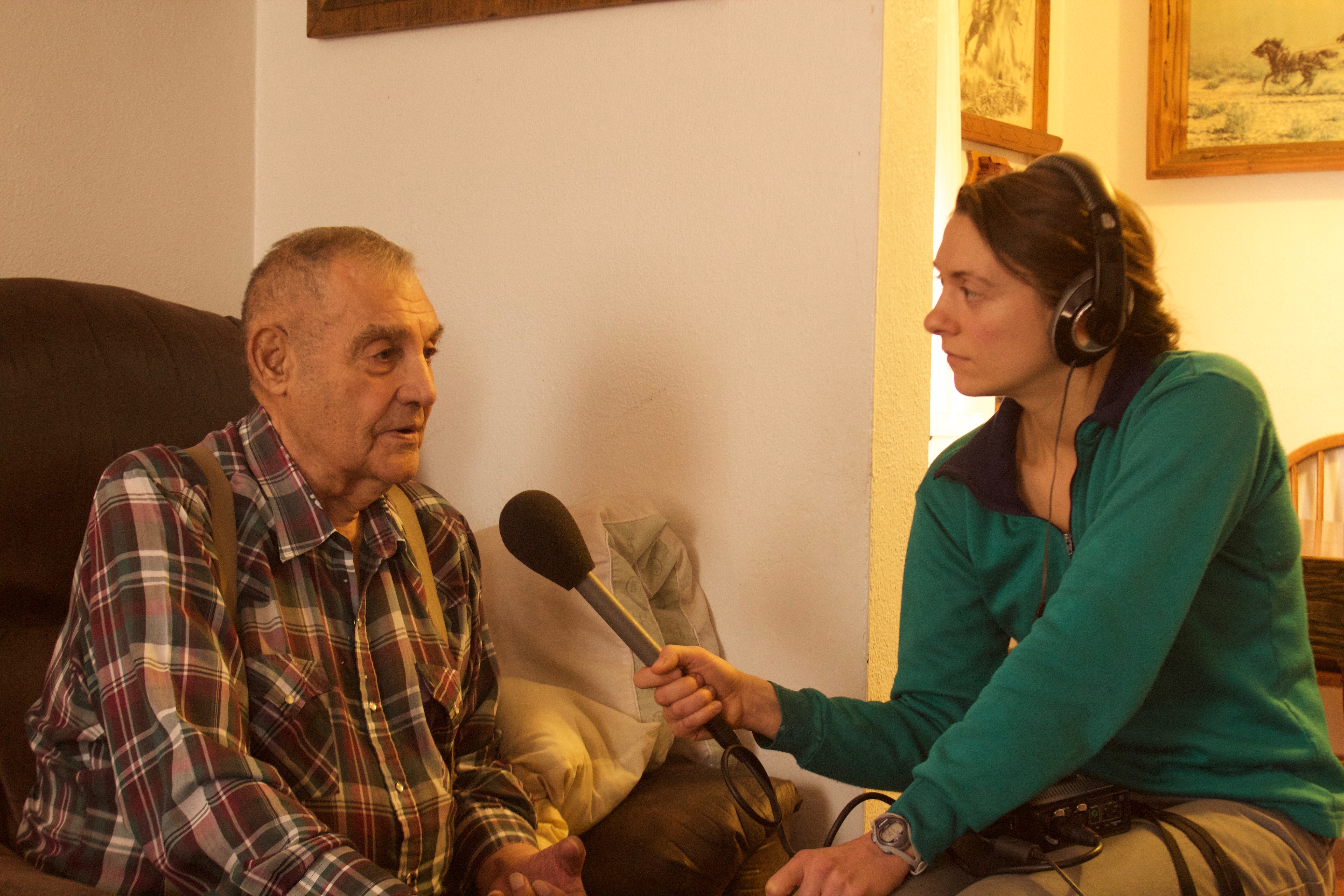
Graduate student Nicky Ouellet interviews Sonny Morigeau, a former tribal council member of the Confederated Salish and Kootenai Tribes.
Graduate student Nicky Ouellet interviews Sonny Morigeau, a former tribal council member of the Confederated Salish and Kootenai Tribes. Photo by Andrew Graham.

Her interview takes place in a house decorated with paintings of Western scenes, in a tiny town called Old Agency on the shores of the Flathead River.

Ouellet is known around the Journalism building as a dogged journalist, but she starts this interview out patiently. Very patiently. Her subject, Sonny Morigeau, is over 80 years old. To reconstruct the process which led to the dam changing hands, Ouellet had to delve into history and interview former tribal council members like Morigeau.

For Ouellet, the structure of government on Indian Reservations, and the modern tensions between Tribes and the Federal Government, is not new territory. From 2010 to 2012 she worked for Teach For America, who assigned her to live on the Pine Ridge Indian Reservation in South Dakota. There she taught creative writing, high school English and Journalism.

Being a part of life on a reservation, and teaching in a school with a high dropout rate helped push her into the Masters Program for Environmental Science and Natural Resource Journalism. Ouellet became conscious of a national dearth of stories from reservations.

Every two weeks Ouellet’s Journalism class filled four pages of the local newspaper. She turned their classroom into a newsroom. “I was teaching myself the whole time too,” she said. When the stories came off the presses, her students were delighted, as was the larger reservation community.

At the University of Montana she has focused much of her own reporting on Native American communities. Leaving teaching was hard for Ouellet, but this kind of reporting feels like another way for her to advocate for her students.

“I wanted to find and tell stories that would shed a light on inequities in our system,” Ouellet said.

Completion of the Masters program involves the choice between producing a single long form story, or creating a portfolio of three shorter projects, each centered around a central them. Ouellet chose the latter, which she said gives her more chances to practice the story making process in its entirety, “from coming up with ideas to following them through to publication.”

This is the first year Masters Candidates will have the choice of a portfolio. “The portfolio option aims to validate the impulse of student who are hungry to explore a broader issue over several semesters, rather than dive deep on a single story, as the professional project does,” said Associate Professor Nadia White, who helps run the Graduate Program.

Ouellet’s first story was about efforts to legalize marijuana on the Northern Cheyenne Indian Reservation in Montana. That piece was a long form written story, which ran in the 2015 Native News Project, a School of Journalism program that sends students out to produce stories from every reservation in Montana.

She is currently working on this story about the dam takeover, and one about the impacts of oil and gas production on the Fort Behold Indian Reservation in North Dakota. This spring she will be finishing up both stories, and again be a part of Native News, this time as an editor.

Back in Old Agency, Ouellet is ready to get what she came for, and begins to gently push her subject towards leading her through the history of the tribal council’s negotiations over the hydroelectric dam. As her questions get more pointed, it’s clear she has done her background work.

“Now, Energy Keepers manages the power and sells the power on behalf of the tribes,” she reminds Morigeau when he gets a little off track. Exploring how Native American tribes manage their natural resources is the theme of her portfolio.

Recalling her time teaching Journalism in Pine Ridge, Ouellet said “they were finding their voices to tell their stories. I found it really empowering for them.”
Three years later, it would appear that she has found hers as well.

By Andrew Graham
Crunch time for the Montana Journalism Review

For those of us involved in the production of the Montana Journalism Review, we awaited Thursday night with baited breath and no small amount of tense hesitation.

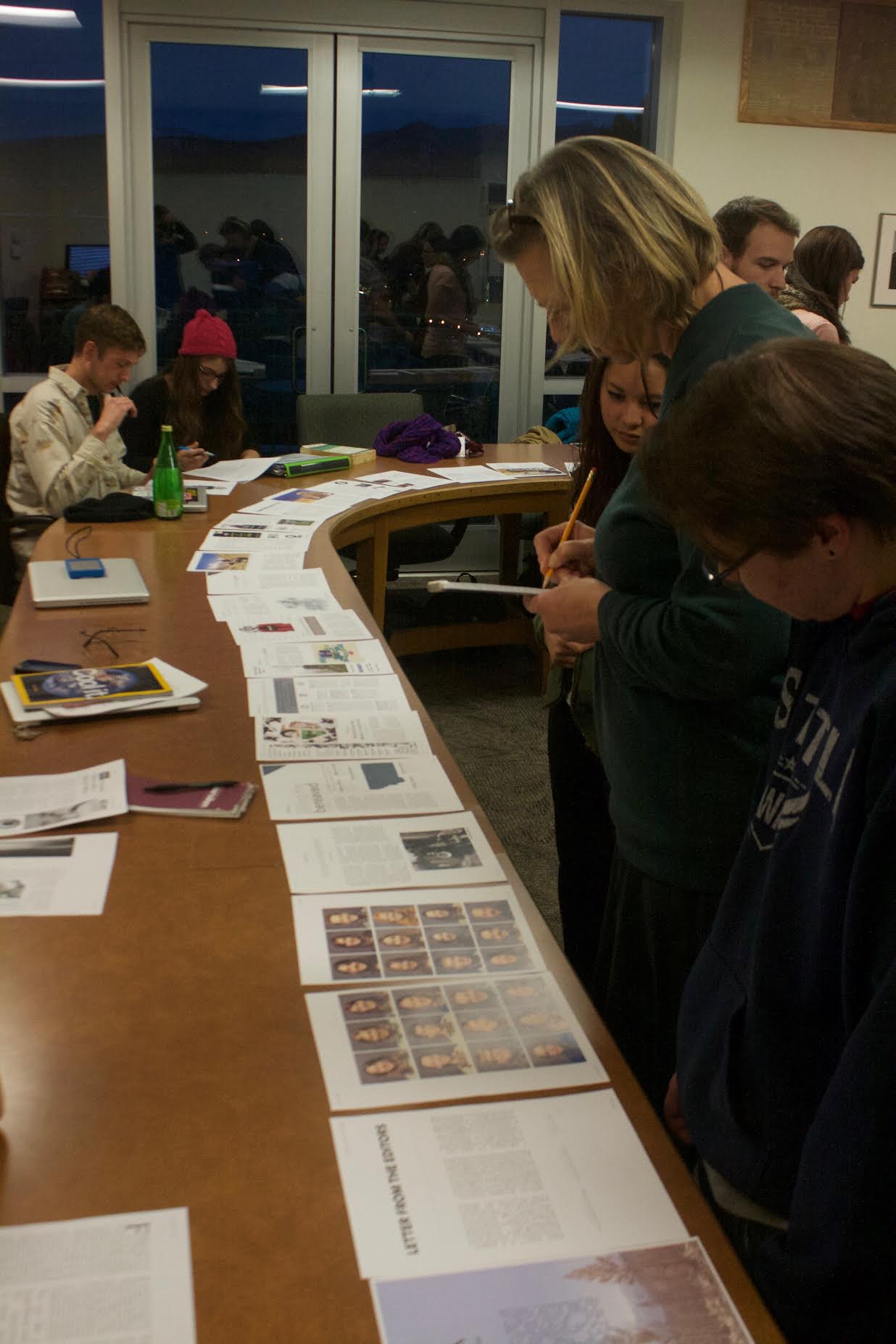
The Montana Journalism Review, affectionately called MJR around the Journalism building, is an annual publication produced entirely by students. The magazine covers media in the West, with an eye towards critiquing our professional peers. This fall’s team brought high aspirations to design quality, photography and writing. Thursday evening, a semester’s hard grind came to a head with the dreaded ‘copy slam,’ when printed out drafts of each fully designed page of the magazine were laid out in a long line, to receive excruciating scrutiny by our team.

The copy editing crew dives deep into every page, even the table of contents and staff portrait ones.
The copy editing crew dives deep into every page, even the table of contents and staff portrait ones. Photo by Andrew Graham.

I’d heard nightmarish tales of copy slams that last well into the night, and fueled up with pizza and coffee accordingly. But when I arrived, the excitement of seeing our magazine laid out in full color quickly swept away the dread. The next few hours passed quickly, between hard work and excitement, as I dissected my story as well as stories from other authors.

As staff writer, I’d been responsible for producing the cover story; a feature piece on the way western media covers wildfires. My MJR experience was both challenging and rewarding, and I decided to check in with a few of my classmates about theirs.

Two of our senior editors; Erin Loranger, 21 and a senior, and Taylor Wyllie, 20 and a junior, rested their backs against the wall in a corner of the room, pages splayed out across their laps and the floor. Two big traveler boxes of Starbucks coffee steamed gently on a table nearby. All semester Taylor and Erin have been balancing their jobs as MJR editors with being editors of the Montana Kaimin, the weekly print and daily online student newspaper. It’s been a tricky tight rope to walk, and I asked them how they’ve enjoyed the feel of working on a magazine as opposed to the newspaper.

“It’s nice to have the time to work with reporters through multiple drafts,” Erin said. MJR stories go through several rounds of edits, fact-checking and copy editing, something that would be impossible for a weekly newspaper or breaking news online article.

“It’s been really cool to work with these professional journalists that have different expertise,” Taylor added. At the Kaimin, they supervise student reporters. MJR, however, draws content from a wide range of contributors, and Taylor and Erin must edit writers who have been in the game far longer than they have.

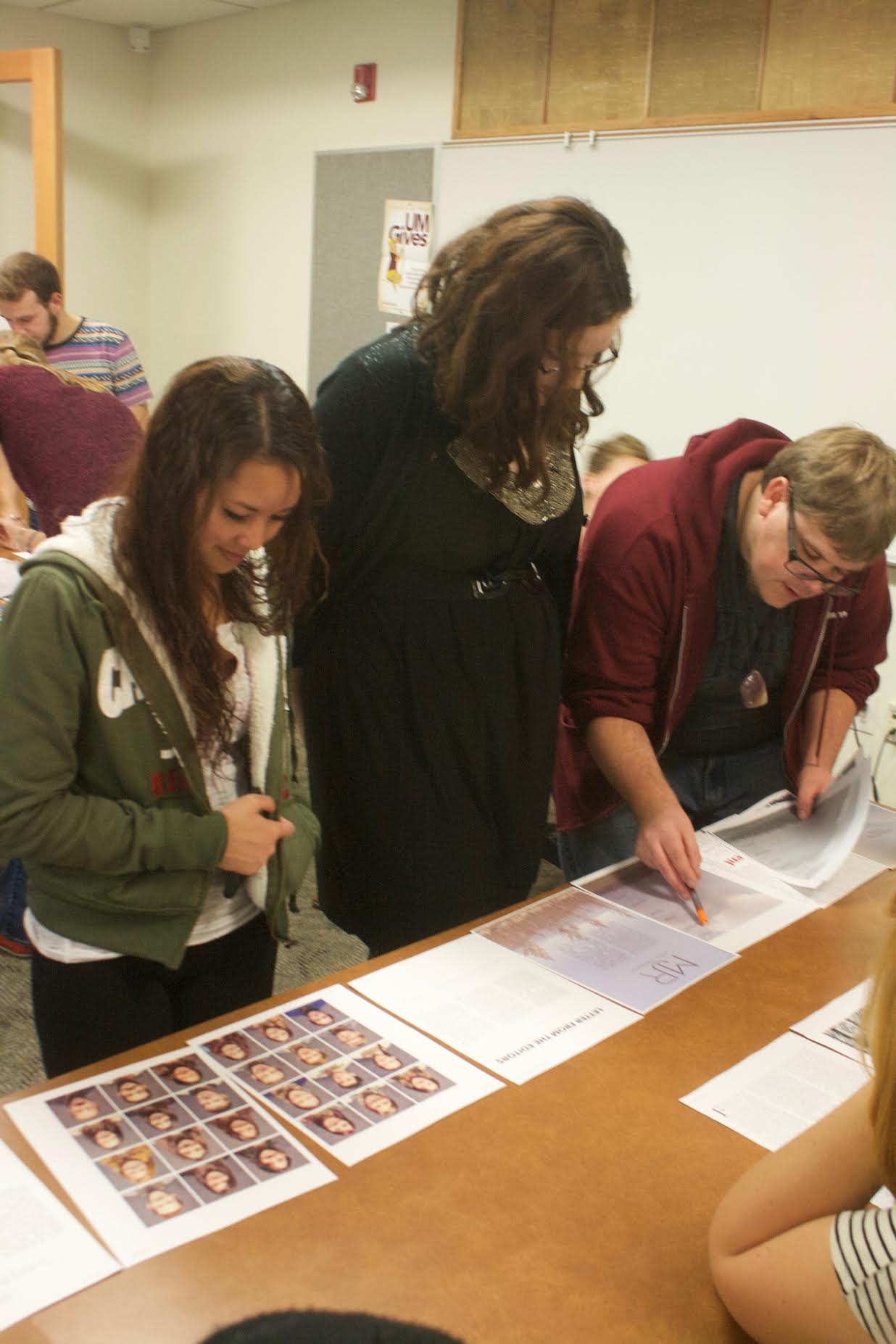
Page by page, faculty advisor Henriette Lowisch and members of the MJR staff go through their magazine, looking for errors in copy or design.
Page by page, faculty advisor Henriette Lowisch and members of the MJR staff go through their magazine, looking for errors in copy or design. Photo by Andrew Graham.

On the far side of the room the copy-editing team huddled in a bunch. For them, the last few weeks have been one continual copy slam, as the stories they’ve been waiting for all semester came flooding in from writers and editors.

“Copy editing for the first time for MJR allowed me to open my eyes and dig deeper” Ailene Camacho, 21 and a senior, told me. “Everything needs to be as accurate as possible.”

Every fact, quote and detail in each story had to be thoroughly fact-checked. That means sources had to be called anew, stories corroborated and statistics rechecked or calculated again and again. To give a sense of what a challenge this could be, the story I wrote contained quotes from twelve different people and even more written sources. There were several scenes where details had to be reconstructed and corroborated, and facts pulled from fire reports, journal articles, newspapers and TV broadcasts, all of which had to be confirmed. There are several other feature length pieces as well, and all the stories in the magazine reflect deep reporting.

In the end, the ‘copy slam’ didn’t take too long, at least for me. We made sure every story, design element and advertisement (sold to businesses by our staff to fund the magazine) were looked over by many pairs of eyes, and most of the team headed out. I’d put in my long nights trying to meet deadlines at the beginning of the semester, so I didn’t feel bad when I waved goodbye to the senior editors as they settled in to make the changes we’d marked, adjust designs and go over every piece and page with a fine tooth comb, several times.

This morning, I checked in via text message with Editorial Managing Editor Nicky Ouellet. “What time did you get out of there?” I asked. Two texts came flying back:

“2!” she wrote, then added, “still needs a lot of work.”

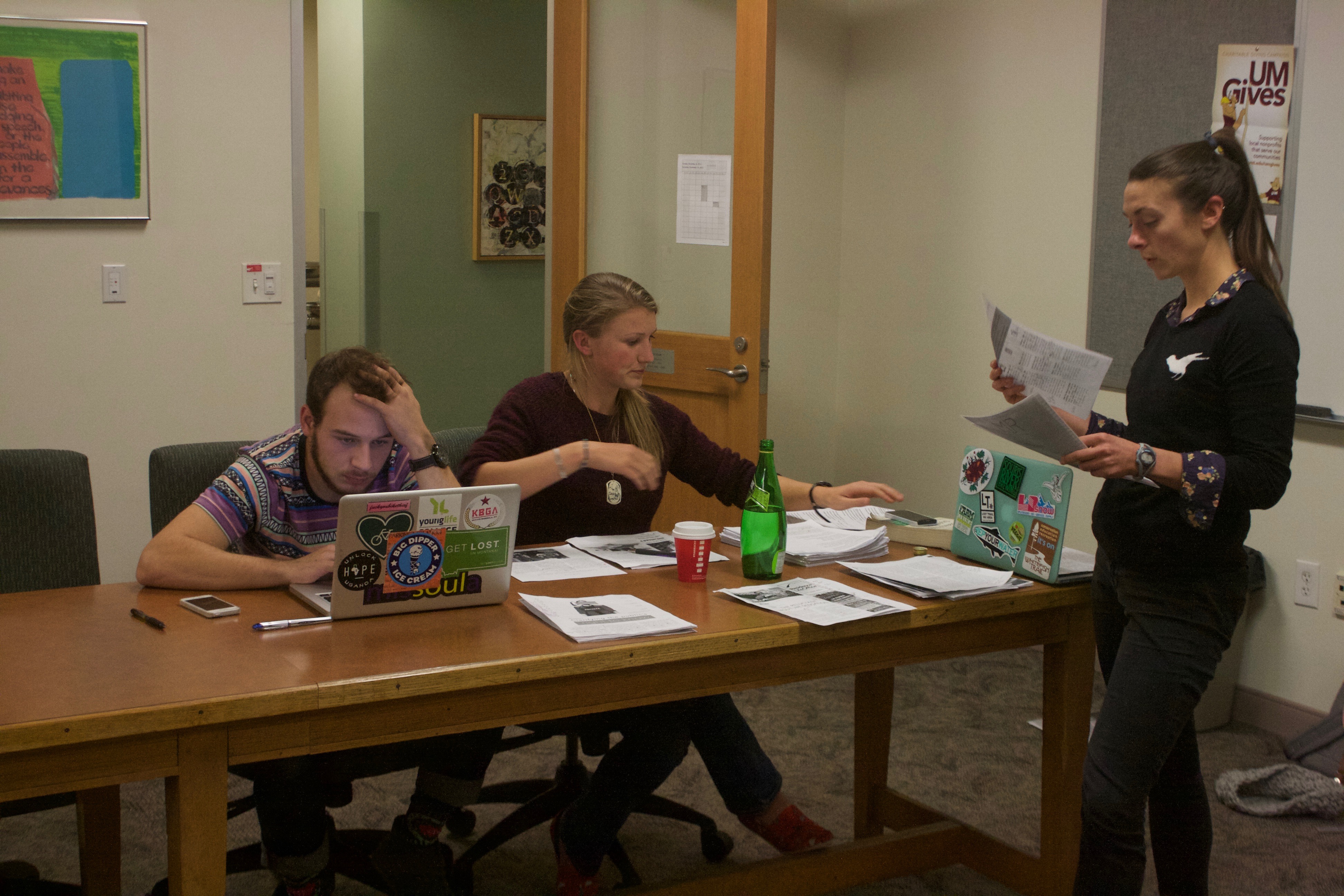
Editorial Managing Editor Nicky Ouellet, Copy Chief Reagan Colyer and Staff Photographer Jake Green settle in for a long night as the rest of the team files out.
Editorial Managing Editor Nicky Ouellet, Copy Chief Reagan Colyer and Staff Photographer Jake Green settle in for a long night as the rest of the team files out. Photo by Andrew Graham.

The magazine won’t go to the printers for another two weeks, and won’t be distributed until December. For those of us involved in its creation, that stretch until we see the fruits of our labor feels like a long one. While I feel for those of my team on the production side of things, for this writer it’s time for a long exhale.

By Andrew Graham