
Reporting On Reservations: Native News Sends Students Into The Field

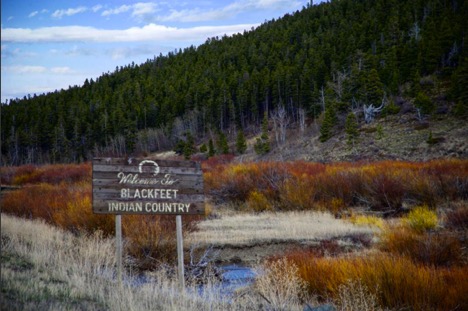
Landscape photo with a sign in the foreground that reads "Welcome to Blackfeet Indian Country."
J-school students divide into teams and travel to visit different reservations across the state. Photo by Courtney Gerard.

After weeks of planning and preparation, UM journalism students in the class Native News are spending spring break reporting on their stories. The students work in teams of two that pair photojournalists with print reporters to create a complete multimedia story.

With the upcoming presidential election in November, Native News professors Jeremy Lurgio and Jason Begay decided this year’s project should focus on politics. “The President has a lot of influence over Indian country,” Begay said.

Yet Begay said the theme is not just about seeing how people on reservations vote. He posed the question, “What do they consider when thinking about politics?”

“Voting on reservations tends to be less bipartisan, especially when it comes to internal politics,” Lurgio said.

However, the reporting teams have chosen stories that dig into the specific political issues that impact their designated reservations, instead of covering the national influence. The students reporting on the Crow Reservation recently followed tribal leader Darrin Old Coyote to the 2016 Montana Energy Convention in Billings to hear him speak about how coal affected jobs on his reservation.

On Fort Belknap, Sophie Tsairis and Lenny Peppers are investigating access to voting and the satellite voting offices on the reservation. Tsairis has been posting reporting updates from Fort Belknap on Instagram.

On the Blackfeet Reservation, Courtney Gerard and Peter Friesen are digging into constitution reform. However, their trip also aligns with the arrival of 88 bison from Elk Island in Canada returning to the reservation, as part of a cultural and ecological relocation effort. To see live updates from the Blackfeet, follow Gerard’s posts on Instagram.

When the students return from the reservations, the pairs will start synthesizing their individual stories into a collaborative, multimedia piece. The final projects from each team will appear on the Native News website in May and circulate the state in the annual print edition.
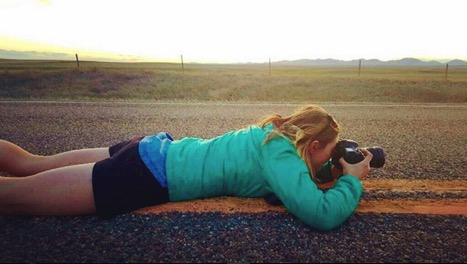
Native News photographer Sophie Tsairis lays in the middle of a deserted highway to snap a photo of the landscape.
Native News photographer Sophie Tsairis tries to find the best angle to capture a spectacular landscape to illustrate her story. Photo by Lenny Peppers .

To catch the latest updates from the Native News reporting teams, follow their accounts on Facebook, Instagram and Twitter.

By Jana Wiegand
Two grad students win fellowships to report from Crown of the Continent

Logo for the Crown of the Continent Reporting Project
The Crown Reporting Project sponsors students at the University of Montana to produce stories about the environment in the Crown of the Continent region.

For the second year in a row, two journalism master’s students from the University of Montana will head into the Crown of the Continent, to report in-depth, unique stories about the landscape and the people who live there. The 2016 Crown Reporting Project Fellows are Nicky Ouellet and Katy Spence. Spence will report on the role of beavers in helping to deal with climate change, while Ouellet will look at how decisions made by forest supervisors affect individuals and communities that depend on the Crown’s forest products for their livelihoods.

Both fellows are graduate students in the University of Montana’s Master’s program in Environmental Science and Natural Resource Journalism. A native of the Kansas, Spence hopes her outsider’s perspective will allow her to approach her story with few preconceptions or biases. “So many people are excited about the possibility of using beavers as a natural water mitigation strategy, but just as many think of them as pests,” she said.

Ouellet’s journey took her from New Hampshire, where she grew up, to Ohio, Russia and the Pine Ridge Indian Reservation before she enrolled at UM. She’s currently completing her master’s work on Native American natural resource management. “The Crown Fellowship means I get to spend time with a mycologist chasing down people in the forest and speak with them about what this really unique place means,” she said. “It’s almost an excuse to go camping, learn about the ecology and economy of mushrooms and meet really interesting people – all to produce some great radio that will hopefully connect listeners with a place I love so much.”

head shots of Nicky Ouellet and Katy Spence

Through the Crown Reporting Project, both students will be matched with seasoned journalism professionals who will guide them as they report, produce and pitch their work. In telling her story, Spence plans to combine photography and writing skills she’s cultivated since her time at Truman State University, where she earned a B.A. in English with minors in Biology and Photography. “This story is important for the landscape and for the people within it, and working with a professional journalist to develop it may be the most important journalistic opportunity I’ve ever had,” she said. “I can’t wait to start reporting!”

Ouellet is gearing up to telling her story as a radio piece. She recently won Best in Festival in the student news competition for the Broadcast Education Association’s Festival of Media Arts, for “An ‘80s Cover Band With Global Dreams.” “The Crown Fellowship is the biggest opportunity this school has to chase down an in-depth story about how people are connected to landscapes,” she said. “And I’m really excited to do that in radio because that takes a lot of time – you have to be there to capture the voices of the people – and this fellowship really makes that possible.”

The Crown Reporting Project was inspired by Ted Smith, a pioneer of large-landscape conservation and lover of the Crown. In 2015, graduate students Ken Rand and Celia Talbot Tobin worked with Chris Joyce, of National Public Radio, and Ted Alvarez, of Grist and Backpacker Magazine, to report stories on aquatic invasive species and mining waste.

By Henriette Lowisch

J-School Grad Student Wins Best In Festival For Radio Piece

photo of Ouellet working in the studio
Photo by Shanti Johnson.

From the blue lights and glow-sticks at The Great Northern Bar in Whitefish, Montana, graduate student Nicky Ouellet followed a band backstage to understand the mission behind their music. Ouellet’s subsequent radio story, “An ‘80s Cover Band With Global Dreams,” recently won Best in Festival in the student news competition for the Broadcast Education Association’s Festival of Media Arts.

“This is one of my first audio pieces,” Ouellet said. “For it to receive national recognition like this is really overwhelming, and I’m really honored.”

The story emerged from Assistant Professor Jule Banville’s Advanced Audio Skills class, when Banville prompted her students to incorporate music into a radio piece. “I wanted mine to be more than just a story about a band,” Ouellet said. “And the New Wave Time Trippers immediately came to mind.”

While the band came together for their mutual love for ‘80s music, they also wanted to find a way to be able to live off their “Rocky Horror Picture Show” style performances. Members of the New Wave Time Trippers told Ouellet that they hoped to turn these occasional night gigs into a full-time job by playing at corporate events and landing a regular show in Las Vegas.

“I thought it was a really interesting combination of the artsy, but also the business savvy,” Ouellet said.

For her, capturing a sense of place was equally as important as recording the essence of the Time Tripper’s music. Ouellet plugged a Marantz kit directly into the bar’s sound system to record clean copies of the songs and set up a secondary recorder to capture the crowd’s experience. After taping two of their shows, one in Whitefish and one in Missoula, Ouellet spent hours listening to the footage, recording her own narration and trying to keep the story under five minutes.

“Most of the challenges were really just keeping it tight and clean and focused,” Ouellet said. “That’s where Jule, my professor, came in and helped me kill all of my darlings, which was a really tough process because there were a lot of good ones.”

“I loved that story, and it will make you happy if you listen to it,” Banville said. “It had this signature mix where Nicky blended her writing and narration with interviews, and of course, great songs.”

The intimacy of radio originally drew Ouellet to the medium. She said the power of each story to delve inside someone else’s head made her change the way she saw the world. “You kind of lose sense of the thing directly in front of you, and it’s like this whole world of your mind and that of the story-teller are blended,” Ouellet explained.

Since the Time Tripper piece, she and Banville have been working closely together on Ouellet’s professional portfolio, which she will defend in May to receive her master’s degree in journalism. Her portfolio includes both written and audio pieces, examining how Native Americans manage natural resources on tribal lands. Ouellet is currently applying to jobs and fellowships for after graduation, and she hopes to find a position that lets her continue to use both print and radio.

“I’ve met very few people who work a story like Nicky Ouellet,” Banville said. “She’s going to do amazing things and just kill it as a journalist who can do it all.”

To hear more about Nicky Ouellet’s Best in Festival piece and the production process, watch her video interview on the School of Journalism’s Vimeo account, or click here to read the transcript of her interview. See more of Nicky Ouellet’s work in print and radio on her blog’s portfolio.

Stay up to date with more UM J-School radio pieces by listening to Jule Banville’s podcast series Last Best Stories.

By Jana Wiegand