
Superfund Tour Sets Tone for Graduate Journalism Studies

You know you’re in the right journalism program when, before the semester has even started, you race to campus at 6:55 am, jump into cars with 10 strangers and drive two hours just to get a close and personal look at the largest toxic waste cleanup project in the country.

And instead of being the slightest bit grumpy, you feel like you have finally found birds that share your particular brand of nerdy feather.

Group photo of journalists students standing at the Berkley Pit in Butte, MT.
The 2018 class of UM’s Graduate Journalism program listens closely as reclamation specialist Tom Malloy describes the future plan for the Berkeley Pit. Photo by Doug Simpson.

Staring into the Berkeley Pit may not be everyone’s idea of a good time, but it tends to be right up the alley of new graduate students in the University of Montana’s graduate program in Environmental Science and Natural Resource Journalism.

It’s become a tradition to kick off the program with what Professor Nadia White calls the “Super Fun Superfund Tour” – a daylong immersion into Montana’s storied mining and extraction history.

This year, the new cohort moved backwards through time and space, tracing the Clark Fork River upstream from Missoula toward its headwaters near the Continental Divide.

The Clark Fork and its tributaries are the veins through which toxic pollutants from a century of copper mining near Butte have spread. Each mile of the river is in a different state of restoration, reclamation, stagnancy or conflict.

Our first stop was Dry Cottonwood Creek ranch – a working cattle ranch owned by the non-profit Clark Fork Coalition located on the Upper Clark Fork. It’s a living laboratory for river and soil reclamation.

Rancher Maggie Schmidt showed students the sections of the river that are in the process of being cleaned up and explained the impact the reclamation project is having on her ranching operation. The visit was a window into how the federal government’s Superfund program plays out with private landowners and the agriculture sector on the ground.

Our caravan then wound through the town of Opportunity, which continues to be the dumping ground for other places’ hazardous waste. Brad Tyer, one of our chaperones and author of the book “Opportunity, Montana: Big Copper, Bad Water, and the Burial of an American Landscape” offered insight as to how some communities, lands, and rivers in Montana may be restored, but there is almost always another one that becomes a kind of sacrificial lamb in exchange.

We stopped for lunch in Anaconda, which is famous for its remnant landmarks from its smelting days. At Smoke Stack State Park, I looked around to see my fellow graduate students clambering over a brick wall to touch slag from the old copper smelter with their bare hands.

Finally, we landed in Butte, the “black heart of Montana,” to meet up with Tom Malloy, the reclamations manager for Butte-Silver Bow County. Malloy lives and breathes environmental reclamation. He knows more sneaky passageways to mining sites than just about anyone else in the county, or maybe the entire country.

Malloy treated students not only to a bird’s-eye view of the Berkeley Pit, but also to a once-in-a-lifetime visit to Yankee Doodle Tailings Pond, which is hidden from the general public’s direct sight.

Seeing the legacy of extraction helped some students ground their ideas about these infamous places.

Journalism student Matt Blois’ only prior connection to the Pit was from hearing about it on Radio Lab. “I expected it to be much more sinister looking – bubbly, green and horrible looking,” he said. “It was strange to see it and know it was so acidic, because it looks so benign.”
J-School students stand in the grass near the pit.
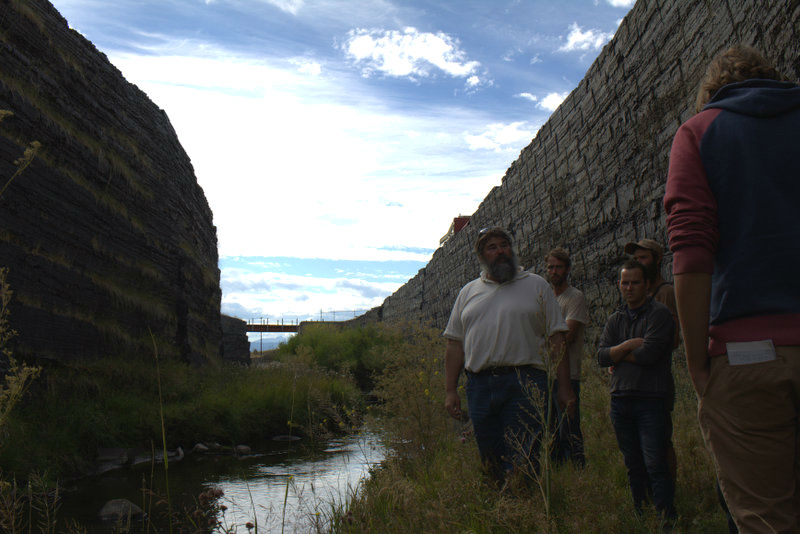
Tom Malloy leads students through Slag Wall Canyon outside Butte – the last stop of the Super Fun Superfund tour. Photo by Olga Kreimer.

Tromping around with Malloy was like having an all-access pass to the behind-the-scenes drama of Butte. I knew he had saved the best for last when he said he was going to take us to “Slag Wall Canyon”, a first for students as well as for our chaperones.

We pulled up next to a trickle of water outside of town and ducked under a crumbling archway. Soon, we were watching Silver Bow Creek meander between 30-foot walls constructed of bricks made from smelting waste. To the untrained eye, it was beautiful and eerie at the same time.

But to Malloy, it was another environmental disaster waiting to happen. He told us that toxic tailings are buried just beneath the slag walls. Meaning that if a big flood were to occur, or the slag walls proved structurally unsound, the old chemicals would be unleashed into the creek, enter the Clark Fork and make a dash for the Columbia. All of the reclamation and healing efforts at places like Maggie’s ranch would be undone, and the water supply of this area would be severely compromised once again.

As Malloy pointed out this risk, we thought hard about what it meant in the big scheme of things. As emergent journalists, how can we talk about slag walls and this one creek in a way that connects our audience to the hard and complex choices we all have to make? What about the ones we don’t make, but are implicated in? And how do we do that gracefully, without scaring the public away?

For his part, Malloy advocated for the creek to be re-routed away from danger. He made it sound as if changing the path of an entire creek was a relatively quick-and-easy fix, and to a reclamations specialist, perhaps it is.

But long after we arrived back in town, a little late and very hungry, I kept thinking about progress. I wondered how someone like Tom Malloy defines progress in his work on a daily basis when he is surrounded by problems created decades ago and solutions that will take a century. And how we are willing to define “solutions” themselves – when it’s so much easier to wish some of these harms had never been caused in the first place.

I hope the questions that bubbled to the surface that day will stay present as we willingly and bravely enter the fray as journalists, listeners, storytellers and witnesses.

Story by Nora Saks
J-School Students Set to Premiere Documentary Examining Autism in Montana

Every Monday morning, adjunct professor John Twiggs started class with a countdown, reminding the students how much time remained for them to finish their documentary. That number started with 15 weeks, but on the first day of finals week, the countdown hit the final 48 hours of production.

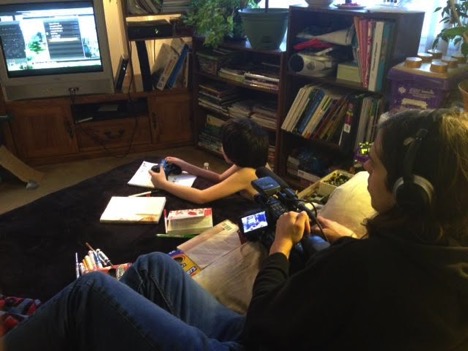
A student films the subjects of the documentary in the behind the scenes photo.
J-School students work closely with their subjects as seen in this behind the scenes pic. Photo by Jana Wiegand.

The documentary, “Aging Out: Autism in Montana,” will premiere at the University Center Theater on Friday, May 13, at 7 p.m. as part of the Senior Showcase. However, the rest of the state will get to see the show on MontanaPBS on Tuesday, May 24, at 8 p.m.

Upper-level journalism students have the option to take the Student Documentary Unit every spring semester. However, this year’s group started researching ideas for the show back in December. A class vote revealed an overwhelming decision to pursue the topic of autism and how it impacts the lives of Montanans.

After more research, the students noticed a significant gap in autism care as individuals with autism spectrum disorder (ASD) transitioned from school-age to adulthood. With the number of individuals being diagnosed with autism on the rise, they realized that the stress placed on the limited number of current care options for adults with ASD was ill-prepared to meet the needs of the incoming wave of adults on the spectrum.

“I want to do something that’s worthwhile, and I feel we have a good group to do it,” said senior Peter Riley, the director of the show. “Everybody knows we have each other’s back as a team, and everyone’s really stepped up and come to the table with some fresh ideas and some talents.”

The students traveled across Montana to follow the lives of four families, each with a child on the autism spectrum. As a class, they chose their main characters to reflect a diversity of ages, abilities, finances and access to care. The class spent quality time at home with their characters, attending therapy sessions and time at the workplace too. Students also interviewed autism specialists to shed insight on autism itself, the diversity care options and relevant legislation in Montana.

Once the group made the transition from shooting to editing, Twiggs told the class, “It’s time to take a hard look at what you do and don’t have. Get everything on the table that shows your best moments.”

Since then, the students have rewritten their scripts and finessed the edited footage to tell a story that speaks to the unique situations of each family, while also capturing the overarching struggles that unites them all.

“It’s definitely the most worthwhile thing I’ve done at the J-school,” said Andy Anderson, the director of photography. “It’s also been the hardest project I’ve worked on, without a doubt, but I think we have a really good pairing of people with skills. We just have killer writers and awesome videographers.”

The majority of the members in Student Doc will graduate the day after the documentary premieres on campus.

“I think Doc is a wonderful experience. We may not get the chance to do this thing for quite a while, if ever again, so let’s step out strong and leave with a product that we can be proud of,” Riley said. “I’m so thankful to be surrounded by a group of individuals that thinks that way too.”

SDU2016

Check out the 30-second and 60-second trailers for the documentary on the Facebook page, “Aging Out: Autism in Montana,” which will also air on MontanaPBS in the days leading up to the television premiere. Students also plan to post behind-the-scenes footage from the making the documentary, providing exclusive insight to their process and the families they followed.

The complete documentary will be available via the MontanaPBS website after the scheduled air date on Tuesday, May 24, at 8 p.m. Past documentaries from the Student Documentary Unit can also be accessed from their website.

By Jana Wiegand

NPR producer, award-winning science writer to mentor 2016 Crown fellows

Two science journalists with a national reputation and a knack for working with young reporters will mentor this year’s recipients of the Crown Reporting Fellowship.

npr crown

NPR Senior Health and Science Producer Jane Greenhalgh will work with Nicky Ouellet, a second-year graduate student at the UM J-School, while Hillary Rosner, an independent science and environment writer, will mentor first-year graduate student Katy Spence.

“Both mentors are stellar journalists who know the region and have ample experience in covering science and the environment,” said Henriette Lowisch, director of the Master’s Program in Environmental Science and Natural Resource Journalism at The University of Montana. “Their guidance and example will be invaluable to our student fellows as they report, produce and pitch their stories from the Crown of the Continent.”

Ouellet’s radio feature will look at how decisions made by forest supervisors affect individuals and communities that depend on the Crown’s forest products for their livelihoods, while

Spence will report on how citizens on both sides of the US-Canadian border perceive the link between beavers and climate change.

While the students will report their stories in the field, their mentors will recommend sources, edit drafts and help place the final product in a regional or national publication.

Greenhalgh, a Portland-based producer and editor for National Public Radio who specializes in science and health coverage, said mentoring younger reporters was one of her favorite things at NPR. “I loved Nicky’s pitch so I’m excited at the prospect of working with her,” she said.

Rosner, an award-winning journalist who covers science and the environment for National Geographic, Wired, Scientific American and other publications, said she was excited about the chance to work on an important story with a young writer one-on-one. “Katy seems like a sharp and talented reporter, and I’m looking forward to seeing her project unfold,” the Colorado-based writer said.

Now in its second year, the Crown Reporting Project aims to advance quality storytelling on landscape-level conservation, conflicting demands for natural resources and community efforts to build climate resilience. It was inspired by Ted Smith, a pioneer of large-landscape conservation who recognized a need for journalists trained to engage communities by explaining the science behind the policies that affect our backyards.

In 2015, graduate students Ken Rand and Celia Talbot Tobin worked with Chris Joyce, of National Public Radio, and Ted Alvarez, of Grist and Backpacker Magazine, to report stories on aquatic invasive species and mining waste.

By Henriette Lowisch