
Students study Fashion Photography during J-term

When photojournalism professor Keith Graham asked his students what other types of photography they wanted to explore, three distinct themes emerged: the outdoors, travel and fashion. While January in Montana might not be the best time to teach class outside, the three-week winter term is perfect for delving into the world of fashion photography, first offered in January 2011.

Globally, the fashion industry is worth over a trillion dollars. Graham says fashion photography crosses commercial and editorial borders, so it helps stretch opportunities for photojournalists as editors and freelancers.

Photo of woman in dark room in a vibrant red dress
Photo by Kira Vercruyssen, from the collection “Red.”

Kira Vercruyssen, a UM senior from Honolulu, Hawaii, said that the class was a fun break from traditional journalism, since students had the chance to trade their role as a reporter for one of a creator. “It was really fun to make these ideas in your head come to life,” she said.

Students directed their own photo shoots, using friends and co-workers as models. However, for the first project Graham made students step in front of the lens and take their own self-portraits. Vercruyssen said it was good for them to understand what it felt like to be a model, and that it helped her when she had to direct her models and capture strong angles.

Once Graham revealed the theme for each photo shoot, students had no other restrictions “besides time and imagination.” Themes ranged from Coco Chanel’s classic “little black dress” to “red” to “replication,” where students had to find a professional fashion shot and capture the same image with their models. “It might look easy,” Graham said, “but can you try to re-create it?”

Both the “denim” and “futuristic” shoots led to more iconic shots, including Bruce Springsteen’s 1984 Born in the USA album cover and Grant Wood’s portrait of the American Gothic.
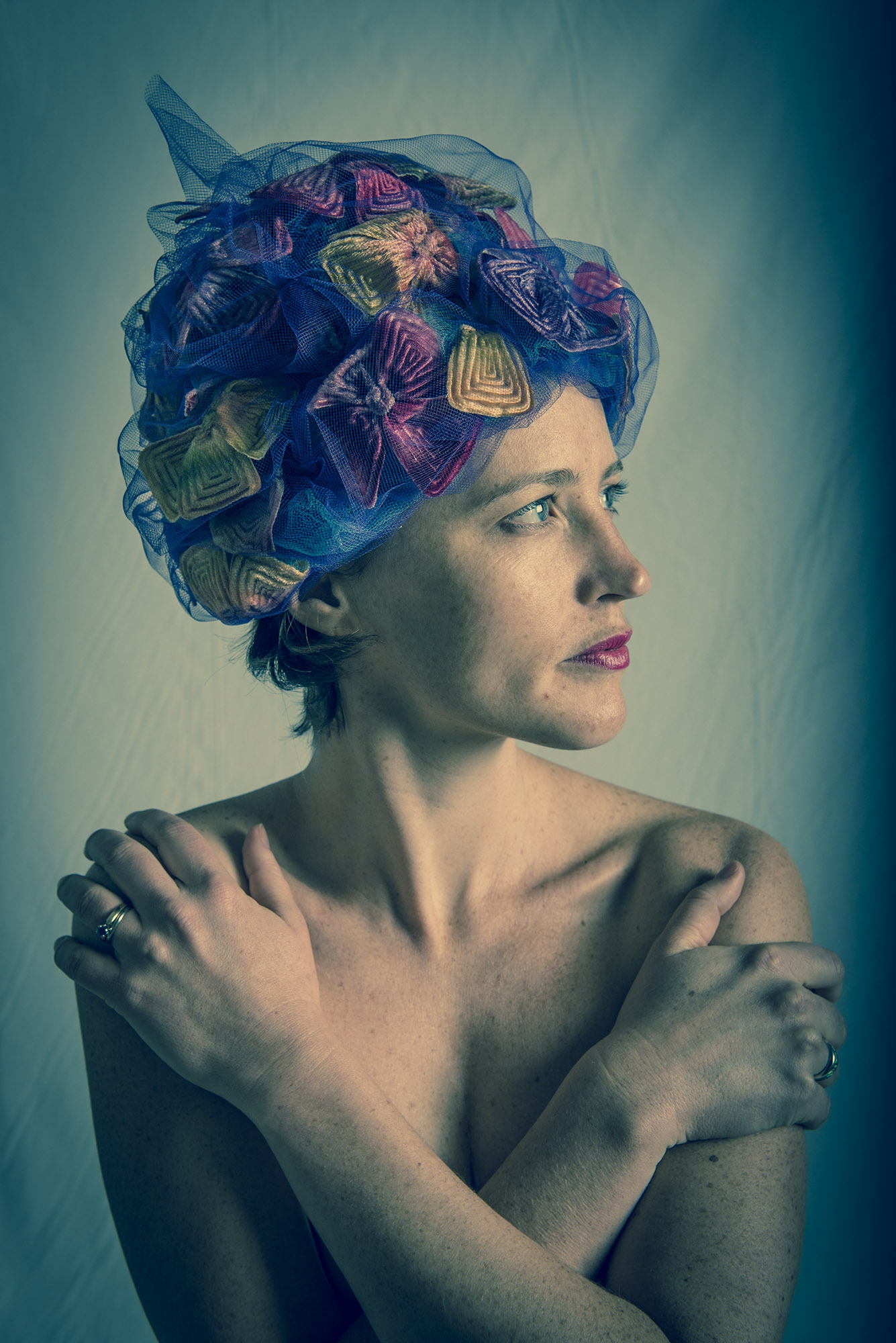
photo of woman wearing multi-colored cap
Photo by Kira Vercruyssen, from the collection “Hats.”

These shoots gave students the freedom to work both in the studio and around town. One of the highlights for Vercruyssen was getting permission to shoot inside the old Mercantile building in downtown Missoula. She also rented a collection of vintage hats from a local theater company for her final free-topic project.

Photo of woman in leather jacket in an empty room with many windows
Photo by Kira Vercruyssen, from the collection “Mercantile.”

Graham challenged the class to create narrative arcs within each campaign and consider what made their images visually and emotionally compelling for an audience. In addition to these spreads, they experimented with diptych photography, where two photographs are placed side by side to make an artistic statement.

With a standard week’s schedule compressed into a single day, all this kept the class busy.

“This kind of immersion is a very useful way to learn,” Graham said. “They produce stronger, better work as a result.”

Vercruyssen chose to attend the University of Montana for its strong journalism program, which is currently ranked 8th in the nation. For her, this class was “like a breath of fresh air” that re-charged her passion for photojournalism as she prepares to graduate this spring.

by Jana Wiegand
UM J-School Professor Publishes Hard-Hitting Investigative Report On Medicare Fraud

Before Assistant Professor Joe Eaton joined the faculty at the University of Montana School of Journalism, he was an investigative reporter at the Washington D.C. based Center for Public Integrity, where he specialized in sifting through data to find stories of things gone wrong with America’s health care system. Today he passes his skill at investigations on to his students, but he hasn’t given up chasing his own stories.

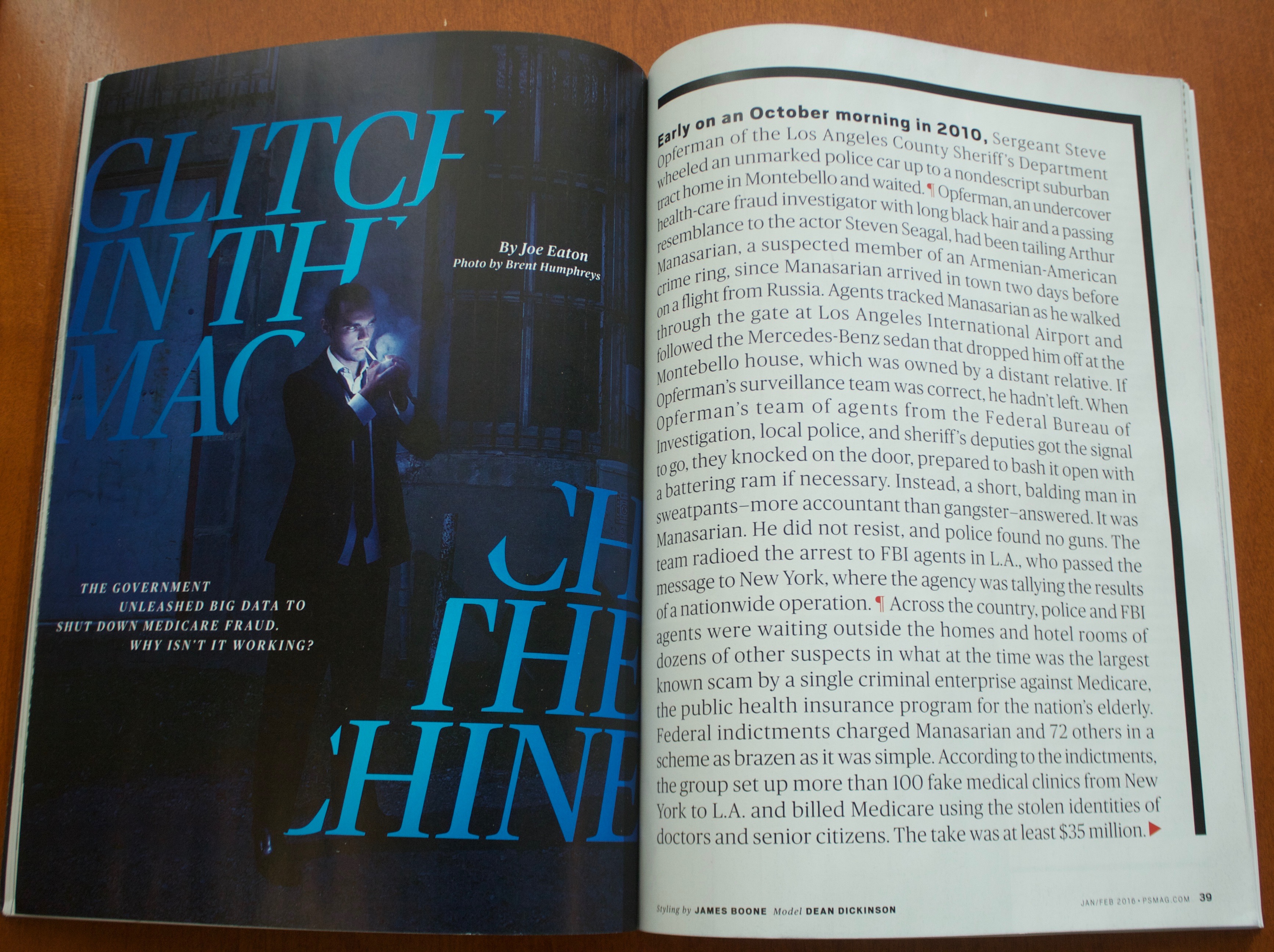
photo of article layout in magazine
Above: Eaton’s article as it appeared in print. Photo by Andrew Graham.

This January, a story by Eaton about the government’s inability to stop widespread Medicare fraud ran on the front cover of Pacific Standard, a magazine with national distribution that is based out of Santa Barbara, California. To get the story, Eaton relied on sources and knowledge from ten years of covering the topic.

Eaton knew that scamming Medicare is relatively simple, given the scope of the program and the porousness of the review process for insurance claims. An expert Eaton quoted in the story estimated that the medicare fraud rate could be as high as 20 percent, of a program that spends $600 billion. When a 2010 bill passed through congress and mandated that Medicare follow the lead of the credit card industry and use big data tools to prevent fraud, Eaton’s ears picked up. “I wanted to take everything I know about Medicare and do a big story,” he says.

When the government contracted the creation of the fraud detection system out to Northrup Grumman, a company better known for building airplane parts, Eaton suspected that he would soon have a story. Sure enough, when he later reached out to old sources in Medicare from his time at the Center for Public Integrity, they told him that an evaluation of the anti-fraud program had come back showing it was underperforming wildly. Eaton went to work.

He wrote a story pitch in the hopes of attracting a publication – often the first step in a freelance journalist’s writing process. The pitch, he said, along with the story itself, seemed pretty dense for the kind of broadly read magazines Eaton had in mind. While he framed the story with the idea of Wired Magazine in mind, they didn’t bite on the pitch. New York Times Magazine liked the story but thought it wasn’t right for their audience. The Atlantic wanted it, but didn’t offer him enough money for the time and effort he knew it would take to write it. Finally Pacific Standard accepted the pitch, for the right price.

Eaton started working on the story at the end of the 2015 spring semester. Writing and reporting it would take him all summer. As a long time investigative reporter, Eaton places high value on off-the-record sourcing, which can be essential for a story that casts doubt on the system and exposes mistakes by people’s employers. For this story, he said, there were twice as many sources behind the scenes as those whose names would eventually appear in the story. Many of them were sources in law enforcement, or amongst congressional staffers, who he has used over the course of his career.

While the story follows the colorful narrative of an Armenian-American crime ring responsible for a large and lucrative Medicare scam, Eaton did all the reporting from his office. “You can write a narrative without going anywhere,” he says, “you just have to report for it.”

The result would grace the cover of Pacific Standard’s January issue. The magazine is a bi-monthly publication. It was Eaton’s first magazine cover story. Today, he remains in front of a class room, beginning a new semester with classes in editing, public affairs reporting and freelance journalism. He still keeps his nose to the ground for new stories, and is working on an expose of businesses scamming the elderly into buying gold that they may never see. That story will eventually run in AARP The Magazine. Eaton says it may be on the cover.

By Andrew Graham