
Students uncover Montana voices about race

In the UC Ballroom on Thursday, November 5th, a group of seven students and their professor talked about what they’d learned over a semester spent exploring questions of race in Montana. The students have created the Montana Race Project, in which they drew in six-word essays from around the state that touched modern questions of race and diversity in Montana and beyond.
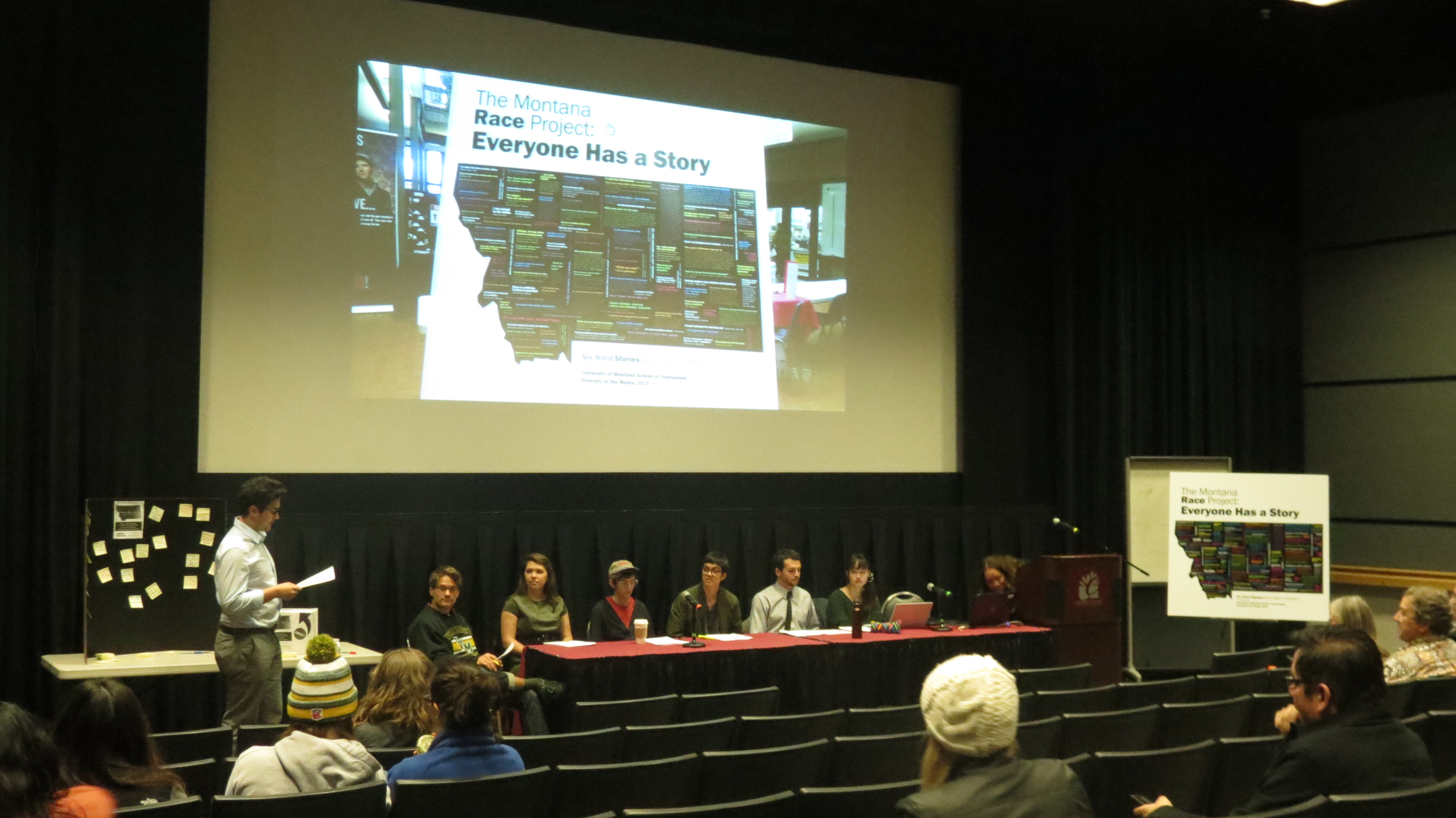
Photo showing student panel at the presentation of the 6 word essays.
Students took turns reading their favorite submissions from the project. Photo by Alyssa Rabil.

The professor, Kathy Weber-Bates, is an adjunct instructor at the School of Journalism, and the project was created through her Diversity in the Media course. To introduce Thursday’s panel discussion, Weber-Bates talked about her frustration with the idea that it was difficult to talk about diversity in a state that was not that diverse in comparison to others. That idea, she said, is misleading.

“It made an assumption that the state doesn’t have a multitude of voices,” and that’s not true, Weber-Bates said.

For her and her students, a focus that arose over the course of the experience was on the importance of conversations about race and diversity even, or perhaps especially, in institutions or places that are predominantly white. The students on the panel said they were surprised by how often the sentiment that Montana didn’t have a race issue and had no need to discuss the subject seemed to come up.

To uncover the real concerns about race in Montana, the class created an online form where anyone could submit a six-word essay, which they then promoted as a class via social media. By November 5th they had received over 300 essays from all over the state.

The idea of the six-word essay may have been born from Ernest Hemingway, Weber-Bates said, who was a firm believer in the value of saying much with few words. When challenged by his peers, Hemingway allegedly wrote the following six-word story:

“For sale: baby shoes, never worn.”

Whether that story is true or not, the form carries a lot of power. This held true for the stories brought in by the Montana Race Project. Here are just five examples of stories the students chose to read at Thursday’s event:

“Columbus day shouldn’t be a holiday.”

“Don’t tell me there’s no problem.”

“Half Peruvian, looks white, strange world.”

“Blind eyes can’t fix the past.”

“When will Native American lives matter?”

Some stories showed ignorance, others hope and optimism and still others expressed challenges of self-identity in today’s world. All showed a state where questions of race are very much alive.

Five of the students on the panel study journalism. They’re certain this experience will help guide their future work in a profession based around the idea that telling stories, everyone’s stories, matters. “The stories that I choose to tell and how I choose to tell them can bring things to light or bury them,” said Mia Soza, who is co-news director at the student run radio station KBGA.

Chloe Reynolds, another journalism student, said she learned the value of casting a wide net with her reporting, in order to find stories in unlikely places. “You don’t know somebody’s story unless you ask them,” she said.

To read more about The Montana Race Project and submit your own six word story, you can visit their website or search for them on Facebook.

By Andrew Graham

UM J-School professor to speak about immigration and refugee influx to Germany

Wednesday, October 28th at 12 p.m. UM J-School professor Henriette Löwisch will speak about her home country Germany as a part of ‘Walking on Water: The Refugee Crisis and European Contradictions,’ a presentation sponsored by the Central & Southwest Asian Studies Center. Löwisch’s talk is focused on Germany’s leadership role in the European refugee crisis, and echoes efforts in the journalism school to tell stories of immigration and human movement.

Professor Henriette Lowisch
Professor Henriette Löwisch

Löwisch came to the journalism school after a career with the international wire service Agence France-Presse, and will be co-leading a study abroad program in Berlin this summer, where she lives when not in Missoula. The trip is directed by the School of Journalism and will focus on telling stories from the refugee influx to Germany.

“The trip will be a model for how future study abroad programs can work: follow the news to tell big stories around the world,” Löwisch said. Seventeen students have signed up for the program thus far.

Stories of human migration are also present in Montana, and this fall semester students in the Advanced Multimedia class have been seeking out immigrants in Montana to report on what brought them here and on adjusting to a new life in the state. The project includes past refugees, as well as those who immigrated to Montana for other reasons.

Shanti Johnson, a graduate student in the class, has been working with a family of Vietnamese refugees in Missoula. “I’m being led into a world of Southeast Asian traditions and histories I never expected to find this far north,” she said.

As for Löwisch upcoming talk, she believes that Germany and its Chancellor Angela Merkel are at the epicenter of a refugee crisis of historic proportions, reshaping the country as well as Europe. “Merkel has undergone a dramatic transformation in terms of political goals. I’m looking looking forward to explaining Merkel to my fellow Montanans,” Löwisch said.

Find out more about the event here.

By Andrew Graham

Photojournalism students learn the reality of freelancing

Journalism school students and others received a crash course in how to run a photography business, when Judy Herrmann, past president of the trade association American Society of Media Photographers (ASMP), spoke to a large crowd Wednesday evening.

Close up of Judy Herrmann speaking to students and faculty
Judy Herrmann spoke to budding photojournalists and told them how to make it in the business. Photo by Katy Spence.

Although with a show of hands the vast majority of the audience identified themselves as aspiring photojournalists, that didn’t stop Herrmann from starting her talk with a dose of industry reality. “As much as all of you that raised your hand for photojournalism are thinking ‘I’m getting a staff job,’ you’re probably not,” she said.

Given the changing nature of the business, with staff jobs disappearing but opportunities for self employment increasing, Herrmann said it’s likely most people in the audience will at some point start their own photography business. She then proceeded to give a highly practical, nuts and bolts seminar on how to do so.

She began at the first step and covered most aspects of running a freelance businesses. Throughout her talk, Herrmann emphasized the benefits of speaking with and hiring professionals for business advice, from accountants to lawyers. “Photographers are not lawyers,” she said, “as much as some of them would like to think they are.”

Judy Herrmann speaks to students and faculty in large lecture hall.
Photo by Katy Spence.

Herrmann, who has won numerous awards for her own business, Herrmann + Starke, brought years of experience to the topic. She is aware of the hidden pitfalls that await freelancers starting out; bad contracts, unforeseen disasters like equipment theft (for which she recommends a careful choice in insurance), and losing control and copyright of your own work.

Erik Petersen, an adjunct photojournalism professor and long time freelancer, weighed in on her advice. “The material she covered,” he said, “is essential to anyone wanting to run a successful freelance photography business.”

At the core of her message was the importance of being a professional. By conveying professionalism at the beginning of a client relationship a freelancer ensures they’ll receive professionalism, and a fair deal, in return, Herrmann said.

By Andrew Graham