Accomplished Journalist, Ken Wells, Speaks About The Evolution Of Newspapers

Ken Wells, a seasoned business journalist, watched print news outlets evolve from traditional printing presses to the Internet’s 24-hour news cycle. At the first newspaper where Wells worked in Bayou Black, Louisiana, he used to run downstairs and smell the ink of the first papers coming off the press. In today’s world, he considers himself agnostic on which medium to use for publication, as long as people continue to tell these news stories.

Ken Wells speaks to a crowded room
“The best business stories aren’t about business,” Wells said. “But about their use as an interface for the human condition.” Photo by Alyssa Rabil.

Yet when Wells first started college, he didn’t dream about becoming a journalist. “I liked biology, and my father was a marine, so I decided to become a marine biologist,” Wells said.

He quickly became disillusioned with his classes and dropped out of college. Wells started working as a short-order cook at a 24-hours diner, but he quit that job after intervening in a late-night fight between customers. “I decided that breaking up attempted murder for minimum wage was not a good career,” Wells said.

He found an ad in his hometown newspaper, the Houma Courier, that read “Wanted: Part-Time Reporter, $1.87 / hour.” After the Courier hired Wells, his editor sent him off with a Polaroid camera to report on a bartender who had caught a 300-pound snapping turtle. Wells spent several years at the Courier before getting his master’s degree at the University of Missouri School of Journalism in 1977. From there, Wells worked at the Miami Herald, The Wall Street Journal and Bloomberg News.

Wells spoke to J-school members as part of the Jeff Cole Distinguished Lecture, which honors Cole’s dedication to the journalism field after his death, on-assignment, on January 24th, 2001. Cole graduated from the UM J-school in 1980 and had worked his way up to The Wall Street Journal by 1992 as an editor and reporter. Participating in this lecture series had personal meaning for Wells, who met Cole through The Wall Street Journal. Wells said, “He was a great writer, a great reporter and always in amiable spirits.”

Both Wells and Cole followed their editors’ mantra “We can fix your writing, but we can’t fix your reporting.” Since then, Wells developed his own idioms for today’s journalists: “Google might run the news, but it won’t write it” and “You can break news on Twitter, but Twitter won’t save the world.”

Over the years, Wells’ reporting proved to him how strongly business relations influence science, culture and other important fields. He said, “Outside of terrorism, the business stories are probably the most important of our lives.”

During the question and answer session at the end of the lecture, second-year graduate student Andrew Graham asked Wells about approaching his first non-fiction books after his lengthy career writing for newspapers.

“There a few things you should never do for money,” Wells replied. “Get married, make love and write a book.”

Wells enjoyed the reporting stage so much that he didn’t become a diligent writer until he confronted his first 80,000-word deadline. He said he had to lock himself in the attic for 12 hours a day to write. “I stopped talking to my wife, I stopped taking showers and I started kicking the dog.”

Regardless of the medium, Wells said that business journalists must embrace their responsibility as public watchdogs to be the truth-sayers in society. “There are stories growing on trees,” he said. “I think that we have a bright future in front of us.”

Learn more about Ken Wells’ work as a journalist, author (fiction and non-fiction), photographer and musician from his website.

To catch up with live coverage of Ken Wells’s delivery of the annual Jeff Cole Distinguished Lecture, follow the University of Montana School of Journalism’s Twitter and Instagram accounts.

By Jana Wiegand

Live Reporting Via Social Media: Grad Students Experiment At Vandana Shiva Lectures

Graduate students in the Environmental Science and Natural Resource Journalism program used several social media platforms for reporting live coverage of Vandana Shiva’s lectures at the University of Montana last week.

By reporting live, via Twitter, Instagram and Periscope, the grad students tried to engage with a broader audience and instigate a conversation with people who weren’t physically present to hear Shiva speak. Prior to Shiva’s talks, to gain journalistic insight on Shiva’s influence, Associate Professor Nadia White had the grad students read a controversial profile on Shiva that the New Yorker published in August 2014 and the consequent responses from Shiva, the New Yorker’s editor and outside journalists.

Vandana Shiva speaks at the Dennison Theater
Vandana Shiva speaks at the Dennison Theater on Wednesday, February 24th, 2016. Photo by Courtney Gerard.

Vandana Shiva, an environmental activist who passionately opposes genetically modified organisms (GMOs), spoke at the University of Montana on Wednesday, February 24th. During the afternoon she led a seminar called “Living Seed, Living Soil, and Earth Democracy”. Then, in the evening Shiva spoke as part of the Brennan Guth Memorial Lecture series, sponsored by both the Environmental Philosophy and Environmental Studies programs. Both presentations were part of the on-going President’s Lecture Series at UM.

Shiva’s evening lecture, “We Are All Seeds: Food Security and Environmental Sustainability,” followed the metaphor of humans as seeds, as Shiva spoke about the need to preserve the diversity and health of both physical and metaphorical seeds. Her presentation was met with a packed theater and three standing ovations. More people queued up for the Question & Answer sections than she had time to address.

From Shiva’s hotel room in Missoula, she said that looking out at the Clark Fork River reminded her of where she grew up in India. Over the years, she watched a swimming stream dry into a trickle and a natural forest turn into cultivated apple orchards. “I realized how vitally our ecosystems are under threat,” Shiva said. “And how much we took them for granted.”

Some J-school graduate students took Shiva’s quotes to Twitter—capturing both the questions Shiva raised as well as her prolific statements about how industrialization has changed humans’ relationship with nature. Katy Spence received an immediate like when she captured Shiva’s message, “We’ve been brainwashed to believe we are separated from nature…that nature is dead.”

Courtney Gerard also felt quick support from Instagram after posting pictures of Shiva speaking in the Dennison Theater. Gerard also had an eye on the crowd and captured a few people thinking more critically of Shiva’s message. While she snapped pictures of the audience and Shiva from center stage, Gerard left her tape recorder running so she could accurately quote the lecture in further stories.

Benjamin Alva Polley noted Shiva’s efforts to make a connection with UM community members. Polley tweeted Shiva’s opinion, “Campuses are not just about education anymore, but about life.” At the evening lecture, a researcher at UM asked Shiva what she would tell academics researching GMOs and furthermore, what evidence would she need to change her absolutist stance against GMOs.

“My scientific background tells me this is not the future,” Shiva said. She continued to speak about the corporations promoting GMOs “only to collect royalties,” and called GMO research an “inaccurate science” and “failed technology.”

Looking out at the full auditorium, Shiva asked, “How long do these corporate benefactors take care of you or the planet?”

Graduate student Matt Roberts noticed the lack of verifiable, scientific facts backing up Shiva’s prolific speech. He produced a multimedia article via Storify that addressed the disconnect between Shiva’s anti-GMO beliefs and the vague scientific facts she cited. In Roberts’ editorial “Going Through The GMOtions” he wrote, “If you attended the event to gain a deeper level of understanding about how GMO’s work and why they might be bad other than “because it’s unnatural and people say so,” then you were probably left a little confused.”

During one example, Shiva cited the rates of autism prevalence in the United States as 1 in 35 people and faulted BT toxins and GMOs in gut bacteria. She predicted that ratio would rise to 1 in 2 in the next hundred years.

However, current autism research reflects a ratio of 1 in 68, and to understand autism’s role in the brain, current research focuses more on the neurological and genetic causes. Additionally, autism experts think that the recent rise in both awareness and diagnoses programs also contribute to the rising rates of people who experience autism spectrum disorder (ASD), so Shiva’s prediction reflects more on scare-tactics than scientific fact.

Coming from a journalist perspective, the main challenge came not from any controversial opinions about GMOs or Shiva’s personal beliefs, but from the lack of her ability to answer the basic and specific “who, what, where, when, why and how” questions.

While Robert acknowledged Shiva as a notable scholar, the tone of her lecture made him feel like he was reporting on a politician instead of a scientist. Roberts said, “The whole evening was an anti-GMO pep rally.”

The next event in the Presidential Lecture Series, will take place on Monday, March 21st and feature Roald Hoffmann, who won the Nobel Prize in Chemistry in 1981.

By Jana Wiegand

Award-Winning Documentary Director, Chad A. Stevens, Speaks At J-School

Chad A. Stevens, director of the documentary “Overburden,” tried out two other titles for his film before settling on the third. Appropriately, Stevens’ presentation at the UM School of Journalism on Wednesday, February 24th, also came with three potential titles: “The Life, Death & Afterlife of a Documentary,” “How in the World did I Survive this Thing?” and “Thank God for Talented Friends and Box Wine.”

“Overburden” played at the Wilma Theater as part of the 2016 Big Sky Documentary Film Festival later that same day. The film follows two women in the heart of Appalachian coal country and their fight to save Coal River Mountain from the Massey Energy Company after an underground fire kills 29 miners.

Stevens said the first iteration of this project began while he was working on his master’s thesis at Ohio University. However, his moment of inspiration began several years earlier, in 2003, during his time as a photojournalist-in-residence at Western Kentucky University. One day, Stevens and a friend were driving through the hills when they crested a ridge and Stevens got his first look at a mountain top removal site. “There was a shocking amount of destruction,” he said.

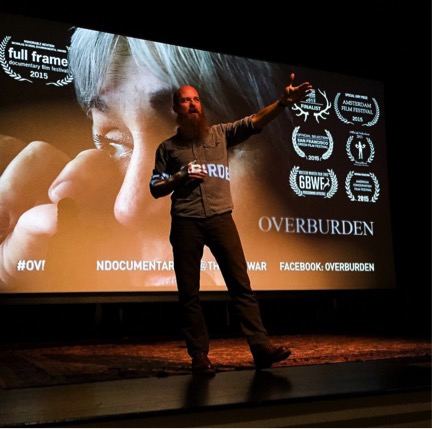
Chad A. Stevens speaks to the audience a screening of “Overburden” in Boulder, Colorado.
Chad A. Stevens speaks to the audience a screening of “Overburden” in Boulder, Colorado. Photo by Erin Hull.

Originally Stevens focused on the environmental aspects of coal mining. He photographed events at the Mountain Justice summer convergence and followed the activists who chained themselves to bulldozers at the top of Coal River Mountain. Yet Stevens realized that this story lacked the intimacy to connect with a broader audience. He looked to the valley where people lived right below the mining sites, whose blasts shook their homes’ foundations.

“I started to have this idea that maybe it could be more,” Stevens said. “I was like, 100% heart. I have to do this no matter what.”

It took Stevens about two years to gain the trust of one of his main characters, Lorelei Scarbro, who had seen plenty of journalists disappear after getting their pictures and quotes from the community. Yet Stevens referred to time as a gift and said it allowed him to understand what mattered most to Scarbro and her battle against coal.

“I was so damn stubborn and wouldn’t leave,” Stevens said, and his patience paid off. “To be there when her grandson was born—that never would’ve never happened without that time.”

One of the project’s major turning points came on April 5th, 2010, when a methane leak and an errant spark caused an explosion in the nearby Upper Big Branch mine.

“As you can imagine, that deeply impacted the community,” Stevens said. “And of course, it changed the film as well.”

A second main character emerged—a pro-coal activist whose brother died in the explosion and spurred her to join Scarbro’s fight.

Stevens also realized that the film’s central theme switched from an environmental perspective to more economy-based story, which explored how extraction-based economies limit local communities.

During the production process, Stevens licensed some of his footage and sold it to organizations that were working on tangential stories, as long as he knew they wouldn’t overlap with “Overburden.”

“I actually paid an editor to edit my film because I felt too close to it,” Stevens said.

Looking back on this ten-year project, Stevens reminded the room full of UM Journalism students about the importance of reaching out to others for help and the importance of remaining humble, because “it’s always bigger than just us.”

Stevens also spoke of the potential that comes from “opportunity blindness.” He said, “When you first start off, there’s no way to know what doors will open down the road. You just got to put it out there.”

While funding such projects remains a challenge for today’s journalists, one of Stevens’ teachers once told him, “Sometimes you do what you gotta do to feed your belly. And sometimes you do what you gotta do to feed your soul.”

Now a tenured professor at the School of Journalism and Mass Communication at the University of North Carolina in Chapel Hill, Stevens has his own mantra for students to learn.

“It’s all about collaboration and community,” Stevens said. “When we care, we as the story-tellers care, that care transfers.”


“Overburden” is currently available for rent on iTunes, Amazon, Google Play and Vudu. Check the film’s website or follow its Facebook or Twitter accounts for details about upcoming screenings.

To learn more about UM J-school affiliates reporting on coal communities in Montana, check out second-year graduate student, Andrew Graham’s contributions to National Geographic’s blog The Great Energy Challenge, and adjunct professor, Matthew Frank’s publications on Mountain West News.

By Jana Wiegand