
Staying Curious: NPR Host Susan Stamberg on Becoming a Veteran Journalist

On a Sunday afternoon in Paris, while walking through the Luxembourg Gardens, Susan Stamberg came across a woman holding a sign that said “Hello! Let’s Talk.” Stamberg sat down with her, and when 81-year-old Miss Lily discovered she worked as a radio correspondent for NPR, she asked, “Well, don’t you want to interview me?”
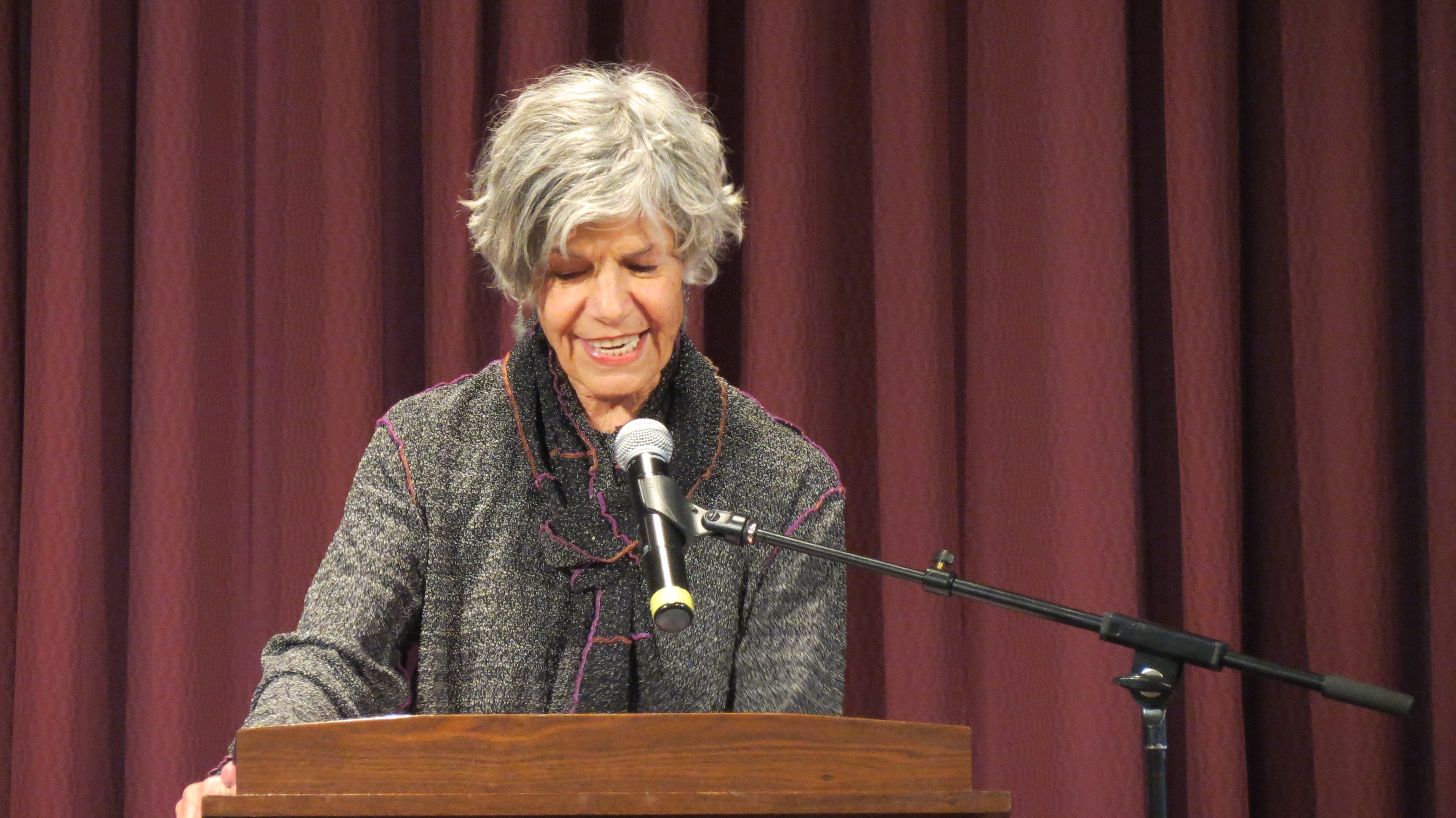
stamberg

“Do lobsters want to fly? Of course,” Stamberg said, relating the tale to the audience at UM, gathered for the School of Journalism’s annual Dean Stone Lecture. Each spring the UM School of Journalism honors its founder, Dean Arthur Stone, and current journalism students with a two-night celebration featuring a guest lecturer followed by an awards banquet.

Miss Lily told Stamberg about a certain loneliness that she saw in people that she hoped to ease by getting more strangers to talk to each other. As a journalist, Stamberg related to Miss Lilly’s mission because she always tried to take her interviews with people to a more intimate level and advised students to do the same.

“Don’t accept ‘fine’ as an answer. Tell me what’s really happening. Go deeper,” Stamberg said. “After talking with Miss Lily I felt like I was walking on joy. It was such a serendipitous experience. I look for her every time I’m back in Paris.”

Stamberg started working at NPR in 1971 as a tape editor, but started hosting All Things Considered the following year. In the US, she became the first woman to anchor a nightly news broadcast fulltime. “It was a time when anything was possible at NPR,” Stamberg said. “We were still inventing ourselves, so we got to do everything.”
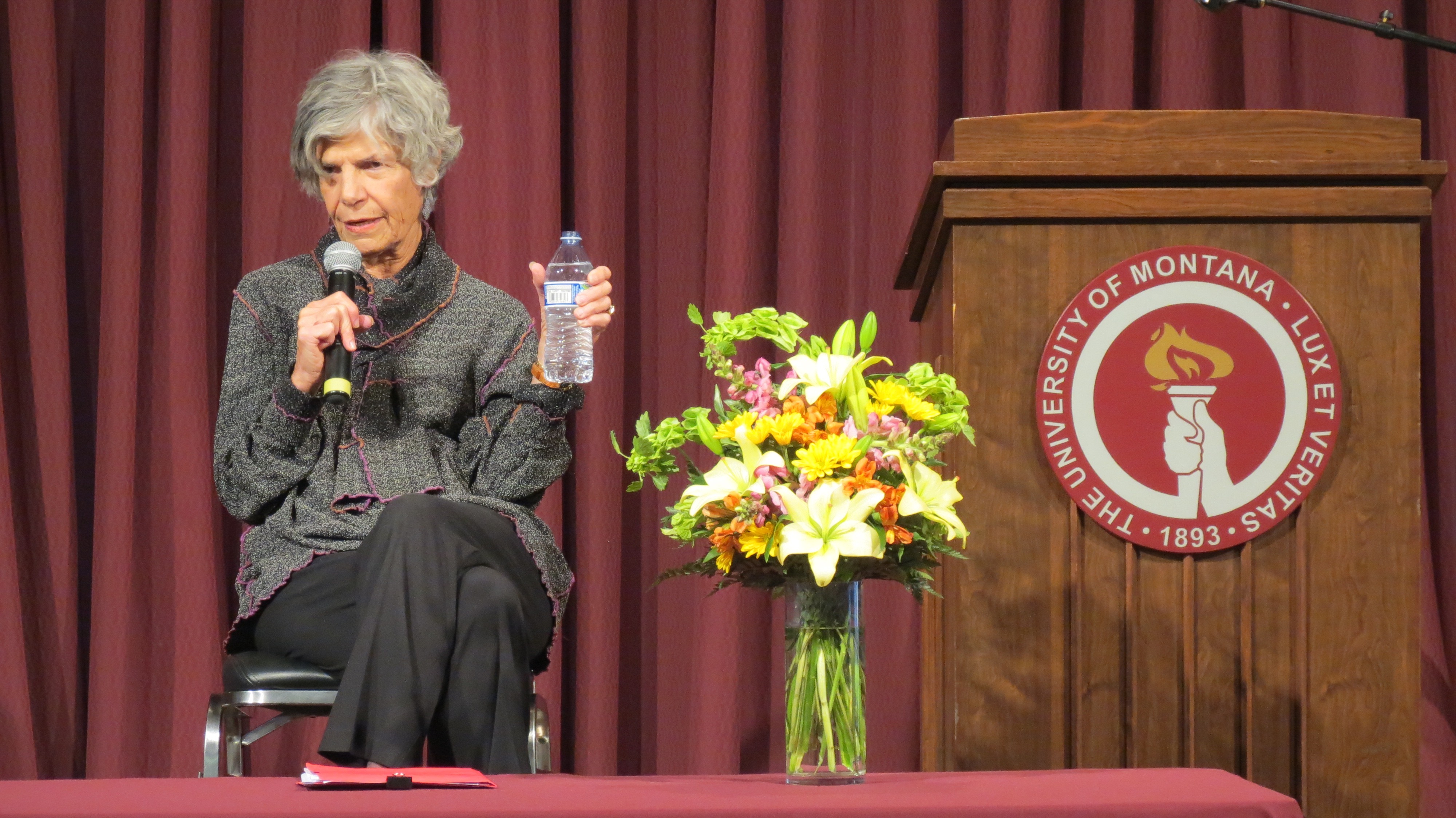
Susan Stamberg took questions from the audience after her talk.
Susan Stamberg took questions from the audience after her talk. Photo by Alyssa Rabil.

Dean of the UM School of Journalism, Larry Abramson, worked with Stamberg at NPR for many years, often sharing a ride to the office together. “Susan, for me, and for her followers, led the pathway out of a stiffer kind of journalism,” he said. “She showed that you can be a good journalist and be passionate, without sacrificing your objectivity.”

Stamberg also shared stories about her work with professor Jule Banville’s Advanced Audio class earlier that day. Her favorite pieces covered individuals’ personal achievement, “especially in the face of vigorous challenges.”

“Students asked her about her curiosity, how she keeps it sharp after all these years of reporting and interviewing,” Banville said. “She told them, ‘it’s not so much about style as it is about curiosity.’ I wrote it on the board because I thought it was so insightful.”

Later, Stamberg joked, “I am getting worse at remembering things, but I guess that’s why God invented Google.”

Yet having now worked at NPR for 45 years, she credited her genuine curiosity to the fact that she’s a life-long learner. After growing up as an only child, Stamberg also maintained her desire to reach out to new people, understand and befriend them.

“Susan’s an extremely diligent listener,” Larry Abramson said. “She can show the students how important it is in broadcast, and in journalism in general, to be a good listener.”

Stamberg took the time to listen to parts of Banville’s class’s brand new podcast series, Rest Stop Radio, offering feedback and sharing in their excitement.

“I’d always heard about how lovely and gracious she was, and now I know that’s the truth,” Banville said. “She made a huge impression on my students and on me, too. We were so lucky to get to know her.”

By Jana Wiegand

ACLU Executive Director Reveals the Lives Behind the Laws

When Anthony Romero joined the list of guest speakers for the President’s Lecture Series at UM, the dean of the School of Journalism, Larry Abramson, asked for the honor of introducing him. Romero has been the executive director of the American Civil Liberties Union (ACLU) since September 2001, and Abramson had spoken with him over the years while working on stories for NPR.

“I did a lot of work on privacy and surveillance issues, and the ACLU is pretty central to that,” Abramson said. “Since he’s the head, they’d often give him to me when I called.”

The ACLU also defends freedom of speech issues, which makes them handy resource for journalists. Media coverage of the ACLU’s projects shows that the benefits can go both ways.

“The moments when I really despaired were when I felt like no one was listening, that the huge, important issues were not getting the attention they deserved,” Romero said. “The most important thing is to engage in these issues, especially for students, because these issues determine your future.”

quote reading "When you want to glaze over rhetoric and statistics, imagine all those faces and don’t allow yourself to fall into the cynicism."

During his lecture, Romero focused on the civil liberties pertaining to the current state of the prison system in America. Romero shared the stories that he learned from visiting prisons like the Los Angeles Country Men’s Jail, which he rated worse than Guantanamo Bay. He said the problems were worse than just overcrowding and violence, but included issues such as restrooms that were inaccessible to disabled detainees and outing gay prisoners by making them wear powder-blue jumpsuits. As one such man told Romero, “Every day’s open hunting day here.”

“Prisons are very strange things and that’s why I force myself to go to them. It’s our tax money put to our purported use, like building roads or bridges, but prisons are such removed from the public psyche and public sight that we have to crack open these black boxes so that they’re less opaque,” Romero said. “I often find my sleep troubled after I’ve been there.”

Romero also spoke about how the prison system lacks opportunities for people to redeem themselves, especially if they’re poor. Even a one-time, minor crime could stick someone in an endless cycle of growing dept and imprisonment. He said, “It’s hard to imagine a more Kafka-esque, Catch-22 type situation.”

Yet his motive for talking about so many specific people remained the same. “I wanted to talk about real people and use their stories to paint a picture of what’s wrong and what needs to be fixed,” he said.

“I like reading legal briefs because lawyers are like journalists in that they like to tell stories,” Abramson said. “The ACLU’s gotten engaged in the issues, fostered national debated and they speak true to power. I think students can learn from them and take things one step further.”

However, while the ACLU takes a stance on the issues, it doesn’t take a stand on political parties. Romero said that working across political boundaries and tackling issues from multiple viewpoints was crucial to their progress. Romero warned the audience to be wary of whistle-dog metaphors like ‘act tough on crime’ that can imply situations are intractable or that something is inherently wrong with the individuals swept under those labels.

“When you want to glaze over rhetoric and statistics, imagine all those faces and don’t allow yourself to fall into the cynicism,” Romero said.

“Anthony’s a very good speaker,” Abramson said. “He made some very eloquent arguments, and I think he found a vein of sympathy in the Missoula community.”

By Jana Wiegand

NPR producer, award-winning science writer to mentor 2016 Crown fellows

Two science journalists with a national reputation and a knack for working with young reporters will mentor this year’s recipients of the Crown Reporting Fellowship.

npr crown

NPR Senior Health and Science Producer Jane Greenhalgh will work with Nicky Ouellet, a second-year graduate student at the UM J-School, while Hillary Rosner, an independent science and environment writer, will mentor first-year graduate student Katy Spence.

“Both mentors are stellar journalists who know the region and have ample experience in covering science and the environment,” said Henriette Lowisch, director of the Master’s Program in Environmental Science and Natural Resource Journalism at The University of Montana. “Their guidance and example will be invaluable to our student fellows as they report, produce and pitch their stories from the Crown of the Continent.”

Ouellet’s radio feature will look at how decisions made by forest supervisors affect individuals and communities that depend on the Crown’s forest products for their livelihoods, while

Spence will report on how citizens on both sides of the US-Canadian border perceive the link between beavers and climate change.

While the students will report their stories in the field, their mentors will recommend sources, edit drafts and help place the final product in a regional or national publication.

Greenhalgh, a Portland-based producer and editor for National Public Radio who specializes in science and health coverage, said mentoring younger reporters was one of her favorite things at NPR. “I loved Nicky’s pitch so I’m excited at the prospect of working with her,” she said.

Rosner, an award-winning journalist who covers science and the environment for National Geographic, Wired, Scientific American and other publications, said she was excited about the chance to work on an important story with a young writer one-on-one. “Katy seems like a sharp and talented reporter, and I’m looking forward to seeing her project unfold,” the Colorado-based writer said.

Now in its second year, the Crown Reporting Project aims to advance quality storytelling on landscape-level conservation, conflicting demands for natural resources and community efforts to build climate resilience. It was inspired by Ted Smith, a pioneer of large-landscape conservation who recognized a need for journalists trained to engage communities by explaining the science behind the policies that affect our backyards.

In 2015, graduate students Ken Rand and Celia Talbot Tobin worked with Chris Joyce, of National Public Radio, and Ted Alvarez, of Grist and Backpacker Magazine, to report stories on aquatic invasive species and mining waste.

By Henriette Lowisch