
Journalism Dean Larry Abramson addresses University budget cuts

           On November 17th, University of Montana President Royce Engstrom named the School of Journalism as one of the programs essential to the University’s “mission and identity” but targeted for budgeting cuts given a campus wide drop in enrollment.
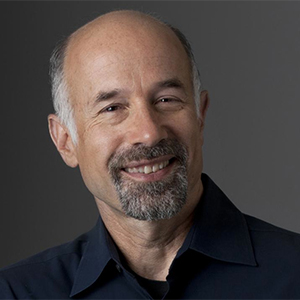
UM J-School Dean Larry Abramson
J-School Dean Larry Abramson
     “The journalism school is a part of this campus and the campus is hurting financially, so we’re going to take a hit,” Journalism Dean Larry Abramson said, in an interview two days later.
     While some departments will be able to escape adjustments, the School of Journalism was one of those that have seen what Engstrom called a substantial enrollment reduction. However, Abramson pointed out that Journalism is the smallest school on campus, which means smaller changes in the numbers of enrolled students manifests itself as a bigger percentage drop. A  13.9 percent drop between 2014 and 2015 means 44 less students in the School of Journalism.
     Abramson said that while it is still unclear what form an adjustment would take, he and the rest of the faculty are marshaling arguments to avoid a harmful budget cut and maintain the School of Journalism’s high rank, at 9th in the nation.
     “As much as we want to be good citizens of the University and help solve this problem, we also want to protect our program,” Abramson said. The biggest challenge, he said, will be to avoid losing a faculty position in order to keep the school as a competitive destination for those who want to pursue careers in digital journalism.
     Capstone journalism classes, such as the Native News Project and the Montana Journalism Review, are student produced publications that run to wide exposure each year. Native News runs as a special edition in several Montana newspapers and the Montana Journalism Review is distributed widely to media professionals across the region, as well as nationally and internationally. Both publications have begun to push more effectively into digital productions to match their print editions. Abramson pointed out that Assistant Professor Jule Banville is pushing increased attention to audio podcasts as well.
     “It’s not just about enrollment numbers, and I think the President and the Provost are open to that,” Abramson said. “Reputation and role in society is important and I think we have a really outsized role in comparison to many of the other departments on campus.”
     Abramson said that while he wished he could say more specifically what may happen, at the moment he remains in the fact finding phase. Being open with students and faculty is important to him, and Abramson said he will share any information he feels the school needs to know.
     Meanwhile, he remains committed to innovating in the journalism school, streamlining programs and pushing the school towards the digital age skills that are defining today’s market. “Our people are placed in newsrooms and startups and in their own entrepreneurial efforts all over the world,” Abramson said.
     He believes that tradition, and a high ranking among the nation’s journalism schools, is well worth protecting. “It’s taken a hundred and one years to build that reputation, and we don’t want to see it eaten away at by more cuts.”
By Andrew Graham
To our supporters and fellow J-Schoolers…

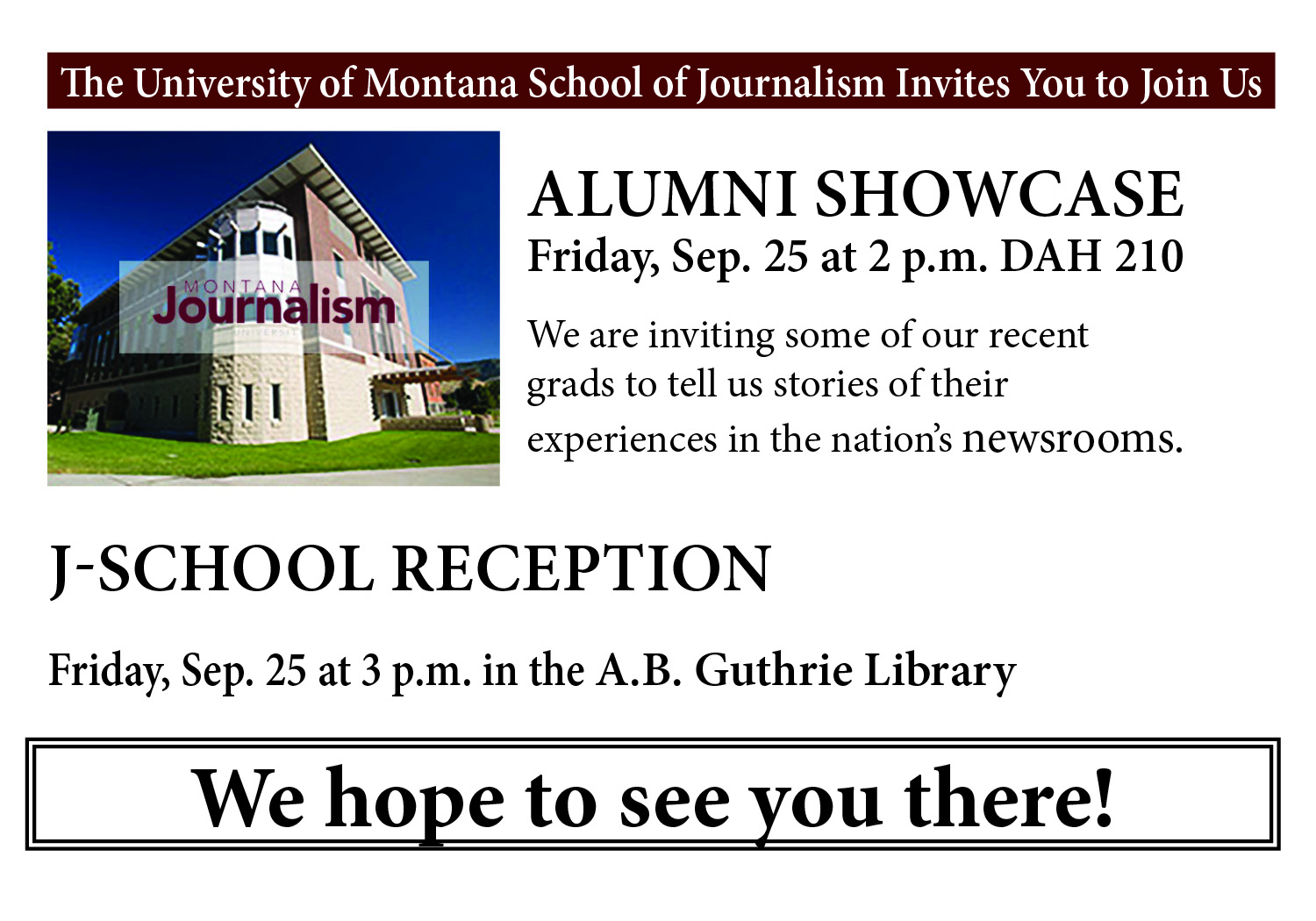
The year is off to a fantastic start here at the UM J-School. The smoke from the summer fires has cleared, and we’re enjoying blue skies and cool fall weather. Our students and faculty are hard at work already.Postcard which reads: Alumni Showcase, Friday, Sept. 25 at 2 p.m. in DAH 210. J-School Reception , Sept. 25 at 3 p.m. in the A.B. Guthrie Library. We hope to see you there!

Our student produced show, “Business: Made in Montana,” will air Oct. 22 at 7:30 p.m. on MontanaPBS. The Kaimin, our school newspaper, is moving more content online, while the printed edition has become a full-color weekly publication. The Montana Journalism Review is off to a strong start with a new staff, and a wealth of new stories to produce.

This year’s Pollner professor is Kevin Van Valkenburg. He is a distinguished reporter and known for his work with the Baltimore Sun, ESPN.com and ESPN the Magazine. He will present a talk titled “The Art of Storytelling Will Always Be What Matters, Not the Medium.” The annual lecture will take place Oct. 19th at 7:00 p.m. and, as always, the event is free and open to the public.

As we move forward into the new school year, we invite you to celebrate with us. The festivities begin this homecoming weekend.

Join us for our alumni showcase and J-School reception. The showcase is Friday, September 25 at 2 p.m. in Don Anderson Hall, room 210. As usual, we are inviting some of our recent grads to tell us stories of their experiences in the nation’s newsrooms. This is a great chance to see how our students are adapting to the changes in our ever-evolving industry. As we move into the digital age, our students must learn new skills and we must modify our idea of traditional media. We teach our students to maintain the same level of integrity and ethical conduct as we have taught our alums for the past 100 years.

We hope to see you after the showcase. Join us for a reception in the A.B. Guthrie Library (3 – 4 p.m.). We look forward to sharing a libation, catching up on your news, and talking football.

--UM J-School Dean Larry Abramson

Just do it.

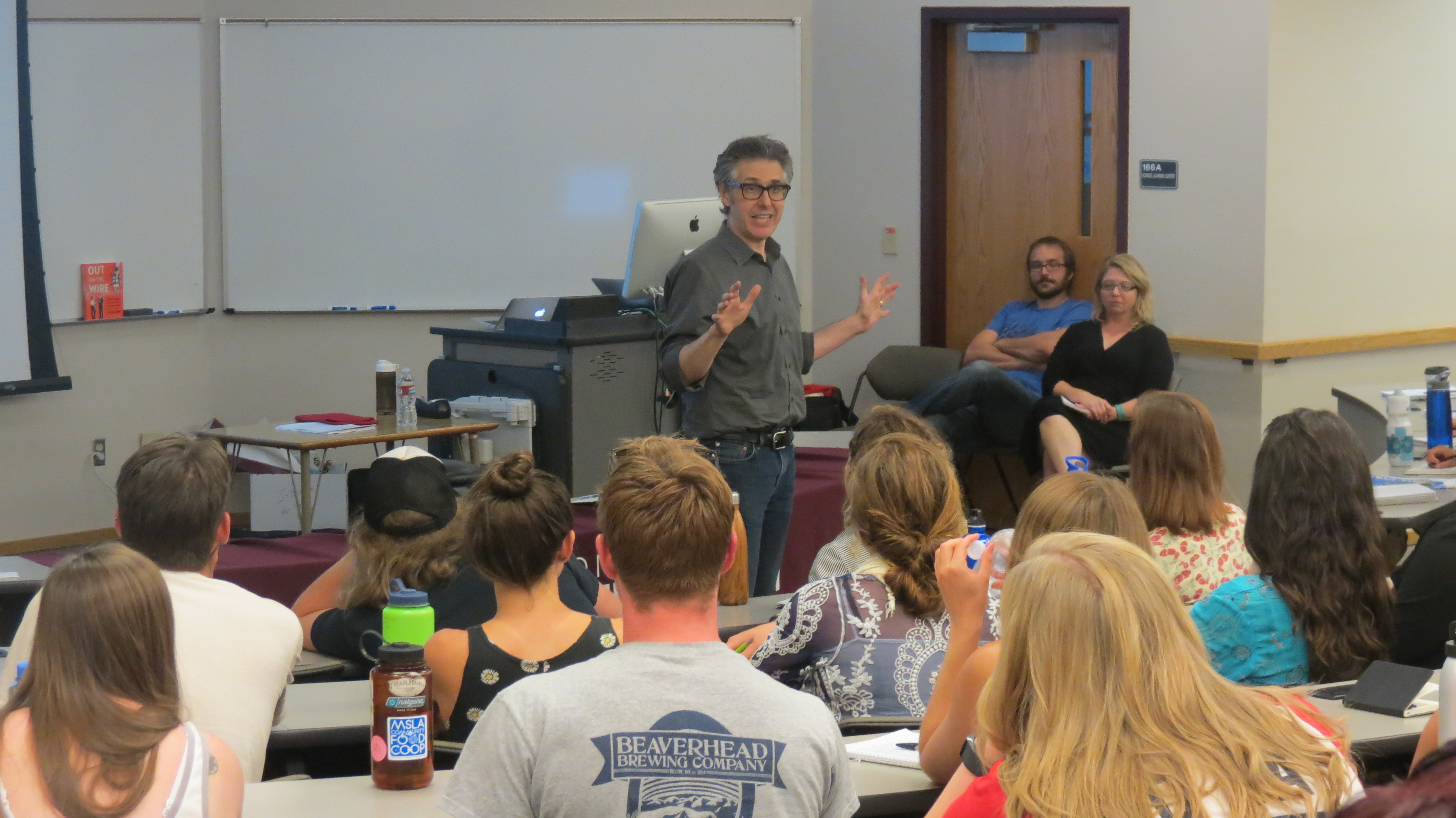
Ira Glass speaks to students and professors from the UM J-School

Radio demigod Ira Glass came to Missoula last week to entertain the public radio faithful, and to speak to J School students. Of the many lessons he imparted, one stuck with me: don’t wait, he said, before starting to create the journalism you have in your head. This is good advice for many reasons.

Ira confessed it took him decades to get good at radio. He stressed that the only way to get good at journalism is to do it. If you could buy journalism training at the drug store, the directions would read: write, edit, repeat. Learning about the history of journalism is a noble pursuit, so is trying to analyze trends in coverage. But the only way to become a great writer is to write. Great photogs need to shoot, radio folks need to gather sound, and of course we all need to post and tweet.

Part of Ira’s point is that there’s no need to wait until some employer gives you permission to do a story. Reporters—and students—today can develop their own news products, and can publish without a big backer. The podcast explosion has opened up new possibilities for many creative minds, and has turned out to be a great source of revenue for Ira’s show, This American Life. The barriers to entry are dropping. Your audience will be small at first, but you will be learning, and you may come up with something that will impress a prospective employer. So why are you wasting time with this blog? Go start your own.

By Larry Abramson