Meghan Fatouros Takes on Video and Broadcast TV from Both Sides of the Camera

By Kathleen Shannon

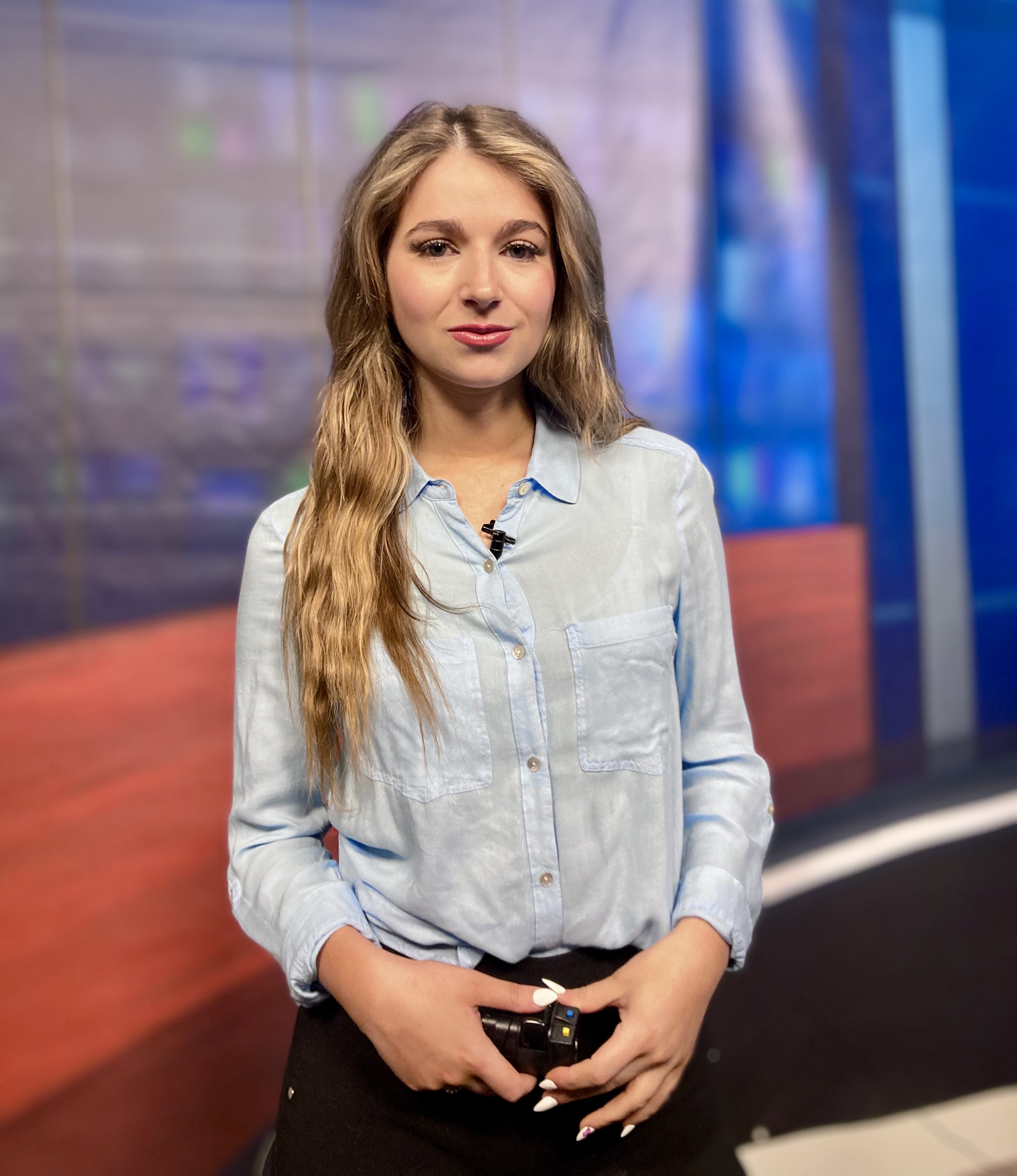
Meghan Fatouros prepares to anchor the Montana PBS News Brief.

Learn about the TV/video/film track at the J-School from sophomore Meghan Fatouros, who moved to Missoula from Bozeman for school. She got hooked on broadcast TV when she started anchoring the PBS News Brief. Meghan has spent time behind the camera, too. She hit her creative stride filming a mini documentary about horses on Montana ranches.

Meghan sat down with graduate student Kathleen Shannon to talk about her time at the J-School. The transcript of their conversation has been edited for length and clarity.

Q: So you’re in the broadcast TV track?

A: I’m kind of trying to focus in broadcast however, I’m willing to do whatever just because there’s so much to do. I’m just in my second year, which I think is fun, because I’m kind of right in that middle where there’s so many pathways and opportunities, but I don’t have to be stuck to anything. When I got into the PBS News Brief [class], I was like: ‘this is really awesome. I kind of want to stick with this.’ So I’m just looking to see where it goes.

Q: Did you have a medium in mind when you first got to the J-School?

A: Writing. 100%. But writing can really just adjust itself wherever it’s needed in journalism. And when I took all these classes here, I didn’t realize how much applied [to] writing, but then so many other media as well. And then broadcast writing really stood out to me too, especially with the PBS News Brief because we [the anchors] have to write our own scripts and then have someone look over them. But we’re mainly our own producers, which is really fun.

Q: What’s the premise of the PBS News Brief class?

A: The PBS News Brief, run by [Professor] Denise Dowling, is an opportunity for J-Schoolers to produce a weekly news brief, which is essentially two 30-second clips giving an overrun of the news of the day. So it’s mainly Montana-based, nothing too regional, but for all of Montana. And then its aired that night at a random time, which is always fun, because you kind of have to watch the TV and then: ‘Oh, here I am after the commercial break.’

Q: What about this class got you hooked on broadcast?

A: So, I kind of lucked out. Denise Dowling is my advisor. And I decided to do an in-person meeting because I’d never met her face-to face-because I entered college during COVID. So I felt like I got to actually talk about more of what I wanted to venture into. And she said, ‘you have to do this. This is a great opportunity.’ And I was nervous because I felt like a fish out of water. I didn’t really know anything. But so doesn’t everyone else? Because we’re all learning. At first, it was really daunting until I actually did it. [Then it was:] ‘Oh, gosh, this is fun. I like this.’

Q: How does it feel to be in front of the camera now versus when you first started the news briefs?

A: I did theater in high school. I was a big theatrical kid. And then I ventured a little bit into film acting. So I was always [pretty] comfortable speaking in front of audiences and, of course, being on stage. But one thing that was extremely different for me is I kept, like, projecting my words. So I was speaking so loud, you know, I was hooked up to a mic. And they’re like: ‘this isn’t the theater.’ And a lot of the times, it’s just getting more comfortable. Sometimes I would mess up words, but everyone’s just so willing to work with you on things and do multiple takes. Because there will be days when I cannot say one simple word for the life of me. So it took some time, but I’m getting more comfortable now and I’m happy I get to come back next semester [and] do PBS News Brief for two semesters, so I get even more time with it.

Q: What are the best parts and the most challenging parts of the broadcast track in general?

A: I think it’s just you don’t know what kind of opportunities are going to hit you. Those are the best parts. We’re in Montana. And I always wanted to go to school out of state, which was a horrible idea for me, especially with COVID. I was bummed, because I didn’t think there was going to be a lot of opportunities in Montana. And it feels so lame to say that now [because] there’s so many opportunities [here]. I really liked [the J-School internship fair] when everyone got to interview with different journalism networks across the state. I got some great interviews out of that and got so many connections. There’s just crazy amount of connections. I want to go abroad. And Denise was mentioning connections in other countries. And I’m like: ‘how do you really know these people? How does this even work?’ But it really is such a small world. And I think the J-School encapsulates that perfectly.

Q: Where do you want to study abroad?

A: I want to go to Spain and I’m doing the GLI certificate program [through the] Franke Global Leadership Initiative. And it’s essentially just global leadership [through] communicative learning. My roommate my freshman year was from Spain, and I learned so much from her and I just really appreciate the area from everything she told me.

Q: I know you’re a few years away from graduation. But at this point, what’s your dream job after graduation?

A: Okay. I am such a strategic planner. So right after graduation, I’m going to start off smaller and I want to do more local and I’m probably going to stick in Montana and build my way from there. But I have a dream job of being on “Good Morning America” and just waking up the world.

Q: Are there certain topics or projects that you hope to focus on in the future?

A: It’s always kind of whatever comes my way. That’s just the type of person that I am. So if something arises and I’m like: ‘I have to jump on this,’ I will. I’ve been really following closely with the Native News project. And I love what those students have been doing. And it’s cool watching the work that everyone puts in here.

Q: Are there other classes you definitely want to take before you graduate?

A: Maybe a little bit more photography. I never pictured myself enjoying it until I took the intermediate class that I had to take. But it didn’t feel like a requirement. It was more fun. And it was great going out into the community and just taking photos of really anything. Yeah, so it’s definitely a medium I did not expect to enjoy. And then we got to do video in that as well, which I really enjoyed because then I got to put some creative twists on it, especially since I want to be more of a multimedia journalist.

Q: So you’ve had classes where you’re in front of the camera and others where you’re behind it. Can you talk about how it feels to be on either side?

A: I think I’m harder on myself when I’m in front of the camera. But everyone’s their own worst critic, especially when something’s right on you. But I got to be a little bit more relaxed behind it. And I was shooting with a dear friend of mine on Montana ranches and horses, which was really fun. So I got to do a mini documentary on that. And it felt like a grand adventure. When I am in front of the camera, it’s its own little spotlight, in itself. But it’s definitely not as relaxing. It’s more just like: ‘Okay, we have to do this. We have 30 seconds to do it. Let’s go.’ But when I was out there on the ranch with my friend, it was more like: ‘well, let’s just shoot all day, eat some lunch and hang out.’ It was a good time.

Q: Talk more about that mini documentary.

A: It involved so many aspects of what I liked, and [I enjoyed] the creative freedom of it. And that’s what I love about the J-School is there so much creative freedom. It’s not one of these things where: ‘here’s the rubric, here’s the themes I’m looking for.’ It’s like: ‘what are you passionate about? Go out there and do it. Learn by doing.’

And another class I really enjoyed is writing. It’s something that is just so fun for me, especially fiction writing but also, of course, journalistic writing. I really loved feature writing with [Professor] Jule [Banville] and it was such a great experience because we were quite literally getting out of our comfort zones. And we got to write obituaries in her class and they were on people in the community and we had zero idea who these people were. And we had to reach out to them, which is something that’s extremely heavy. But at the same time, it had this bitter sweetness to it, that we got to share these people’s stories, even though they were just strangers to us days before. So that was exciting, too.

Q: Talk more about writing obituaries.

A: That’s the thing, too, with journalism: it’s always changing things. So originally, I found a really good story. And it was the oldest barber in Missoula. And it was running since the ‘30s. One of the original sons, I believe, passed. And the family still has the barber shop and I went in to go speak with them. And they were willing at first. They had to think on it for a bit. But I really fell in love with what I did find, because there were already some stories on the barber shop from years earlier. And I already fell in love with their story in general because it was a family of immigrants who moved here and they just built this from the ground up. And when I got the call that they weren’t willing to do it, because it was too hard—which, of course, you’re dealing with loss, it’s heavy—at first, I was so scared of being rejected. And it was like: ‘What am I doing wrong?’ But at the same time, it has nothing to do with me. And we have to put ourselves in perspective sometimes. So when I did initially get that rejection, I was a little bit down. But I was like: ‘I really hope that they heal as much as they can.’ Because that’s really all you can do. So then I went on the hunt for another story and I found the most random connection. And it was my roommate’s cousin’s grandpa. I reached out to this family that didn’t even live here. I did Zoom calls [with] this family in Idaho. And the couple was married for 75 years and they had their own painting business. And he passed. And so it was basically just storytelling from the wife. And at first I was really nervous [approaching as] a stranger. But having been rejected from the first one, I’m like: ‘what’s the worst that’s gonna happen?’ So I did end up getting a really great story that I could really get involved with.

Q: I think it’s a good lesson to learn early that rejection isn’t necessarily about you. And then, what piece of advice would you give to an incoming student who’s surveying the different tracks?

A: Oh, just when I think about myself, especially during COVID, it was such a weird time and I changed my plans so much. So probably, don’t be afraid to change and [change] is always going to be coming your way. Life is done through such a zigzag pattern. And the journalism school will [support] you. You don’t have to fit this certain mold.
Ridley Hudson Learns through the Lens

By Kathleen Shannon

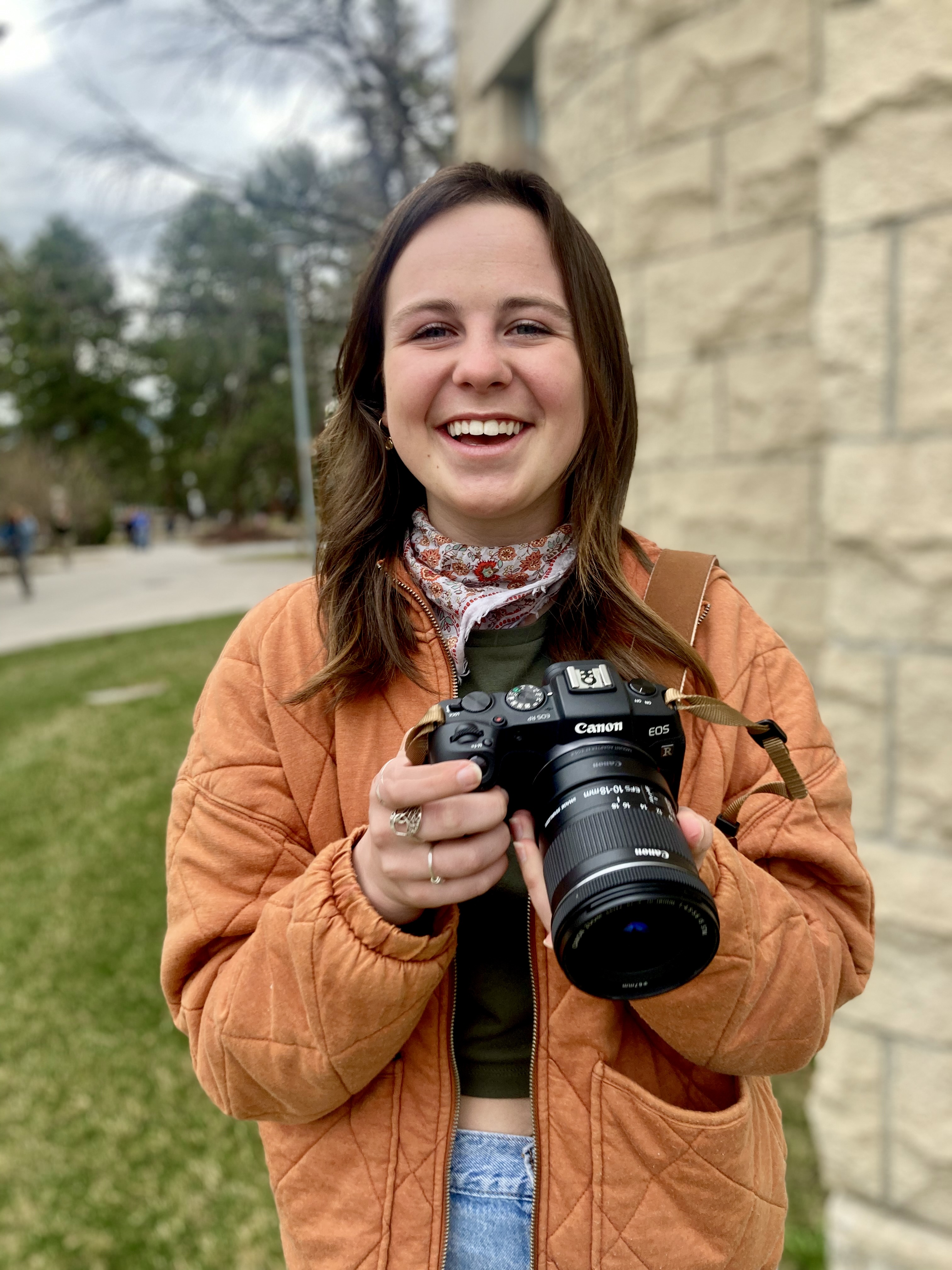
Ridley Hudson outside the J-School.

Up next on our exploration of J-School tracks is Ridley Hudson. She came to Montana all the way from Georgia to learn about photography at the J-school, where she’s now a junior. She does photography work for the Montana Kaimin student newspaper and is currently busy editing photos from her spring break reporting trip to the Crow Reservation for her Native News class.

Ridley sat down with graduate student Kathleen Shannon to talk about her path in photography. The transcript of their conversation has been edited for length and clarity.

Q: What made you decide to enroll in this program?

A: I did a student expedition with National Geographic in Yellowstone. And it was like, really photo heavy. And that’s where I learned really in depth how to use Lightroom. And then after that trip, I was like: ‘why not go to school out here?’ And then I decided to do journalism my senior year of high school.

Q: And how did you end up being most excited about photography?

A: It’s just always been an interest of mine. But when I first got my camera in middle school, we went to my first National Park facility, and we went to the Ansel Adams [exhibit] where all of his work is. And I was like: ‘I want to do that.’

Q: How has journalism shifted the way you look at photography?

A: So photojournalism [has] pushed me to be more creative in the way that I make people feel about images or, like, the way that I can pose my images. I feel like sometimes people [are] like: ‘oh, photojournalism–you just take a photo of the event.’ But there’s so many ways that you can make it interesting and make people want to read the story and want to learn more about it. We’ve been working a lot on portraits of people this semester with the Kaimin and making portraits of people very dynamic and showing their personalities more, which I think makes people want to read the stories, too.

Q: What’s the best part about the photo track at UM?

A: I would say that the professors help a lot. Definitely working at the Kaimin has helped a lot—you get a ton of experience. I don’t know how else I would have gotten so much experience. But, yeah, the professors are great. They help a lot. Their classes are great. And they’re always available if you have any questions or anything.

I would just say the biggest thing that I’ve learned is connections are super important. The J-School and professors are a great place to start with that. And getting involved in the J-School is really important. Because getting involved, you make connections, and then connections lead you to connections that lead you to further opportunities down the road. Because you never know who you’re going to run into.

Q: What’s one of the challenges of doing photography?

A: I like to do freelance and, obviously, journalism. And so [the challenge is] making time to do what you want to do [while] also work[ing] on your expertise. Because [with] journalism, you’re going to events all the time. You never know when breaking news is going to happen.

Q: Can you talk about making time specifically for shooting things that aren’t for class?

A: I’m taking a class right now with the Pollner professor [Daniella Zalcman]. And we’re working on long form stories right now, which has given me a lot more insight on how to pitch, how to apply for a grant, all these things. So I’ve started like thinking a lot more on long form stories. [And] whenever I’m able to travel or enjoy my weekends. I go skiing in the winter a lot. And we do galleries every week for the Kaimin. And so I’m like: ‘Oh, maybe I could do a skiing gallery for the Kaimin, on a ski team or some ski event that’s happening.’ I try to incorporate things that I love to do with my job.

Q: What advice would you give to new students who are charting their course through the program?

A: Even if you have an idea of what you want to do or you have an idea of what you’re interested in, definitely try classes out of your comfort zone or classes that you think you might be interested in. Try all [kinds] of journalism just to get a good idea of where everything is. And then usually you’ll find what you love.

Q: What’s your dream job after school?

A: I want to work for National Geographic to do long form stories. I mean, that’s the ultimate goal.

Q: Tell me about a project you’ve created that you’re particularly proud of.

A: Right now, I’m working on women in rodeo. The photos are really fun. The women are great. I’m mainly working with the U.S. rodeo team. But it’s been really fun going to the rodeos and their season’s coming up soon. I did do the reproductive rights rally for the Kaimin, which was fun to cover, if that’s the right word. I’m hoping to work on a story about wildlife moving into the city more with climate change and everything. Right now, I’m working on the Native News story. I just got back from our trip [to the Crow Reservation]. And my team, we’re doing lodgepole pines and [how they’re] so affected by everything like drought. [Over] years and years, the trees are becoming thinner. Just a bunch of things with climate change on the reservation.

Q: Can you talk a little bit about the highlights of that trip?

A: Yeah. I met a lot of great people, a lot of great connections. On the trip, I feel like it was like my first real experience with on-the-go traveling for journalism. I learned a lot [about] how to manage my time. The reservation we were on is super spread out. [If] you’re going to one side of the reservation, you can’t just come and then go back. You have to plan out your days. You have to be very prepared before you go.

Q: Describe a photo that you took on that trip that you’ll probably use in the final project.

A: So this lady that works at newspaper there, she was kind of our connection to most of our interviews that we had. And one day she was like: ‘Do you want to tour the whole reservation?’ So we’re like: ‘sure.’ [It’s] a four-hour drive. And we’re like two hours in and we see a bunch of smoke, so we drive over to see it. And it’s a huge dumpster fire. And there’s a Smokey the Bear sign in front of it. So I got a photo with the fire in the back and then the Smokey Bear sign and it was a pretty cool photo. Sad to see, but pretty cool.

This guy showed us where the Crow Fair is. And then he asked if we wanted to see it from this lookout point, which is, like, this area that’s a little tiny hill that stands by itself, because the reservation is pretty flat. And then you have this random hill. And he went up this really steep dirt road up to the very top, [and] his truck was barely on the top. And so I took his portraits up there. And then took a photo from up there and you can see the winding dirt road and then the Crow Fair below it.

Senior Austin Amestoy Embraces All the Media

By Kathleen Shannon

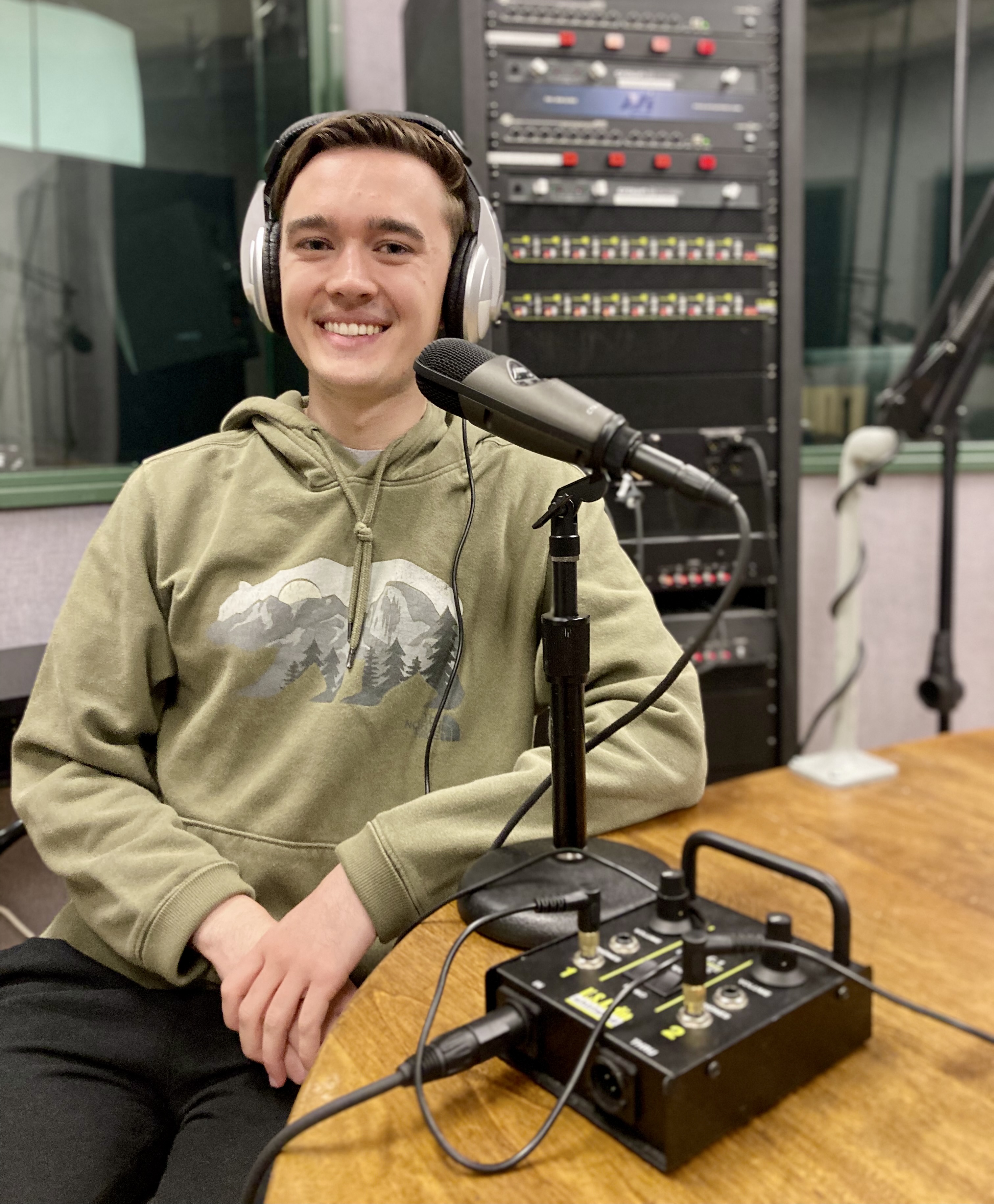
Austin Amestoy in the audio booth.

Austin Amestoy is originally from Laurel, Montana, and is now a senior, majoring in journalism with a minor in political science. His experiences include spending a semester covering the Montana legislative session in Helena and starting a podcast for the Montana Kaimin student newspaper.

Austin sat down with graduate student Kathleen Shannon to talk about his years at the j-school dabbling in all the media tracks possible. The transcript of their conversation has been edited for length and clarity. Read to the end for Austin’s sage advice to incoming students.

Q: How are you feeling about wrapping up your time at UM?

A: Excited and nervous. I am leaving well-prepared for the outside world, but I have to get a wrangle on what I want to do first because I like it all. There’s going to be some decisions being made in the next month or so. But I’m also not trying to pressure myself too much.

Q: If you could pull together a dream job, what would that be?

A: Well, it was probably my dream job from when I was young. And it’s still probably true today. But the interesting thing about journalism is by the time I get to that point, it might not really even be a job anymore. But it’s [to be a] nightly news anchor. Because I’ve always admired that job. And I admire the anchors who can go out and do their own reporting and bring it back into the newsroom or just report live from the scene of an important event that’s happening. I’ve always admired that. And that’s something that a lot of national-level nightly news anchors get to do. But more and more, we’re seeing, like [at] the local level, that anchor position is kind of phasing out, especially in Montana. At least the MTN stations are focusing a lot more on turning their anchor positions into senior reporter positions and doing less anchor newscasts and more just hopping from story to story, which delivers more news, which is really awesome. But I feel like there’s a special place in people’s hearts for their nightly news anchor. So I would love to do that at a national level. And I think those jobs will be sticking around at least in the near term. I also think it’d be really awesome to work on a podcast for NPR or something like that because I think podcasts are only going to grow as a medium for journalism. And that’s why I was really excited to be able to start practicing that now, while I’m still in school.

Q: What track are you following in the j-school?

A: I’m graduating with a broad base degree in Bachelors of Arts in Journalism. I think the track that I’ve done the most classes in is probably just writing, which is funny because I have done probably more reported work in TV broadcast and radio. But, you know, I did Denise Dowling’s intermediate audio class, which was really awesome, and got my foot in the door with audio reporting. And then I took intermediate video photography last semester with Jeremy Lurgio, which was really great. And that actually helped push me a little bit because it was more of a documentary style class, and I’ve done mostly broadcast work before at KTVQ in Billings over the last few summers. The great thing that the j-school taught me is a very foundational knowledge of AP style and broadcast writing and reporting. And I don’t think a lot of people realize that if you have those skills, it’s not a big stretch to put them to use in TV, radio or print because it’s all the same skill set. You just need to learn a few of the technical nuances of shooting video or recording audio and then editing and once you can do that, you can tell stories in any medium. So, I got a lot of my practice in broadcast outside the j-school, but it would have taken so much more effort and work and, you know, trial-by-fire learning to get to that point without all the skills that I learned here.

Q: That’s really insightful. I’m curious if you had a specific track in mind when you started out. What’s your journey been like exploring the different tracks?

A: Well, as a student in the j-school, I’m a little bit nontraditional. I did my freshman year at MSU in Bozeman, so I’m a turncoat. But when I transferred, very little of what I did in Bozeman actually even came over. I got a lot of my general credits that transferred over. But I came to Missoula because of my interest in TV broadcasts. My original interest was in that arena because I grew up watching the nightly news and I loved TV journalism. I thought it was super fascinating. But I also love to write just on my own. I’m a creative writer. And so it didn’t take me long to figure out that I also liked print reporting. Because it really is just writing creatively, but sticking to the truth and the hard news and the information that you can report out in the world. I transferred in as a sophomore and started in the program a little bit behind because I didn’t get to do the freshman level classes in the j-school as a freshman. So over the next three years, I really did a lot of catching up. And I’m graduating on time. But you know, going through that program, and getting so much of the journalism program so quickly, was really beneficial I think because it encouraged me to just hop from one class to the next to the next to the next and just build on those things. And I also just did a sampling platter of all the forms of media, just to see what would stick. But I think really the turning point of my time here was definitely when I covered the legislature. Because that was a really big deal for me and, like, figuring out what I was interested in and getting a chance to just go out and just be a reporter for a semester, you know? And do what everyone else in that capitol building was doing. And making some radio stories, but doing a lot of print reporting. It’s a really cool opportunity to test my education and say: ‘Oh, I actually really do like doing this. I’m on the right track.’

Q: So by that you mean you’re interested in continuing to cover politics?

A: Yeah, I’m actually a political science minor. So I’ve always been interested in government, I guess– maybe government more than politics. That’s one of the things that [Professor] Courtney Cowgill and I talked about a lot at the legislature was separating the policy from the politics. Because politicking is that sort of high art of spinning things to, you know, to win votes. Whereas government, and the processes that actually turn ideas into laws, and then the enforcement of those laws is so interesting. But those two concepts are really married, as well. And so I had a great opportunity to take some political science classes here and kind of sharpen my understanding of politics and government, and then really got to put that to use at the legislature. And I discovered that I really do love government reporting, state health reporting, and I’d love to do more of it in the future.

Q: And what semester were you in Helena?

A: This time last year, so spring semester 2021. It’s an amazing opportunity. And it’s really only afforded to a couple of students every two years. And so I was really lucky to have been one of them because I mean, it’s the epitome of the ‘learn by doing’ idea, right? It’s the j-school paying for students to go to Helena for four months and to just report and be reporters and then have really direct one-on-one support from an editor, being Courtney in this case. That was huge. [There’s] no newsroom out there [in which] two reporters [are] working with one editor. You’d be lucky if you’re sharing an editor with like four or five other people at most newsrooms, at least at the local level. So that was a huge opportunity to grow as a writer and reporter.

Q: Can you talk a little bit about some of the challenges of embracing all the tracks?

A: Well, I guess one of the challenges was by wanting to try all the different tracks, and just by the nature of me not wanting to go to school for six years, I wasn’t able to pursue all of them out to their capstone ends. But that was a choice that I made because I wanted to get experience in all of them. And I knew that even getting that baseline experience would help me practice that in the field, which I have fortunately been able to do. I did a lot of print reporting at the legislature, I was able to do some audio work there. Of course, I’m doing audio work now at The Kaimin Cast. And then I did a lot of TV reporting experience over my last three summers at KTVQ in Billings. So I guess the calculus in it for me was: I still want to graduate in four years, you know, because I want to graduate with all my friends and everything. But I’m going to get the foundational learning here, and then practice it and get that sort of higher level insight from editors outside of the classroom. And the j-school facilitated that super well. Like I already said, the legislature provided that opportunity for me. And then the Kaimin was willing to open an entirely new section this last fall after I pitched them the podcast for me to sort of selfishly practice my own audio techniques, but also hopefully leave something behind as value for the Kaimin. So definitely a challenge is the more areas you’re interested in, the more time it’s going to take to get to know those fields. But I think it’s just all about, you know, the amount of time that you as a person decide you want to devote to class and then how much you want to devote to your extracurriculars. And that’s a different calculus for everyone.

Q: Talk about a project you’re particularly proud of.

A: The Kaimin Cast. It’s sort of my—well, really, it’s the Kaimin’s baby as a whole—but I am particularly proud of it. And I know our editor in chief Addie Slanger is proud as well because we were able to really make it come together. I think that every reporter at the Kaimin should be proud of it [because] especially for the first semester, I was exclusively talking with the reporters at the time for The Kaimin Cast. So they were the ones who were out there doing the reporting for their stories and I just helped them turn it into a an audio story. But I’m super proud of that project because we really did build it from nothing, from scratch. Last fall, we found the distribution service, and I had to go in and figure out how to get us linked to Spotify and Apple podcasts and Amazon and every distribution platform you could imagine and get those accounts set up and those services linked. And, you know, we had to come up with the production schedule and the production flow and when we would publish. And then, not only that, but we were putting out episodes on a [weekly] basis. So while they were always based on the feature story from that week’s paper, we had to determine how that was going to translate best into an audio format. It’s an ongoing challenge every week. You know, sometimes some stories are easier to translate to audio than others, but we made it happen. I think I’m most proud of the fact that we never missed a week of regular publication with The Kaimin Cast since we started in the fall. We’ve always had an episode. And then this semester, we were able to devote some more hours to get an audio reporter in the section as well. And Elinor Smith has been putting out a companion episode every Monday to accompany the Thursday main Kaimin Cast as A Second Look, we call it, at the previous week’s episode. So we’ve been really able to create an audio department at the paper and then turn it into what it is now in the course of a few months and that’s been a huge point of pride for us. And now we’re working on succession and making sure that the program keeps around after, you know, a lot of the current editors graduate, and we’re on track to do that, too. I didn’t think it was right for, you know, this 100-year-old paper we have at the university to not have an audio component. That’s just becoming so much more common these days. And Addie I both said last fall, that if we could create an audio department and a podcast that would be self-sustaining after we graduated, we would have done our jobs. And we’re pretty close to doing that.

Q: Can you talk about something that you learned from doing The Kaimin Cast that surprised you?

A: I think what would have surprised me when starting out was that it would become easier as we went along. The initial learning curve of starting something off can seem really daunting. And, you know, for the first probably five, six, seven episodes, I would spend three, four, five hours straight editing after we had finished recording. And the more you do something and you develop your workflow and you develop your processes, you start cutting that time down. And then you can afford yourself more time to focus on other aspects to make the storytelling better. Last year, we talked pretty much only to reporters, and there was a lot of editing involved. And by the end of the semester, you know, our advisor of the Kaimin, Jule Banville, who’s also a professor here at the school, was saying: ‘How can we make this happen? How can we shake this up, make this more interesting?’ And it was something that, you know, can be discouraging to hear after you’ve been working, just to get out a product every week. But was what we needed to hear. Well, we decided to change the publication day from the Monday before the paper came out to Thursday, the same day as the paper. And in doing so we pushed our timelines back by four days, and then in doing so, we were able to switch up the format a little bit and we started bringing in people from outside the Kaimin to interview on the on the Kaimin Cast. We were getting students from around campus into the audio booth and people from the community and then we were still talking to reporters sometimes as well, you know, and we had this really healthy balance of sources for the podcast. So I guess I was surprised at the trajectory The Kaimin Cast took because you go into it thinking it’s going to be one thing, and you really just kind of have to let go of the reins sometimes and figure out where the horse wants to go. And then you’ve got to follow. That was the case with the podcast. And you know, I think it’s in a better place now for it. I’m a notorious control freak. Learning to let go of the control and also being okay with that, was definitely my surprising, revelatory moment.

Q: That’s a good life lesson, too. Okay, last question. What sort of advice would you give to someone who’s just starting out at the j-school?

A: Oh, well, first of all, congrats for choosing the best program in UM and also the state. You’re in a good place. And you picked right.

My advice to them would be, well, this is the cliche advice, but get involved with the Kaimin, first of all. Two stories per week is the expectation of a reporter. But if you’re interested in photo, apply to be a photographer. If you’re interested in design, apply to be a designer of the paper. If you’re interested in audio, please apply to be an audio reporter. Even if you’re not picked to be a paid reporter, we do hire interns all the time. And the best thing you can do at the j-school is start getting involved, whether that is at the Kaimin or not. Start making connections and friendships with people in the building and get to know your professors. Because that was really hard for me coming in as a transfer student. I came in and didn’t really get an orientation like traditional freshmen do coming in. And so I sort of started off a little bit cold and really had to get to know everyone. But once I did, it was like transformational—a better experience when you’re connected to the people around you and in the school. So that would be my recommendation. Because once you have those connections, your learning will also just bloom. You’ll be surrounded by people with different ideas and methods of going about journalism, and you’ll get advice from so many different corners. And you can pick and choose the best pieces of advice that serve your style of learning and your style of reporting. And you’ll make yourself an infinitely better reporter in the process. You’ll also just have more fun. So I would say just don’t be afraid to dive in and get your feet wet. Because the ‘learn by doing’ thing is a motto, but it’s also a mandate, basically. You’ve got to do it here because otherwise you’re doing yourself a disservice. And don’t be scared. Yeah, it can be really scary. But there’s a reason you’re here and not starting off at The New York Times, right? You’re supposed to be learning. You’re supposed to be failing—but, you know, hopefully failing upward.