
Journalists On Social Media: Q&A with MTN’s Ashley Washburn

Ashley Washburn is a multimedia journalist working as sports reporter and anchor at the Montana Television Network, which is a network of CBS affiliates with local stations in just about every major city in Montana. She graduated with a bachelor’s degree in journalism from San Diego State University in May 2019. During her time in San Diego she covered her university’s athletic department. Later she interned with ESPN and worked as a morning news producer for NBC 7 San Diego.

UM Journalism student Meghan Fatouros interviewed Washburn about her ideas on best practices on social media. What follows in a transcript of their conversation, edited slightly for clarity and brevity.

Q: How do you decide what is beneficial to post and what is not? How does this pertain to sports journalism?

A: If there is one thing about this industry, it’s that building relationships are more important sometimes than being the first to break a story. This more pertains to sports, but I always weigh the situation and I’m definitely careful with putting information out there about college athletes. I also try not to post anything (breaking news wise) unless I have the information confirmed by two different sources and I feel 100% confident about the information that was given to me. If there is any type of uncertainty, it’s an automatic no because I don’t want to get into a situation where I was wrong or say something incorrect that backlashes and hurts my credibility.

Q: Has there ever been a moment you chose to delete something or backtrack?

A: Going back to my first answer, there isn’t a moment I can think of currently mainly because of that checklist I just stated. Having several sources is always important, and you need to feel 100% confident about what you are putting out there. If there is any sense of doubt, try to find more information or put it on the back burner until you are certain.

Continue reading “Journalists On Social Media: Q&A with MTN’s Ashley Washburn”
Journalists On Social Media: Q&A with Newsy’s Maritsa Georgiou

By Katy McCumber

Maritsa Georgiou, a 37-year-old broadcast journalist, spent 15 years at NBC Montana before moving to the national market as a correspondent for Newsy, a multi-platform news channel often watched on streaming services. An alum of the University of Montana School of Journalism, Georgiou has covered COVID-19, politics and wildfire coverage while working for NBC Montana. Additionally, she won the 2021 Walter Cronkite Award for Excellence in Television Political Journalism. The Cronkite Award is given every two years to “shine a spotlight on journalism that seeks truth, examines inequities, serves the public, and demonstrates the indispensability of a free and trustworthy press.”  The judges highlighted her investigation into the planned removal of USPS blue collection boxes before the 2020 election. With nearly 12,000 followers on Twitter and 2,400 followers on Facebook, Georgiou boasts a large audience on both social media and as a news anchor.

UM Journalism student Katy McCumber recently chatted with Maritsa about her work while Maritsa was covering hurricane Ian in Florida and they specifically talked about how she uses social media as a journalist. Below is a transcript of their conversation, edited slightly for brevity.

Q: Let’s start with the big question: what’s the biggest challenge on social media in your job as a broadcast journalist?

A: Definitely the nastiness and hatred that circulates online. In the last six years, if you go to any news I’ve posted on Twitter or Facebook that gets a lot of comments and traction, there aren’t many stories that don’t turn political and nasty. Most posts take a turn for the worst. The things you would think of being a totally benign story, that there’s no way they could make political, and all of a sudden, someone’s fighting in the comments. It’s wild.

Q: What are some of the journalistic guidelines you follow within your own work on social media?

A: Well, the one thing is, I really try not to inject my opinion wherever I can. The whole point is to put posts out there and let the audience make their own opinions and judgements. Now, that doesn’t mean that I won’t spell some things out for people, like, you know, follow the trail, this is interesting and here’s why, or here’s the course that this took. That’s my number one rule. My number two rule is to really, really, really, double check everything before I post it. With the nastiness on social media, there is nothing worse than making a mistake, because you become fresh meat. But if you do make a mistake, acknowledge it, correct it, apologize, and move on.

Q: For sure. Could you give me an example of a mistake you’ve made on social media?

A: Oh, when I first started covering COVID, I inverted a number once on the number of cases in a certain area. Those numbers are super important- if you get it wrong, that totally changes what you’re trying to report.

Q: Does being a journalist make you use your social media differently?

A: Definitely. There are things I post on my personal Facebook that’s private for only my friends and family that I would never post on my public accounts. For instance, my kid. In recent years especially, when I’ve seen hatred against journalists grow more, I’m really protective of my son, and I don’t want to make him the target of anything. Also, on my personal page, I don’t post political things. Often, the things people use social media for, I don’t, because I have a responsibility to keep my personal opinions out of things. I can get personal on my private stuff, but I don’t get political, because that’ll kill you.

Continue reading “Journalists On Social Media: Q&A with Newsy’s Maritsa Georgiou”

Journalists On Social Media: Q&A With MTN’s Jane McDonald

Jane McDonald is a broadcast journalist and a reporter at the Montana Television Network, which is a network of CBS affiliates with local stations in just about every major city in Montana. McDonald graduated from the University of Washington with a degree in Journalism and Media Production from the Murrow College of Communication. She was involved with multiple multi-media productions and the Murrow News 8 team before joining MTN news in June 2021.

UM Journalism student Meghan Fatouros interviewed McDonald about her ideas on best practices on social media. What follows in a transcript of their conversation, edited slightly for clarity and brevity.

Q: How do you decide what is beneficial to post and what is not?

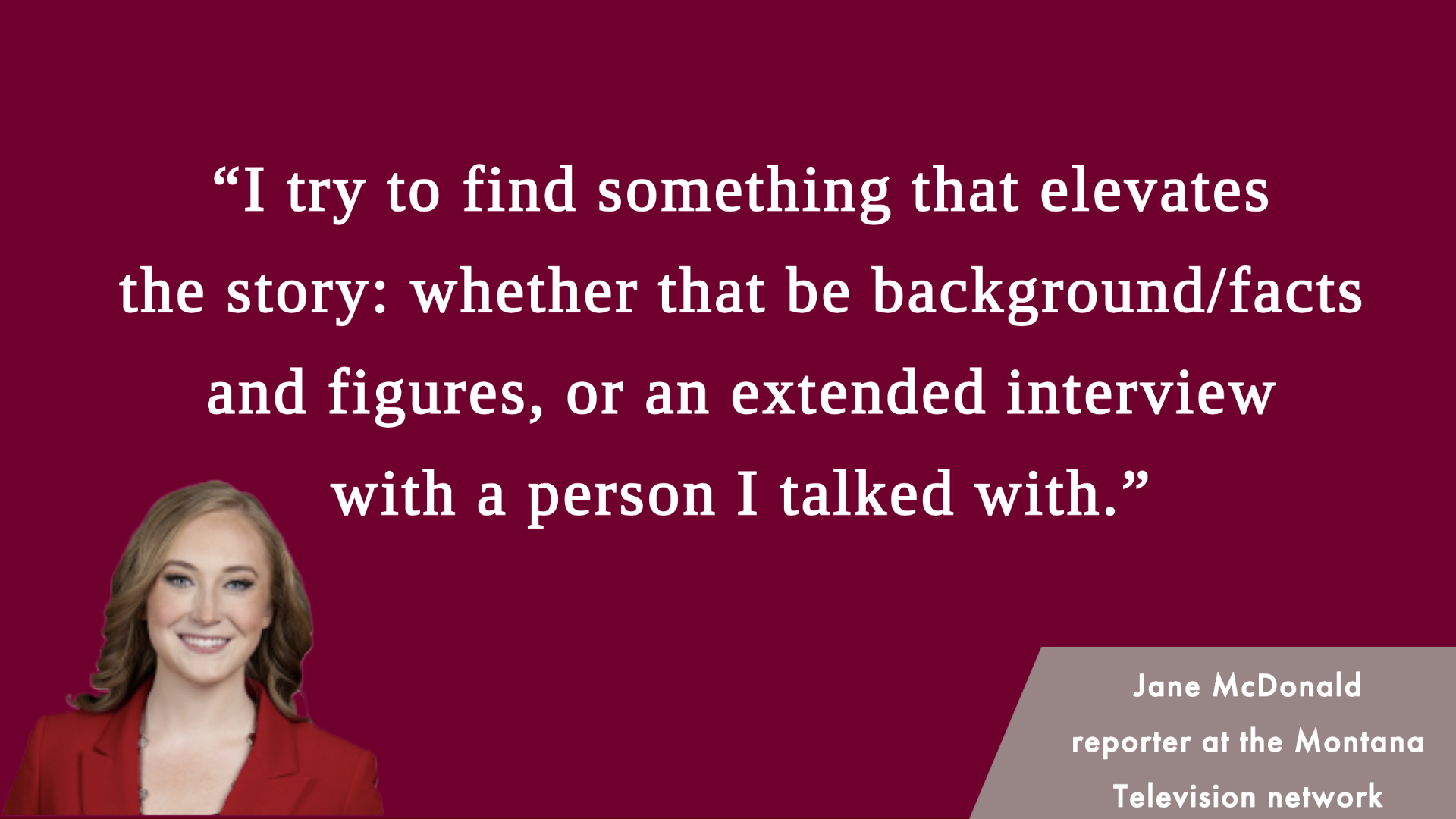
A: Digital elements of storytelling have really become a focus for broadcasters. When I’m back at my desk, thinking what would be a good piece for our social media, I try to find something that elevates the story: whether that be background/facts and figures, or an extended interview with a person I talked with.

Q: Has there ever been a moment you chose to delete something or backtrack?

A: There have been several times where I head back to my team and ask for their advice, for instance, the title of an article. I always try to think of journalism from all angles—and if a new angle hits me later on in the day, I reach out to my coworkers and see what they think.

Continue reading “Journalists On Social Media: Q&A With MTN’s Jane McDonald”