J-School Grad Student Wins Best In Festival For Radio Piece

photo of Ouellet working in the studio
Photo by Shanti Johnson.

From the blue lights and glow-sticks at The Great Northern Bar in Whitefish, Montana, graduate student Nicky Ouellet followed a band backstage to understand the mission behind their music. Ouellet’s subsequent radio story, “An ‘80s Cover Band With Global Dreams,” recently won Best in Festival in the student news competition for the Broadcast Education Association’s Festival of Media Arts.

“This is one of my first audio pieces,” Ouellet said. “For it to receive national recognition like this is really overwhelming, and I’m really honored.”

The story emerged from Assistant Professor Jule Banville’s Advanced Audio Skills class, when Banville prompted her students to incorporate music into a radio piece. “I wanted mine to be more than just a story about a band,” Ouellet said. “And the New Wave Time Trippers immediately came to mind.”

While the band came together for their mutual love for ‘80s music, they also wanted to find a way to be able to live off their “Rocky Horror Picture Show” style performances. Members of the New Wave Time Trippers told Ouellet that they hoped to turn these occasional night gigs into a full-time job by playing at corporate events and landing a regular show in Las Vegas.

“I thought it was a really interesting combination of the artsy, but also the business savvy,” Ouellet said.

For her, capturing a sense of place was equally as important as recording the essence of the Time Tripper’s music. Ouellet plugged a Marantz kit directly into the bar’s sound system to record clean copies of the songs and set up a secondary recorder to capture the crowd’s experience. After taping two of their shows, one in Whitefish and one in Missoula, Ouellet spent hours listening to the footage, recording her own narration and trying to keep the story under five minutes.

“Most of the challenges were really just keeping it tight and clean and focused,” Ouellet said. “That’s where Jule, my professor, came in and helped me kill all of my darlings, which was a really tough process because there were a lot of good ones.”

“I loved that story, and it will make you happy if you listen to it,” Banville said. “It had this signature mix where Nicky blended her writing and narration with interviews, and of course, great songs.”

The intimacy of radio originally drew Ouellet to the medium. She said the power of each story to delve inside someone else’s head made her change the way she saw the world. “You kind of lose sense of the thing directly in front of you, and it’s like this whole world of your mind and that of the story-teller are blended,” Ouellet explained.

Since the Time Tripper piece, she and Banville have been working closely together on Ouellet’s professional portfolio, which she will defend in May to receive her master’s degree in journalism. Her portfolio includes both written and audio pieces, examining how Native Americans manage natural resources on tribal lands. Ouellet is currently applying to jobs and fellowships for after graduation, and she hopes to find a position that lets her continue to use both print and radio.

“I’ve met very few people who work a story like Nicky Ouellet,” Banville said. “She’s going to do amazing things and just kill it as a journalist who can do it all.”

To hear more about Nicky Ouellet’s Best in Festival piece and the production process, watch her video interview on the School of Journalism’s Vimeo account, or click here to read the transcript of her interview. See more of Nicky Ouellet’s work in print and radio on her blog’s portfolio.

Stay up to date with more UM J-School radio pieces by listening to Jule Banville’s podcast series Last Best Stories.

By Jana Wiegand
J-School Alum Makes Top 10 List For Hearst Radio Awards

Emily Proctor talked with Vietnam War veteran Roger Cox for an hour and a half with the recorder running. She cut these 90 minutes down to three minutes and thirty-seven seconds of Cox’s own narrative, not adding a word of her own. The final piece, “Roger Cox’s Vietnam,” was one of two stories she submitted to the 2015 Hearst Journalism Awards Program. On February 3rd, 2016, the Hearst Radio News and Features competition ranked Proctor 9th in the nation.

hearst logo

“I had an ah-ha moment with this piece,” Proctor said. “It totally changed what I wanted to do with my career.”

Over the course of the interview Proctor probed deeper into Cox’s memories as a marine in the Vietnam War. As she edited the piece, she listened to the moments where Cox’s stolid replies began to falter. Proctor felt the power of Cox’s voice and the emotion it carried without needing any extra narrative.

Assistant Professor Jule Banville, who worked with Proctor on the story as part of her Intermediate Audio class, watched Proctor’s interest in radio grow. “He was just really honest with her about what happened there and what he thinks about it now,” Banville said. “And because what she produced was his voice telling his story, it had so much more power for her than any journalism she’d done before. It just clicked.”

The story aired on the podcast Last Best Stories, and the full interview can be accessed through the Veterans History Project.

Since graduating last May, Proctor’s been working on some independent radio projects, including a Montana-themed piece about the modern cowboy. This summer she will be doing more radio work in Alaska and potentially connecting with J-school alum Ruth Eddy, who works at a public radio station in Ketchikan. However, Proctor’s next major goal involves going to graduate school for audio design, hopefully in Germany or New Zealand, she said.

When Proctor studied abroad in Athens, Greece, she shot a short documentary about the smoking culture and its importance to their society. She also tried to produce some audio stories, but said, “The language barrier made it hard to do good radio.”

Proctor addressed this issue again in the second story she submitted to the 2015 Hearst Awards, a piece called “Language Is No Barrier For Senior Companions.” The story centers on Frank Havlik, a native from the Czech Republic who now lives in Missoula and volunteers as a Senior Companion. Coming from Stanford, Montana, Proctor was conscious of the fact that her Montana audience wasn’t used to hearing a heavy Czech accent, so she took care choosing the most enunciated sound bites.

“I wanted to cover all my bases and make sure people understood the story,” Proctor said. She added her own voice-over narrative and provided a complete transcript when the story aired on MTPR on April 28th, 2015.

“I’m pretty insanely proud of her,” Banville said. “She went on to intern at Montana Public Radio, so she’s got some news chops too, and I’m so glad the judges recognized her talent.”

By Jana Wiegand

J-School Alum Wins Hearst Journalism Award

February 10th, the Hearst Journalism Awards Program released its top ten winners in the Multimedia One/Features category, ranking Kaci Felstet’s piece “Late Start” 6th in the nation. Felstet produced the multimedia piece last spring as part of the class Native News, co-taught by Assistant Professor Jason Begay and Associate Professor Jeremy Lurgio.

“Late Start” tackles attendance issues at Rocky Boy Elementary School located in the center of the Rocky Boy Reservation in north-central Montana. Originally, Felstet and her reporting partner Courtney Anderson had been researching teacher retention rates, but they realized that the story’s core remained with the students.

Photo shows a darkly shadowed mug of tea sitting on a railing with a bright orange sunset in the distance
Taken during a photo-a-week challenge. By Kaci Felstet.

“Kids weren’t getting the education that they needed,” Felstet said. “And that was something really close to our hearts.”

Begay and Lurgio chose the theme “Relationships” for Native News in spring 2015. They challenged students to find unique, personal bonds that explored “how people on reservations connect with each other,” Begay said.

“It left a lot of room for us to branch out and find our own stories,” Felstet said.

She and Anderson traveled to the Rocky Boy reservation during spring break and spent several days following their characters and gathering classroom footage at the elementary school. Felstet said the kindergarten kids needed some time to get used to the cameras and stop making funny faces at them, but that their patience paid off in the end.

“The hardest thing is that you can’t go back,” Felstet said. “You have to get everything you need in three or four days.”

That was where working as a team came in handy. Despite extensive background research and planning, Felstet and Anderson knew that they need to stay both flexible and focused while in the field, so that they could find the true story even if it was different from the one they had envisioned. Lurgio said, “Kaci was very organized. She knew what she needed and she got enough to be able to adapt.”

Felstet’s first exposure to video came from a summer internship with KRTV in her hometown of Great Falls, Montana, but she considers herself more of a photojournalist these days. She’s currently pursuing a master’s in Economics here at UM, which will not only diversify her education but also open up new doors to her as a journalist, especially regarding business and finance beats, “which not everyone wants to cover,” she laughed.

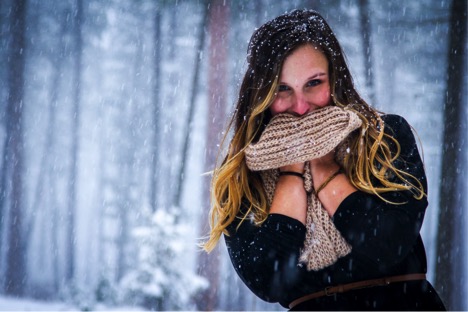
A self portrait of Felstet clutching a scarf to her face while standing in the snow
Felstet’s self-portrait from her photo-a-week challenge. By Kaci Felstet.

To stay familiar with her camera, Felstet decided to create a photo-a-week challenge for herself to keep her creativity fresh. The recent recognition of “Late Start” serves as another boost from the journalism world.

“Kaci has a great eye for shooting and producing multimedia packages,” Lurgio said. “She works extremely hard, and she was very dedicated to producing a professional caliber story. And that’s just what she did.”

Kaci Felstet and Courtney Anderson’s collaborative piece can be found on the Native News website, which features more stories from reservations in Montana.

By Jana Wiegand