Every day looks different when you are the digital strategist for a publication that boasts 123,000 followers on Instagram, 430,000 likes on Facebook and 452,300 followers on Twitter.
Tynin Fries works on everything from the Denver Post’s website, social media platforms, newsletters, and other engagement efforts.
Fries recently answered a few questions from University of Montana student Abigail Cook over email about her work. Below is a transcript of their email conversation.
Q: What does a typical day at work look like for you?
A: It changes every day! Depending on the news, my day can be really busy with breaking news or be slower, with time to work on longer projects or big-picture goals.
Q: What are some important factors your team considers when posting something on social media? Do you set goals for social media posts, like advertising for full stories or interactions on the platform?
A: We consider whether a story fits into a few categories: high mission or low mission, high audience or low audience. Those high mission, high audience stories are the key to social success. Yes, we have goals that we try to reach each month for referrals and engagement.
Q: Does the Denver Post have strict guidelines and consequences to unprofessional or biased behavior on social media?
A: You can read about this in our union contract but ours are pretty industry standard.
Editor’s note: The Post has no specific policy regarding ethics on social media, but their online behavior applies to a general policy that every journalist at the Post follows, covering everything from fairness throughout news coverage to the journalists’ personal lives.
Q: What strategies are used to grow and maintain your audience?
A: We like to meet our audience where they are and also listen to them. Are we providing the kind of stories they want? How do we do better?
Q: How different is social media-based journalism from the classic print journalism that most people assume of the industry?
A: Very different skill sets but social media works hand-in-hand with print or digital news.
Abigail Cook is a student in the UM School of Journalism’s Social Media and Engagement class, which conducted Q&As this semester with more than 20 journalists as part of a research project on best practices for journalists on social media.
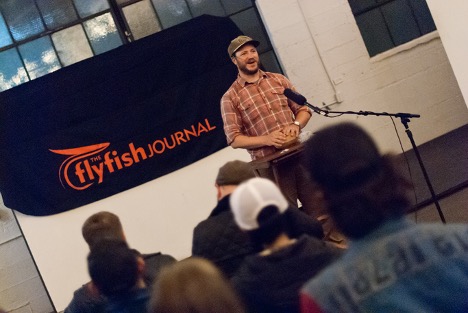
Jason Rolfe is an editor for The Fly Fish Journal, a publication based in Bellingham, Washington that covers the world of fly fishing. Rolfe has been a freelance writer and been involved in the “The Fly Tapes” podcast.
Rolfe recently spoke to University of Montana journalism student Joseph Evans about how he works with social media. An edited transcript of their conversation is below.
Q: How has social media helped or hurt the promotion of The Fly Fish Journal?
A: I think as far as “promotion” is concerned, it has likely helped. Social media is a simple way to reach people, and especially on the image-based social media apps (like IG), it plays to one of our strengths (photography), which people turn to TFFJ for.
Q: How do you keep social media posts separate from published? What’s your strategy?
A: I think our basic SM strategy relies on a few different kinds of posts. Some are just general flyfishing stoke/culture posts, but obviously with a nod toward the TFFJ aesthetic. Some are posts promoting our content–a new piece of work online or in print (we make two written pieces available at our website per issue), or a new film that we’ve produced. And the third category is typically conservation-related, because you can’t really work in the flyfish space without having a focus on conservation–it’s just not ethically sound.
Q: Who is the voice of these captions for posts on social media?
A:Posting is typically done by Copi Vojta, our photo editor. When he writes captions, sometimes they are in his voice — a sort of irreverent one in some respects. At other times, if necessary, he and I will work together to create a caption if we feel that wording is important.
Q: What has been TFFJ’s favorite social media platform to promote on and why?
A: Probably IG, for the reason noted above. I think a key draw of TFFJ is the imagery–we find and publish the best–and so it would make sense for us to really lean into an image-based SM platform.
Q: Has social media made the work of your publication more difficult? If so, why?
A: I don’t think so. Though, of course, we don’t have an overly heavy social media presence either. With that being said, our marketing director does keep up with best practices on various platforms and we try to incorporate those best practices into our posting and engagement where we can.
Joseph Evans is a student in the UM School of Journalism’s Social Media and Engagement class, which conducted Q&As this semester with more than 20 journalists as part of a research project on best practices for journalists on social media.
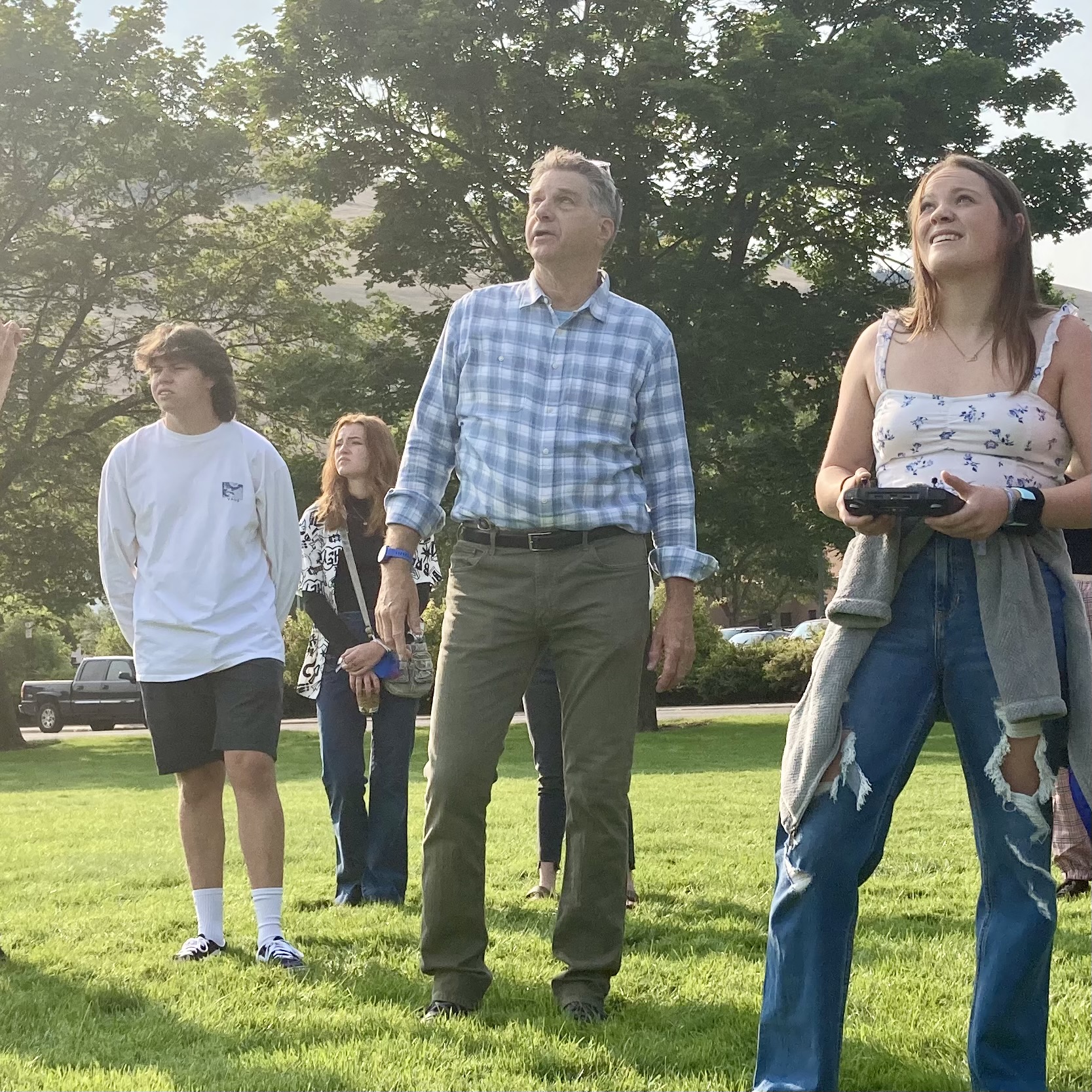
Professor Keith Graham helps a student pilot a drone during new student orientation this year. Photo by Kathleen Shannon.
As far as anyone can calculate, Keith Graham has been a professor in the J-School for 22 years. For many graduates, when they think of the faculty of the J-School, Keith is the first name and face they see. Before he came to UM, he worked at the Miami Herald, San Jose Mercury News and the Roanoke Times.
Keith teaches photography, multimedia and graphic design courses and with his compatriot Jeremy Lurgio, leads the photo side of many of the school’s professional capstone classes. This semester at UM, he’s teaching the Byline Magazine capstone, which will publish a magazine next month, a freelance photography class and a design class.
Keith recently sat down with graduate student Kathleen Shannon. They talked about his journalism career, what it was like being part of a newspaper’s very first website and more. The transcript of their conversation has been edited for length and clarity.
Q: I didn’t realize how multimedia focused you are. You’ve worked with a lot of media!
A: As video and audio came into more prominence, [Jeremy Lurgio and I] picked up more of that because, well, one: it’s fun, but two: it’s a needed piece of the visual reporting that journalists [do] today. Even in our [introductory] class, [we’re] trying to teach those skills. [We’re] trying to get people to understand what’s the best way to tell the story. So that’s when I look at multimedia. Audio can work great when you’re trying to get emotion and listen to background history stories.
Q: Yeah, I recently watched a ProPublica video about environmental justice for class and I learned so much in two and a half minutes.
A: So, it was an explainer video? Then that’s also when you’re saying: “well, this graphic helped me remember that seven out of 10 people did x,” right? So the graphic is what’s going to allow us to process visually.
Q: Right. I noticed that your background is more in print. Can you tell me a little bit about your path in journalism?
A: I started as a photographer. I was an English and history major in undergrad at Vanderbilt. We didn’t have journalism. My second year of college there, a fellow photographer said, “Hey, we need people [to] come work for the yearbook. Come work for the paper.” And I think that was my first taste of journalism. So I left school with English and history degrees, freelanced for three years, studied in Switzerland, came back and did grad school in photo-j, did a book for my master’s project. And so that was the first part of writing and photographing, and then also try[ing] to learn the art of interviewing. Then I got hired at the Miami Herald [as] a photographer and also did some photo editing [and] design work. I wore three hats there.
When I moved from East Coast to West Coast, I [worked in] San Jose and that was a very sophisticated paper. They were fabulous reporters. I mean, I worked with at least two people who had Pulitzers that were great teachers [as a result]. When a lot of big stories came up, because I could photograph and edit, I would go on as a photographer, but be a photo editor on-site. [I’d] cover the World Series, Super Bowls, things like that. I picked up the love of seeing the bigger picture of journalism: how words and images work together.
Then my wife got tired of the fast lane [and we] moved to Roanoke. I was there as a picture editor, photographer and then, at the end, director of photography. And that’s where the Vice President came in one day and [said] we were going to start this thing called a website for our paper. This was just a couple of years after papers were getting online. And he said “I don’t care if you lose money the first year, I want you to start.” I remember the first piece we did. That was a true multimedia piece. We interviewed the remaining World War I Vets that were alive at the time.
Q: Wow. How many were there?
A: Twenty. Before we published, the only woman [of the group] died. You’ve got to remember the tools were rudimentary. We didn’t have apps. Adobe Audition didn’t exist. We actually had to go to a studio in town to do all the audio pieces.
Having done that World War I piece, it was like: This is what you can do online. This is what you can’t do in the paper. You can’t hear the voice of the World War I Jimmy. And I remember to this day [a photographer] walking down the road with Jimmy and interviewing him. And that was like: “Wow, this is different. We used to just be in print.” We can now tell a different story.
So that was the first piece. But here [at UM], as video became more important, and audio became more important and multimedia storytelling became more important, we just moved in that direction.
Q: That sounds like a really exciting time to be at the helm in the newsroom.
A: Oh, yeah. We got to do everything. We got to do anything. In Miami, literally after the first time they called me to go out of town, I had a suitcase packed. I got called one day and they go: “You need to be in the Miami Airport within 45 minutes, if you can.”
“Where am I going?”
“Out of the country, we’ll tell you later.”
That was part of the joy of being in that. It wasn’t: can we? It was: who’s going?
Q: Yeah. I know that the [newsroom] culture is a little different now.
A: Well, the culture is different. But the storytelling is still there. [The trick is] finding what’s relevant and finding a niche for yourself and an audience. Good stories need to be told. Good storytellers need to tell those stories, in whatever form.
Q: Is there a part of your academic year that’s really exciting for you?
A: Well, when we teach capstones [like the] Byline magazine class, this is when the time gets fun and crazy. Tuesday, we [did] our first copy slam.
When I’m teaching a freelance photo class, it’s so different because it’s not just editorial. It’s the only class where I expand past journalism, if you will. Because you want to train people here to be [able to freelance] when they want to work [both] in [and] also outside of journalism. So that class is fun, because it’s different assignments. They just turned in nature and wildlife. They’ll do portraits, we’ll do food, we’ll do products, we’ll do fashion, we’ll do travel and adventure sports portraits. We’ll do drones. Then we talk about business. I talk about copyright. I talk about contracts. It’s different every week. There are so many things we can do.
Then I teach a design class, too. I customized that class for Illustrator and InDesign, and then content management systems. I used to teach HTML and Dreamweaver in there. But I’ll leave that for a coding class. It’s a fun class because, again, it’s custom. Do you want to do more concert posters and book covers? Or do we want to do more magazines and social media graphics? We always do websites, but we also talk about theory of typography and color. It’s a different mindset, too. People get to have the creative part, but they’re graphic journalists. You were talking about the graphics earlier. You know, those are a part of storytelling. And why we’re attracted to that and how we need to display that. So people will look at, read, consume and understand [it]. And educate along the way.
Q: My last question is a light-hearted one. What would you get up to on an average Saturday?
A: Oh, well, depending on the week, it’ll be mowing the lawn and raking leaves. If [it’s the right] time, we’ll be at the Griz game! But also working. Most of my projects are rural. That’s what I love. I’m looking at a project on 150 years of livestock brands in Montana. The first livestock brand book: 1873. So [2023] would be the 150th anniversary. So that’s why I’m looking. It’s still being a journalist and it’s a lot of fun.

 Montana Journalism