
Faculty Q&A: Professor Ray Fanning on Past and Present Projects

By Kathleen Shannon

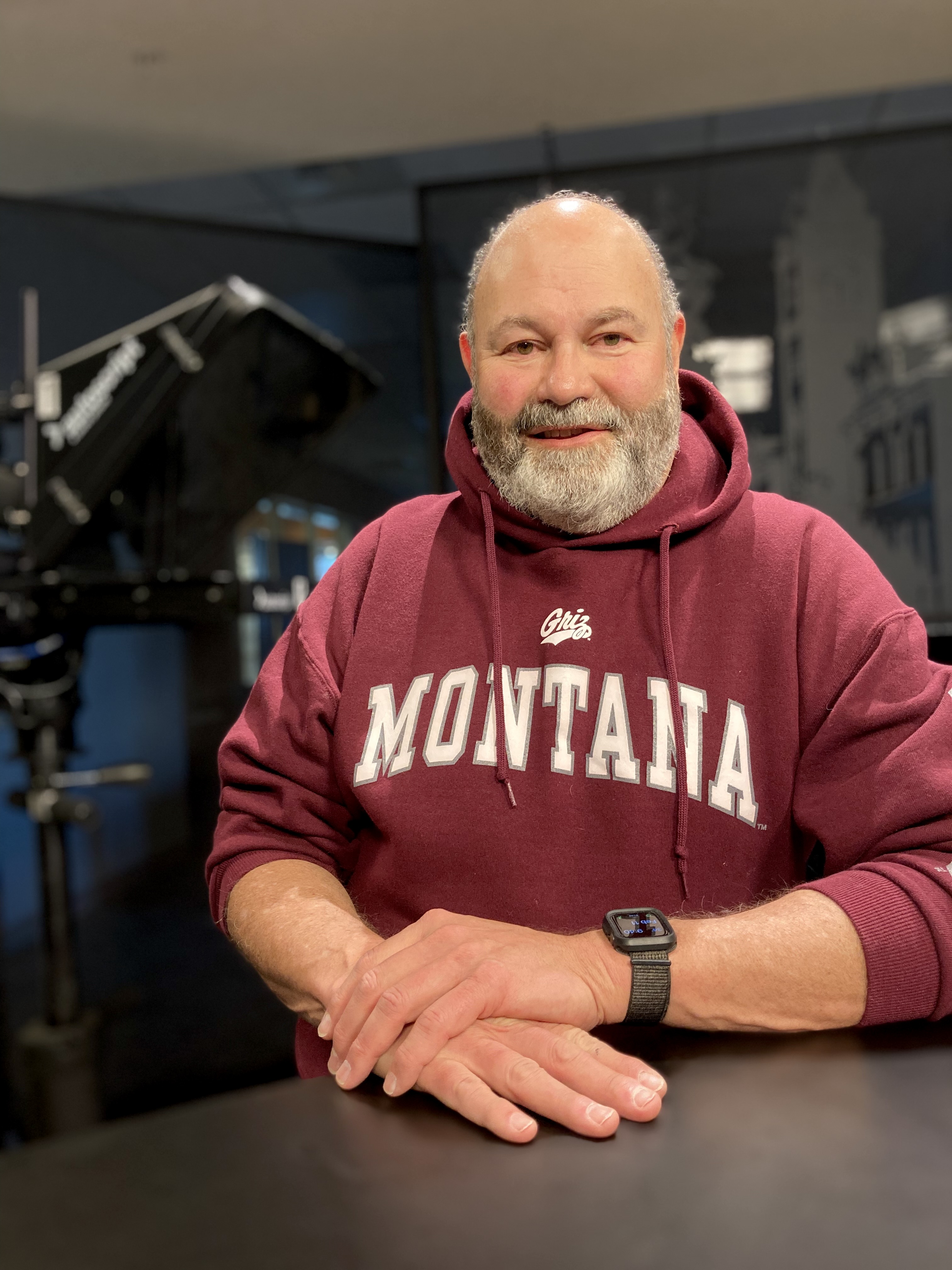
Ray Fanning under excellent lighting in the j-school’s broadcast studio.
Photo by Kathleen Shannon

Professor Ray Fanning teaches broadcast journalism courses as well as core undergraduate courses in the j-school. He joined the staff in 2007 after working at TV stations in Portland, Ore., Salt Lake City, Spokane, Wash. and Boise, Idaho. His radio reporting on wrongful convictions in Montana won multiple awards. He’s currently working on a project about one of Missoula’s most influential architects.

Ray sat down with graduate student Kathleen Shannon to talk about his career, projects, the courses he teaches and the growing accessibility of video journalism.

The transcript of their conversation has been edited for length and clarity. Read until the end to learn his favorite ways to get out on the water.

Q: What was the most formative experience of your career before you started teaching?

A: I worked as a as a newscast producer for probably 20 years. And, you know, you’re putting together a newscast every day. The highlights of things I got to do in that time was I got to cover three Olympic Games: Nagano, Salt Lake City and Athens. And the last one I did right before I switched over to start teaching. That [meant] getting a chance to cover something that the world is watching. That’s really gratifying.

Q: Are you tracking the Beijing games right now?

A: Absolutely. Yeah.

Q: When you’re watching the Olympics now, as someone who has formerly worked at producing the coverage of that, do you find yourself lost in the games? Or do you find yourself sort of critiquing the video approach?

A: I think it’s a lot more curated and packaged now. There are lots of different places to see the Olympics and, you know, no one’s waiting to hear who won because you can find out [even] when it’s in a different country [and] a different time zone. So I find that they’re really curating and finding these stories that they’re going to follow, you know, like the Shaun White story. They put a lot of emphasis on that when there’s a whole lot of other stuff going on. The sort of nightly news, primetime coverage, is narrower than it used to be. They’re finding the stories that they really think people will tune into emotionally. So then you’re on your own to go out and find the other stuff that they aren’t covering in the prime time block in the evening.

Q: Yeah. I can see how that’s happened, too. Tell me about some recent projects you’ve worked on.

A: Around 2012 or 2013, I did a series of stories for Montana public radio on wrongful convictions in Montana. If you’ve listened to Jule [Banville’s] podcast, [An Absurd Result], it was sort of based around the same case, but not the same angle. The impetus for the stories I did was that it had been 10 years since [the wrongfully-convicted man] was exonerated. So I went back and looked at what the state had done to maybe solve some of the problems that lead to wrongful convictions, like the way they do photo lineups for eyewitness identification. There were problems in that case in the state crime lab. So I went back to the state crime lab and looked at what reforms they’d done. There were problems with the public defender’s office [I looked at]. Ten years after his exoneration, what has the state done to try to minimize wrongful convictions?

And then I did a documentary for Montana Public Radio on race. At the time, there were a lot of the protests going on for Black Lives Matter. Montana was one of those states that never gets much attention in terms of what the race relations ar, and what the racial problems are. So I tried to look at that in terms of, you know, over-representation of minorities in Montana prisons, and just different experiences of minorities in Montana and tried to tell some of their stories.

Now I’m currently working on a documentary for Montana PBS, that’s going to be about an architect named A.J. Gibson. He’s probably Western Montana’s most prominent architect, not that most people would know his name. But he designed Main Hall, he designed Jeannette Rankin Hall, he designed five of the first buildings on campus. He also designed the Missoula County Courthouse and a lot of residential homes including the big Daly Mansion in the Bitterroot. He was a force in shaping the idea of Western architecture. That’s what I’m working on now.

Q: I’m interested in what it’s like approaching video stories that are more historically-based. I imagine it’s different to talk to someone who’s currently dealing with the issues of race or wrongful conviction versus digging into history.

A: There are a lot of sources. You can’t go, “what was this guy like?” because, you know, all the people who knew him were no longer with us. H. Rafael Chacón in the art department wrote a book about Gibson. We’re sort of using Chacón as our central expert, and then looking at the architecture and the development of the architecture. So it’s more visual than it is interview-based, which makes it interesting. And then a lot of it’s going to be archival photographs. You can also do some some interesting things with drone photography now that give you interesting angles and shots on the buildings. So, that’s the idea: looking at how this sense of Western architecture evolved from the idea of a log cabin into various other things.

Q: What are you excited about this semester?

A: Well, one of the things I’m excited about is we’re revamping the intermediate video class. We lost the faculty member who taught the production side of the class. Normally, this is the class where students get to learn how to put together a live newscast. Now it’s shifting into being an advanced video recording class. So it’s been fun to tweak that class and change it up a little bit this semester.

Q: What other courses are you teaching this semester?

A: I’m teaching Journalism 100, sort of the basic entry class that we teach online in the spring. I have about 110 students in that class. Most of our classes are, you know, 20 students or fewer, but that’s one of the bigger ones.

[Another class] I’m teaching this semester is the beginning photo and video course, Journalism 257. I teach that most semesters. I’ve taught all of the lower [division] core courses, but in the upper division, mostly I teach in video.

Q: How did you get interested in video?

A: I’ve always had kind of a fascination with the idea of being able to share pictures of stories across long distances. It’s fun to tell a story, but when you can add the pictures and the sounds that go with it, I just think it enhances that.

Q: And this is probably one of the media that’s changing the most rapidly.

A: Yeah. Certainly the internet has changed the way video and television work. I mean, it used to be that you had to have hundreds of thousands of dollars’ worth of equipment to produce a film or a television program or a video. Now, you can do it with your phone. So it’s opened it up to a lot more people. It’s not exclusively in the hands of the media, you know? Anyone can use that technology now.

Q: Do you have a sense of how that’s affected the interests or expectations of incoming students now that they all have video production equipment in their pockets?

A: I don’t know if that’s affected their expectations. But a lot of students are much more savvy coming into the classes. They’ve shot video before, they’ve shot pictures before, whether it’s for Tik Tok or some other social media. I think there’s probably more experience because before, it was quite a financial investment to be able to play around with video. And now the entry level is your phone.

Q: Cool! Last question: can you tell me about something you like to do on a weekend that has nothing to do with work?

A: I have a kayak that I like to take out [on] one of the little lakes around, often Seeley Lake, and get out and paddle for a while to get away from things. Yeah. I’m also a big movie fan, although that’s been curtailed a bit by the pandemic. Something [else] I enjoy doing is sailing. I have a cousin who’s a big sailor so often I’ll go up in the San Juan Islands, north of Seattle and spend some time there. That’s fun, too.
Faculty Q&A: Professor Nadia White on the ‘Happy/Crappy’ of Sabbatical and Why She’s Excited to be Back

By Kathleen Shannon

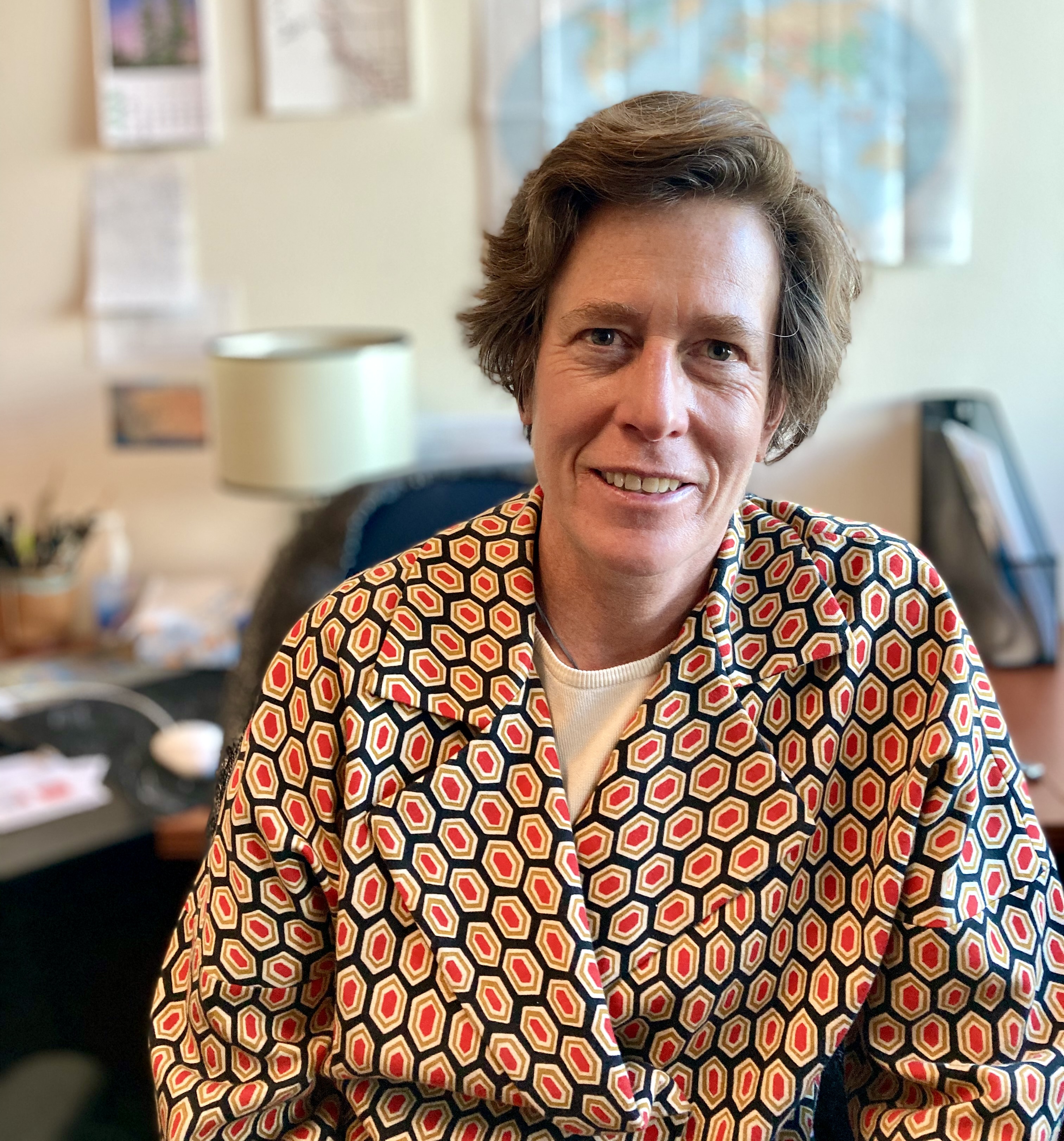
Nadia in her office. Photo by Kathleen Shannon.

Nadia White is the director of the master’s program at the j-school: Environmental Science and Natural Resource Journalism. She joined the faculty in 2006 after making her way from the East Coast through the Midwest and into the Mountain West as a newspaper journalist. In addition to shepherding students through the graduate program, she also teaches classes on science reporting and global current events reporting.

Nadia recently answered some questions from graduate student Kathleen Shannon about how she spent her time on sabbatical (including a particularly wild bike ride) and what she’s digging into now that she’s back on campus.

The transcript of their conversation has been edited for length and clarity. Read to the end to find out how Nadia most likes to play in the Montana snow.

Q: Let’s play my favorite interview game for professors returning from sabbatical. What was one happy thing about being on sabbatical and one crappy thing?

A: I didn’t even know you’re allowed to have a crappy about sabbatical.

Q: There’s no crappy?

A: Well, there’s a very multi-dimensional question there. Gosh, sabbatical was a great time to refresh and invest in my own creative process. So I got to do some journalism. I got to do some art. I got to read. And I got to teach a class that helped me really expand my knowledge locally, which was part of my goal: to know Montana better. So I’m happy about all of those things. The crappy part about sabbatical during a pandemic if you don’t have kids at home, which I don’t, is it’s just super lonely. I had a partner who’s working very hard on Zoom at home for a lot of hours a day. And we were pretty isolated and hell-bent on not getting sick. And we didn’t get sick. I was healthy but lonely. So my dog and I were very fit. And we got out a lot.

Q: Tell me a little bit more about teaching a class. Was it through the University of Montana?

A: It was from the Wild Rockies Field Institute. And it was a bicycle tour course on climate change and energy. One of the objectives of my sabbatical was to really get to know Montana better. A huge part of my career was working in Wyoming and I know Wyoming quite well. I am not as familiar with Montana. So this course allowed us to ride our bikes from Billings to Whitefish, about 700 miles, working our way along looking at energy production and climate change issues. We had students from MSU, from the University of Wisconsin from a couple private schools in Minnesota. It was a great bunch of nine students and was very self-supported. I learned so much about teaching in the field. I had a very excellent, experienced field-teaching partner, Dave Morris. We took a deep dive into climate change issues facing Montana and the challenges to engaging solutions in Montana and met people who were doing those things. We looked at energy production from a coal perspective, wind, solar and a pumped hydro storage perspective. And we got off our bikes. I went and met with those people and looked at those things. We talked to ranchers about regenerative agriculture. We talked a lot about meatpacking consolidation because that is what ranchers want to talk about. It was fabulous and an honor and just a great pace to meet people and learn about their lives.

Q: I wish all my classes could be like that.

A: It was a high point. Now, there were those days [when] we hit all the heat domes, when Seattle was like 112 degrees. Yeah, we were riding our bikes across the Musselshell River Valley in really impressive headwinds. You really learned to appreciate roadside bars [and] leafed-out trees.

It was fantastic. I love the prairie. I even love the wind. I lived in Casper for a long time and I’m okay with wind. It does great things for the air. It is a beautiful transition to find yourself moving across the prairie into Badger-Two Medicine, up and over Glacier and down into the Mountain West of the state. The transitions are beautiful. The sunrises and sunsets are beautiful. It was a great way to accomplish part of my mission of learning more about the state.

Q: Definitely. Did you learn any surprising Montana facts? Or something you still think about?

A: Montana facts? Well, no, I don’t know about Montana facts. On day four, I got hit very directly by a dust devil. We had separated a little bit. There’s a little group of three or four of us out front, maybe 20 yards ahead of a little pack behind us and the back bunch said, “Oh, that’s coming right at them. What’s going to happen?”

And they said “I don’t know, I guess we’ll see.”

And it just, it hit us and [my] bike just got blown out from under me. And there I was in the borrow pit. There you have it. I [saw] it coming, [but] there was just nothing to be done about it. We talked about it later. What should you do if you’re about to be hit by a dust devil? Maybe I could have stopped and put my feet on the ground.

Q: That’s really more of a surprise encounter with Montana. I like that. You mentioned spending a lot of time in Wyoming. Can you give me an elevator pitch version of where you’ve been in the world of journalism?

A: You bet. I am a print journalist by trade. I worked in newsrooms in Maine, Minnesota and Wyoming. I was [at the Casper Star-Tribune in Wyoming] for over a decade working as an environmental reporter, a Washington, D.C. bureau chief living in D.C. and covering federal issues important to the cowboy state. Then I was the state editor for many years directing coverage of our Washington, D.C. bureau, and the bureaus that we have around Wyoming. And I loved that job. That was the newsroom that raised me.

Q: Cool. What are you teaching this semester now that you’re back at UM?

A: Well, while I was on sabbatical, we got some great professional science journalists to fill in for Story Lab [a class for grad students who work with a research lab on campus to practice science reporting]. And they agreed to do it again. I think I’ll go back to teaching Story Lab next year. So I am teaching Basic Reporting and Global Current Events, which is an honors class that is ridiculously labor-intensive, but it is a labor of love. And I work hard, the students work hard. Both of those classes are really fun, undergraduate classes. But I kind of miss teaching graduate students.

Q: We miss you, too. What excites you about being back after two semesters away?

A: I am so glad to be back. I’m the only person ever to be this excited to be back at work. It was a lonely pandemic sabbatical. I take a lot of responsibility for that. But, nonetheless, I apparently need structure.

I am refreshed. I am excited about teaching journalism [and] about thinking forward about the journalism school. Our graduate program is really catching a lot of applicants’ attention and [we’re] hearing from a lot of international students. I’m anxious to see how we work that out.

We got a very generous gift that came in while I was on sabbatical. That will allow us to offer some bigger scholarships, hopefully to some international students, but also to expand and keep working on our Crown Reporting Fellowships. So I’m super excited to reinvest my energies in in our existing programs and to see what we need to build going forward. It’s a changing world. We need to change, too.

Q: My last question: what is your favorite winter recreational sport to do in Montana?

A: Oh, I have to say cross country skiing. I really love Nordic skiing. I don’t backcountry ski as much as I used to. But I have my secret stashes where my dog and I find our way up into the high country without triggering avalanches. So that’s very much my favorite thing.

During sabbatical I got back into ceramics, which I’ve done off and on and has brought sanity to my life at various stages, especially when I lived in D.C. But then I had not worked in a ceramics studio since I started teaching full time. I never could figure out how to combine those two things. So my great goal is to try to continue to work in ceramics while I’m teaching. Let’s see if I can do it.

Faculty Q&A: Professor Dennis Swibold on the Enduring Appeal of Journalism

By Kathleen Shannon

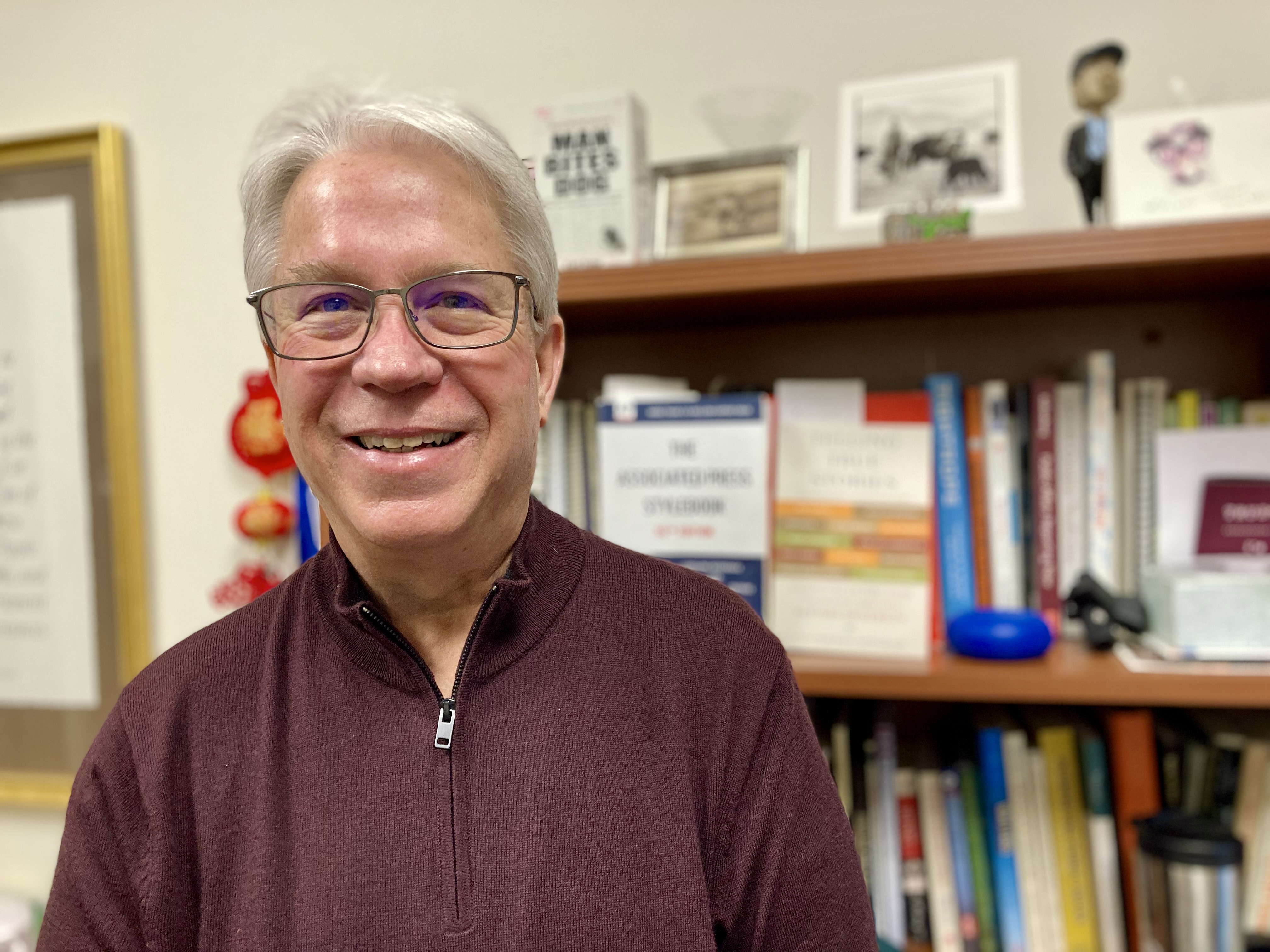
Dennis Swibold stands with his impressive office book collection.
Photo by Kathleen Shannon

Dennis Swibold began teaching at the J-School in 1989, where he’s known for his in-depth knowledge of Montana politics and history. He teaches classes on the elements, ethics and trends of journalism. In the 1990s, he launched the J-School program in which students report from the legislative session in Helena.

Before coming to UM, he was the editor of the Bozeman Daily Chronicle and his book Copper Chorus: Mining, Politics and the Montana Press, 1889-1959 was published in 2006.

Dennis recently answered some questions from graduate student Kathleen Shannon about changes in the journalism industry, the power of the first amendment and the coming 50th anniversary of Montana’s state constitution. The transcript of their conversation has been edited for length and clarity. Read to the end to learn which Thanksgiving dish is Dennis’s favorite (fun fact: you’ve probably never heard of it!).

Q: What classes are you teaching this year?

A: I’m teaching a very beginning writing courses called writing the news. It used to be elements of journalism. Basically, what we do is just teach students the conventions of news writing and how it’s different from other forms of writing. And we introduce them to things like style and convention. It’s also a chance to sort of brush up on things like grammar and punctuation and spelling, which sadly aren’t really taught very well anymore. And I understand exactly why because it’s hard to do. But I just try to make it a safe zone for people, to sort of say: “what are your worst fears about grammar and punctuation?” Let’s get them all out here and see if we can fix [them] up.

Then I’m also doing ethics and trends, which is the senior ethics seminar. There’s no end to what you can discuss in terms of ethics and so I try to show my greatest hits and greatest disasters, and I try to keep it as current and topical as possible. And then we talk about industry trends. They had a good introduction to the media landscape when they began and now it’s talking about where it’s changing and why and they could do some research on that, too. So, it’s a fun class. We argue a lot. It’s a good, respectful, but lively discussion almost every time.

Q: It sounds like you’ve been at the j-school longer than any other professor here, right?

A: I started in the fall of ’89, not as a professor, but I was a graduate student. I came here on a teaching fellowship, and one of the things they suggest that you do is work on a master’s degree while you’re doing that. I’d been in the newspaper business for 10 years at that point. So I started teaching right away, mostly very beginning kinds of classes with the help of great faculty members who’ve been doing it for a long time. And two years later, I was a member of the permanent faculty.

Q: What keeps you interested in teaching after 30 years?

A: It’s the students. And it’s just changes in the profession. You know, I get older but they stay the same in terms of their passions for things. It’s all new. It’s constantly good to sort of see it afresh and their questions and even their thoughts about it. And it’s always sort of an interesting time for journalism, whether it’s in crisis—it’s always in crisis! It’s kind of fascinating to see how they look at it and seeing their passion and enthusiasm for it, you know. I’m always inspired by that, by them and the things that they want to do and, and it helps me remember how passionate I was [and] why I started doing this kind of stuff, too. I don’t see any lack of desire today. People want to do it. They know it’s a fun job. They know it’s a privileged kind of position no matter how lousy it pays. But just to be this front-row spectator with the right to be nosy and tell everyone about what you know, just seems like kind of a fascinating thing.

I did a book on Montana history at a crucial time, which seems so quaint and antiquated though, at a time when the copper company owned the major dailies of the state and was so close to the press, because it’s hard to pick it that could happen today. We just have Facebook. So, the idea that ownership matters and how it’s monetized and incentivized and what the individual practitioner’s role in all of that is, is something that I love to talk about.

History is important because every group of students comes in with the idea that it has just begun, that it didn’t exist before [their] frame of reference, and that’s just the way we are. Right? So I have to talk about where we came from, in a way that makes [their] understanding of what we’re talking about today richer and not just: “well, back in the day.” It’s a difficult thing to do. Students seem to appreciate it if you approach it right. Or ask them the questions and get them to looking into: Where did this come from? How did it start? What’s been its evolution? And they talk about things today, like: “God we’re so politicized.” And I think, “you should have seen the press in 1810.”

Q: I’ve only been here one semester, but on the way out of the building at one point, I read the first amendment in the lobby I was reminded that it’s badass. I just hadn’t really appreciated it. Joe Eaton was telling us how, when he had taught journalism in Vietnam and Russia, he explained the Freedom of Information Act to them. And that was not something they could use.

A: I taught in China ona couple of occasions, just briefly, but I was careful not to tell them how they should do it. I was very interested in showing them what American journalism practice was and what it had been: good, bad, indifferent, you know. I just represented it. Then I brought 14 graduate students from Shanghai International Studies University to Montana to spend a month. All we did was kind of look at American journalism as practiced locally and their coverage of civic institutions. The first time we walked into a court session, they were flabbergasted. I mean, even the idea that you could walk into a court session was revolutionary. It was a municipal court thing, so not a big deal. Nobody comes to this full court session when somebody’s arguing a traffic ticket. And so 14 of us come in and we take up the jury box because there’s no room for us.

And the judge is bored, so he starts to say, “oh, who are you? Where are you from?” And he says, “if you have any questions during the procedure, just ask them and I’ll stop and I’ll explain how this all works.”

The poor guy in the docket is like “Oh, geez.” But it was a fascinating experience for them, from a society that even then was getting more tightly-controlled than they knew. The second time I went back, it had changed in the space of three or four years.

Q: What year did they come?

A: Oh, that was 2014 and then I went back in 2019. Yes, it was quite a good challenge. I mean, 2014 I was in Shanghai, which is like going to New York. It’s super modern, super “highways in the sky” kind of a place and buildings as far as you can see. And the faculty were there was so proud of all their technological expertise and ability to get anything anytime. They had a Montana party for me. They’re bringing me pizza and stuff like that, but they’re so proud of their ability to connect to a larger world and do that kind of stuff.

If I went back to that same faculty today, personally, they’d be great. They’d be warm. But this openness to the world would be different. Even then, it’d be like if all American TV shows were about the Civil War or antebellum South: just a historical time frame designed to promote nationalism. So there was an effort to build pride and build a national esteem because they’d been hammered, you know, if you look over the 20th century at that country.

I remember a year ago over Christmas break, I did a five-hour session with graduate students on Zoom. But they were really skeptical. I mean, more and more skeptical and I wasn’t really trying to argue for a position. I just tried to explain how it was. And all the people in journalism schools all had to be party members because they’re part of the state’s messaging apparatus. That’s their job.

Q: I’m surprised they even had you in as a teacher at that point.

A: I was surprised, too. But I think they liked my approach because I was basically telling them how the American journalism system works. And I wasn’t afraid to talk about its flaws. But I also made it clear that there were things that were expected of American press and in its own principles that—I didn’t say “you don’t have”—but [that]’s clearly the case. It was powerful. And a lot of them would come up afterward and talk to me in sort of hushed tones and tell me I should go visit Tiananmen Square, and that kind of stuff. So they were kind of fascinated but they couldn’t really be that open about it.

Coming back here with that experience was like: “oh, now this puts everything in a different light.” Yeah, it’s been a great place to see the profession.

Q: When other j-school staff bring up your name, they’re usually encouraging students to talk to you about Montana history and politics. Is there anything fueling your fire in that world at the moment?

A: Montana history is fascinating and right now the political environment in Montana is swinging to the right in ways that it’s not been in my time here. It’s been pretty much a purple state until the last 10 years or so. And so that trend and that change, you know, I’m fascinated by it. This morning, I read a piece in the Montana Free Press [about] some powerful House members calling for throwing out the state’s Constitution as a socialist drag. This is the 50th year anniversary of Montana’s constitution, so that’s a pretty amazing thing to say. It wasn’t that popular in the past, but it’s kind of been venerated over the years as a fairly progressive model. But he wouldn’t have said that if he didn’t think there was a fertile ground for that kind of idea. And so that’s something that fascinates me. What’s going to happen? What’s the change?

One of my favorite classes is with Lee every other year because we teach the covering elections class. We also groom some students to go to Helena and cover the legislature, which has been something I started and sort of amplified in the early ‘90s. But we send two or three students to help out or to cover the session for all these really small weeklies that can’t afford to cover it. And if they do, they’re just getting op-eds from the local legislator that are mostly self-serving. So this way they can kind of get independent of that. Courtney’s the wonderful editor of that. I did it for the first, you know, 20 years and she’s taken over the last 10 and done it really well, too, and expanded not only how it’s done, but all the different places that it shows up. And our students are more ambidextrous in terms of mediums than they have ever been, which is something that’s been encouraging to see. They’re doing audio stories, they’re doing their regular print analysis, they’re doing online stuff. They know what the demands of different mediums are and how to look for stories there. So that’s fascinating to me. I’ve got to help create some of those things that have gone on. It’s kind of been gratifying to see them flower in different ways.

Q: Yeah, that was part of my research before I moved to Montana. I listened to the podcast Shared State and I thought they really broke down the state constitution pretty well.

A: The thing about it is it has a beautiful prelude. You can’t argue with it. It’s perfect. At the time of its passage, it was considered sort of a progressive model, that’s what Time Magazine said and yet it barely passed the public vote. It passed by 2000 votes. People had to vote to approve it and it was close. And yet, the public impression sort of grew over past years. But now I think there’s a point of discontent with it. I don’t know how deep that really runs, but it certainly is something that’s interesting to me.

Montana has always been really good at beautiful words. What’s always been sort of lacking is the effective administration and follow through and organization to sort of make the right-to-know sort of work. I mean, enforcement is, you know, more than half the battle for me. I got to work on a project with the Center for Public Integrity. We had this concept called state integrity project where we looked at laws and then see how they’re enforced [regarding] openness and civil society kinds of things. We had this huge database [and after] all these editors looked over it with me, we came up with a B+ for Montana laws in that regard and a D for its execution. If you think about this being a place with not many people and not many resources, you can kind of understand how there could be that disconnect.

We’d go to local counties and look for information and be told: “it doesn’t exist and we can’t get it.” It seems to be the default answer from people who really don’t know the law or don’t understand it or don’t know how to help people or if they should, if they’re going to get in trouble or whatever the case may be. So that’s a constant process of re-educating people all the time. But it’s hard, particularly when you’re talking about public information because it’s one thing to have it available to a few people to go and see it. It’s another thing to have it available to everyone. So, it’s raised questions about privacy. And that’s always been the battle with Montana in terms of the information and it continues to be: privacy and openness. I think there are reasonable reasons to think that Montana’s constitution says you have a right to privacy and a right to know.

Q: Yeah, that goes back to the beginning of our conversation about how badass the First Amendment is and how a lot of people probably don’t even realize that’s the case.

A: It’s one of those things you don’t know what you’ve lost until it’s gone. And you realize you can’t get these fundamental things. I think there’s a real respect for having this kind of stuff. But there’s also a growing fear about privacy in ways that sort of worry me as a journalist. I mean, I used to always get that information. How would I know how things are working? What systems are fair or just if I can’t see that stuff? And yeah, I could see people worrying about what might be the effect of having somebody doing damage to them as a result of having this information, too. All these things are worth talking about.

Q: On a less serious note, this will be published the day after Thanksgiving. So what’s your favorite Thanksgiving dish?

A: My wife and I have had kind of a tradition the past few years of making this soup, that takes all day. It’s an Iranian recipe because my brother-in-law is Iranian-American. It’s called ash [pronounced osh]. And the hard part is chopping up a million different kinds of things. And then every hour, you have to put more in the pot. It’s a five-hour process, which is kind of a fun thing to do when we cook together, throw things in the pot. There’s meat, but you can use mushrooms if you want to make a vegetarian version. There’s different kinds of legumes and different kinds of greens and there’s a rice that’s part of it. There’s different kinds of beans in it. It’s fun to do. You don’t really have to think about it. You chop it all up for the first hour and get all the stuff ready and then you go sit down for an hour.