

By Kevin Trevellyan
My nascent journalism career has included a few beats thus far. I covered education at a daily paper, as well as science and city government—unwieldy, amorphous subjects. Part of learning to report a beat is deciding which stories are worth pursuing beyond the obligatory ones. Sure, you need to cover the city council meetings, but what will you work on in between? An analysis of the effects of partisan versus nonpartisan elections? A profile on the longtime city clerk? A records request on communications between local business leaders and elected officials? There isn’t really a “correct” answer, so much as one that represents your journalistic priorities and how they can best serve your audience.Like those beats, which are basically topics, my current focus on hemp – yes, hemp — is similarly expansive. This spring I received a Crown Reporting Project fellowship. My winning pitch was to examine the potential of hemp as an export crop for farmers along the 49th parallel.
As one cliché goes, one can wring 50,000 uses from the fiber, grain and cannabinoids of the 16-foot-tall plant. So, there’s plenty to learn about the crop, and the challenge becomes deciding which angles to include in my long-form print story about Montana’s burgeoning hemp economy.
Hemp, I’ve learned, is a beat of its own. Instead of shaping coverage with stories published over a span of weeks and months, I’m forming a single piece with the varied ideas, sources and scenes that will make for something rich and well-rounded.
Well-rounded, but hopefully focused. I’ve identified a main character or two with whom I’ll spend considerable in-person time. At this stage, though, most of my interviews have been done over the phone. And on nearly each call, new things seize my interest. This or that farmer co-op trying to market boutique hemp-derived products, a lab here researching new crop varieties, or a farmer over there who feels treated more like criminal than businessman. I furiously type these interview returns into my Word document; often they’re followed by exclamation points and bolded for emphasis after I take the phone off my shoulder.

That’s the thrill of discovery. But what do I do with all that junk after the initial excitement of discovery fades? For 20 or so minutes I burn the retinas from my skull staring at the pages and pages and pages of notes on my laptop. Then I relocate to the couch with a novel to “clear my head.” Not every thread can be woven into a single story. It’s difficult deciding which belong, and which muddy my main points.
Still, gaping craters in my reporting lie beside mounds of interview excess. I’m figuring out what I don’t know, but should. It always feels like there’s another phone call to make and person to visit. And there actually is, at this stage in the reporting process. But I don’t know if that feeling will evaporate even after I’ve actually collected the goods.
In the meantime, I keep making calls, combing archived newspaper clippings and seeking technical documents. But reading what I’ve gathered over and over, the material can lose its sheen. A quirky fact becomes mundane with familiarity, and it’s sometimes hard not to eventually think “does anyone even care about this after all?” The worst part is having kind, thoughtful people ask about the thing. Getting beers with a friend: “You’re working on a story about hemp? Can you tell me about it?” Phone call with mom: “Did you see this article about CBD?” In fact, I swore I heard my cat meow “decorticator” the other day after I finished a particularly technical interview about hemp processing equipment.
If the extended reporting process is responsible for my fatigue, though, it also jumpstarts waning enthusiasm. Just when I’m thoroughly tired of hemp — wishing it were still illegal to grow; that I could move on to a story about anything else — I learn something new that gets me hungry all over again. Or I see how an interview or scene could fit into the larger story, and the whole project becomes clearer. Then I start this process again, but I know slightly more and the finished product seems a little closer.
Graduate student Kevin Trevellyan is working with New York Times journalist and author Jim Robbins on a Crown Reporting Project fellowship, which includes Kevin’s work investigating the rise, and legalization, of hemp. See more about the project here.
 After spending the spring semester researching the issues and organizing the logistics, these intrepid student journalists will spend three weeks producing stories across a variety of media. They will focus on energy policy, First Nations perspectives, wildlife conservation and other topics related to oil sands development and the proposed Trans Mountain pipeline expansion, which was recently purchased by the Canadian government in order to fast-track its construction—despite growing opposition from the British Columbia government and many First Nations.
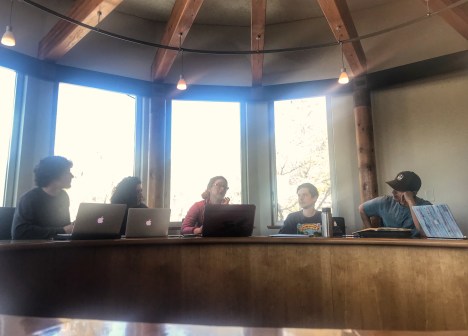 But the controversial oil sands that feed the pipeline have been criticized as dirty, carbon-intensive, and cost-inefficient, especially in the age of growing concern about the social and economic impacts of climate change. Additional development could further threaten the health of Canadian communities and wildlife surrounding oil sands operations, which is why many First Nations members are fighting the expansion, which would cross their traditional lands.
 Though this year’s class needn’t travel far to find their stories,
  Montana Journalism