
By Tommie Oplinger
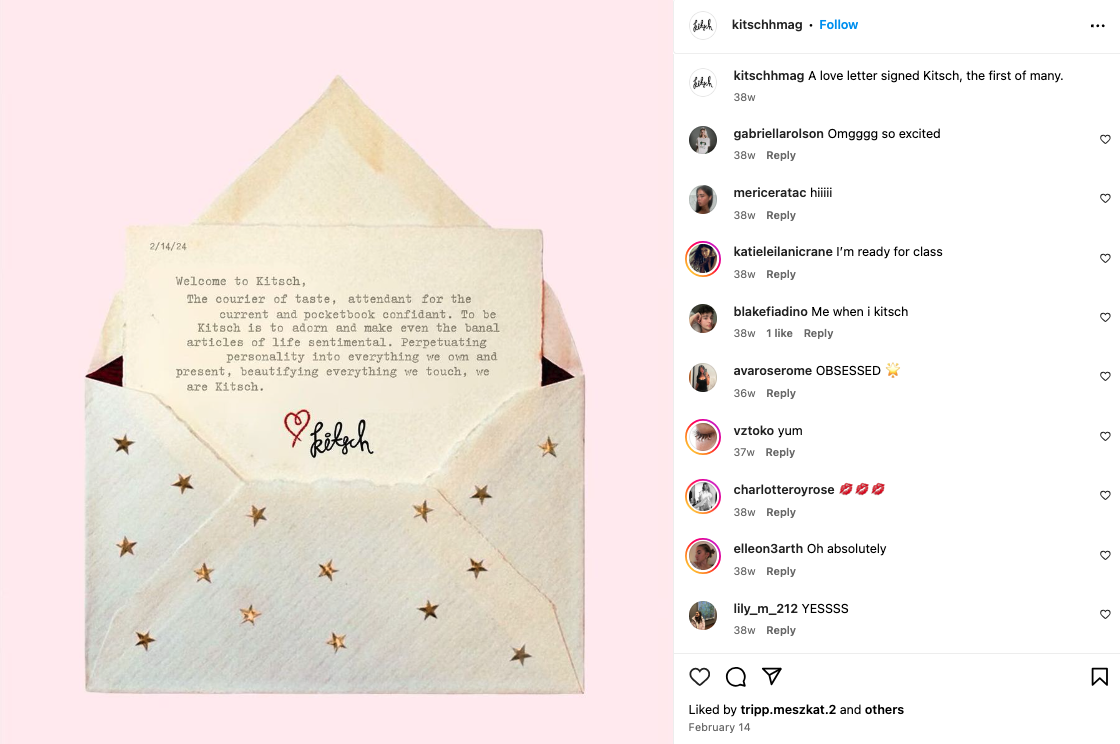
Rachel Oplinger, Stella Pallone, and Enzo Viado are all students at the Fashion Institute of
Technology in New York. They began Kitsch Magazine nearly a year ago as an online-based
publication to share content critiquing and analyzing new designer collections, to give
commentary on rising fashion trends, and to share fashion inspiration. In addition to their
website, they utilize Instagram, TikTok, and Spotify to share short form content and visual
content. On Spotify they create monthly playlists inspired by current fashion and style.
Tommie Oplinger, a student at the University of Montana, interviewed the three recently as part of a research project about best practices on social media. The following is a transcript of the conversation edited lightly for clarity and brevity.
Q: What was the motivation behind starting Kitsch? What did you draw inspiration from when developing the brand?
Oplinger (Managing Editor): We wanted to start something with our friends that we could really have fun with. Down the line once we graduate and fully start our careers, we won’t get the same creative freedom and liberty that we do with Kitsch. We also have been able to pick up many side skills as a product of having to teach ourselves things like graphic design, proper lighting, photo editing, etc. The inspiration, like Stella mentioned, is just what we’re into in every facet of life from music, to fashion, to New York bars. We’re also really lucky to live in such a creative place with so many creative people. From our friends to random people on the street, we take a lot of inspiration from our environment and the many silly places we go to.
Stella Pallone (Editor and Chief): The motivation was we didn’t see any media we really connected with or liked the look of. Nothing was feeling authentic and feeding our needs. We also just love being creative and found that we needed our own outlet where we could really build something we thought was great and of our own style and preferences. As for inspiration I personally look at the way me and my best friends dress, what we watch, what we eat, all of our favorite points of culture.
Kitsch is personal. It’s definitely a passion project that really has to do with the individual taste of me and my fellow creators.
Enzo Viado (Director of Photography): Stella had a plan and a vision, and we were like “yeah, let’s give it a shot”. I think I pulled some inspo for how things were shot for the mag and related media by just looking through old mags and Popeye [magazine] and then seeing which ones match up I guess we tried to emulate what we thought was cool and hasn’t been shared.
Q: How has Instagram been a useful tool to grow a following and promote your written content?
Oplinger: I feel like it’s hard to get people to read anything in general. Mostly it’s hard to get people to read something that’s tangible. So like on Instagram people are sliding through then it’s easy to promote our stuff and they see like a pretty picture or whatever, it’s something we did and they’re more likely to do that than go on to the blog or onto the magazine and like read anything. It’s easy to get people to like see our stuff in that way
Pallone: It’s pretty important and so I definitely agree with Rachel for promotion wise, like that it allowed us not to have to print our magazine right away that way we can get followers. Followers, exposure and spread the word, spread the vibes without I don’t know like money like advertising, I guess. Also, the website, [Instagram] has allowed us to show our website very easily. So I really like to post on Instagram I have a good time doing it the Kitsch feed is no different. I Love seeing all the pictures come together it’s really satisfying especially when they work out really well like together that’s a whole different kind of satisfying but obviously Instagram is important. Everybody scrolls, everybody does it, everybody does it seriously so without it if you’re on it like it’s just a disadvantage.
Q: How does the engagement of your social media posts compare to the engagement that your articles receive?
Oplinger: I would say that people definitely look at our Instagram more. So, um, we should probably be better about tracking that. But I feel like when we ask people like what their favorite part about, like, the magazine is, or like which article they like the best, they don’t like, know what to say because they haven’t really looked at it, but they just appreciate our social media posts.
Pallone: Unfortunately, it’s really hard nowadays to click a website link, so sometimes the only impressions we get are on Instagram, literally. We have to maybe like prove it, make some exclusives on the blog. At this point, it’s just like authentically posting when we want to. We’re not like doing like a posting schedule. There’s no posting grid, it’s just whenever we want, making it look good and getting the information across. That is only by any means, by any means necessary.
Viado: I think people definitely engage with Instagram more, but then again, I feel like looking at other magazines with bad Instagrams makes you kind of turns you off from that magazine, unconsciously just following our magazines through their Instagrams more than we are actually purchasing. So I think if we have a strong, you know, magazine or, um, Instagram, like, people are going to be more enticed to go for the mag and go for the full experience or kitsch experience, if I say that.
Q: Has the creation of your playlists increased the attention that the magazine receives? What made you want to incorporate music into conversations surrounding fashion?
Oplinger: I feel like it has increased attention, because it’s just an easy thing to send to somebody. And sometimes people are like more inclined to listen to a playlist if they’re like driving or like walking around, than they are to like, sit down and like, read something. Um, as far as, like incorporating it into the magazine, that was like, pretty much like Stella’s idea. I would say for like most part. But I think, like the three of us all very much like are into different types of music and also like associate, just like fashion and like music and like various things kind of like together, like fashion isn’t just necessarily clothing, but it’s like a whole, like multitude of things.
Pallone: So, we created the playlist because I love music. Everybody loves music. But I wouldn’t say that it necessarily brought more people to us, but I think like, people who like music would be more appreciative of it. But the thing about it is that it’s kind of like weird music. It’s underground. It’s not music a lot of people are liking. But it would take a lot for somebody who doesn’t listen to that, to listen to it just because it was Kitsch. So, I think that’s cool. And if we can give Kitsch a sound, that’s everything, because their music and fashion go hand in hand. Always have, always will. But also, I don’t think Kitsch is just a fashion magazine. It’s kind of just like a touch point of culture. So, like anything we like that’s happening in our everyday lives, that’s how kitsch changes. It changes with us and it’s just what we like. It’s just our taste. That’s all it is. And the playlists are just one part of that.
Q: How do you think social media helps student run projects like yours? Has the magazine’s social media presence given you any other opportunities within the fashion or media industry?
Oplinger: I think social media helps student run projects like ours, mostly because it’s free, so it’s super nice. It’s just like a way to promote what you’re doing and your brand. As far as other opportunities that the magazines had from social media, not really, because our following isn’t, like, crazy. I’m sure like other magazines on social media, do you know? Well, we get girls who are trying to model or some people who want to write for the magazine or something like that, but nothing like past that, I would say.
Pallone: Social media is crucial to a project like ours because it’s ran by four students, So, money is slim. And, again, if we weren’t on social media, it would be just a mistake. That’s a mistake. It hasn’t given us any opportunities, to be honest that are of mention, and hopefully one day it can be a tool to do that. But as of right now, it’s we’re not as active as we need to be. But I think in the future it could definitely be an important instrument to give us more opportunities.
Q: What are the next steps for Kitsch? Are you looking to broaden your horizons or grow the content you have so far?
Oplinger: So, the next steps for Kitsch are we’re currently planning a new fall lookbook, that we’re going to do this month, we’re probably going to have the magazine biannually. Just because working and going to school full time, it’s hard. We do our best. But yeah, like Stella said earlier, it’s always like, just growing how we do and as we get older, our tastes definitely change. It’s fun to do different things now and look back on the old stuff, but just seeing how we’ve learned a little bit and gotten better, you know, progressed.
Pallone: Get that lookbook out. It’s going to be snazzy. We’re getting pin packs. Soon we’ll be uploading a shop to the website. It’s going to be pretty cool to see. You’ll be able to purchase Kitsch for the first time. Always looking to grow. Broadening our horizons comes naturally with Kitsch, things will get bigger as we get bigger, hopefully. And honestly, that’s not the goal, though. It’s just fun to create things and have somewhere where they’re all together. And now we’re about to do it for a year in February, and it’s going to just get better every year, and you can look back over things you created over a year, and it’s just good. It’s not necessarily for anybody else.
Viado: More photos, more like fun little posts. Or theme wise, you know, it goes with the Kitsch, Kitsch ethos, I guess.
Q: How is developing content for social media different than developing content for the magazine?
Oplinger: We just post the best stuff from the magazine on the Instagram page, like on social media, TikTok and stuff too. But usually the TikToks are like, like little bits and pieces throughout, like a shoot. On the Instagram, it’s just whatever pictures we all liked the best. Um, and then like, there’s more pictures that go into the magazine because we just have, like, more space to fill.
Pallone: One thing about Instagram is that when you go to post a photo on the grid, it’s a stupid size. It’s the size that’s like nothing else. So, you have to size those images and it’s really annoying. And we also have a great videographer, Diego. He makes these videos for Instagram that we don’t post on the website or anything, but they’re just for Instagram and TikTok. Those are nice. We get to actually put the visuals and music together and its technicolor, you know what I’m saying? So, it’s pretty cool.
Q: How are you personally using social media to break into/market yourself in the fashion/media industries
Oplinger: I’ve gotten, like, a couple things from Instagram. I’ve gotten to assist a stylist a couple of times, and then I’ve gotten to assist different designers. None of it was like, paid or anything, but it was definitely a good time. And it’s cool to meet people and see how fashion shows and everything work. I’ve just gotten random DMs and then or I’ll reach out over DM, and then you just go and you help the person for like a weekend.
Pallone: Okay, so I have a TikTok I post on TikTok all the time. Whenever I have a great outfit on, I set it up in this little spot by my work, it’s very casual. But it is marketing, if you look at it like that. Because I’m showing what I do, how I do it, you know, and that is marketing myself. And if anybody wanted to look at it, I wouldn’t be upset. You know, for the industry that I want to go into. It might help me out and it might not.
This Q&A is part of a series created by students in Courtney Cowgill’s Social Media and Audience Engagement course at the University of Montana School of Journalism. Students sought out creatives who are doing using media for good to offer tips and insights into the ever-evolving landscape of social media.

 Montana Journalism