Katy Wade is the new community media specialist at Montana Public Radio. She’s a 2019 graduate of the University of Montana School of Journalism. Her radio station has 2,806 followers on Instagram, 18,500 followers on Twitter, and 13,432 likes on Facebook. Wade’s “Big Why” podcast is one of the featured elements of the Montana Public Radio social media page.
UM student Nicolas Kuster interviewed Wade over Zoom about her work and her approach to social media. Below is a transcript of their conversation, edited slightly for brevity.
Q: What is the most fun part of your job? What do you do on a daily basis?
A: So, the most fun part of my job is that every day looks kind of different. I work on a lot of little projects but mostly I’ve been working with our news team and our development team to kind of bring in new listeners. And kind of see which listeners we’re talking to and which listeners we aren’t talking to and how to get those people more engaged with the station.
So, that can look like doing some social media work. That can also look like starting a podcast. I helped start a listener engagement podcast called “The Big Why,” and I have also been working on different ways to get sponsorship to kind of help bring in some more money to get those listeners.
Q: What is your biggest and smallest demographic?
A: It’s kind of hard to get a record of who we are listened to most, but I do think we have quite a lot of older listeners. We’ve got quite a variety of listeners as well, which is cool. But we did do a source audit where we looked at everybody over a 3-month period from last summer that we use as the source in a story and kind of broke down the demographics of that. It seems like the people that we talked to the most are older and more white and everything else is pretty matched with the Montana census. It does seem like people we were kind of missing out on, our smallest demographic that we were missing, were younger voices and rural places. So, people in Montana who live kind of off-the-grid, or, you know, not in big cities.
In an effort to celebrate and highlight some of the best journalism happening in Montana, in environmental and science journalism as well as the good work being produced by our UM J-School alumni, each week, the School of Journalism is compiling these stories in this new feature: Good Work Wednesday. Look for it every week and if you have suggestions of journalism works we should highlight, email Good Work Wednesday curator and grad student Jocelyn Harris at jocelyn.harris@umconnect.umt.edu.
Scott writes about wildlife biology master’s student Landon Magee. Magee grew up on the Blackfeet Indian Reservation and his research focuses on the important task of monitoring the elusive moose population there. Magee is quoted saying, “the Fish and Wildlife Department has always been limited in its capacity to fill these biologist positions to do the scientific work that’s needed, and it’s been especially difficult to recruit native biologists.” Magee plans to use his grant money to hire two young Indigenous field technicians, providing them an opportunity he never had in high school.
Lundquist reports on long-term lynx and wolverine monitoring efforts by Swan Valley Connections biologists. Population counts for the entire Southwest Crown area were sometimes as low as 7 and 13 for lynx and wolverines respectively, which speaks to the difficulty of the task at hand. Lundquist notes that the information gathered is important when it comes to logging projects that could harm critical habitat for these critters.
Heston reports that a bull elk was found decapitated and “disrespectfully dumped in the canal” on the Bison Range. She includes that officials are checking to confirm if this was the elk known as “Harold,” a large and popular bull among Bison Range visitors.
Miller writes about the new friendship between two centenarians who spend their evenings reciting poetry to each other. The story is sweet, sentimental and sprinkled with wholesome quotes from the elderly poetry fanatics.
Begert’s story looks at the lack of funding for adaptation to climate change and how that “adaptation gap” stands to widen if financing goals continue to go unmet and climate change impacts worsen. Begert emphasizes that communities least responsible for contributing to climate change are most vulnerable to its effects. She quotes U.N. Secretary General António Guterres in a press statement that said, “The world is failing to protect people from the here-and-now impacts of the climate crisis.”
Keeping the story fun and succinct, Overbye writes about a new and intriguing cosmic discovery: the closest known black hole to Earth. Astronomers are taking special interest in this “shell of yawning emptiness,” not just because of its relative nearness to Earth, but because it isn’t behaving like a typical black hole.
Several UM J-School alumni are behind Montana Public Radio’s series, “The Big Why,” including Austin Amestoy, Corin Cates-Carney, John Hooks, Freddy Monares, and Shaylee Ragar. In each episode, the podcast seeks to answer a question from the community about “anything under the Big Sky.” Check out their latest stories about Montana water rights, knapweed infestation, and the lack of salmon in the Clark Fork.
Editor’s Note: In an effort to celebrate and highlight some of the best journalism happening in Montana, in environmental and science journalism as well as the good work being produced by our UM J-School alumni, each week, the School of Journalism is compiling these stories in this new feature: Good Work Wednesday. Look for it every week and if you have suggestions of journalism works we should highlight, email Good Work Wednesday curator and grad student Jocelyn Harris at jocelyn.harris@umconnect.umt.edu.
Thornton dusts off several spooky stories from Butte’s past and share them in honor of Halloween. The tales are grim, especially the one about an abused baby, but Thornton’s wit helps take the edge off.
Rispens’s story about UM’s “Carcass Club” makes hanging around dead things sound like a good time. The students help prepare specimens for the Philip L. Wright Zoological Museum, which is home to 22,000 animal specimens including a Desman, the planet’s largest mole species, which can only be found in two other museums around the world. The museum is hosting a public open house this November and Angela Hornsby, the Wright’s curator, is quoted saying, “We can show you cool stuff all day long.”
McConnaha writes about Montana wildlife artist Amber Sampson, whose work will be featured in Art Focus Gallery and Framing on Friday, Nov. 4. Sampson’s realistic paintings capture the personalities of her animal subjects, and she adds some creative flare. McConnaha quotes Sampson as saying, “The splattering process is exhilarating and nerve-wracking at the same time. I hope everyone feels the strong essence of each animal’s spirit projected from the painting.”
Peterson ‘12, updates readers that the 17 abandoned huskies from the Hungry Horse Reservoir have all been adopted and that the woman who shot and killed the 18th husky pup has been cited for animal cruelty. The bad news is that the Flathead County Animal Shelter is still nearly overflowing with surrendered dogs that could be euthanized if adopters aren’t found soon. Peterson includes shelter director Cliff Bennet attributing the excess surrenders to fewer Flathead County landlords accepting pets.
In this story about the pandemic’s toll on Flathead County students, Sagner reports that disruptions in learning patterns and mental health issues contributed to declines in student performance. She spoke with Columbia Falls Public Schools Superintendent Dave Wick, who is optimistic about future learning and said, “Kids are resilient, I think we’re going to recover.”
In his piece about human embalming practices, Whang starts by following experienced embalmer Shawn’te Harvell into his lab. It quickly becomes clear that preserving the dead is as much an art as it is a science, albeit a dying one due Americans’ rising interest in green burials. The topic takes a philosophical turn when Whang speaks with Ed Bixby, president of the Green Burial Council, who said, “We need death in order to live happy lives, making space in order for more life to emerge.”
Noack takes his readers on a journey to the valley of a melting Swiss glacier where archaeologists are racing to collect ancient artifacts emerging from the ice. With climate change accelerating glacier melt, researchers are concerned that ice-preserved artifacts and the history they represent will be lost once exposed. One of the archaeologists Noack spoke with, Nicholas Jarman, said, “For every patch we find, there are probably dozens that go unnoticed and quietly melt away — and the cultural heritage embedded in them is out there under the August sun, rotting.”
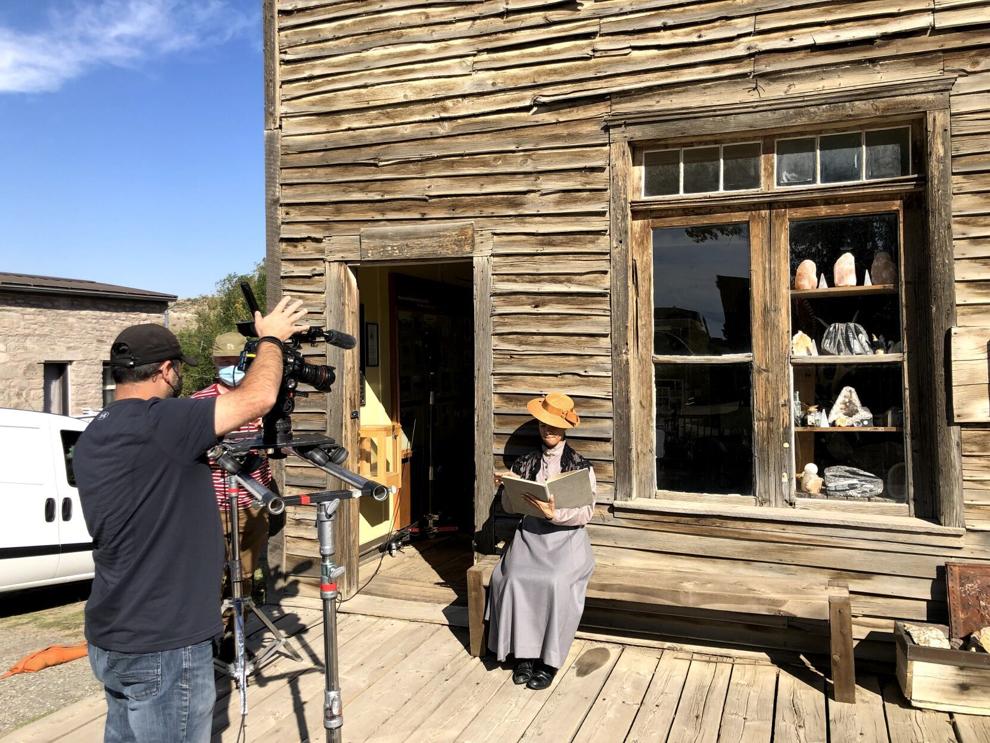
A scene from the filming of “The Story of Us: The Women Who Shaped Montana.”Courtesy Photo
Hogberg earned her Master’s in broadcast journalism from UM in 2008 and works as a producer and editor for North by Northwest. Her newest documentary examines the struggles and accomplishments of four women in Montana’s history: Sarah Bickford, Rose Hum Lee, Maggie Smith Hathaway, and Susie Walking Bear Yellowtail. A screening and Q&A will be held in Missoula Wednesday, November 2 at 6 p.m. in the University Center Theater.
The documentary has already screened in Helena and Bozeman. At the Bozeman screening in September, Hogberg said: “There’s so many incredible historical stories that are just untold and we should really try to seek them out, and I think that was really the idea was trying to bring some of these stories to life,” according to reporting from the Bozeman Daily Chronicle’s Nora Shelly.


 Montana Journalism