UM Junior, Kate Shea Wins Dow Jones News Fund Internship

One phone call completely changed Kate Shea’s summer plans. She had been preparing for an international reporting trip to Berlin, Germany, when she received a call from the Dow Jones News Fund offering her a paid copy-editing internship for the same period.

While the decision to go to Texas instead was a hard one, Shea admitted, “I’m kind of a copy nerd.”
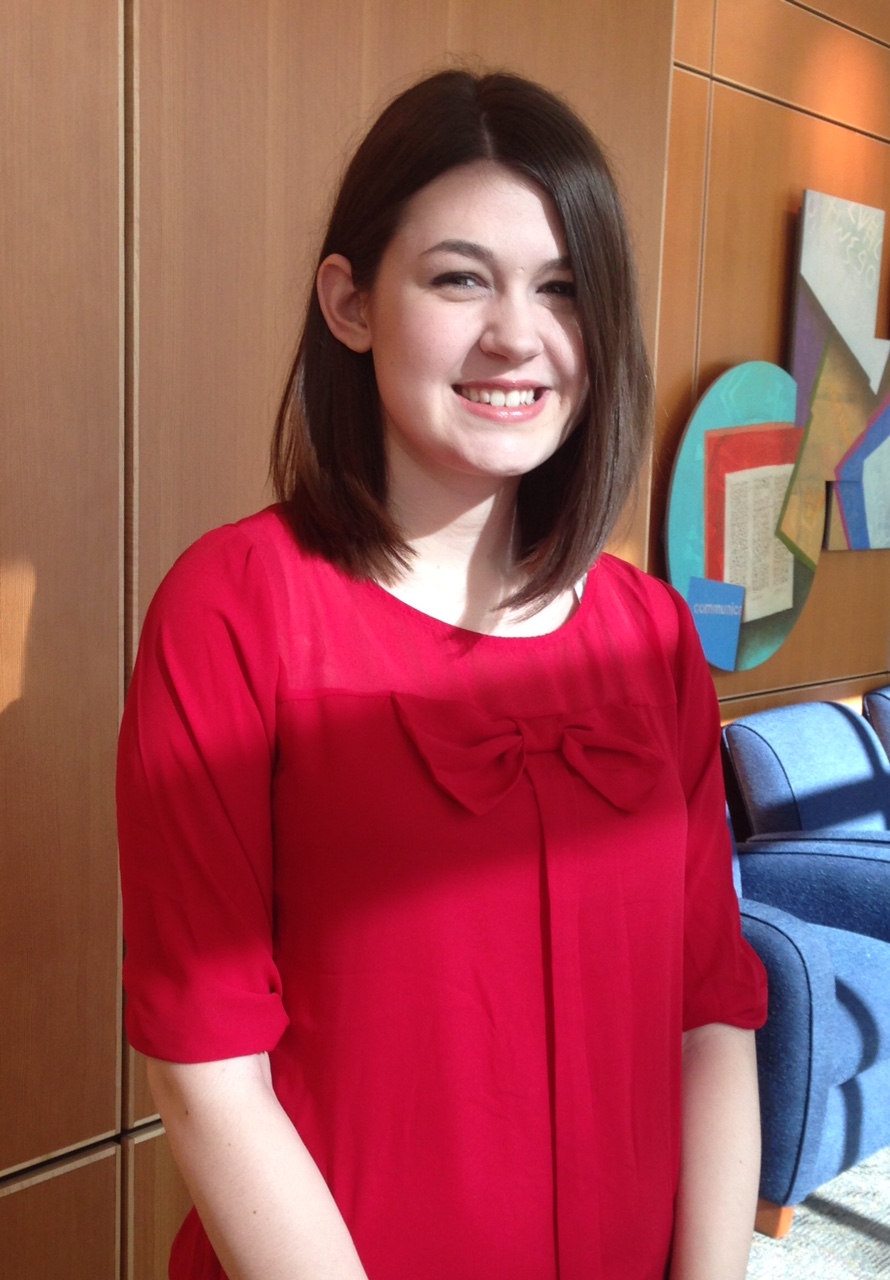
photo of Kate Shea
“In journalism, there’s still a bias against women, and women face different expectations where their looks are more important than their reporting ability,” Shea said. Photo by Jana Wiegand.

Shea currently works as the copy chief at the Montana Kaimin, UM’s weekly student-run newspaper. At her high school in Helena, Mont., she was one out of two students who worked on both their newspaper and their yearbook.

Assistant Professor Joe Eaton, recognized her drive and talent as soon as she entered the J-School. “Pretty much from Day One here it was clear that Kate was going to take on the world,” he said.

In News Editing class last fall, Eaton encouraged Shea to apply for the Dow Jones internship and take their editing test, which Shea described as “the SAT for copy editors.”

The internship will take Shea to Austin, Texas for a ten-day training program about the specific Dow Jones style of copy-editing before she enters the newsroom at The Corpus Christi Caller Times.

While Shea enjoys the journalism world, she ultimately wants to go to law school and delve into another field that will allow her to effect change in the world.

Her passion for politics comes from interning with Sen. John Tester (D-Mont.) in high school, as well as from her experience winning the Distinguished Young Woman of Montana award in 2013. In Mobile, Alabama, Shea met the winners from other states—all very well-rounded, intelligent and well-spoken women, she said, and she wants to make their voices heard.

“In journalism, there’s still a bias against women, and women face different expectations where their looks are more important than their reporting ability,” Shea said. “Sometimes you hear things like women should be on the cops beat because men will talk to pretty girls.”

However, Shea said that’s never been the case at the Montana Kaimin and that “there’s no gender bias there.” And while the Kaimin keeps her busy, especially with the switch to a weekly, more magazine-style publication, she said it’s been a great experience.

“I thought about moving out of state for college,” Shea said. “But there’s a top-ten journalism program right here in Montana.”

UM immediately recognized Shea’s strength as a leader even when she applied to the program, awarding her the Presidential Leadership Scholarship in 2013.

“She’s a very talented and hard-working journalist. I’m sure that showed through in her application,” Eaton said. For him it was no surprise when Dow Jones offered Shea the copy-editing internship. “She’s going to do a great job.”

By Jana Wiegand

Wall Street Journal, Bloomberg Journalist to Lecture at UM

Journalist and novelist Ken Wells will deliver the eighth annual Jeff Cole Distinguished Lecture at 7 p.m. Monday, Feb. 29, in the University of Montana School of Law Room 101. The event, hosted by the UM School of Journalism, is free and open to the public.

photo of Ken Wells standing on a mountain edge after a hike.
Wells also dabbles in blues and jazz guitar and songwriting and cooks a mean Cajun gumbo.

The talk, “Not Your Grandpa’s Business News: Confessions of an Accidental Business Journalist,” is part of a series of lectures honoring Jeff Cole, a 1980 UM School of Journalism alumnus who worked as an aerospace editor at The Wall Street Journal and died in a plane crash while on assignment in 2001.

According to the bio on his website (http://bayoubro.com/), Wells grew up in Bayou Black, Louisiana, where his father “was a part-time alligator hunter and snake collector and full-time payroll clerk for a local sugar mill” and his mother was “a homemaker and gumbo chef extraordinaire.” Wells began writing stories for his hometown paper when he was 19 years old and served as editor from 1973 to 1975. After graduating from the master’s program at the University of Missouri School of Journalism, he worked as a reporter for the Miami Herald for four years and was a Pulitzer Prize finalist for his series on how an agribusiness drainage system was destroying the Everglades.

Wells joined The Wall Street Journal in San Francisco in 1982, covering a variety of stories across the West and writing the popular Page 1 “middle column” feature. He transferred to its London branch in 1990 and traveled extensively, reporting on the first Persian Gulf War and nonracial democracy in South Africa. Wells moved to the New York branch in 1993 and worked as both a writer and editor, with two of his reporters winning Pulitzers. While working in New York, he won the American Society of Newspaper Editors’ distinguished headline-writing award in 1994. He joined Bloomberg News in 2009.

Wells also has written five novels about Cajun culture in Louisiana and two nonfiction narratives. He has edited two anthologies of The Wall Street Journal’s front-page stories. He currently serves as an adjunct faculty at Columbia University’s graduate School of Journalism. He received an honorary doctorate from Nicholls State University and an induction as a Louisiana Legend by Louisiana Public Broadcasting in 2009.

In 2015 Wells left Bloomberg News to work on a book about the “social and cultural history of gumbo.” It is scheduled to be published in 2017. To read more about Wells, visit his website at http://bayoubro.com/.

Founded in 1914, the School of Journalism is now in its second century of preparing students to think critically, to act ethically and to communicate effectively. They were recently named as one of the “Top Ten” journalism programs in the country by the Radio Television Digital News Association. Check out the website at jour.umt.edu.

This news release is also online at:http://bit.ly/1nADY6G

Students study Fashion Photography during J-term

When photojournalism professor Keith Graham asked his students what other types of photography they wanted to explore, three distinct themes emerged: the outdoors, travel and fashion. While January in Montana might not be the best time to teach class outside, the three-week winter term is perfect for delving into the world of fashion photography, first offered in January 2011.

Globally, the fashion industry is worth over a trillion dollars. Graham says fashion photography crosses commercial and editorial borders, so it helps stretch opportunities for photojournalists as editors and freelancers.

Photo of woman in dark room in a vibrant red dress
Photo by Kira Vercruyssen, from the collection “Red.”

Kira Vercruyssen, a UM senior from Honolulu, Hawaii, said that the class was a fun break from traditional journalism, since students had the chance to trade their role as a reporter for one of a creator. “It was really fun to make these ideas in your head come to life,” she said.

Students directed their own photo shoots, using friends and co-workers as models. However, for the first project Graham made students step in front of the lens and take their own self-portraits. Vercruyssen said it was good for them to understand what it felt like to be a model, and that it helped her when she had to direct her models and capture strong angles.

Once Graham revealed the theme for each photo shoot, students had no other restrictions “besides time and imagination.” Themes ranged from Coco Chanel’s classic “little black dress” to “red” to “replication,” where students had to find a professional fashion shot and capture the same image with their models. “It might look easy,” Graham said, “but can you try to re-create it?”

Both the “denim” and “futuristic” shoots led to more iconic shots, including Bruce Springsteen’s 1984 Born in the USA album cover and Grant Wood’s portrait of the American Gothic.

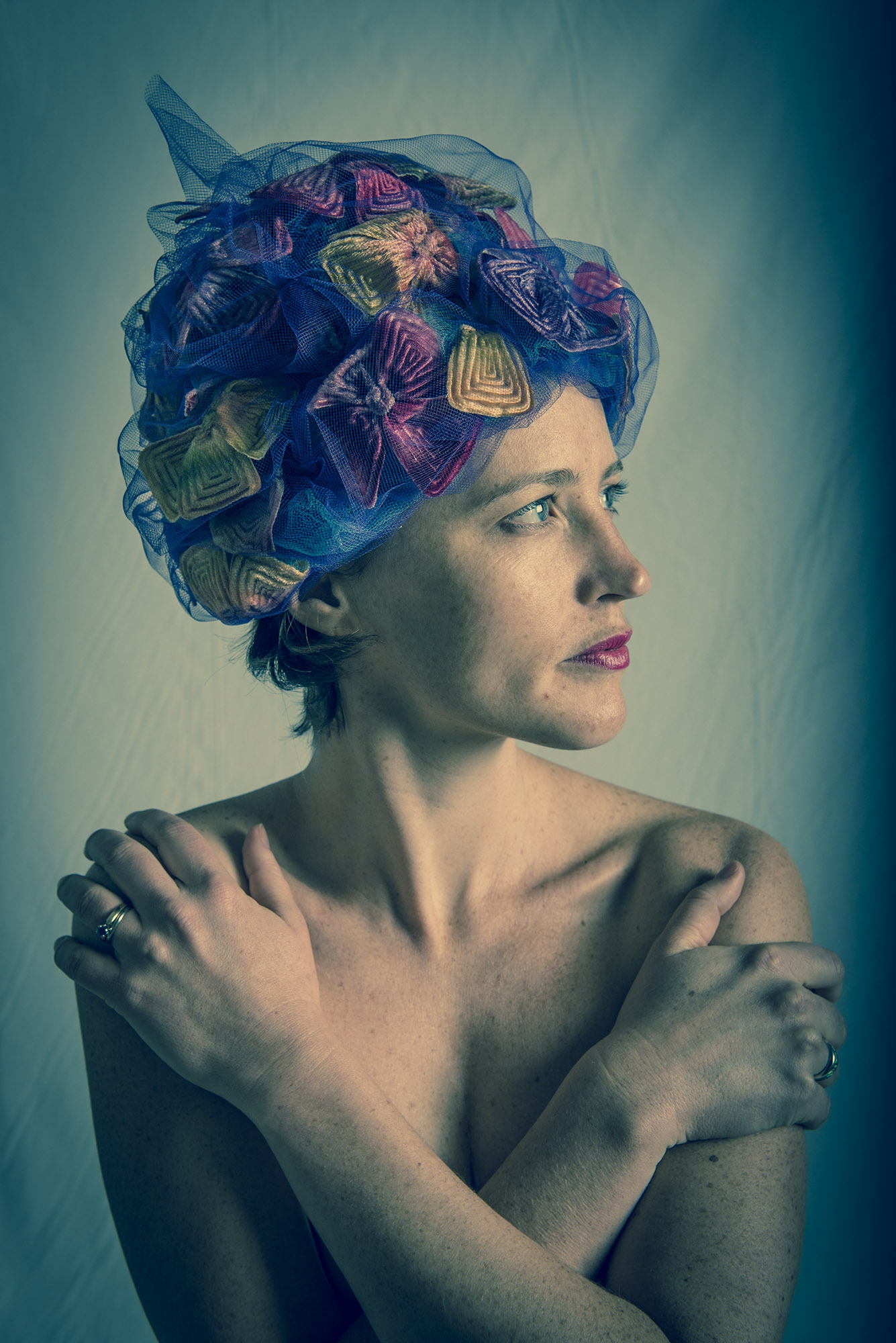
photo of woman wearing multi-colored cap
Photo by Kira Vercruyssen, from the collection “Hats.”

These shoots gave students the freedom to work both in the studio and around town. One of the highlights for Vercruyssen was getting permission to shoot inside the old Mercantile building in downtown Missoula. She also rented a collection of vintage hats from a local theater company for her final free-topic project.

Photo of woman in leather jacket in an empty room with many windows
Photo by Kira Vercruyssen, from the collection “Mercantile.”

Graham challenged the class to create narrative arcs within each campaign and consider what made their images visually and emotionally compelling for an audience. In addition to these spreads, they experimented with diptych photography, where two photographs are placed side by side to make an artistic statement.

With a standard week’s schedule compressed into a single day, all this kept the class busy.

“This kind of immersion is a very useful way to learn,” Graham said. “They produce stronger, better work as a result.”

Vercruyssen chose to attend the University of Montana for its strong journalism program, which is currently ranked 8th in the nation. For her, this class was “like a breath of fresh air” that re-charged her passion for photojournalism as she prepares to graduate this spring.

by Jana Wiegand