
Radio enthusiasts tune in to Missoula’s first podcast festival

While the crowd gathered for a sold out event at The Roxy Theater turned their eyes towards the big screen, it was their ears that did the work. This was the first Missoula Podcast Festival, and those in attendance were partaking in the unique experience of group listening as a full theater absorbed Montana centric radio stories.
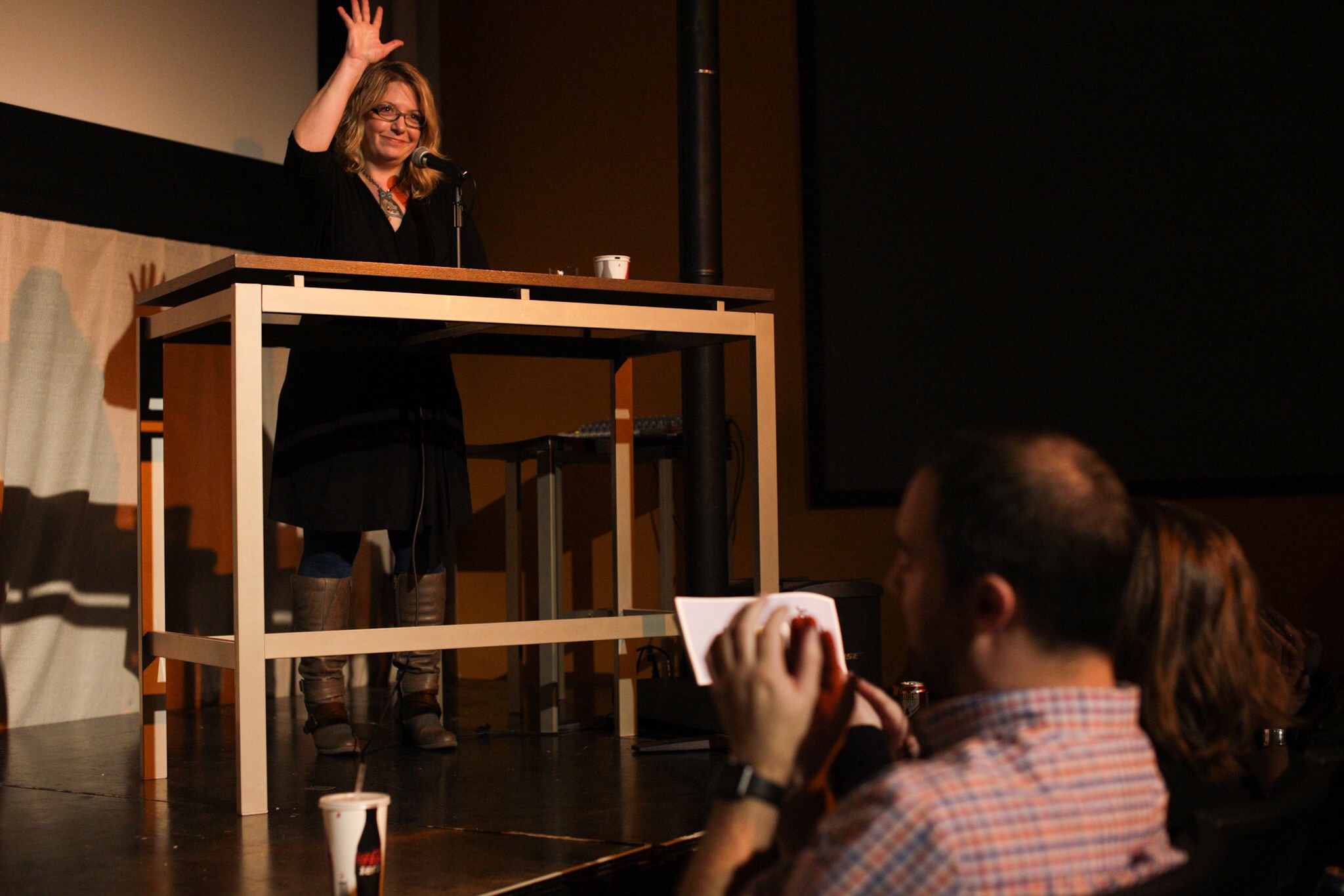
Jule Banivlle stands on stage at the festival and sets up the next group of stories.
Jule Banville introduces the next set of stories to the audience. Photo by Evan Frost.

The podcasts, which ranged in length and subject matter, were independently produced by authors with connections to Missoula and curated by Jule Banville, an assistant professor at the School of Journalism.

“I’m excited that we’re podcasting, and about where this is going,” Banville said to open the show. Many of the stories were produced by past and present students of Banville, who teaches audio reporting and feature writing. Banville said she first conceived the idea of the podcast festival as a showcase for student work, but later expanded it to include other producers.

“It’s about the stories,” she said. “There are too few places for people who are doing cool radio stories.” Banville also hosts a podcast of her own online called Last Best Stories, where she posts both her own work and others.

The stories she chose ran from the heartbreaking, like the story of an avid outdoorsman who lost the use of his legs, to the lighthearted, like a piece about a small town 80s cover band with very big dreams. The voices of every day and unique Montanans were well represented, as were issues of race, sexuality, and environmental change.
Creative visuals danced across a large screen, changing color and design with each story.
Creative visuals danced across a large screen, changing color and design with each story. Photo by Evan Frost.

In the theater on Thursday, an audio visualizer played on the big screen in ever changing colors. Between the story blocks producers talked about the art of creating podcasts. That was it for visuals however. The crowd mostly listened in silence, except when they gasped, laughed or sighed.

By Andrew Graham
Students uncover Montana voices about race

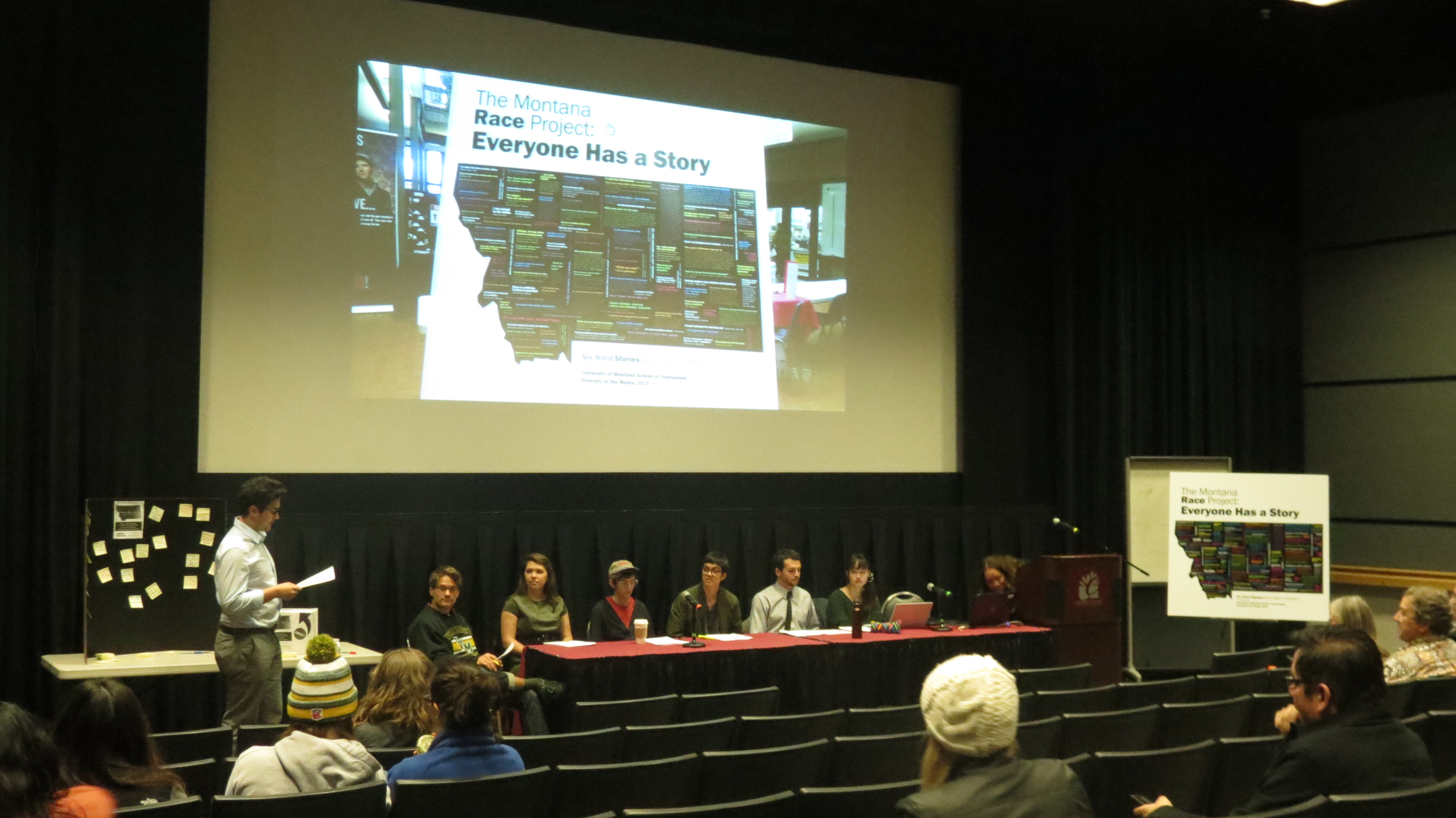
In the UC Ballroom on Thursday, November 5th, a group of seven students and their professor talked about what they’d learned over a semester spent exploring questions of race in Montana. The students have created the Montana Race Project, in which they drew in six-word essays from around the state that touched modern questions of race and diversity in Montana and beyond.

Photo showing student panel at the presentation of the 6 word essays.
Students took turns reading their favorite submissions from the project. Photo by Alyssa Rabil.

The professor, Kathy Weber-Bates, is an adjunct instructor at the School of Journalism, and the project was created through her Diversity in the Media course. To introduce Thursday’s panel discussion, Weber-Bates talked about her frustration with the idea that it was difficult to talk about diversity in a state that was not that diverse in comparison to others. That idea, she said, is misleading.

“It made an assumption that the state doesn’t have a multitude of voices,” and that’s not true, Weber-Bates said.

For her and her students, a focus that arose over the course of the experience was on the importance of conversations about race and diversity even, or perhaps especially, in institutions or places that are predominantly white. The students on the panel said they were surprised by how often the sentiment that Montana didn’t have a race issue and had no need to discuss the subject seemed to come up.

To uncover the real concerns about race in Montana, the class created an online form where anyone could submit a six-word essay, which they then promoted as a class via social media. By November 5th they had received over 300 essays from all over the state.

The idea of the six-word essay may have been born from Ernest Hemingway, Weber-Bates said, who was a firm believer in the value of saying much with few words. When challenged by his peers, Hemingway allegedly wrote the following six-word story:

“For sale: baby shoes, never worn.”

Whether that story is true or not, the form carries a lot of power. This held true for the stories brought in by the Montana Race Project. Here are just five examples of stories the students chose to read at Thursday’s event:

“Columbus day shouldn’t be a holiday.”

“Don’t tell me there’s no problem.”

“Half Peruvian, looks white, strange world.”

“Blind eyes can’t fix the past.”

“When will Native American lives matter?”

Some stories showed ignorance, others hope and optimism and still others expressed challenges of self-identity in today’s world. All showed a state where questions of race are very much alive.

Five of the students on the panel study journalism. They’re certain this experience will help guide their future work in a profession based around the idea that telling stories, everyone’s stories, matters. “The stories that I choose to tell and how I choose to tell them can bring things to light or bury them,” said Mia Soza, who is co-news director at the student run radio station KBGA.

Chloe Reynolds, another journalism student, said she learned the value of casting a wide net with her reporting, in order to find stories in unlikely places. “You don’t know somebody’s story unless you ask them,” she said.

To read more about The Montana Race Project and submit your own six word story, you can visit their website or search for them on Facebook.

By Andrew Graham